 +91 93730 08466
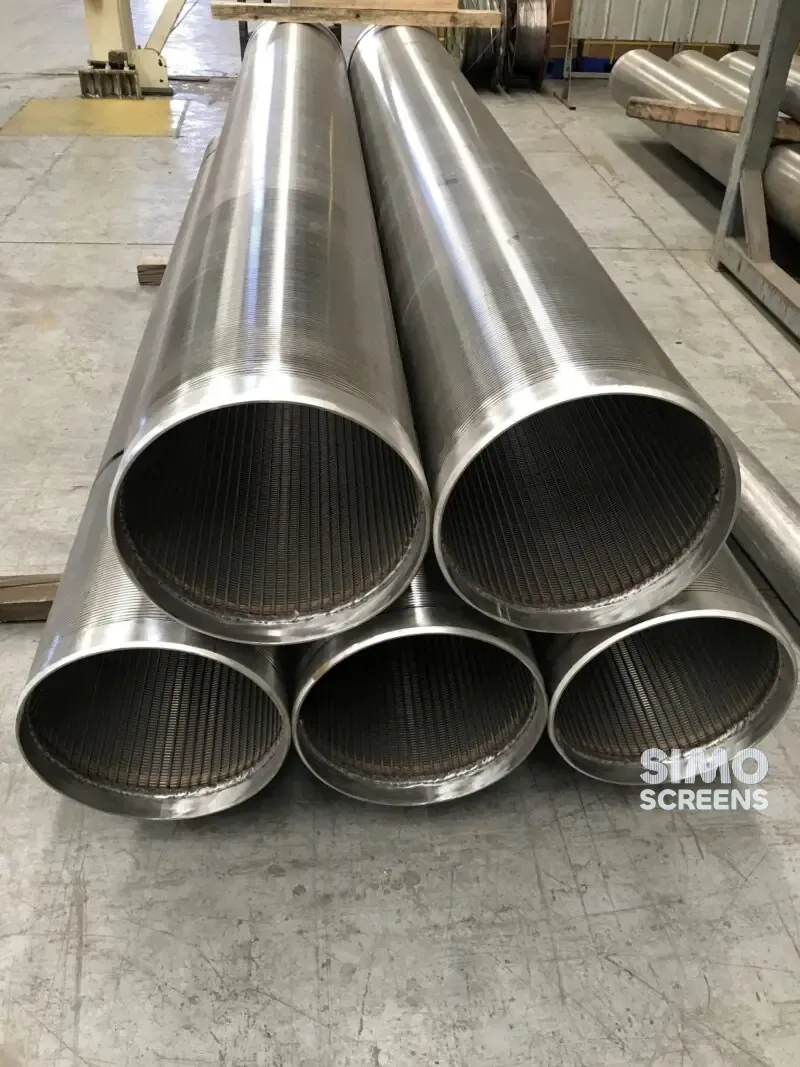
 Screen tubes and pipes
 Screen cylinders
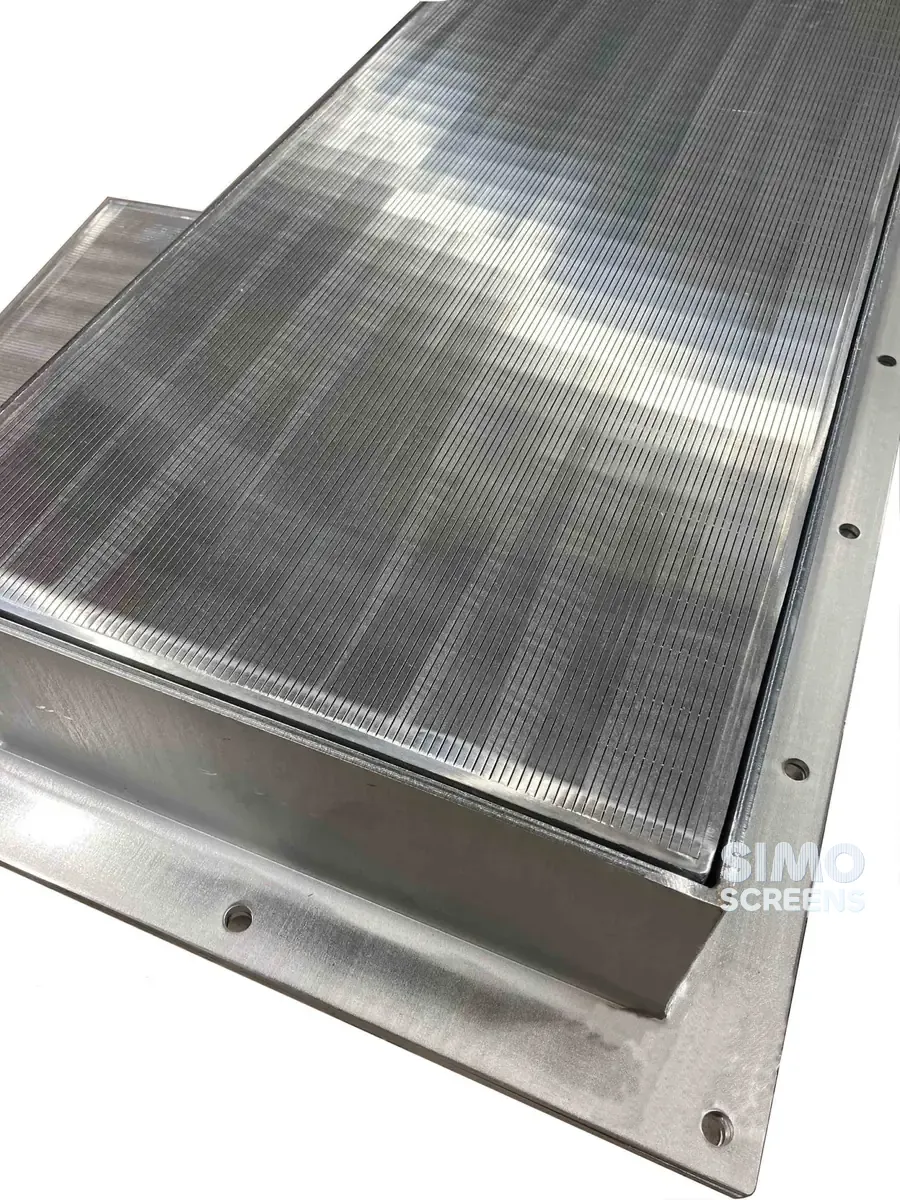
 Flat panels and false bottoms
 Candle filter elements
 Water well screens
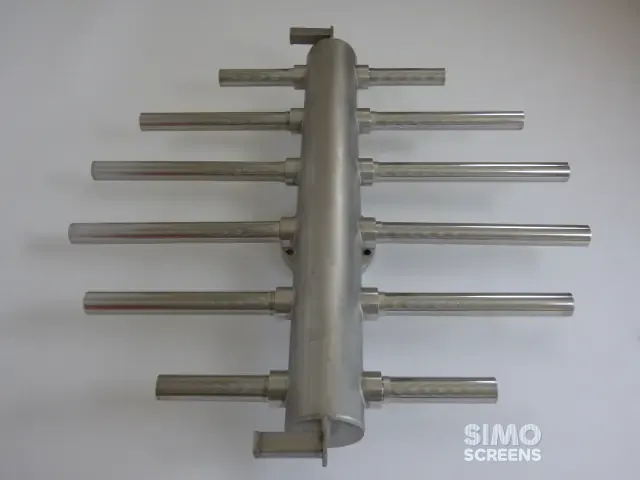
 Header and hub laterals
 Filter nozzles
 Resin traps
 Support grids
 Sieve bend (DSM) screens
 Centrifuge baskets
 Pressure screen baskets
 Screw press screens
 Rotary drum screens
 Passive intake screens
 Coanda intake screens
 Water and wastewater treatment
 Water wells and groundwater
 Sugar and distillery
 Brewing, malting and beverages
 Food processing
 Mining and minerals
 Oil, gas and petrochemicals
 Chemicals, fertilisers and pharma
 Power generation
 Pulp and paper
 Buildings and drainage
What a wedge wire screen is
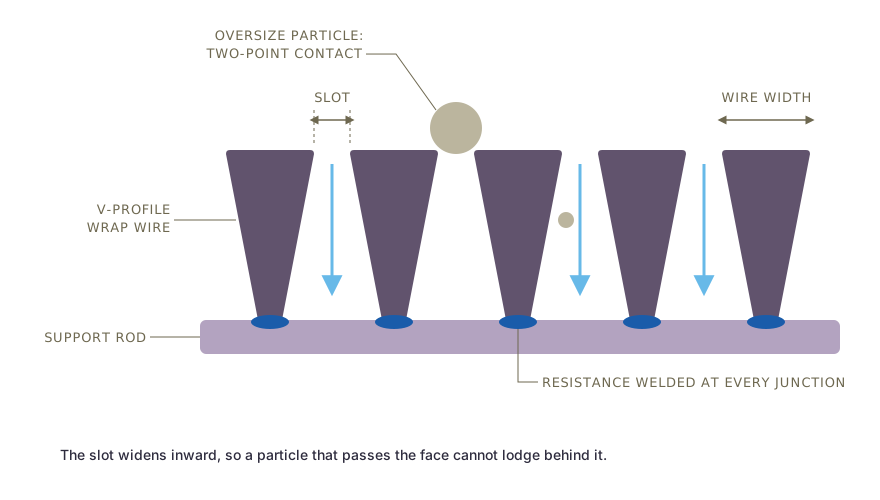
A wedge wire screen is a screening surface built from two kinds of wire. A V-shaped profile wire forms the face, support rods run across it underneath, and the two are welded together at every intersection. The gaps between adjacent profile wires are the slots, and because the wire is V-shaped, each slot is narrowest at the face and widens behind it.
The construction goes by several names. Wedge wire, V-wire, profile wire, continuous slot screen and wire-wrapped screen all describe the same product, and the wedge wire glossary defines these and over fifty related terms.
The problem wedge wire solves
Process screens usually fail in one of three ways. They blind, so that pressure drop rises and flow falls; they tear or crack, so that media or product escapes; or they wear until the opening no longer retains the particle it was sized for.
Each failure has a familiar consequence on the plant. In a borewell it appears as sand pumping, in a DM plant as resin in the outlet, in a lauter tun as long run-off times, and in a coal washery as wet product and lost fines. Wedge wire addresses these failures through two properties: a slot geometry that resists blinding, and a welded construction that carries loads which woven mesh and thin plate cannot.
Johnson screen, V-wire and wedge wire
Buyers often ask for a Johnson screen when they mean a continuous slot wedge wire screen. Johnson Screens is a trade name, now of Aqseptence Group, which has come into general use for this design. The construction is the same under any name: V-profile wire wound or laid on support rods, welded at every intersection, with a slot that widens behind the face.
SIMO Screens is not affiliated with the owner of the trade name. SIMO makes wedge wire screens to its own designs and to customer drawings, and when an enquiry names a brand, the screen is engineered from the process conditions and the dimensions of the existing equipment.
How a wedge wire screen is built
Swipe to see the full drawing.
The profile wire is cold rolled from round wire into a V-section. SIMO forms its wire in house to SIMO profile codes, which fix the shape, head width and height, and checks it with calibrated micrometers before welding. The wire is then wound onto a cage of support rods, or laid across them for flat and axial designs, and resistance welded at each intersection on high-frequency transformer machines.
The winding pitch equals wire width plus slot, and controlling that pitch keeps the slot accurate along the whole screen. Every wire and rod intersection is resistance welded, so the screen acts as one rigid structure that resists thermal cycling and pressure transients up to 300 PSI.
The welded cylinder can be used as wound, cut and flattened into panels, rolled into curves, or fitted with end rings, flanges and housings. The guide on how wedge wire screens are made covers each stage, and profile wire and support rod selection gives the full SIMO tables.
Why wedge wire does not clog
Swipe to see the full drawing.
Two features of the geometry work together:
- Two-point contact. A particle larger than the slot touches only the two wire edges, so it cannot wedge into the opening, and backwash, spray or the next flow lifts it away.
- Widening slot. A particle smaller than the slot passes the face and meets an opening that becomes wider behind it, so nothing holds it in the screen.
In woven mesh, near-size particles lodge between crossing wires, and in perforated plate a particle can jam anywhere along the straight bore of a hole. The comparison of wedge wire, perforated plate and wire mesh sets out the differences in detail.
Slot size and open area
The slot is the clear gap between wires at the face, stated in microns or millimetres. SIMO makes slots from 25 microns (0.025 mm) to 25 mm, to a standard tolerance of plus or minus 5 percent of nominal.
Open area is the share of the screen surface that is open:
Open area (%) = Slot x 100 / (Slot + Wire width)
| Slot | 12SB wire (1.0 mm) | 18SB wire (1.8 mm) | 42SB wire (3.3 mm) |
|---|---|---|---|
| 0.25 mm | 20.0% | 12.2% | 7.0% |
| 0.5 mm | 33.3% | 21.7% | 13.2% |
| 1.0 mm | 50.0% | 35.7% | 23.3% |
| 2.0 mm | 66.7% | 52.6% | 37.7% |
Swipe sideways to see the whole table.
The slot is selected from the particle that must be retained. The wire is then the narrowest profile that carries the load and wear, because wire width controls open area. The slot and open area guide has the full table and worked velocity examples, and specifications written in mesh are converted in the mesh to micron guide.
Flow configurations
A wedge wire cylinder can be built in four configurations. In each one the slot face meets the side that carries the solids.
| Configuration | Slot face | Flow | Typical uses |
|---|---|---|---|
| Radial external | Outside | Outside to inside | Well screens, intakes, nozzles, candle filters |
| Radial external | Outside | Inside to outside | Distributors, backwash of laterals and nozzles |
| Radial internal | Inside | Inside to outside | Centrifuge baskets, internally fed drums |
| Axial external | Outside, wires along the length | Outside to inside | Scraped or brushed cylinders, slots aligned with product movement |
Swipe sideways to see the whole table.
A profile set the wrong way round blinds quickly in service. The flow configuration guide explains each arrangement and how pressure direction affects the welds.
Wedge wire screen forms and products
From the basic panel and cylinder, wedge wire is made into a wide range of products.
| Form | Products | Typical application |
|---|---|---|
| Cylinders and tubes | Water well screens, wedge wire cylinders, screen tubes | Wells, filters, distributors |
| Flat and segmented panels | Flat wedge wire panels, support grids | False bottoms, decks, bed supports |
| Curved panels | Sieve bends | Dewatering, desliming, fibre recovery |
| Baskets | Centrifuge baskets, outlet baskets, pressure screens | Rotary separation, media retention, stock screening |
| Vessel internals | Header and lateral assemblies, filter nozzles, resin traps | Ion exchange and filter underdrains |
| Filter elements | Candle filters, screw press screens, rotary drum screens, intake screens | Pressure filtration, dewatering, intakes |
Swipe sideways to see the whole table.
On top of the screen, SIMO fabricates frames, flanges, end rings, housings, rolled sections, brackets and segmented decks.
Materials
Corrosion attacks screens first at welds and crevices, so the grade must suit the chloride level, temperature, pH and chemistry of the process.
| Grade | Typical PREN | General use |
|---|---|---|
| SS 304 | about 18 to 20 | Fresh water, food, general service |
| SS 316L | about 23 to 26 | Higher chlorides, mild chemicals, hygienic service |
| Duplex 2205 | about 34 to 36 | Brackish water, warm chloride water, higher strength |
| Super Duplex 2507 | 40 or more | Seawater and brines |
| Hastelloy | not the usual basis | Hot acids and acid chlorides |
| Monel | not applicable | Hydrofluoric acid, alkalis |
Swipe sideways to see the whole table.
PREN = %Cr + 3.3 x %Mo + 16 x %N. The material selection guide gives chloride and temperature guidance and the conditions that call for a higher grade.
Where wedge wire is used
Wedge wire is used wherever a process must separate solids from liquid, retain media, or take in water without debris. Each application has its own design method.
| Application | Screens used | Design guide |
|---|---|---|
| Tube wells and borewells | Water well screens to IS 8110:2019 | Water well screen design |
| River, lake and sea intakes | Intake screens | Intake screen design |
| DM plants, softeners, condensate polishers | Header and lateral assemblies, filter nozzles | Header and lateral underdrain design |
| Ion exchange outlet lines | Resin traps | Resin trap selection |
| Lauter tuns and mash tuns | False bottoms | Lauter tun false bottoms |
| Juice screening, desliming, fibre recovery | Sieve bends | Sieve bends (DSM screens) |
| Sugar, coal and mineral centrifugals | Centrifuge baskets | Centrifuge baskets |
| Rooftop rainwater harvesting | Rainwater filters | Rooftop rainwater harvesting filters |
| Reactors and adsorbers | Support grids, outlet collectors, inlet baskets | Specification checklist |
| Pulp and paper stock preparation | Pressure screen baskets | Flow configuration |
Swipe sideways to see the whole table.
Wedge wire compared with other media
| Property | Wedge wire | Perforated plate | Wire mesh |
|---|---|---|---|
| Clogging risk | Near zero | Moderate | High |
| Structural load | Excellent | Good | Poor |
| Slot accuracy | Set by winding pitch | Set by tooling | Varies with weave |
| Self-supporting | Yes | Yes | Usually needs backing |
Swipe sideways to see the whole table.
Woven mesh remains a sound choice for very fine, low-load filtration, and thick perforated plate suits coarse screening with heavy impact. For most process screening, wedge wire gives longer runs between cleanings.
Advantages and limits of a wedge wire screen
Advantages
- Accurate slot. The slot is continuous along the full length and set by the winding pitch.
- Resistance to blinding. Two-point contact and the widening slot prevent particles from lodging.
- Self-supporting structure. The welded construction carries bed load, pressure and centrifugal force without a backing layer.
- Effective cleaning. Backwash, spray or brushing lifts solids off the face, because nothing is trapped inside the slot.
- Long service life. With the correct grade for the chemistry, the slot holds its size over many cleaning cycles.
Limits
- Separations finer than 25 microns. This is the finest SIMO slot, and fine woven mesh or cartridge media are the usual choice below it.
- Heavy impact from large lumps. Thick perforated plate is often preferred where screening is coarse and wear comes from impact.
Where the choice of medium is unclear, SIMO engineering reviews the particle size, flow and load and advises whether wedge wire is suitable.
Five design checks for any wedge wire screen
The same five checks determine whether a screen performs, whatever the product:
- Retention. The slot is smaller than the particle to be retained, with a margin.
- Hydraulics. The open area keeps through-slot velocity and pressure drop within limits.
- Structure. Profile wire, rods and welds carry the worst-case pressure, bed load or centrifugal force.
- Corrosion. The grade suits the chloride level, temperature, pH and cleaning chemicals.
- Orientation. The slot face meets the side that carries the solids in every flow case, including backwash.
Most field failures trace back to one of these checks being missed at the design stage.
SIMO Screens range at a glance
| Parameter | SIMO range |
|---|---|
| Slot openings | 25 microns (0.025 mm) to 25 mm, tolerance plus or minus 5% of nominal |
| Diameters | 25 mm to 800 mm |
| Lengths | Up to 6,000 mm |
| Flat panels | Up to 2,400 mm wide and 4,000 mm long; larger decks as joined panels |
| Materials | SS 304, SS 316L, Duplex 2205, Super Duplex 2507, Hastelloy, Monel |
| Wire profiles | Light, standard, heavy duty and custom, 12SB to 56SB |
| Support rods | Q23 to Q55, 35SB, F123 to F253, round 120 and 140 |
| Flow configurations | Radial external both directions, radial internal, axial external |
| Design support | CFD for pressure drop, FEA for structural validation |
| Documents | Mill Test Certificate as standard; dimensional inspection report and QAP on request |
| Quality | ISO 9001:2015, water well screens to IS 8110:2019 |
Swipe sideways to see the whole table.
Every SIMO screen is made at the works in MIDC Butibori, Nagpur. Made in India for the world.
Specifying, cleaning and maintaining
A reliable screen starts with a complete enquiry, and the specification checklist lists the information needed for each product type.
In service, differential pressure, flow or run-off time should be monitored and the screen cleaned on condition, from the outlet side first and brushing along the wires. The cleaning and maintenance guide covers methods, safe chemicals and an inspection checklist.
Engineering guides in this series
Fundamentals
- How wedge wire screens are made
- Slot size and open area
- Flow configurations: radial, internal and axial
- Profile wire and support rod selection
- Choosing the material
- Wedge wire vs perforated plate vs wire mesh
- Mesh to micron conversion chart
- Wedge wire glossary
Specification and maintenance
Application design
- Water well screen design
- Intake screen design
- Lauter tun false bottoms
- Resin trap selection
- Sieve bends (DSM screens)
- Centrifuge baskets for sugar, coal and minerals
- Header and lateral underdrain design
- Rooftop rainwater harvesting filters
Related products, tools and engineering support
- Products: water well screens, flat wedge wire panels, header and lateral assemblies and all products.
- Tools: the open area calculator, the mesh to micron converter and the material selector.
- Engineering: for a screen designed to the customer's process conditions, see custom engineering. Our engineers will connect with you within a working day.