 +91 93730 08466
 Screen tubes and pipes
 Screen cylinders
 Flat panels and false bottoms
 Candle filter elements
 Water well screens
 Header and hub laterals
 Filter nozzles
 Resin traps
 Support grids
 Sieve bend (DSM) screens
 Centrifuge baskets
 Pressure screen baskets
 Screw press screens
 Rotary drum screens
 Passive intake screens
 Coanda intake screens
 Water and wastewater treatment
 Water wells and groundwater
 Sugar and distillery
 Brewing, malting and beverages
 Food processing
 Mining and minerals
 Oil, gas and petrochemicals
 Chemicals, fertilisers and pharma
 Power generation
 Pulp and paper
 Buildings and drainage
How to specify a screen
Many screen enquiries arrive with only a slot, a diameter and a quantity. That information is sufficient for a price, but not for a screen designed to perform in the process, because the loads, flow cases and chemistry that determine profile, rod and material are missing.
Incomplete process data leads to repeated clarification, to designs based on assumptions, and occasionally to failures in service when a load or flow case was never stated. The screen RFQ checklist below is in two parts: the data required for every screen, and the additional data for each product type.
Part 1: Data for every wedge wire screen specification
| Item | Information required | Purpose |
|---|---|---|
| Application | Equipment and service, for example DM plant cation vessel, tube well, lauter tun | Sets the design approach |
| Fluid | Water, slurry, juice, wort, hydrocarbon, chemical, with chemistry | Material choice |
| Flow rate | Normal and maximum, plus backwash or reverse flow | Open area and velocity |
| Temperature | Normal and maximum, rate of change | Material and thermal stress |
| Pressure | Operating pressure and maximum differential pressure across the screen, with direction | Profile, rods and welds |
| Solids to retain | Media grade, sieve analysis, particle size or sample | Slot size |
| Slot | Required slot in microns or mm, if known | Retention |
| Material | Grade for wire, rods and fittings | Corrosion resistance |
| Form and dimensions | Flat, cylindrical, conical or curved, with key dimensions | Manufacture |
| Flow direction | Outside to inside, inside to outside, slot face side | Configuration |
| Connections | Flanges, threads, couplings, frames, clamps | Fit to the equipment |
| Quantity | Number of pieces and spares | Planning |
| Finish | Pickling, passivation or electropolishing, if required | Corrosion resistance and hygiene |
| Marking | QR-coded tag as standard; laser marking on the screen where required | Identification and traceability |
| Documents and inspection | MTC (standard), dimensional inspection report, QAP, TPI, PMI, dye penetrant testing | Compliance |
Swipe sideways to see the whole table.
Slot and open area are covered in the slot and open area guide, and grade selection in the material selection guide.
Part 2: Checklists by product type
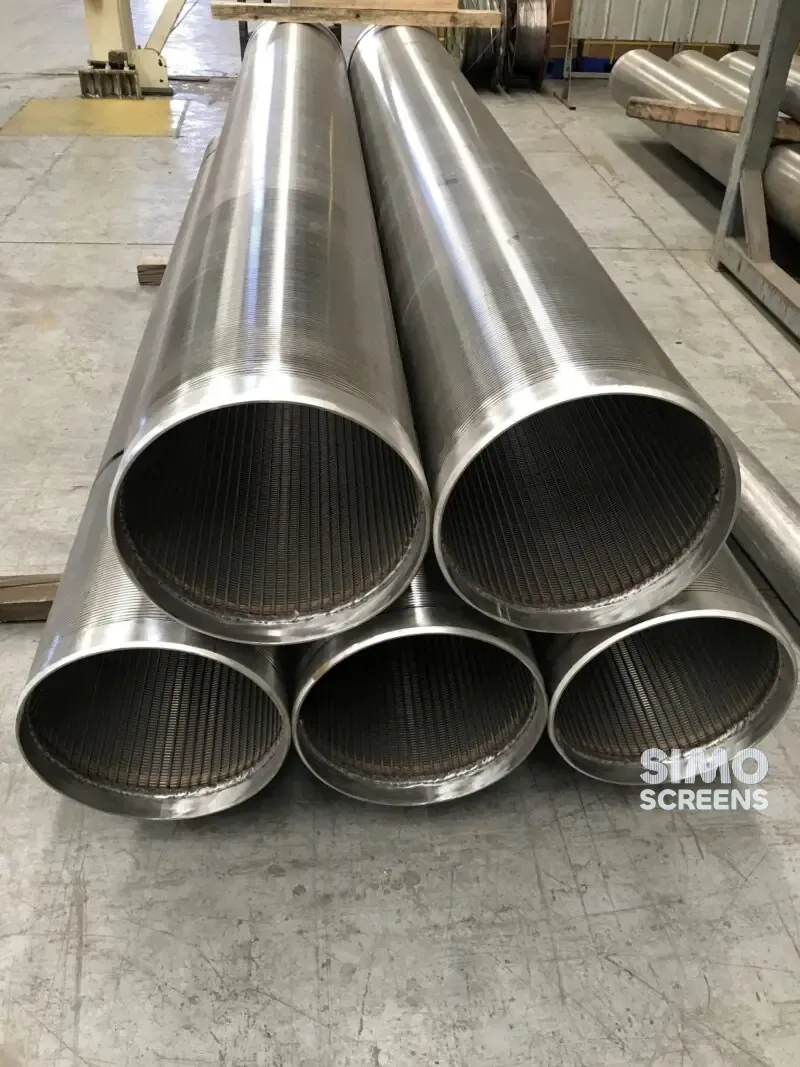
Water well screens
- Borehole diameter, depth and screen setting depths
- Screen outside diameter and total screened length
- Sieve analysis of the aquifer, or gravel pack grading if a pack is used
- Expected yield and pumping rate
- Water analysis, especially chloride, pH and iron
- End connections: threaded, welded or coupled, and casing size
- Whether IS 8110:2019 compliance is required
SIMO makes water well screens to IS 8110:2019, with weld rings, threaded ends and bottom plugs to standard.
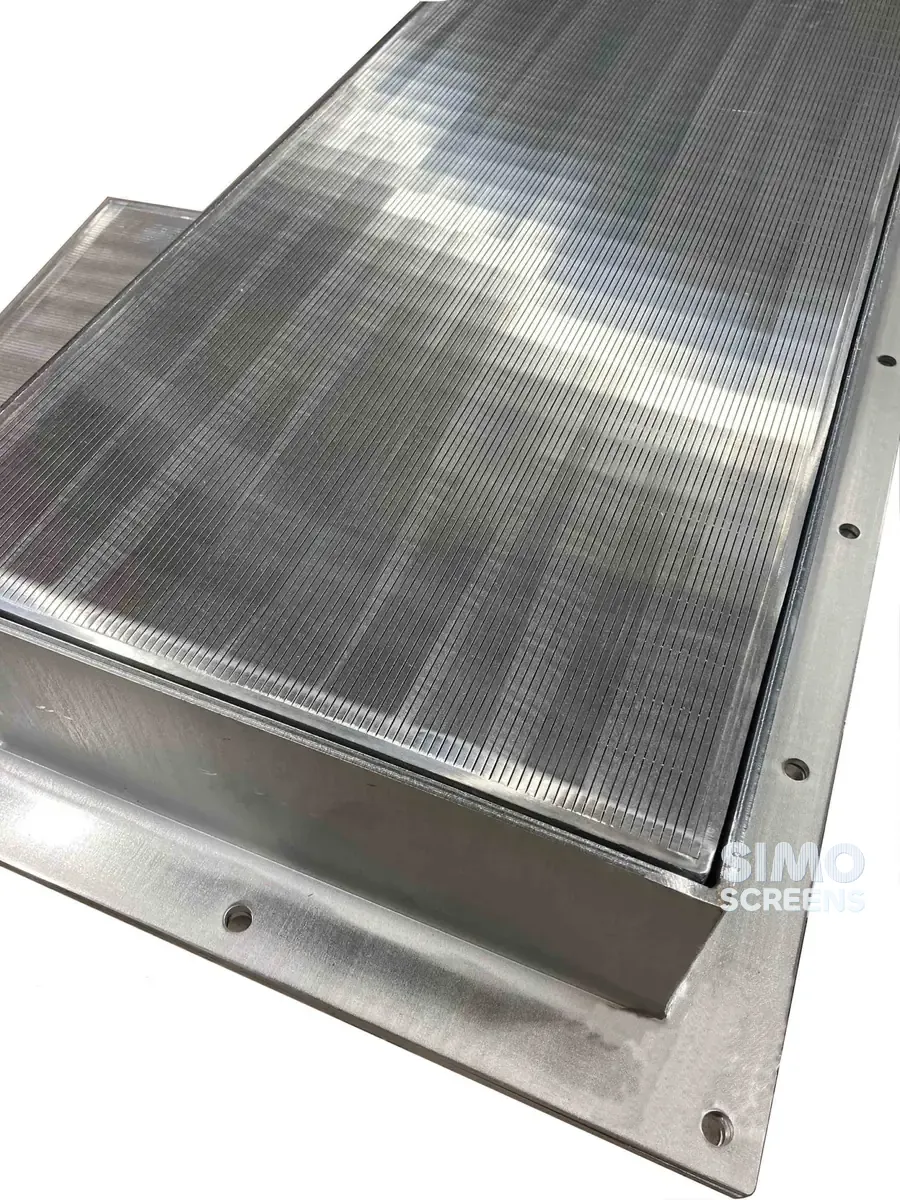
Flat panels, false bottoms and decks
- Panel length, width and number of panels or segments
- Slot and slot direction relative to flow or material travel (for lauter tun false bottoms, 0.7 mm is the most common slot)
- Span between supports and the load: bed depth, density, wet grain or ore load
- Frame or edge detail, fixing method and gasket, and the flatness required
- Access limits, such as the manway size for segmented panels
- Operating temperature and cleaning method
Sieve bends (DSM screens)
- Screen width and arc length, or the radius and arc angle
- Slot and wire profile
- Feed rate, solids content and particle size
- Separation required: dewatering, desliming or fibre recovery
- Frame and feed box details, or whether SIMO supplies the feed box and housing
Centrifuge baskets
- Machine type: batch or continuous, and the make and model of the centrifuge
- Basket dimensions, cone angle for conical baskets, and fixing details
- Slot and profile, or the current screen detail
- Operating speed
- Product: sugar massecuite grade, coal size range, crystal type
- Material and any wear-resistance requirement
Wedge wire cylinders and screen tubes
- Outside or inside diameter, and length
- Slot, wire and rod, if known
- Flow configuration: radial or axial, slot face inside or outside
- End fittings: rings, flanges, threads, caps
- External and internal pressure cases
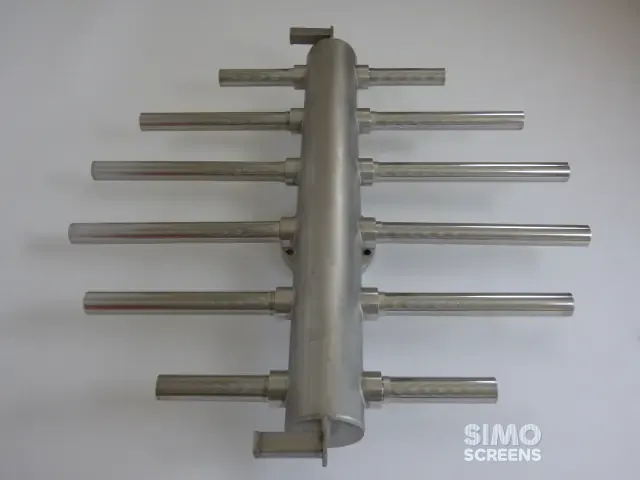
Header and lateral assemblies
- Vessel inside diameter and the internals layout, or a vessel drawing
- Service and backwash flow rates
- Resin or media type and particle size range
- Lateral number, length, diameter and slot, if already designed
- Header or hub size, position and connection to the vessel nozzle
- Regeneration chemicals and temperatures
Filter nozzles
- Nozzle type: single or double stem, and stem length
- Thread or fixing type, and nozzle plate thickness
- Slot and slot area per nozzle, if known
- Filter media type and smallest grain size
- Service, backwash and air scour rates
- Quantity, including spares
Support grids and outlet baskets
- Vessel inside diameter, support ring or beam layout
- Bed type, depth and density, and design pressure drop
- Operating and design temperature, for thermal expansion
- Segment size limited by the manway
- Vessel or licensor specification for material and fabrication
Resin traps
- Line size, flange standard and pressure rating
- Flow rate and allowable pressure drop
- Resin type and smallest bead size
- Orientation: horizontal or vertical, and inspection access
- Material and design pressure
Intake screens
- Design flow rate and number of screens
- Required maximum through-slot velocity
- Slot size required for debris or fish protection
- Water depth, current and debris type
- Cleaning arrangement, if any (airburst systems are supplied by others)
- Water quality, for material choice
Candle filter elements
- Element diameter, length and number per filter
- Slot, and whether the element will be precoated
- Fluid, flow rate and filtration pressure
- End connection to the tube sheet or register
- Cleaning method: backflush, blow-down or manual
Pressure screen baskets
- Screen make and model, and basket dimensions
- Slot width and profile, or current basket detail
- Flow direction through the basket
- Stock type and consistency
- Rotor type and clearance, if known
Screw press and rotary drum screens
- Screen diameter, length and segment layout
- Slot and profile
- Product being dewatered, and target dryness or capture
- Pressure or torque loads from the screw, or drum speed for rotary screens
- Spray and cleaning arrangements
Replacing an existing screen
Many enquiries are for replacements, and SIMO replaces imported and OEM screens from a sample or drawing. The following information about the original screen should accompany the enquiry:
- the original drawing, GAD or data sheet;
- the measured slot, using a feeler gauge at several points;
- wire and rod sizes, from a worn edge or cut sample;
- overall dimensions and photographs of the ends and fittings;
- the failure mode of the old screen: wear, corrosion, broken welds, collapse or blinding.
The failure mode is the most important item, because it shows what must change for the new screen to outlast the old one.
A worked example of a complete enquiry
The following enquiry for a set of laterals is complete, because every line answers a design question.
| Item | Example entry |
|---|---|
| Application | Hub and lateral collector, bottom of a mixed bed DM vessel |
| Vessel | 2,000 mm inside diameter, drawing attached |
| Flows | Service 60 m³/h, backwash 20 m³/h |
| Media | Standard ion exchange resin, 16 to 50 mesh (300 to 1,180 microns) |
| Slot | 0.2 mm |
| Material | SS 316L wire, rods and fittings |
| Pressure | 6 bar operating, 1.5 bar maximum differential in either direction |
| Temperature | Ambient to 50 °C |
| Connections | Hub flanged to bottom nozzle, laterals threaded into hub |
| Documents | MTC, dimensional inspection report, drawing for approval |
| Quantity | One set plus two spare laterals |
Swipe sideways to see the whole table.
Engineering review after the enquiry
SIMO engineering reviews the process conditions and checks the slot, open area, profile and material. Where the design needs it, CFD is used for pressure drop prediction and FEA for structural validation, and a drawing is sent for approval before manufacture.
Our engineers will connect with you within a working day.
Related products, tools and engineering support
- Products: water well screens, header and lateral assemblies and flat wedge wire panels.
- Tool: the open area calculator checks open area before the enquiry is sent.
- Engineering: see custom engineering for the six steps from enquiry to dispatch.