 +91 93730 08466
 Screen tubes and pipes
 Screen cylinders
 Flat panels and false bottoms
 Candle filter elements
 Water well screens
 Header and hub laterals
 Filter nozzles
 Resin traps
 Support grids
 Sieve bend (DSM) screens
 Centrifuge baskets
 Pressure screen baskets
 Screw press screens
 Rotary drum screens
 Passive intake screens
 Coanda intake screens
 Water and wastewater treatment
 Water wells and groundwater
 Sugar and distillery
 Brewing, malting and beverages
 Food processing
 Mining and minerals
 Oil, gas and petrochemicals
 Chemicals, fertilisers and pharma
 Power generation
 Pulp and paper
 Buildings and drainage

Sugar mill juice screen overview
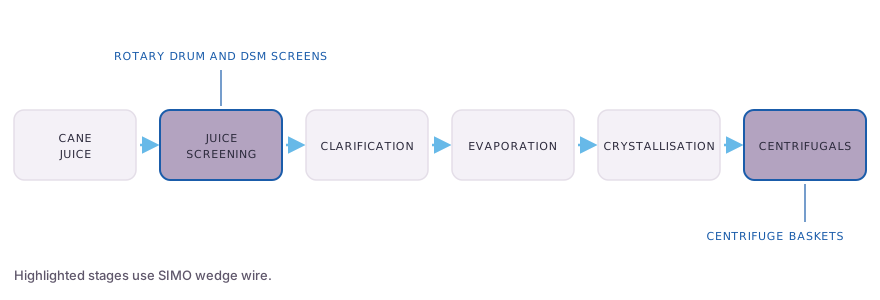
Raw juice from the mill tandem carries fine bagasse, called bagacillo, and coarser cush-cush. The sugar mill juice screen removes it before the juice goes to weighing, heating and clarification, and the screened fibre is usually returned to the mill on the intermediate carrier. Mills use static sieve bends, rotary drum screens or vibrating screens for this service, and wedge wire is the screening surface in the first two.
A poor juice screen shows downstream in the clarifier, the mud filters and the heaters. Perforated plate and mesh trap fibre in their holes, where sugar and lime set and capacity falls through the shift. Worn slots pass bagacillo to the clarifier, raising mud volume and filter load, and thin panels bow and crack at the frame so that juice bypasses the screen.
Swipe to see the full drawing.
Design considerations for a juice screen
Slot. Raw juice screens typically use slots of 0.45 to 0.8 mm. A finer slot removes more fibre but needs more area for the same flow, so the slot and deck size are selected together from the juice flow.
Cut point. On a sieve bend, separation in general practice is at roughly half the slot width, which is how a sieve bend with a moderate slot removes fine bagacillo. Each wire edge skims a thin layer of juice through the slot while fibre slides off the bottom of the deck.
Profile and open area. The V-profile slot widens inward, so that fibre entering the slot passes instead of wedging. Juice screens run all season with fibre and grit, so 15SB or 18SB profiles are typical, with 28SB or the 93 profile (about 2.4 mm wide, from the inch-based numbering in which the number is the width in thousandths of an inch) used on heavier designs. Open area (%) = Slot x 100 / (Slot + Wire width): a 0.5 mm slot on 15SB wire, 1.52 mm wide, gives about 25 percent, and a 0.8 mm slot on 18SB, 1.8 mm wide, about 31 percent. Options can be checked in the open area calculator.
Load and stiffness. Support rods such as F123, F203 or Q35 keep the deck rigid under juice load, so that panels do not bow or crack at the frame.
Cleaning. A continuous slot and smooth wire face leave fewer dead zones for bacterial growth, which reduces sucrose loss and the frequency of washing.
Construction and options
SIMO profile wire is formed in house and resistance welded across the support rods at every intersection, and slot width is checked with feeler gauges at set-up, during the run and on each finished panel.
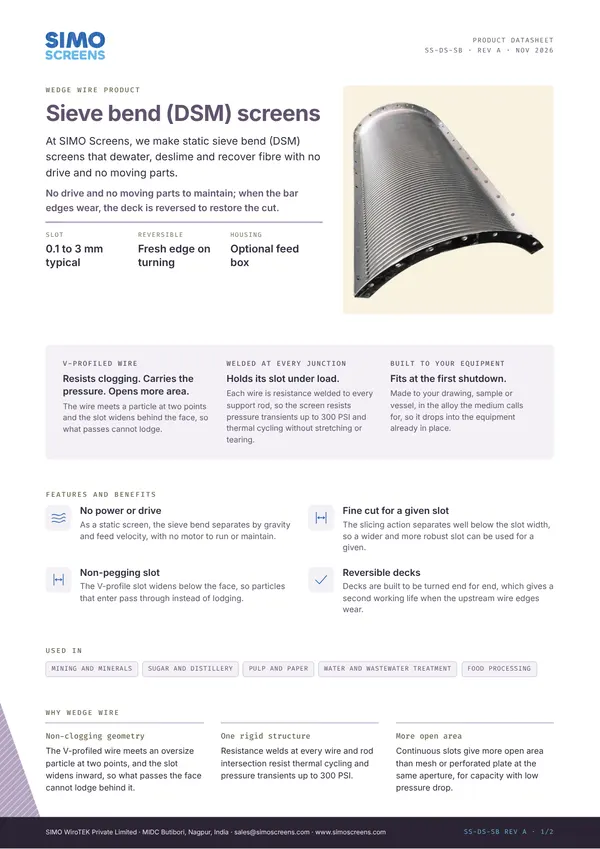
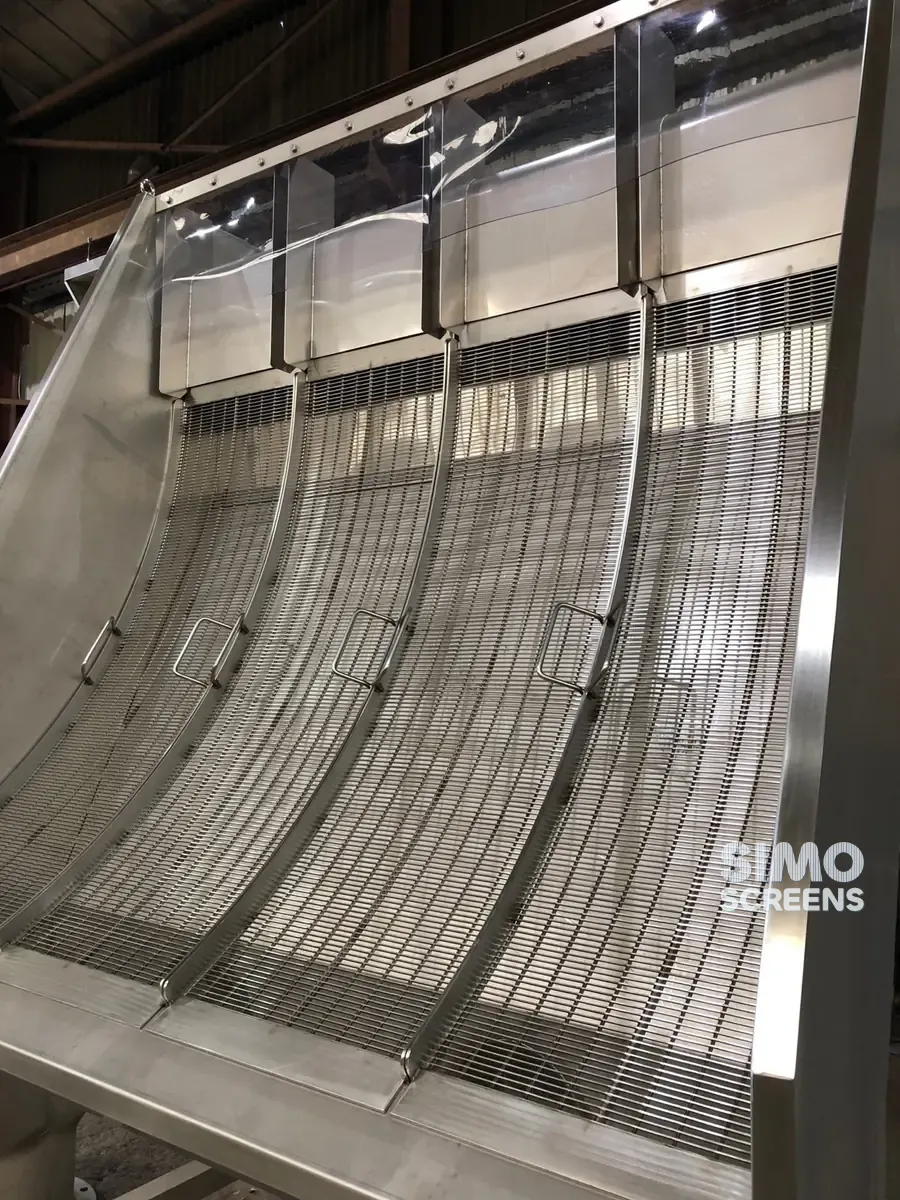
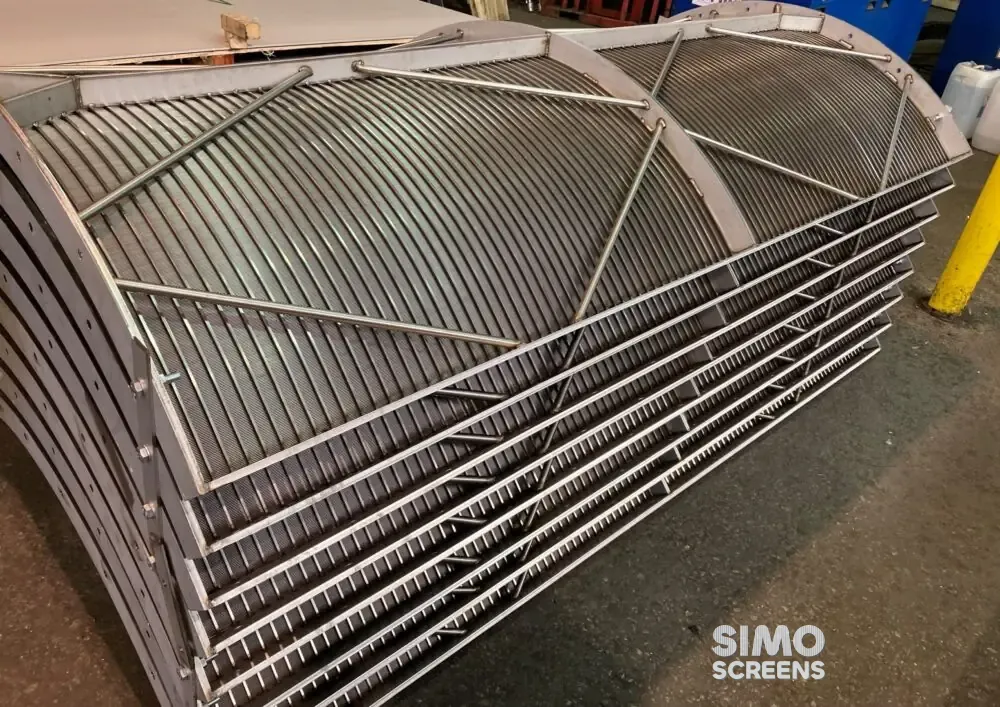
Sieve bend juice screens. The sieve bend is a curved wedge wire deck with wires running across the flow, rolled to the specified radius and arc. Buyers often name the deck by its arc, so an enquiry may ask for 120 bent screens, DSM screens with a 120 degree arc. Decks are supplied in a frame or as panels for an existing housing, and sieve bend feed boxes and housings are supplied on request.
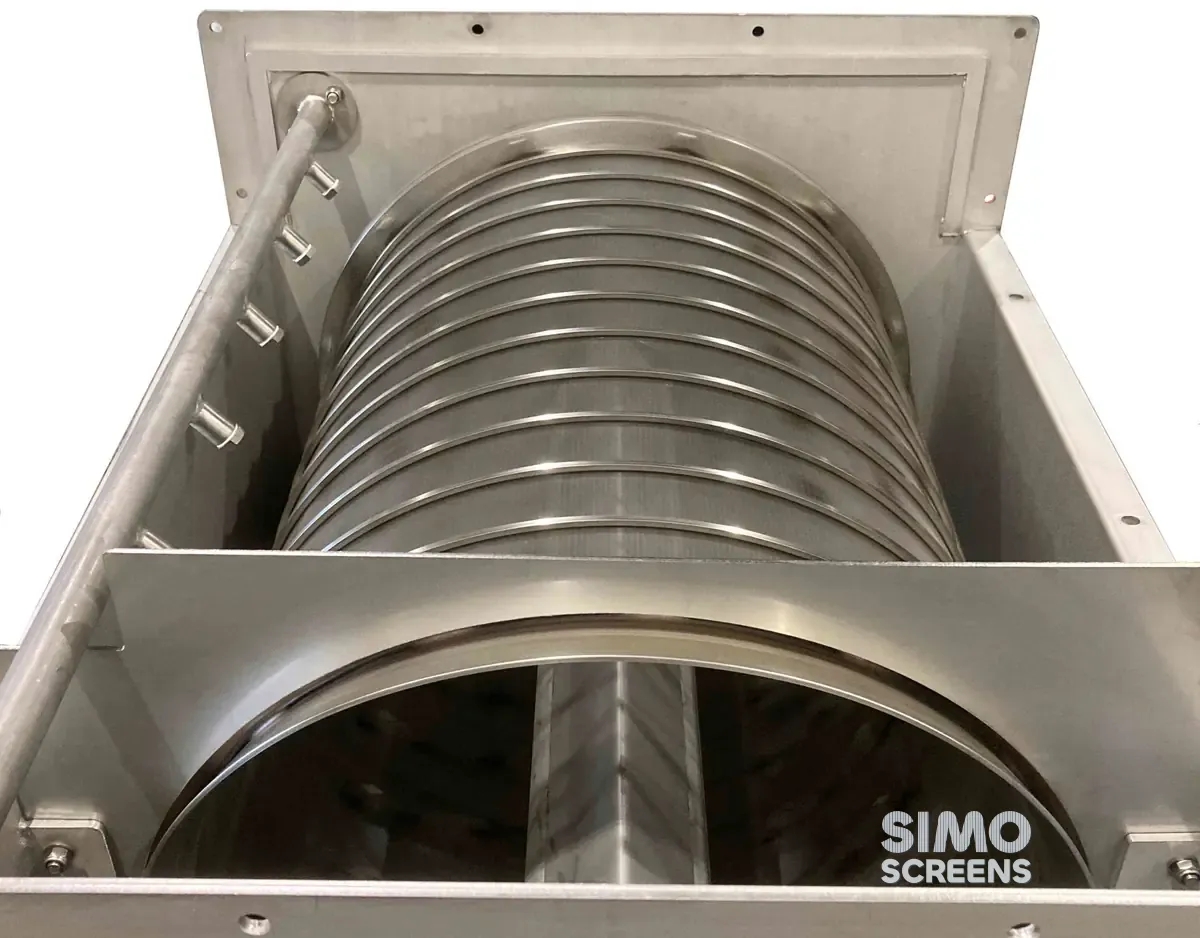
Rotary drum juice screens. A rotary drum screen is a wedge wire cylinder turning on rollers or a shaft, with juice fed to the inside or outside according to the design. Fibre is carried to a discharge chute and a spray bar cleans the drum. Complete machines are supplied on request, with SIMO making the drum and the drive, frame, tank and spray bar sourced under SIMO QC.
| Item | SIMO range or typical value |
|---|---|
| Forms | Sieve bend deck or panels, 120 degree arc decks, rotary drum cylinder |
| Slot opening | 25 microns (0.025 mm) to 25 mm; raw juice typically 0.45 to 0.8 mm |
| Slot tolerance | Plus or minus 5% of nominal, stated on the drawing |
| Wire direction | Across the flow on sieve bends |
| Profile wire | 15SB, 18SB; 28SB or 93 profile on heavier designs |
| Support rods | F123, F203, Q35 |
| Drum size | Diameter 25 to 800 mm, length up to 6,000 mm |
Swipe sideways to see the whole table.
Materials
SS 304 is the standard material for juice screens. SS 316L is selected for mills with frequent chemical washing. The Mill Test Certificate is supplied as standard, and a dimensional inspection report and QAP are supplied on request.
Replacement and retrofit
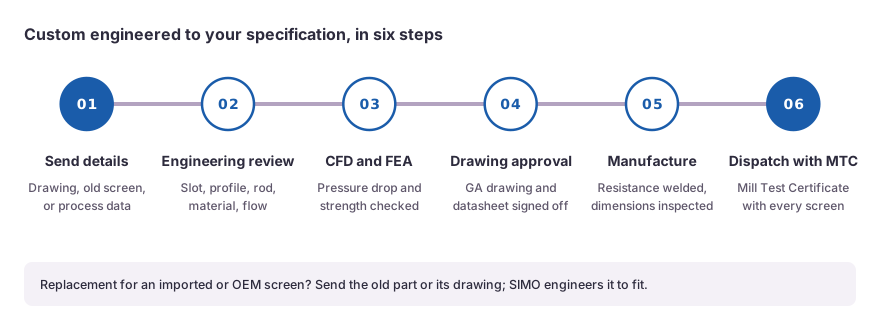
Most mills replace worn sieve bend panels in the off-season, including imported panels and existing juice screen panels of other makes. SIMO Screens builds to the existing panel drawing, or to a sample and measurements of width, radius, arc and fixing holes. Turning sieve bend panels end to end at mid-season uses the second wire edge, and a spare set allows all panels to be changed in one stop.
Our sieve bend screens and rotary drum screens pages give the product range, and the sieve bend guide explains how to size the deck. The same DSM screen designs serve a sugar factory's distillery for spent wash screening.
What to send for a quotation
- Crushing rate and juice flow in m³/h.
- Screen type now in use: sieve bend, rotary or vibrating.
- Panel width, radius and arc, or drum diameter and length.
- Current slot and the slot you want.
- Fixing method and frame details.
- Juice temperature and washing chemicals used.
- Drawing, sample or photographs of the existing screen.

 Upload a drawing