 +91 93730 08466
 Screen tubes and pipes
 Screen cylinders
 Flat panels and false bottoms
 Candle filter elements
 Water well screens
 Header and hub laterals
 Filter nozzles
 Resin traps
 Support grids
 Sieve bend (DSM) screens
 Centrifuge baskets
 Pressure screen baskets
 Screw press screens
 Rotary drum screens
 Passive intake screens
 Coanda intake screens
 Water and wastewater treatment
 Water wells and groundwater
 Sugar and distillery
 Brewing, malting and beverages
 Food processing
 Mining and minerals
 Oil, gas and petrochemicals
 Chemicals, fertilisers and pharma
 Power generation
 Pulp and paper
 Buildings and drainage
The role of the rainwater filter
The filter determines how well a rooftop rainwater system performs. Leaves, grit, bird droppings and plastic wash off every roof, and without a filter they fill the tank with sludge and seal the base of a recharge pit within one or two seasons.
Many simple filters, such as sand beds or fine mesh bags, clog in the first heavy storm, after which water overflows to drain and the harvest is lost when rainfall is highest. A self-cleaning wedge wire filter is designed to keep passing water through the whole storm.
Regulatory context in India
Building bye-laws in many Indian cities make rooftop rainwater harvesting compulsory for new buildings above a set plot size, and some extend the requirement to existing large buildings, institutions and industry. Thresholds and approved methods vary by city and state.
The development authority or municipal corporation should be consulted early in design, since its rules often state whether water should go to storage, to recharge or to both.
Step 1: peak flow off the roof
The filter must pass the peak flow from the roof during an intense shower, which the rational method gives as:
Q (L/s) = C x i x A / 3,600
where C is the runoff coefficient (dimensionless), i the design rainfall intensity in mm/h and A the roof plan area in m².
Runoff coefficient
The runoff coefficient is the proportion of rain that reaches the downpipe. Hard roofs such as RCC slabs and metal sheet are typically taken at about 0.8 to 0.95, with the losses arising from wetting, evaporation and ponding.
Design rainfall intensity
A short-duration intensity is used, because roofs respond within minutes. It is taken from local rainfall data or from the storm drainage criteria of the municipal body, and since intensities vary widely between Indian cities, a figure from another region should not be used.
Roof area
The plan area of the roof draining to each filter is used rather than the sloping surface area. Where several downpipes join before one filter, their areas are added.
Step 2: rainwater filter sizing by capacity
The filter is selected with a rated flow of at least the peak flow, and most sites follow one of two layouts.
- One filter per downpipe. Smaller filters are placed close to each downpipe, which is simple where downpipes are far apart.
- One central filter. Downpipes join into a collector that passes through one larger filter, giving fewer units to inspect at the cost of a longer collector pipe.
The table below uses C = 0.9 and i = 75 mm/h as example values, to be replaced with site data.
| Roof plan area | Peak flow at C = 0.9, i = 75 mm/h |
|---|---|
| 100 m² | 1.9 L/s |
| 250 m² | 4.7 L/s |
| 500 m² | 9.4 L/s |
| 1,000 m² | 18.8 L/s |
| 2,000 m² | 37.5 L/s |
Swipe sideways to see the whole table.
The rainwater filter calculator repeats this calculation for your own roof and rainfall.
Step 3: the self-cleaning wedge wire filter
In a self-cleaning filter, roof water enters at the top and flows across an inclined wedge wire screen inside a housing. Water drops through the slots to the clean water outlet, while leaves, twigs and grit remain on the screen face and slide down to a separate debris outlet.
A small part of the flow carries the debris to drain. This is the cost of self-cleaning, and it allows the filter to keep working in a heavy storm. Wedge wire suits this application for three reasons:
- the flat, smooth face of the profile wire lets debris slide off;
- the slot widens behind the face, so grit that enters passes through rather than wedging;
- the welded stainless steel screen holds its slot and does not tear as mesh can.
A self-cleaning filter needs some fall between the filter inlet and the clean water outlet, so levels are planned together with the downpipe and the tank.
Step 4: first flush
The first rain after a dry spell carries most of the dust, fine silt and droppings from the roof, and a first flush diverter sends this water to drain before the filter takes over.
A common rule sizes the diverter for about the first 1 to 2 mm of rain over the roof. For a 500 m² roof, 2 mm is 500 x 0.002 = 1 m³, or 1,000 litres. The diverter should empty slowly after each storm so that it is ready for the next.
Step 5: storage, recharge pits and recharge wells
Filtered water goes to storage, to recharge or to both. Storage tanks need an overflow, which is often directed to recharge.
- Recharge pits and trenches are shallow excavations filled with graded boulders, gravel and coarse sand, suited to sites with permeable soil near the surface.
- Recharge shafts are deeper bores or shafts that reach a permeable layer below a clay cap.
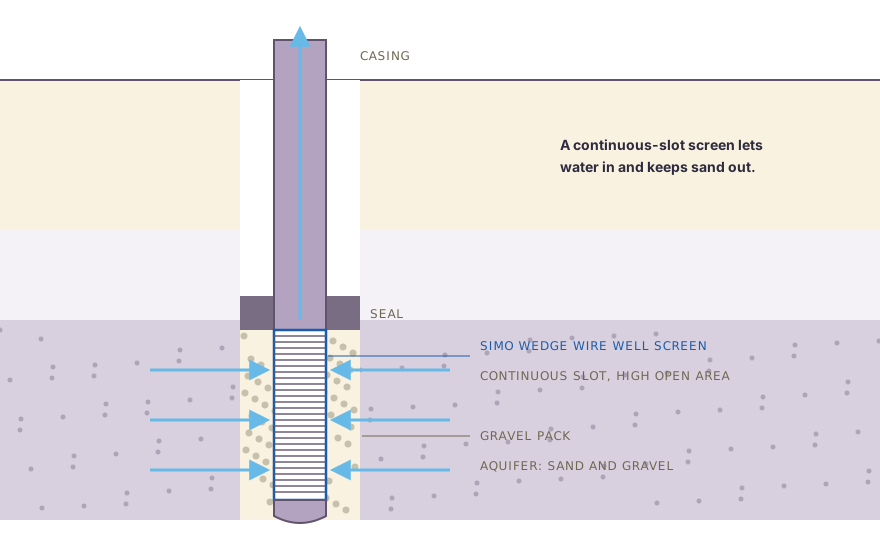
- Recharge wells are borewells or tube wells that feed water directly into the aquifer. They need the cleanest water, a desilting chamber upstream and a screen sized for the aquifer.
Swipe to see the full drawing.
A recharge well screen follows the same slot and open area logic as a production well, with water flowing outward, as described in the water well screen design guide. Recharge structures are kept away from sewers, septic tanks and soak pits, and receive only roof water unless the authority allows otherwise.
Worked example: a 500 m² institutional roof
Site: a school building with a 500 m² RCC roof, draining to two downpipes that join at ground level.
Assumptions: C = 0.9, a design intensity of 75 mm/h from local data and annual rainfall of 1,000 mm.
Peak flow:
- Q = 0.9 x 75 x 500 / 3,600 = 9.4 L/s, or about 34 m³/h
Filter: one central self-cleaning wedge wire filter rated for at least 9.4 L/s, located after the downpipes join.
First flush at 2 mm: 500 x 0.002 = 1.0 m³.
Annual harvest potential: using a lower annual coefficient of 0.8 to allow for small showers and first flush:
- Volume = 500 m² x 1.0 m x 0.8 = 400 m³ a year, or 4 lakh litres
Destination: a 20 m³ storage tank for toilet flushing and gardening, with overflow to a recharge well screened in the aquifer below.
Common sizing errors
- Sizing on annual rainfall. Annual rainfall sets storage and recharge volume, whereas the filter is sized on peak intensity.
- Using sloping roof area. Rain falls vertically, so the plan area is used.
- Omitting terraces and podiums. Paved terraces that drain to the same downpipe add to the flow.
- One small filter on a large roof. An undersized filter sends much of each storm to drain with the debris.
- Poor access. The filter should be placed where it can be opened and inspected without a ladder or confined space entry.
Maintenance
- Inspect the screen after the first storms of the monsoon and clear any trapped debris.
- Check that the debris outlet and drain line are free.
- Clean the first flush chamber and the desilting chamber before the monsoon.
- Keep gutters and roof outlets clear, so that debris does not arrive in a single heavy load.
SIMO Screens rooftop rainwater filters
SIMO Screens manufactures rooftop rainwater harvesting filters as complete housings in SS 304 or SS 316L, with MS and SS 410 available to the client's requirement. Each filter is sized to the flow rate and pipe size of the project rather than drawn from a standard range, and water well screens are supplied for the recharge wells. Send the roof area, number of downpipes, local rainfall data and whether water goes to storage or recharge, and our engineers will size the filter and the recharge screen.