 +91 93730 08466
 Screen tubes and pipes
 Screen cylinders
 Flat panels and false bottoms
 Candle filter elements
 Water well screens
 Header and hub laterals
 Filter nozzles
 Resin traps
 Support grids
 Sieve bend (DSM) screens
 Centrifuge baskets
 Pressure screen baskets
 Screw press screens
 Rotary drum screens
 Passive intake screens
 Coanda intake screens
 Water and wastewater treatment
 Water wells and groundwater
 Sugar and distillery
 Brewing, malting and beverages
 Food processing
 Mining and minerals
 Oil, gas and petrochemicals
 Chemicals, fertilisers and pharma
 Power generation
 Pulp and paper
 Buildings and drainage
Opening geometry and screen performance
Many plants start with woven mesh or perforated plate because both are inexpensive and easy to source. When the screen then blinds, pressure drop rises and the screen needs cleaning every shift, the cause is usually the geometry of the opening rather than the material grade.
The three media are compared here on geometry, open area, strength, wear and cleaning. The comparison covers wedge wire vs perforated plate, wedge wire vs wire mesh, and perforated vs mesh for applications where wedge wire is not required.
How each medium is made
| Medium | Construction | Opening shape |
|---|---|---|
| Wedge wire | V-profile wire resistance welded to support rods at every intersection | Continuous slot that widens behind the face |
| Perforated plate | Holes or slots punched or drilled through a solid sheet | Straight-sided hole the depth of the plate |
| Woven wire mesh | Round wires woven over and under each other | Square opening between crossing wires |
Swipe sideways to see the whole table.
Why wedge wire does not clog
Swipe to see the full drawing.
A particle larger than the slot touches the wedge wire face at two points only, so it cannot wedge into the opening, and backwash or a spray lifts it off. A particle smaller than the slot passes the face and meets a gap that widens behind it, so it has nothing to jam against.
Perforated plate has a straight hole as deep as the plate, and a particle close to the hole size can jam anywhere along that depth. Woven mesh has knuckles and a three-dimensional opening in which near-size particles lodge between the wires.
Wedge wire vs perforated plate vs mesh compared
Swipe to see the full drawing.
| Property | Wedge wire | Perforated plate | Woven wire mesh |
|---|---|---|---|
| Clogging risk | Near zero | Moderate | High |
| Structural load | Excellent | Good | Poor |
| Fine openings | Slots down to 25 microns | Limited by plate thickness | Very fine openings possible |
| Opening accuracy | Set by winding pitch | Set by tooling | Set by weave, varies with wire |
| Open area at fine sizes | Moderate, retained in service | Low | High nominal, lost to blinding |
| Self-supporting | Yes, welded structure | Yes | Usually needs a backing |
| Cleaning | Backwash, jetting, brushing along the slots | Backwash and jetting, holes plug | Difficult once blinded, can tear |
| Wear behaviour | Face wears evenly, deep profile gives allowance | Holes enlarge | Thin wires wear through and break |
Swipe sideways to see the whole table.
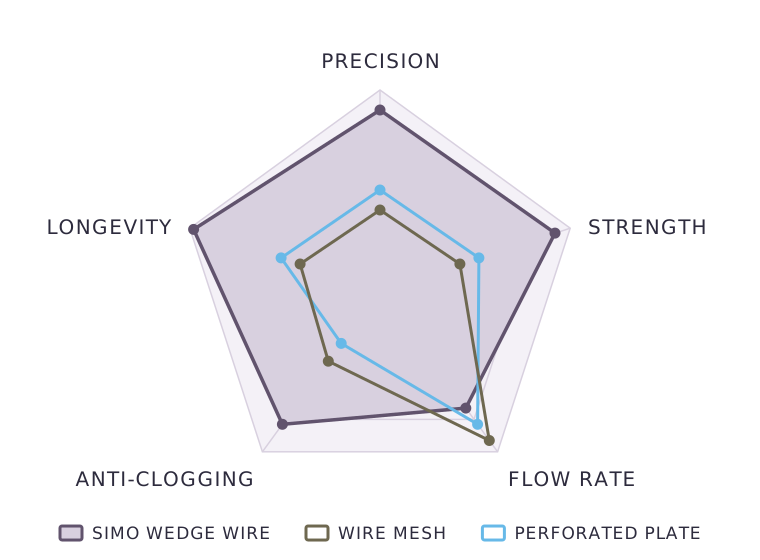
The clogging and structural ratings reflect three features of the wedge wire construction. The slot is continuous along the screen, so open area is distributed evenly instead of being concentrated in isolated holes. Two-point contact keeps oversize particles on the face, where they can be removed. The welded construction lets the profile wire and the support rods share the load, so pressure is carried by the whole structure rather than by thin ligaments or individual wires. For a given application, the comparison should be made by calculation, starting with the open area calculator and followed by a structural check of the wire and rod.
Open area formulas
Each medium has its own open area formula, and each gives nominal open area in percent.
| Medium | Formula |
|---|---|
| Wedge wire | Slot x 100 / (Slot + Wire width) |
| Perforated plate, round holes, 60 degree staggered | 90.69 x (Hole diameter / Pitch)² |
| Perforated plate, round holes, straight (square) pattern | 78.54 x (Hole diameter / Pitch)² |
| Woven mesh, square weave | (Opening / (Opening + Wire diameter))² x 100 |
Swipe sideways to see the whole table.
Worked example: a 1 mm aperture in each medium
Each option below gives a 1.0 mm aperture.
| Option | Geometry | Open area |
|---|---|---|
| Wedge wire, 12SB profile | 1.0 mm slot, 1.0 mm wire | 1.0 x 100 / 2.0 = 50.0% |
| Wedge wire, 18SB profile | 1.0 mm slot, 1.8 mm wire | 1.0 x 100 / 2.8 = 35.7% |
| Perforated plate | 1.0 mm holes on 2.0 mm pitch, 60 degree staggered | 90.69 x 0.25 = 22.7% |
| Woven mesh | 1.0 mm opening, 0.5 mm wire (about 17 mesh) | (1.0 / 1.5)² x 100 = 44.4% |
Swipe sideways to see the whole table.
The mesh shows high open area, but its 0.5 mm wires carry little load and blind with near-size particles. The perforated plate is strong but has less than half the open area of the light wedge wire option.
At a finer aperture
The same comparison at about 0.15 mm gives a different result:
- Wedge wire, 12SB, 0.15 mm slot: 0.15 x 100 / 1.15 = 13.0%
- Woven mesh, 100 mesh with 0.10 mm wire: opening 0.154 mm, open area (0.154 / 0.254)² x 100 = 36.8%
At this size the mesh has far more nominal open area. As a general rule, punched holes are not made much smaller than the plate thickness, so a perforated plate at this aperture must be very thin.
At very fine apertures, therefore, mesh has the advantage in nominal open area. Wedge wire is the stronger choice where the screen must carry pressure, resist abrasion and stay open between cleanings.
Strength under pressure and load
Wedge wire is a welded structure. Every wire and rod intersection is resistance welded, so the face and the rods share the load, and SIMO construction resists thermal cycling and pressure transients up to 300 PSI.
Perforated plate is strong as a sheet, but every hole removes metal, so as open area rises the ligaments between holes become thinner and the plate loses stiffness. Woven mesh has almost no bending strength of its own; under pressure it bulges, stretches or tears, so it needs a perforated or wedge wire backing, which adds cost and shields the mesh from cleaning.
Wear and service life
Abrasive slurries wear any screen, and the important question is how the opening changes as the screen wears.
- Wedge wire. The face wears evenly along the wire, and because the profile is tall, there is metal to wear before the wire fails. A heavier profile adds wear allowance.
- Perforated plate. Holes wear into larger, rounded openings, and retention falls as the plate thins.
- Woven mesh. Fine wires wear through quickly, and one broken wire opens a gap many times the rated opening.
Cleaning and hygiene
The slot face of wedge wire is smooth and continuous, so spray bars, backwash and brushes along the slots reach the whole surface. This matters in food, brewing and pharma plants, where residue left in a screen is a hygiene risk; mesh retains product in the weave, and perforated plate retains it in plugged holes.
Factors beyond first cost
| Factor | Question to answer |
|---|---|
| Run length | How long the screen runs before cleaning is needed |
| Downtime | How much production stops for each cleaning or change-out |
| Media or product loss | What is lost if the screen tears or a hole enlarges |
| Life | How many changes are needed over the operating period of the plant |
| Support structure | Whether the medium needs a separate backing or frame |
Swipe sideways to see the whole table.
A screen that costs more to buy can still cost less to own, and the plant's own figures for these factors give the most reliable comparison.
Where each medium fits
| Application | Usual choice | Reason |
|---|---|---|
| Media retention in vessels (resin, sand, carbon, catalyst) | Wedge wire | Accurate slot, no media loss, carries bed load |
| Water wells and intakes | Wedge wire | High open area, collapse strength, low entrance velocity |
| Dewatering and desliming | Wedge wire | Fast drainage, resistance to pegging and wear |
| Coarse screening with heavy impact | Perforated plate or heavy wedge wire | Impact resistance |
| Very fine laboratory or cartridge filtration below 25 microns | Mesh or other filter media | Openings below the wedge wire range |
| Light, non-critical straining | Mesh or perforated plate | Low first cost |
Swipe sideways to see the whole table.
Converting an existing screen
When a plant changes from mesh or perforated plate to wedge wire, the retention is kept, not the open area. The mesh number is converted to its opening with the mesh to micron guide, or the hole diameter is taken directly, and that value becomes the starting slot. Open area and velocity are then checked with the formula in the slot and open area guide.
Related products, tools and engineering support
- Products: flat wedge wire panels replace perforated and mesh decks, and outlet baskets replace mesh strainer baskets.
- Tool: the open area calculator compares slot and wire combinations.
- Engineering: to convert a mesh or perforated design, see custom engineering.