 +91 93730 08466
 Screen tubes and pipes
 Screen cylinders
 Flat panels and false bottoms
 Candle filter elements
 Water well screens
 Header and hub laterals
 Filter nozzles
 Resin traps
 Support grids
 Sieve bend (DSM) screens
 Centrifuge baskets
 Pressure screen baskets
 Screw press screens
 Rotary drum screens
 Passive intake screens
 Coanda intake screens
 Water and wastewater treatment
 Water wells and groundwater
 Sugar and distillery
 Brewing, malting and beverages
 Food processing
 Mining and minerals
 Oil, gas and petrochemicals
 Chemicals, fertilisers and pharma
 Power generation
 Pulp and paper
 Buildings and drainage
 Datasheet

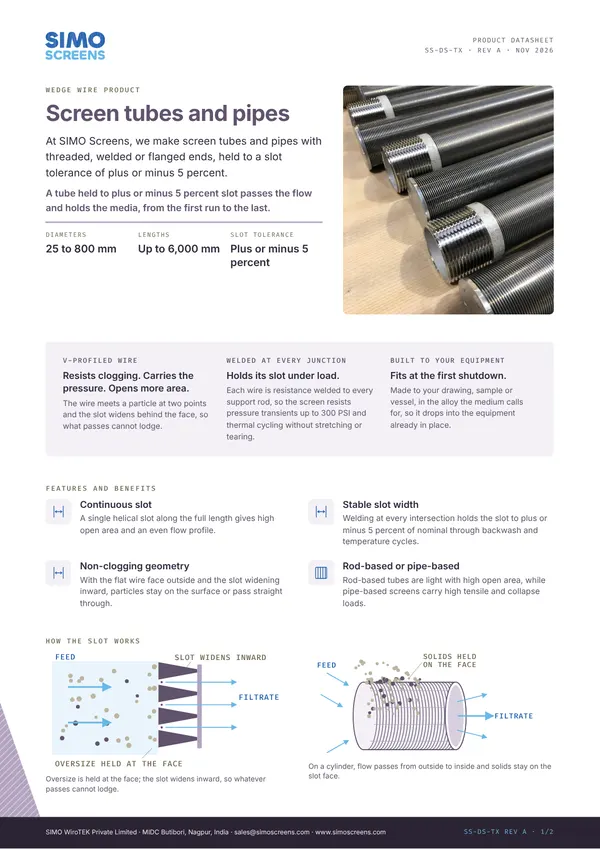
Wedge wire screen tube overview
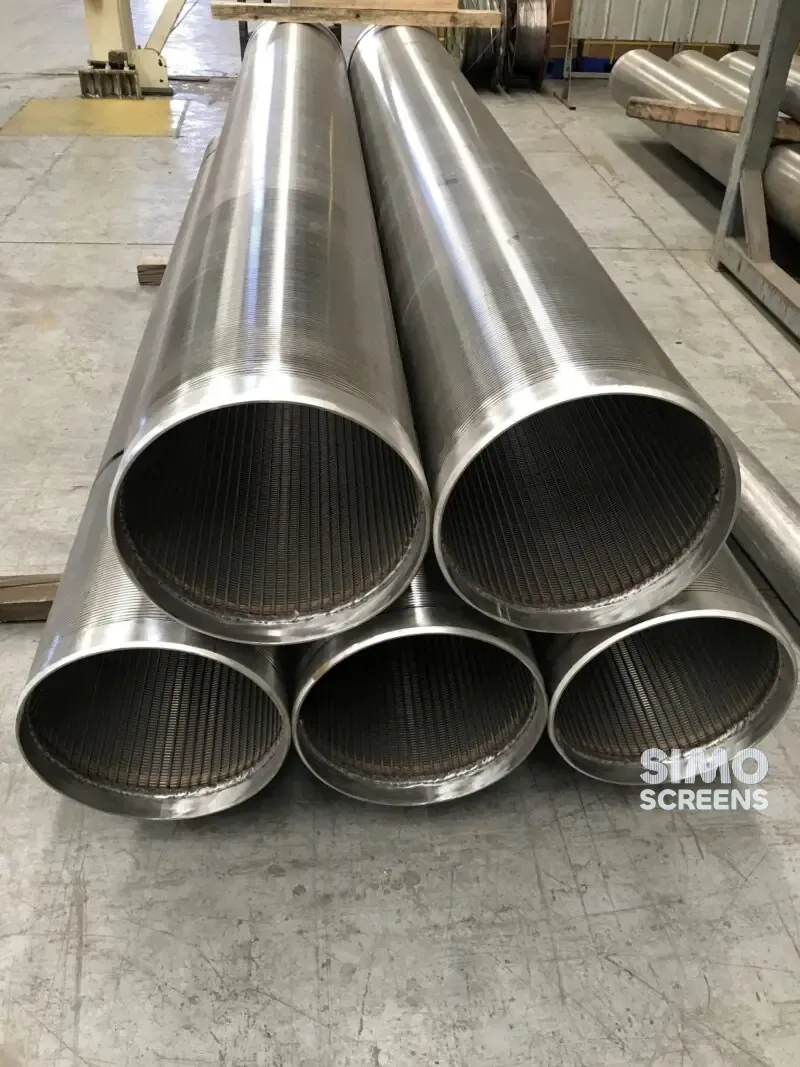
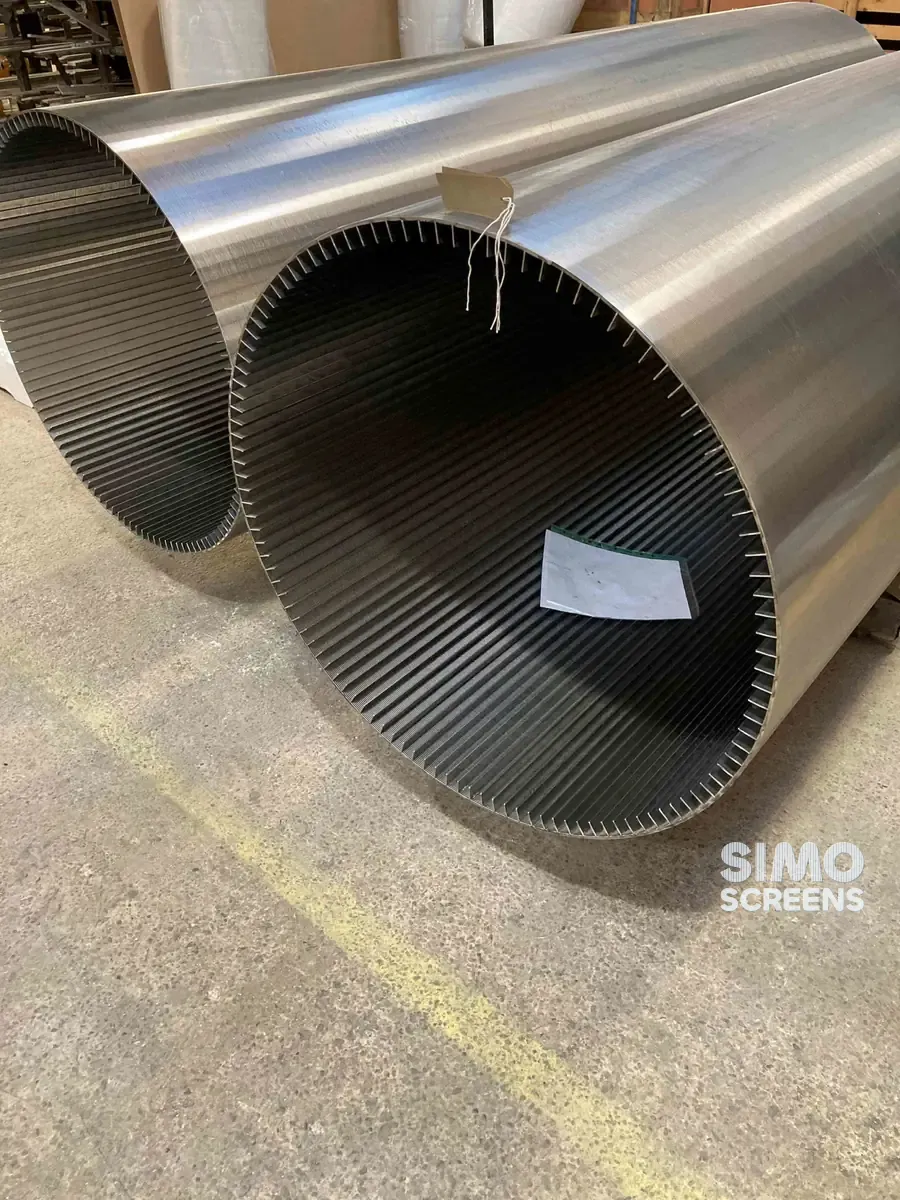
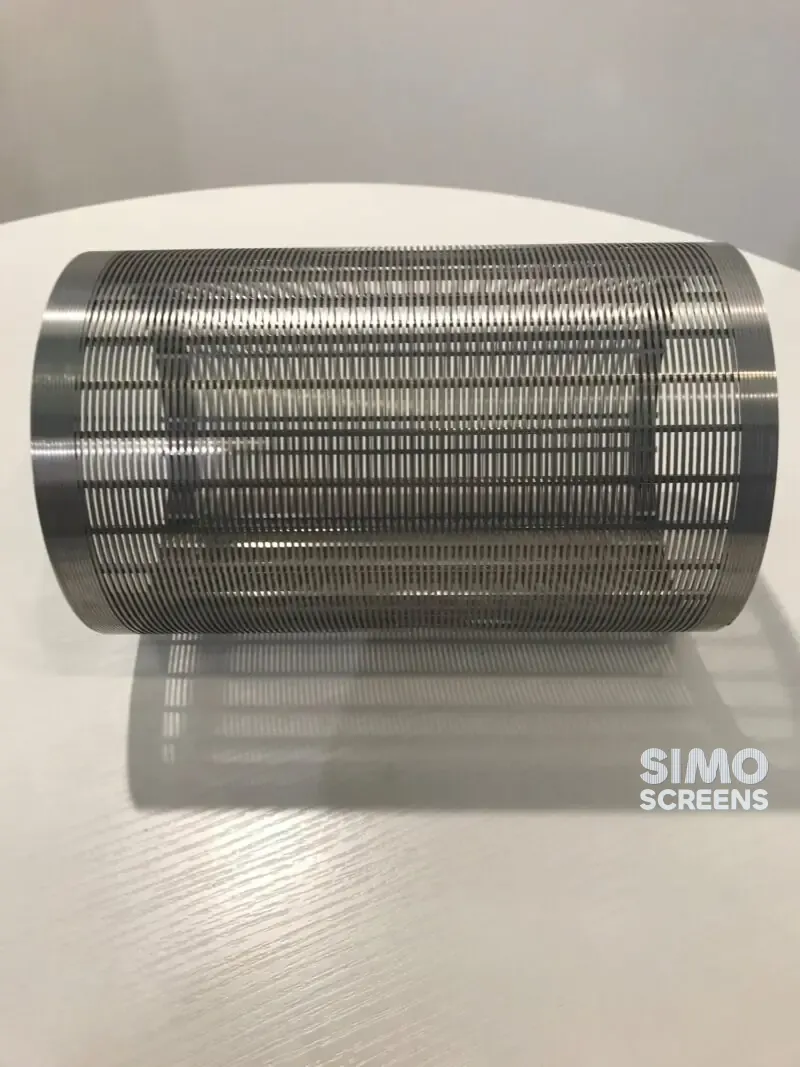
Slotted plastic and drilled pipe are common in underdrains and wells, but over time their slots can widen, the pipe can crack under backwash or heat, and media or sand passes through. A wedge wire screen tube replaces them with a continuous slotted screen, in which one helical slot runs the full length of the tube in place of sawn slots spaced along a pipe.
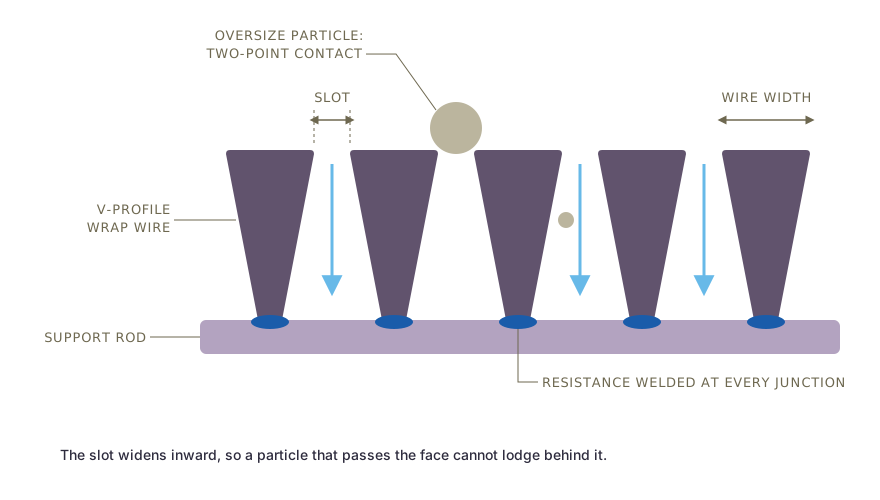
SIMO Screens tubes are resistance welded at every wire and rod intersection, so the wire cannot shift and the slot holds its width in service. The continuous slot gives considerably more open area than drilled or sawn slots, which lowers entrance velocity and pressure drop.
Features and benefits
- Continuous slot. A single helical slot along the full length gives high open area and an even flow profile.
- Stable slot width. Welding at every intersection holds the slot to plus or minus 5 percent of nominal through backwash and temperature cycles.
- Non-clogging geometry. With the flat wire face outside and the slot widening inward, particles stay on the surface or pass straight through.
- Rod-based or pipe-based. Rod-based tubes are light with high open area, while pipe-based screens carry high tensile and collapse loads.
- Pipe-style ends. Plain, threaded, flanged and socket ends and blind caps suit headers, casings and vessel connections.
Applications
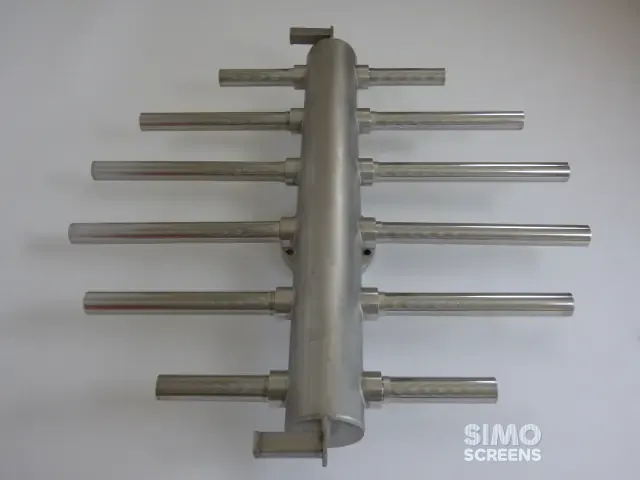
- Underdrain laterals in DM plant vessels, softeners and pressure sand filters, supplied loose or as header and lateral assemblies.
- Well points and small diameter well screens. Larger wells are covered under water well screens.
- Collector and distributor pipes in tanks, intakes and process vessels.
- Strainer elements in water and process lines.
- Pipe-based screens for long strings that must carry high tensile or collapse load, including pipe-based sand control screens.
Construction and specifications
Rod-based tubes are made by winding profile wire onto longitudinal support rods, with the wire formed in house to SIMO profile codes and checked with calibrated micrometers before welding. Pipe-based screens carry a wedge wire jacket over a perforated base pipe, where the pipe takes the mechanical load and the wedge wire sets the slot. For DM plant laterals, 12SB wire on Q23 rods is used for low pressure and high flow, and 15SB wire for higher pressure at moderate flow.
Swipe to see the full drawing.
| Parameter | SIMO range |
|---|---|
| Slot opening | 25 microns (0.025 mm) to 25 mm, tolerance plus or minus 5% of nominal |
| Diameter | 25 to 800 mm |
| Length | Up to 6,000 mm |
| Construction type | Rod-based or pipe-based |
| Profile wire | Light, standard, heavy duty or custom, 12SB to 56SB |
| Support rods | Q23, Q35, Q55, 35SB, F123, F203, F253, round 120, round 140 |
| Materials | SS 304, SS 316L, Duplex 2205, Super Duplex 2507, Hastelloy C-276, Monel |
| End connections | Plain, threaded, flanged or socket ends; blind caps |
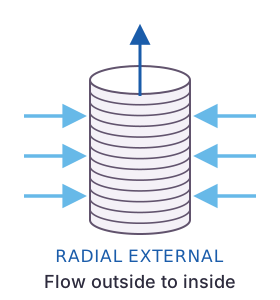
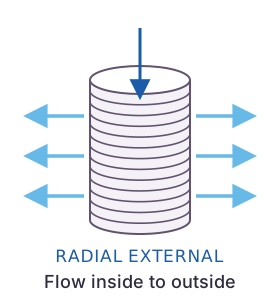
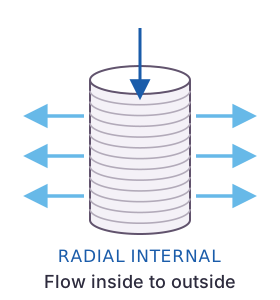
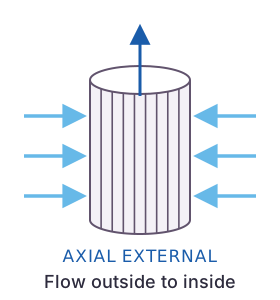
| Flow configuration | Radial, external profile, outside to inside, or as the application requires |
| Construction | Resistance welded at every intersection; resists thermal cycling and pressure transients up to 300 PSI |
Swipe sideways to see the whole table.
SS 304 suits most fresh water and filtration applications, and SS 316L is the usual step up for chlorides and regenerant chemicals. Duplex 2205 and Super Duplex 2507 suit brackish water, seawater and high-load strings, while Hastelloy C-276 and Monel cover strongly corrosive process fluids.
Engineering and quality
Open area (%) = Slot x 100 / (Slot + Wire width). A 0.25 mm slot on 15SB wire (1.52 mm wide) gives about 14 percent open area, and the same slot on 12SB wire (1 mm wide) gives 20 percent, so the lighter wire passes more flow per metre while the heavier wire is stronger. The profile wire selection guide and the open area calculator support this choice, and where flow reverses, as in a backwashed lateral, profile and rods are selected for both directions.
Slot is checked with feeler gauges at welding set-up, during the run and at the end of each tube, and the final inspection report records the minimum, maximum and mean slot. Each tube is identified with job number, item and slot on a QR-coded tag, and laser marked where the client requires it. The Mill Test Certificate is supplied as standard; a dimensional inspection report and quality assurance plan are available on request, and collapse, burst and similar tests on sand control screens can be arranged at extra cost.
What to send for a quotation
- Application: lateral, well point, collector, strainer or other.
- Outside diameter and length of each tube, and the quantity.
- Slot size, or the media or particle size to retain.
- Flow rate and allowable pressure drop.
- End connection at each end, with the thread or flange standard.
- Loads: depth, collapse pressure, tension or backwash pressure.
- Fluid, temperature and material grade.
 Upload a drawing