 +91 93730 08466
 Screen tubes and pipes
 Screen cylinders
 Flat panels and false bottoms
 Candle filter elements
 Water well screens
 Header and hub laterals
 Filter nozzles
 Resin traps
 Support grids
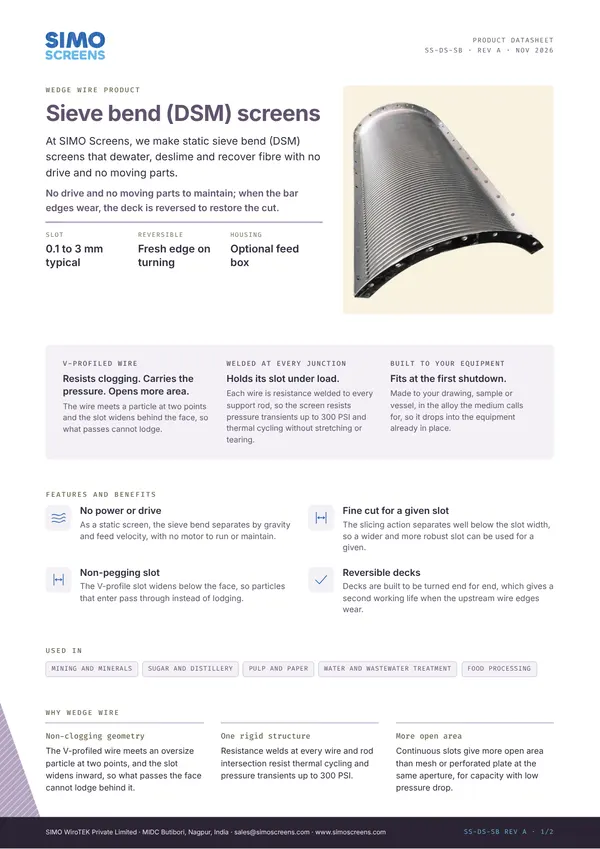
 Sieve bend (DSM) screens
 Centrifuge baskets
 Pressure screen baskets
 Screw press screens
 Rotary drum screens
 Passive intake screens
 Coanda intake screens
 Water and wastewater treatment
 Water wells and groundwater
 Sugar and distillery
 Brewing, malting and beverages
 Food processing
 Mining and minerals
 Oil, gas and petrochemicals
 Chemicals, fertilisers and pharma
 Power generation
 Pulp and paper
 Buildings and drainage

Coal washery screens overview
In a dense medium coal washery, raw coal slurry first passes a sieve bend, which removes slimes and most of the water ahead of the desliming screen. After the dense medium cyclones, drain and rinse screens drain off the medium and spray the magnetite from clean coal and rejects. Dewatering screens and sieve bends then feed the coal centrifuges.
These screens handle abrasive coal, shale and magnetite continuously. Edge wear raises the cut point of a sieve bend, near-size particles blind mesh and polyurethane apertures, and thin wire on light rods flexes and cracks on a vibrating deck. Pyritic coal also makes the process water acidic, which pits low grades, and the combined effect is higher magnetite consumption, wetter product and overloaded centrifuges.
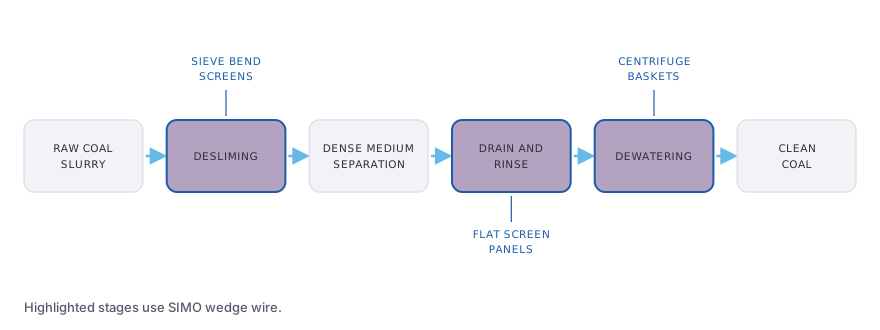
Swipe to see the full drawing.
Design considerations for a coal washery sieve bend and desliming screen
Slot. Desliming sieve bends commonly run about 0.5 mm. Drain and rinse panels commonly run about 0.5 to 1 mm, and some circuits specify 1.5 mm. The slot is set to the cut size and to the medium that has to be recovered.
Profile and wire direction. The wires run across the flow, so that each wire edge slices a thin layer of slurry through the slot. On flat panels the V-profile faces the coal, which gives particles two points of contact so that they do not pack into the slot.
Cut point. On a sieve bend, separation in general practice is at roughly half the slot width. As the wire edges facing the feed round off, the cut rises, so sieve bend panels are built to be turned end to end to bring the second edge to the feed.
Load and stiffness. Abrasion and vibration call for heavy profiles such as 35SB, 42SB, 55SB or 56SB, paired with F203 or F253 bars or Q55 rods for stiffness. FEA is used on custom designs.
Fixing. Flat panels are supplied with side clamps, bolted fixings or hook strips to suit the deck. For polyurethane modular decks, SIMO Screens supplies support members and lock pins.
Open area (%) = Slot x 100 / (Slot + Wire width). A 0.5 mm slot on 35SB wire, 3 mm wide, gives about 14 percent open area, and a 1 mm slot on 42SB, 3.3 mm wide, about 23 percent. Options can be compared in the open area calculator.
Construction and options
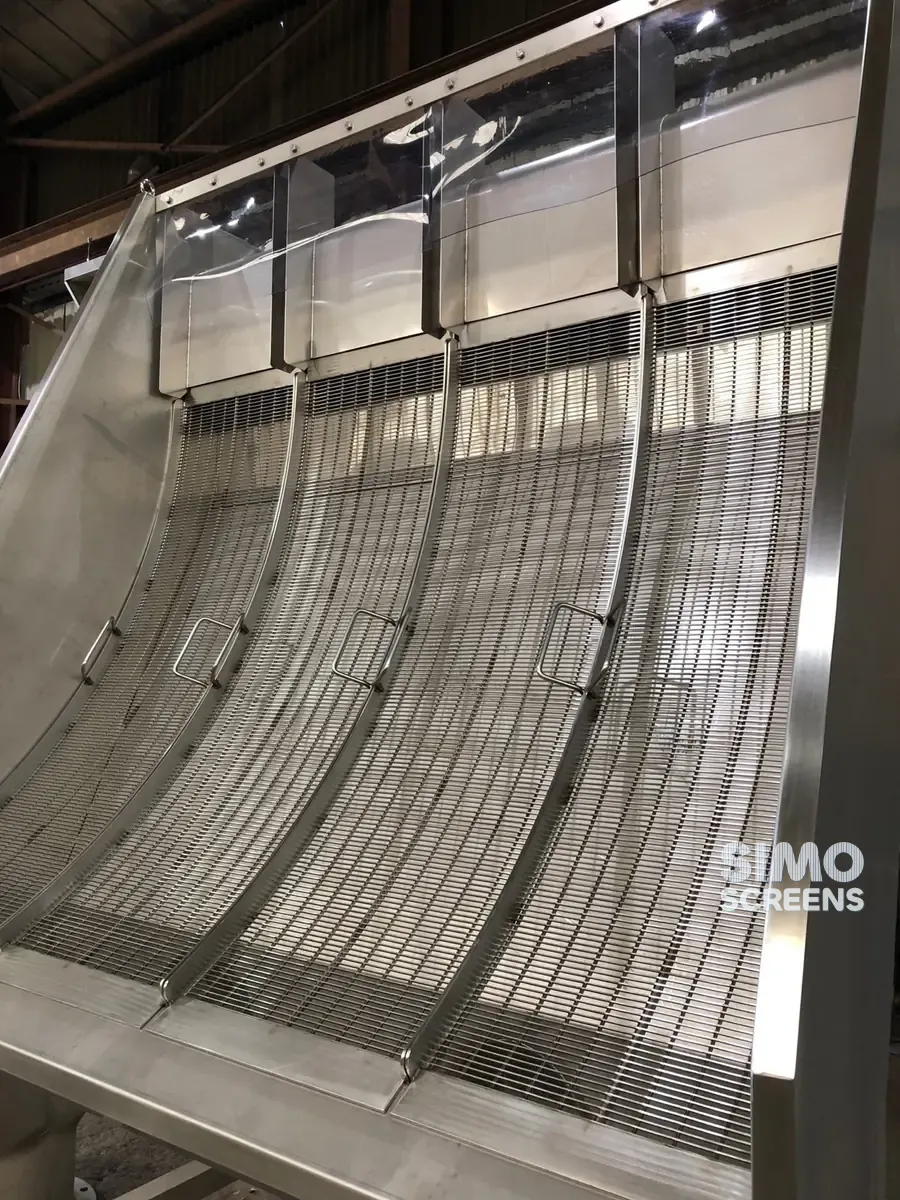
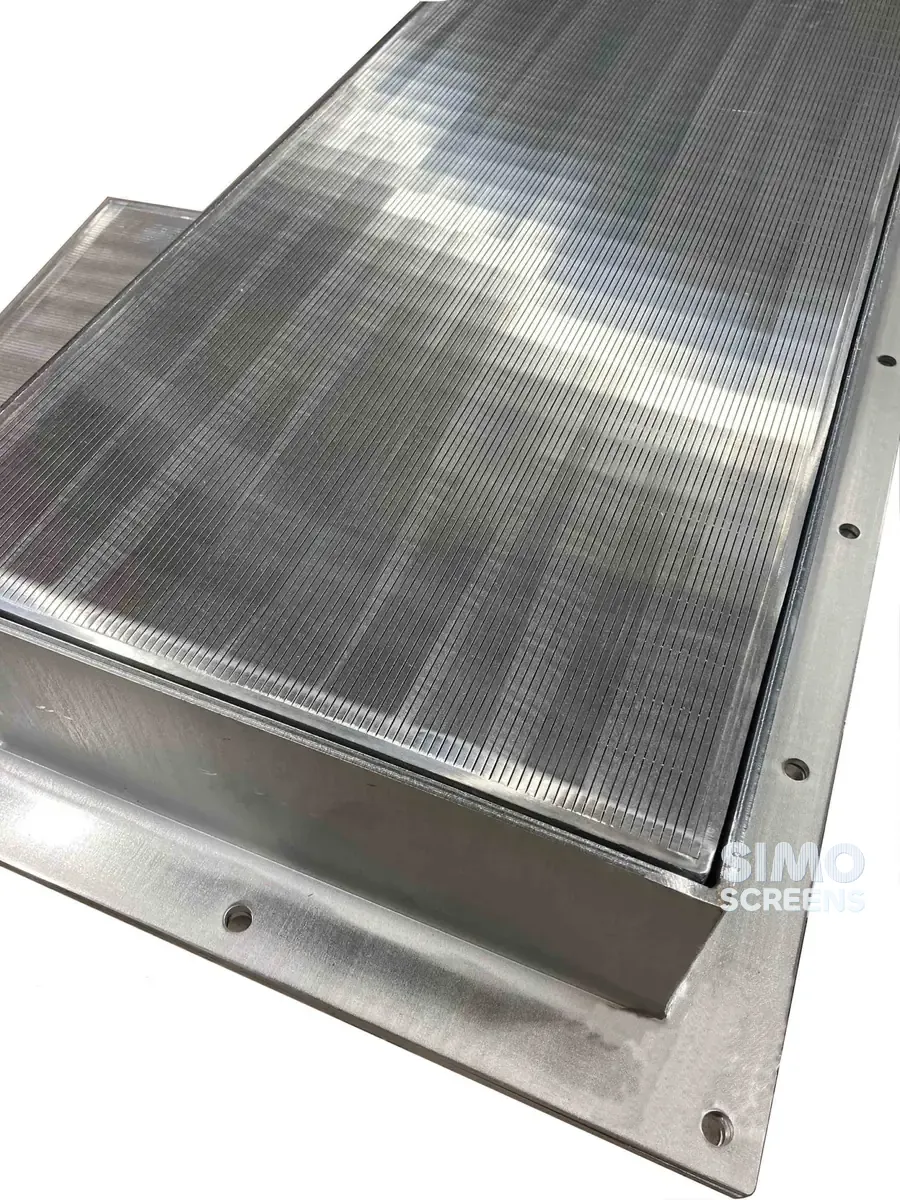
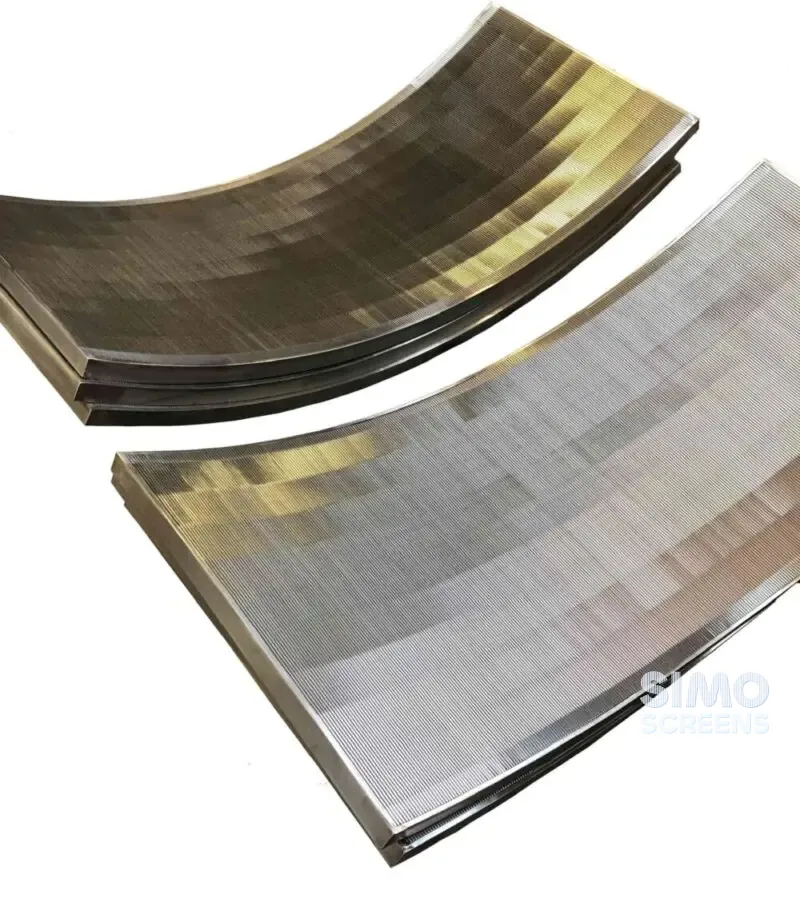
SIMO profile wire is formed in house and resistance welded to support bars at every intersection. Sieve bend decks are rolled to the specified radius and arc and fed tangentially at the top, and flat panels are built to the deck module size with closed edges and the required fixing detail. Slot width is checked with feeler gauges at set-up, during the run and on each finished panel.
| Item | SIMO range or typical value |
|---|---|
| Forms | Sieve bend decks and panels, flat deck panels |
| Slot opening | 25 microns (0.025 mm) to 25 mm; desliming typically 0.5 mm; drain and rinse 0.5 to 1 mm, at times 1.5 mm |
| Wire direction | Across the flow |
| Profile wire | 35SB, 42SB, 55SB, 56SB |
| Support bars and rods | F203, F253, Q55 |
| Single panel size | Up to 2,400 mm wide and 4,000 mm long; larger decks as joined panels |
| Fixing | Side clamps, bolted, hook strips; support members and lock pins for polyurethane modular decks |
| Materials | SS 304, SS 316L, Duplex 2205, Super Duplex 2507 |
Swipe sideways to see the whole table.
Materials
SS 304 suits most washeries. SS 316L handles acidic water from pyritic coal, and Duplex 2205 adds strength and wear resistance where wear and corrosion act together. The Mill Test Certificate is supplied as standard, and a dimensional inspection report and QAP are supplied on request.
Replacement and retrofit
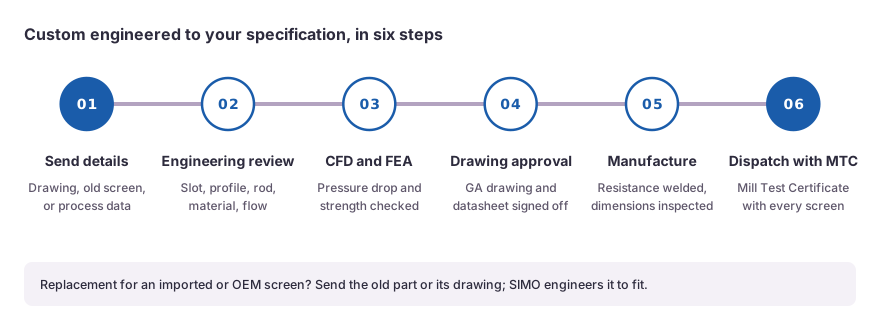
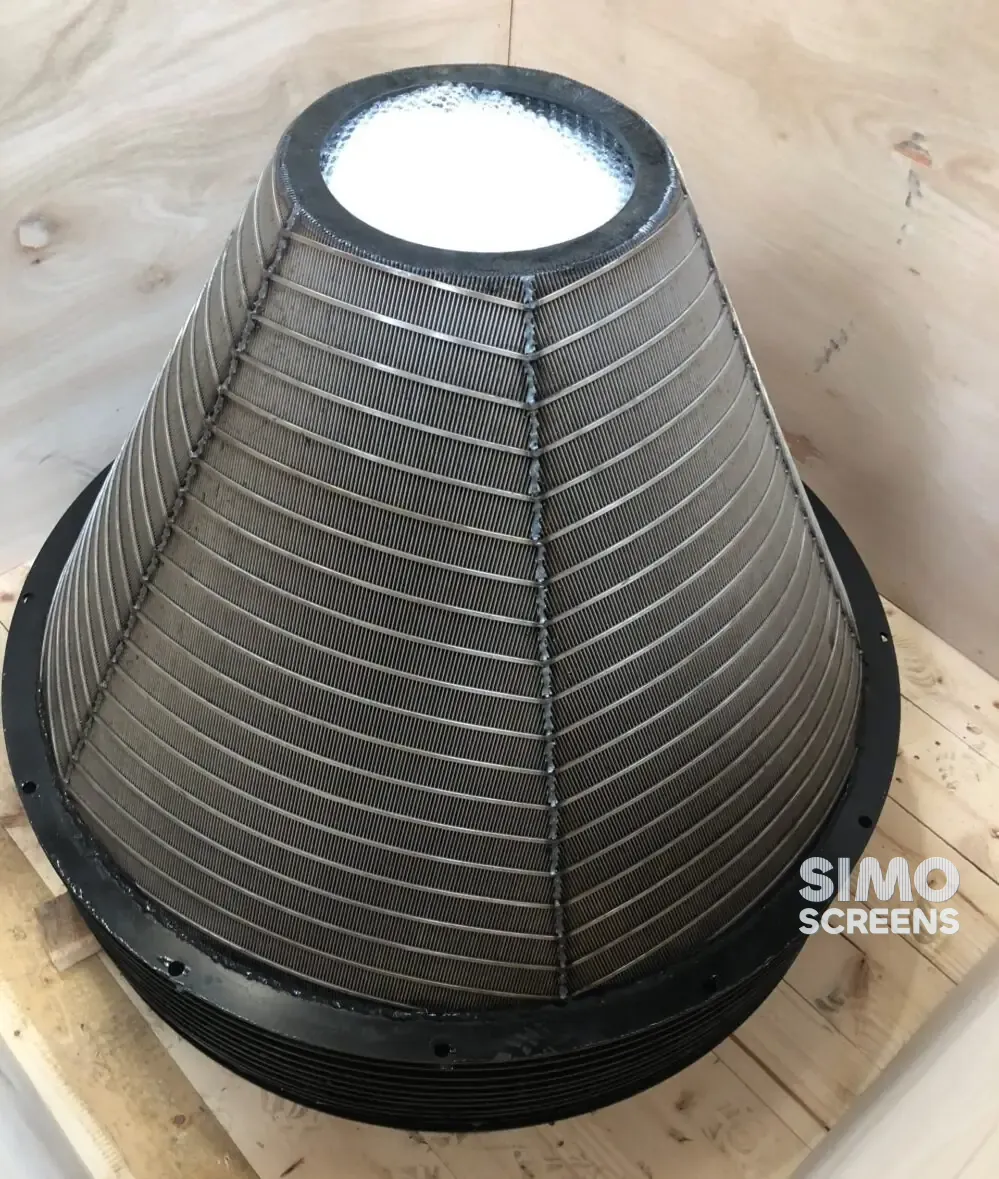
Most orders replace worn sieve bends and deck panels on existing machines, including polyurethane and imported stainless panels. SIMO Screens builds to the panel drawing, or to measured width, length, radius, arc and fixing holes taken from a sample.
One spare set of sieve bends per circuit allows panels to be changed in planned stops instead of after a broken wire. Our sieve bend screens and flat wedge wire panels pages give the full range, and the sieve bend guide shows how to size the deck.
What to send for a quotation
- Application: desliming, drain and rinse, dewatering or classification.
- Slurry flow in m³/h and solids feed in t/h.
- Feed size range and the cut size you need.
- Sieve bend width, radius and arc, or deck panel size.
- Panel fixing method and deck drawing.
- Medium type and spray water arrangement, for drain and rinse.
- Process water pH and chlorides.
- Current panel life and failure mode.

 Upload a drawing