 +91 93730 08466
 Screen tubes and pipes
 Screen cylinders
 Flat panels and false bottoms
 Candle filter elements
 Water well screens
 Header and hub laterals
 Filter nozzles
 Resin traps
 Support grids
 Sieve bend (DSM) screens
 Centrifuge baskets
 Pressure screen baskets
 Screw press screens
 Rotary drum screens
 Passive intake screens
 Coanda intake screens
 Water and wastewater treatment
 Water wells and groundwater
 Sugar and distillery
 Brewing, malting and beverages
 Food processing
 Mining and minerals
 Oil, gas and petrochemicals
 Chemicals, fertilisers and pharma
 Power generation
 Pulp and paper
 Buildings and drainage

Water well screening applications
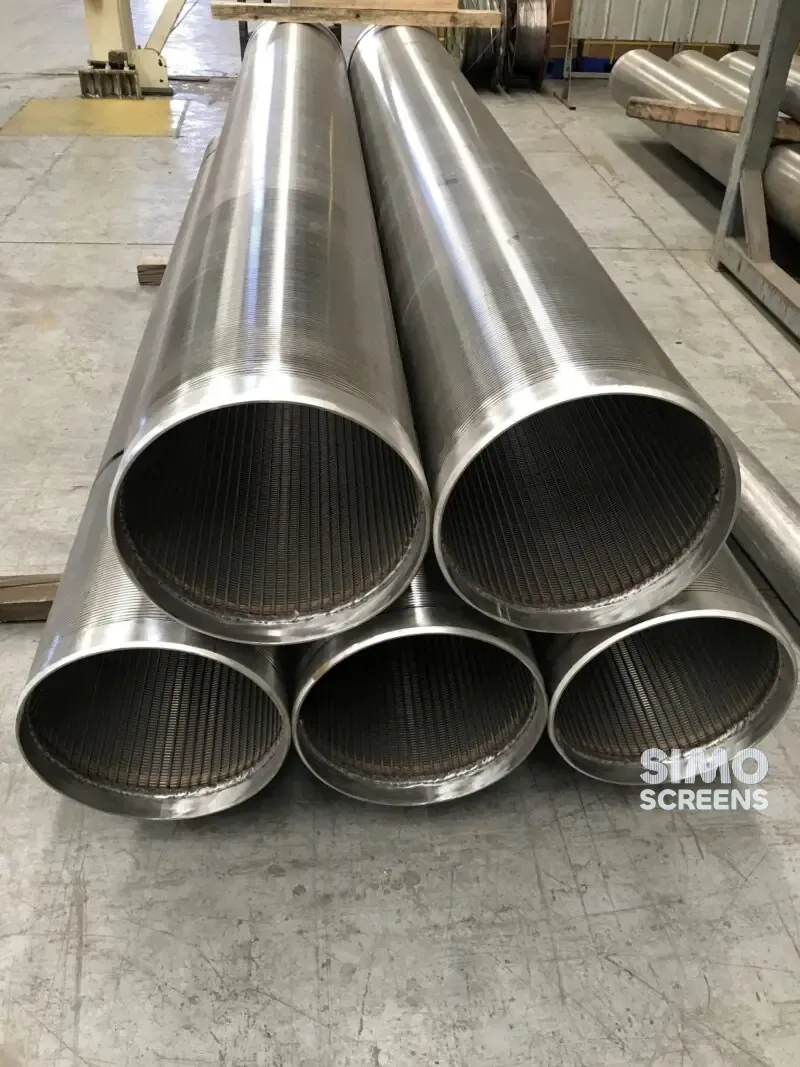
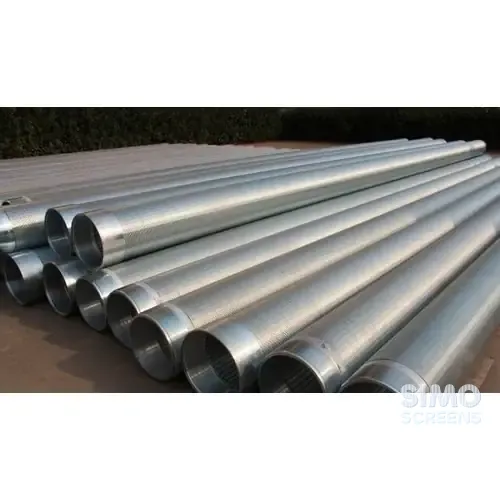
SIMO Screens manufactures wedge wire well screens for tube wells, borewells, recharge wells and monitoring wells. A well screen admits water to the well while retaining the aquifer formation or gravel pack, and it must do so for the life of the well under the load of the formation and without closing through corrosion or encrustation.
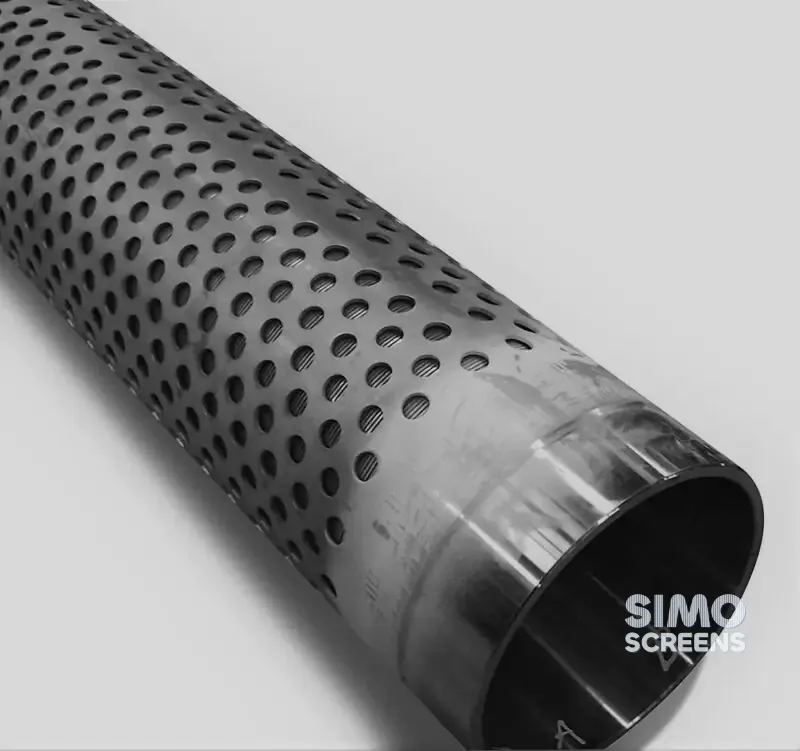
When the screen is unsuitable, the well pumps sand, the pump impellers wear and the yield falls. Slotted MS pipe corrodes, its slots close with encrustation, and the drawdown rises year after year. Most of these problems trace back to open area: machine-slotted or perforated pipe has little open area, so water passes each slot at high velocity, drawing fines into the well and accelerating encrustation.
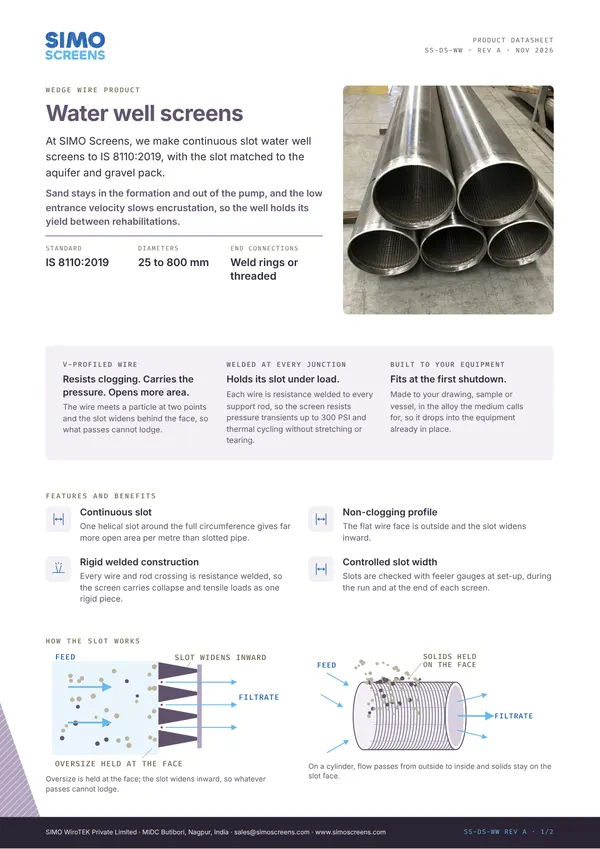
A continuous slot wedge wire screen addresses this. The V-profile wire is wound around and welded to longitudinal rods, forming one slot that runs the full length of the screen. The slot widens inward, so a grain that passes the face falls into the well instead of lodging in the slot.
The borewell screen in a well
In a typical tube well, plain casing runs from the surface through the overburden and any poor quality zones, and a sanitary seal closes the annulus near the top. Wedge wire screen sections, often called the well casing screen, are joined into the casing string against each water-bearing layer. Around the screen sits either the developed natural formation or an artificial gravel pack, and a bottom plug closes the string. The same layout, at a smaller scale, applies to borewells, recharge wells and monitoring wells.
Swipe to see the full drawing.
Equipment and tube well screens selection
| Equipment | Screen function | SIMO product |
|---|---|---|
| Tube wells for irrigation, municipal and industrial supply | Admits water from each aquifer zone at low entrance velocity and retains formation sand or gravel pack | Water well screens (IS 8110:2019) |
| Borewells in alluvial and mixed formations | Holds back sand in unconsolidated zones where an open hole would collapse | Water well screens |
| Recharge wells and recharge shafts | Lets filtered surface water enter the aquifer across the full screened length | Water well screens |
| Monitoring wells and piezometers | Provides a stable, clean intake for water level readings and sampling | Water well screens |
Swipe sideways to see the whole table.
Materials and design considerations
The points below reflect general practice in well design literature. The details for each well are confirmed during engineering review.
Slot selection
The slot is selected from a sieve analysis of each aquifer sample. In a naturally developed well, the slot retains part of the formation and development removes the finer fraction, while with an artificial gravel pack the slot is sized to retain the pack. Different layers often need different slots, so a long screen string can combine sections of different slot sizes matched to the bore log.
Open area and entrance velocity
Open area for wedge wire is calculated as Open area (%) = Slot x 100 / (Slot + Wire width), so a 1 mm slot on a wire 2.2 mm wide gives about 31 percent. Because part of the screen face is blocked by the formation or gravel pack, the effective open area is taken as about 50 percent of the calculated value, or to the client's design factor.
A commonly used design limit for well screen entrance velocity is about 0.03 m/s (3 cm/s), and a higher open area meets that limit with a shorter screen or a higher yield. The water well screen design guide and the well screen calculator set out the method.
Strength and material
Deep wells need collapse and tensile strength as well as open area, so heavier profile wire and support rods are selected from the light, standard and heavy duty ranges to carry the formation load and the weight of the string. SS 304 suits most fresh groundwater, SS 316L is the usual choice for saline or high chloride water, and Duplex 2205 suits aggressive coastal aquifers. Stainless steel also resists the iron bacteria and encrustation that block MS screens.
Oil, gas and deep wells in loose sand need a different construction, covered on the sand control screens page in wire-wrapped and pre-packed designs.
SIMO Screens capability for water wells
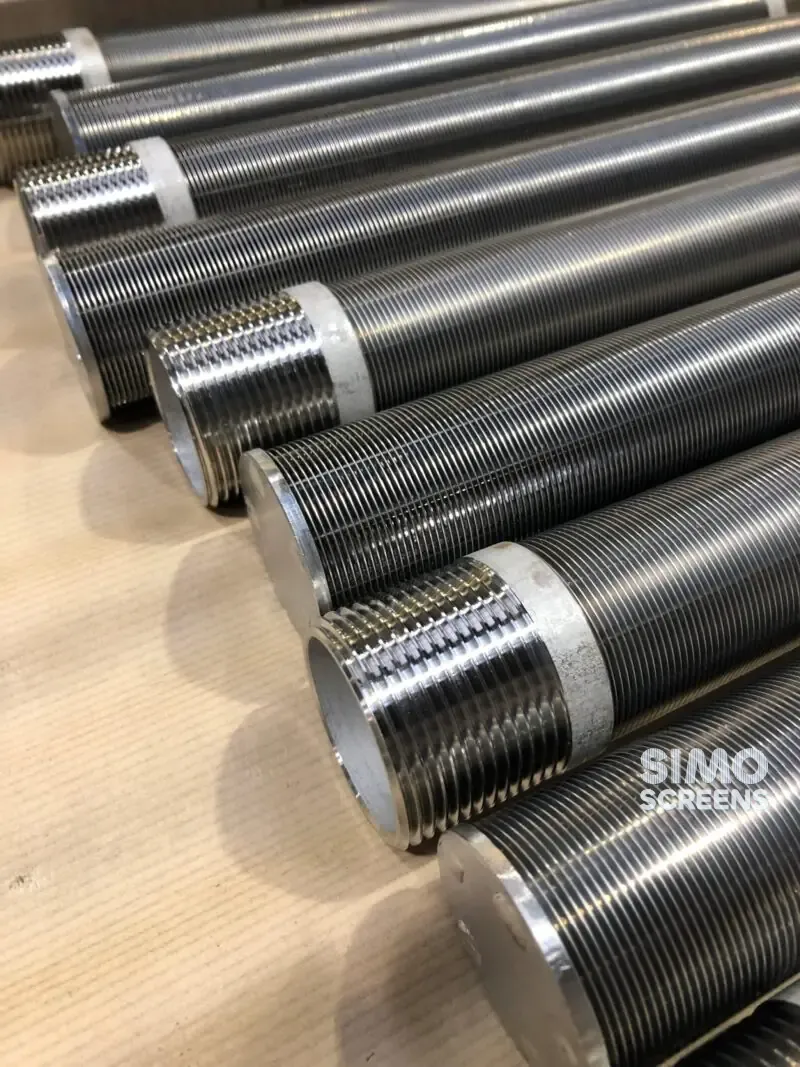
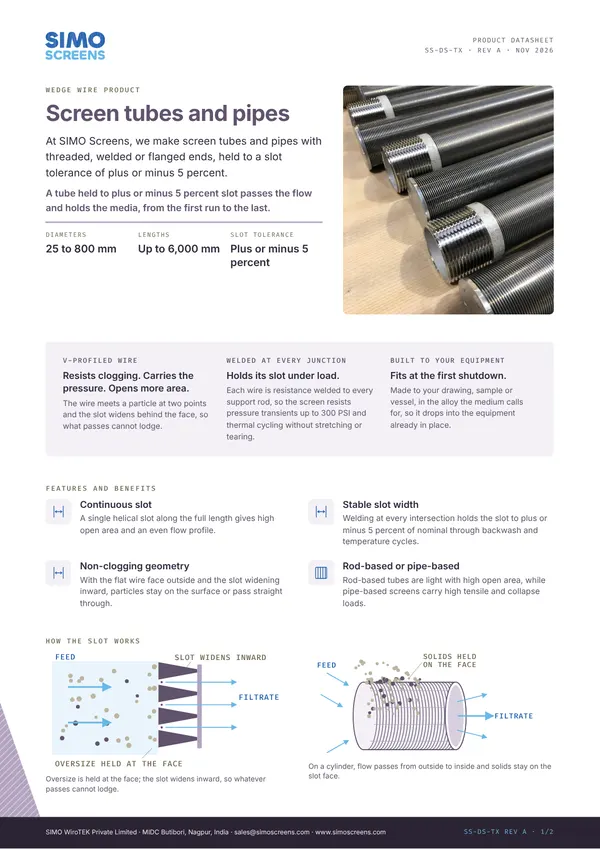
SIMO water well screens are made to IS 8110:2019, under an ISO 9001:2015 quality system at the SIMO works in MIDC Butibori, Nagpur. Each string is built to the bore log, with the slot specified by zone, diameters from 25 to 800 mm and lengths up to 6,000 mm per section. End connections, including weld rings, threaded ends and bottom plugs, are made to standard in the same works.
Profile wire is formed in house to SIMO profile codes and checked with calibrated micrometers before welding. Slot width is checked with feeler gauges at set-up, during the run and at the end of each screen, against a standard tolerance of plus or minus 5 percent of nominal, and each section is identified with job number, item and slot on a QR-coded tag, or laser marked where the client requires it.
Every screen ships with a Mill Test Certificate, and the dimensional inspection report is supplied on request. When comparing water well screen suppliers, buyers should ask each for the slot by zone, the wire and rod profiles and the MTC.
What to send for a quotation
- Type of well: tube well, borewell, recharge well or monitoring well.
- Bore diameter, casing diameter and total depth.
- Bore log showing the depth and thickness of each water-bearing zone.
- Sieve analysis of aquifer samples or the gravel pack specification.
- Required yield and the pump setting, if known.
- Water analysis, especially chlorides, pH and iron, or your material preference.
- End connection required: weld ring, threaded or coupled, plus any bottom plug.
- Total screen length and number of sections.
 Upload a drawing