 +91 93730 08466
 Screen tubes and pipes
 Screen cylinders
 Flat panels and false bottoms
 Candle filter elements
 Water well screens
 Header and hub laterals
 Filter nozzles
 Resin traps
 Support grids
 Sieve bend (DSM) screens
 Centrifuge baskets
 Pressure screen baskets
 Screw press screens
 Rotary drum screens
 Passive intake screens
 Coanda intake screens
 Water and wastewater treatment
 Water wells and groundwater
 Sugar and distillery
 Brewing, malting and beverages
 Food processing
 Mining and minerals
 Oil, gas and petrochemicals
 Chemicals, fertilisers and pharma
 Power generation
 Pulp and paper
 Buildings and drainage
 Datasheet

Wedge wire filter element overview
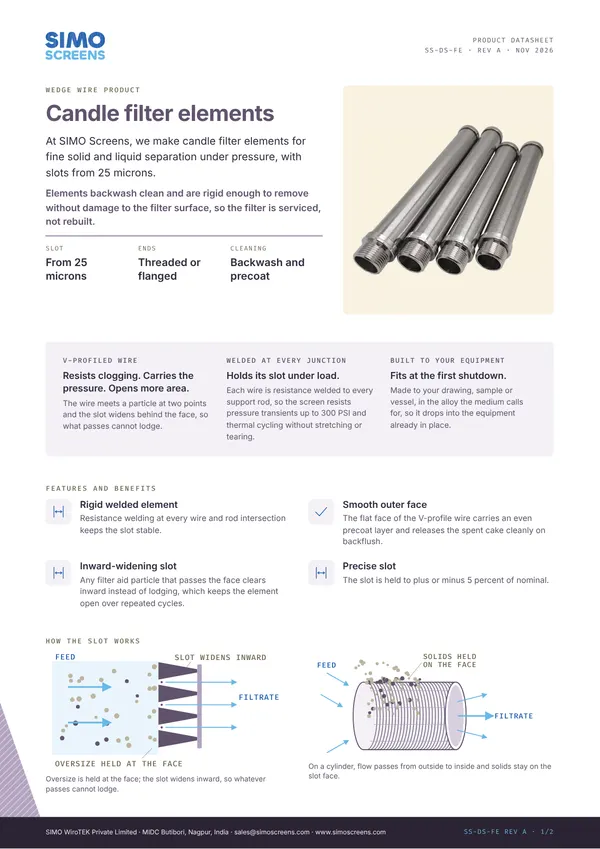
Precoat and backwash filters depend on the stability of the element. If an element distorts, the cake cracks and solids pass into the filtrate, and if it blinds, run length falls and filter aid use rises. SIMO Screens filter elements are rigid, resistance welded tubes with a continuous slot that holds its dimension under filtration and backflush pressure.
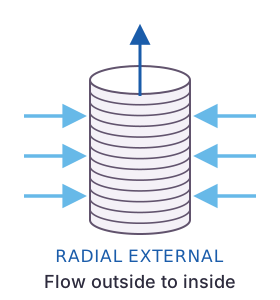
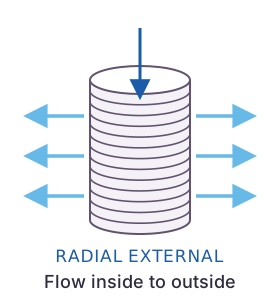
Candles hang from a register plate, also called a tube sheet, inside a pressure vessel. Unfiltered liquid passes from outside to inside each candle, and clear filtrate rises through the candle to leave above the plate. At the end of the run the flow is reversed, so the cake lifts off the smooth wire face and drops to the vessel bottom.
Features and benefits
- Rigid welded element. Resistance welding at every wire and rod intersection keeps the slot stable, so the precoat is not disturbed by movement of the element.
- Smooth outer face. The flat face of the V-profile wire carries an even precoat layer and releases the spent cake cleanly on backflush.
- Inward-widening slot. Any filter aid particle that passes the face clears inward instead of lodging, which keeps the element open over repeated cycles.
- Precise slot. The slot is held to plus or minus 5 percent of nominal, so it can be matched closely to the filter aid grade.
- Fittings to suit. Top fittings are threaded, flanged or clamped, and register plates or complete housings can be supplied with the candles.
Applications
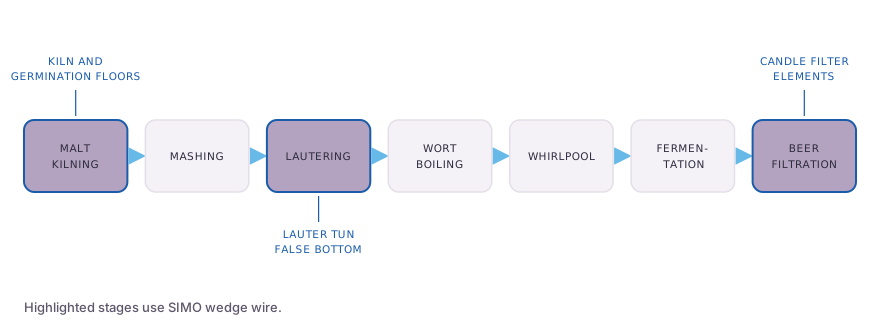
- Beer filtration in precoat candle filters using kieselguhr or perlite, in brewing, malting and beverages.
- Food liquids such as juices, syrups and edible oils, in food processing plants.
- Chemical process filtration, for removal of fine solids or recovery of product under pressure.
- Refinery and petrochemical liquids, with the candles used as backwashable elements.
- Self cleaning filters of the backwash, brush or suction scanner type, where the wedge wire element is the screen inside the unit.
Swipe to see the full drawing.
Construction and specifications
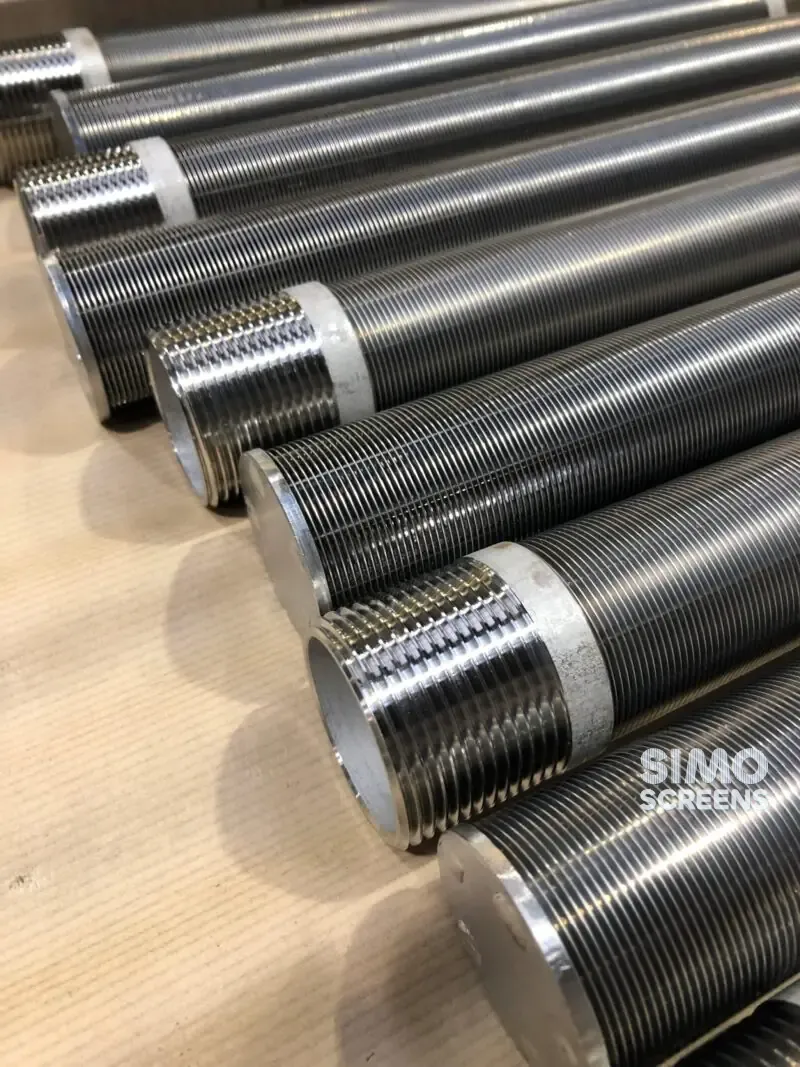
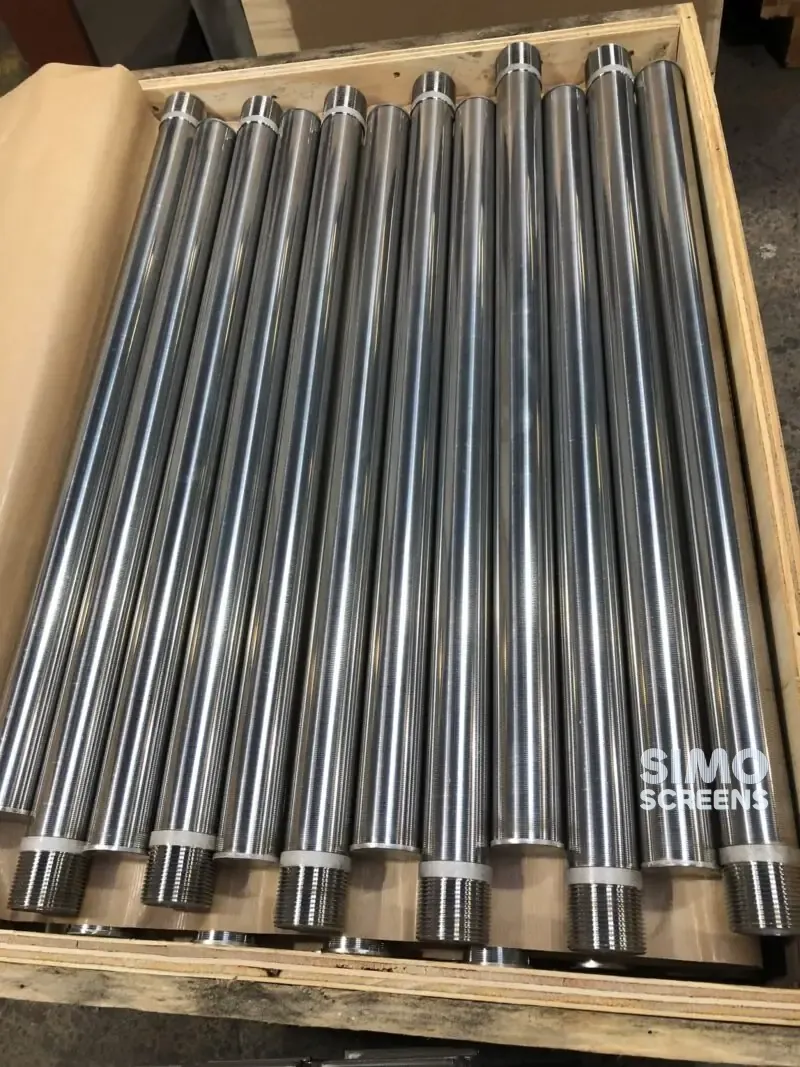
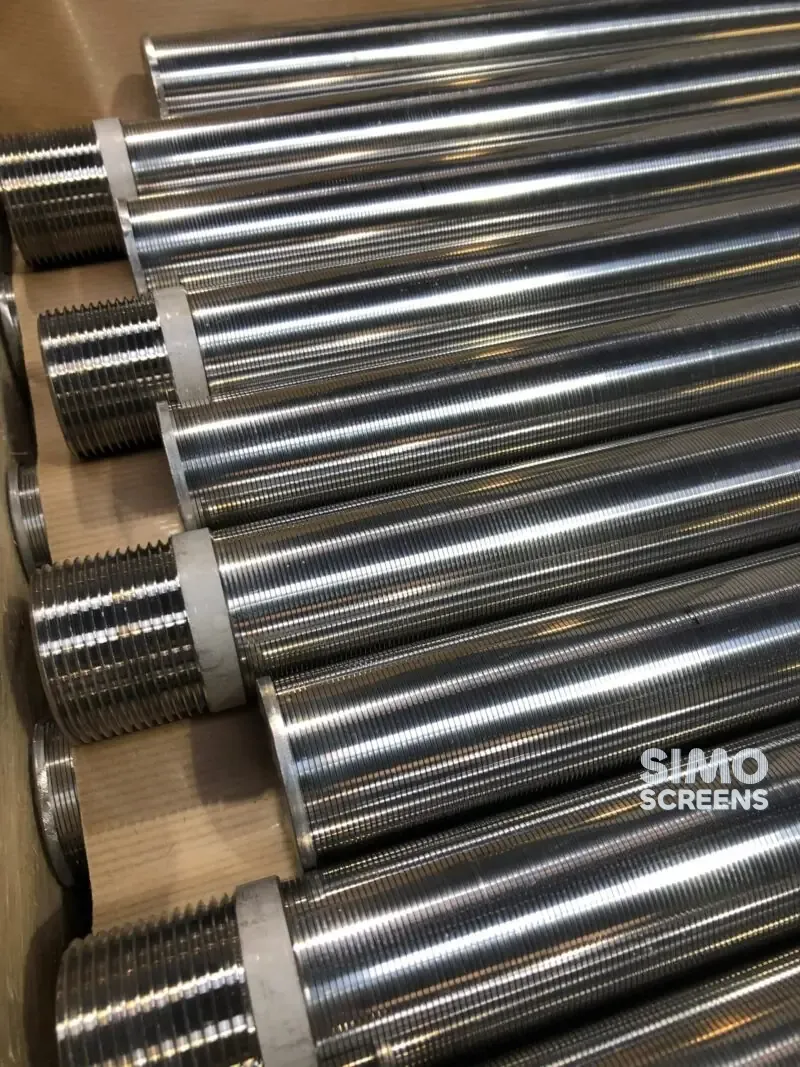
Each candle is a wedge wire tube with the flat wire face outside, where the cake forms, which is radial flow with an external profile from outside to inside. Profile wire is formed in house to SIMO profile codes and resistance welded to the support rods, after which a closed bottom cap and a top fitting are welded on. Long candles can carry intermediate rings to hold straightness.
| Parameter | SIMO range |
|---|---|
| Slot opening | 25 microns (0.025 mm) to 25 mm, tolerance plus or minus 5% of nominal |
| Candle diameter | 25 to 800 mm |
| Candle length | Up to 6,000 mm |
| Profile wire | Light, standard, heavy duty or custom, 12SB to 56SB |
| Support rods | Q23, Q35, Q55, 35SB, F123, F203, F253, round 120, round 140 |
| Flow configuration | Radial, external profile, outside to inside, with backflush |
| Top fittings | Threaded, flanged or clamped, to suit the register plate |
| Supply options | Candles only, candles with register plate, or a complete filter housing |
| Construction | Resistance welded at every intersection; resists pressure transients up to 300 PSI |
Swipe sideways to see the whole table.
Materials
SS 304 and SS 316L cover most brewing, beverage and food liquids, and SS 316L is selected where chlorides or cleaning chemicals are present. Duplex 2205, Super Duplex 2507, Hastelloy C-276 and Monel are used in corrosive chemical service. The material selection guide sets out the basis for each grade.
Engineering and quality
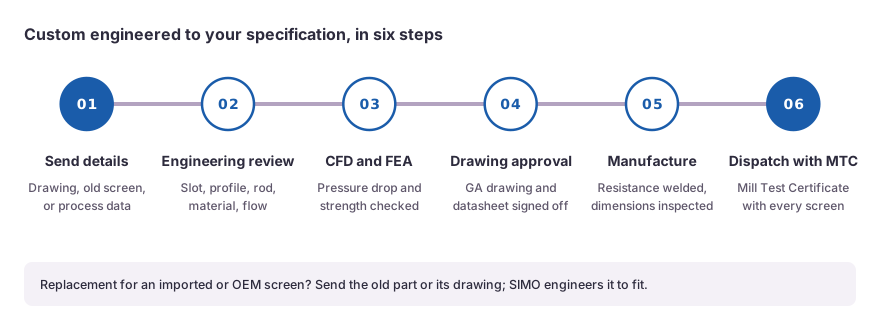
The slot is set by the filter aid grade for precoat filtration, or by the particle size for direct straining, and the mesh to micron converter helps compare a slot with an existing mesh element. Candle diameter and length are then sized for the vessel and the filter area required, with a profile wire that gives the stiffness and open area the length demands.
Slot is checked with feeler gauges at welding set-up, during the run and at the end of each candle, and the final inspection report records the minimum, maximum and mean slot. Each element is identified with job number, item and slot on a QR-coded tag, and laser marked where the client requires it. The Mill Test Certificate is supplied as standard; a dimensional inspection report, quality assurance plan, passivation or electropolishing through approved agencies, and third-party inspection are available on request.
What to send for a quotation
- Application: beer, beverage, food liquid, edible oil, chemical or other.
- Filter make and model, or the vessel and register plate drawing.
- Candle length, outside diameter and quantity.
- Top fitting type and dimensions, or a sample candle.
- Precoat and filter aid grade, or the particle size to retain.
- Filtration and backflush pressures, and the operating temperature.
- Liquid chemistry and cleaning chemicals.
- Material grade if specified, and whether you need register plates or a complete housing.
 Upload a drawing