 +91 93730 08466
 Screen tubes and pipes
 Screen cylinders
 Flat panels and false bottoms
 Candle filter elements
 Water well screens
 Header and hub laterals
 Filter nozzles
 Resin traps
 Support grids
 Sieve bend (DSM) screens
 Centrifuge baskets
 Pressure screen baskets
 Screw press screens
 Rotary drum screens
 Passive intake screens
 Coanda intake screens
 Water and wastewater treatment
 Water wells and groundwater
 Sugar and distillery
 Brewing, malting and beverages
 Food processing
 Mining and minerals
 Oil, gas and petrochemicals
 Chemicals, fertilisers and pharma
 Power generation
 Pulp and paper
 Buildings and drainage
Fabrication on our own screens
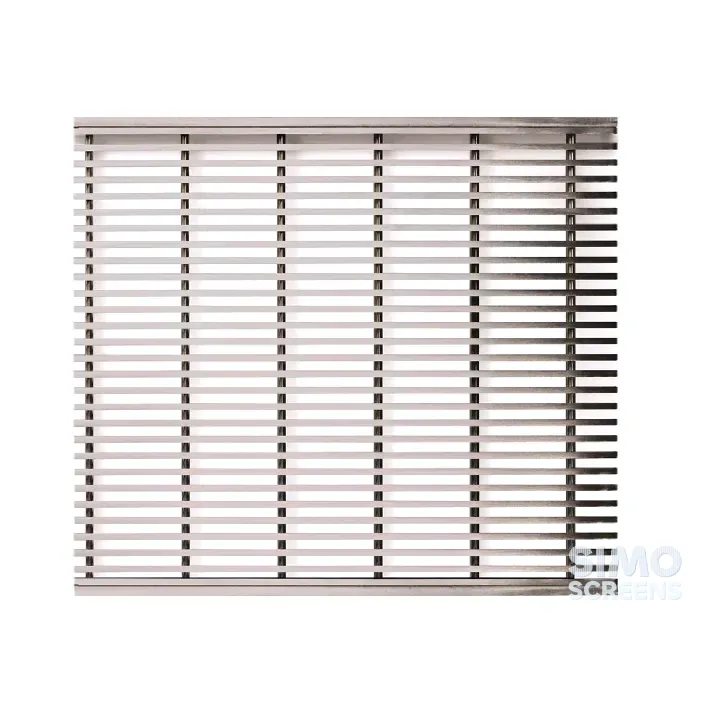
A wedge wire screen must be held, sealed, connected and supported within the equipment it serves. SIMO Screens fabricates these parts on its own screens, so that the screen and every fabricated part are built to one drawing by one team and fit-up problems are resolved before dispatch rather than on site.
Wedge wire fabrication scope
| Fabrication | Function | Typical use |
|---|---|---|
| Frames | Hold flat panels square and provide a seating edge | Decks, false bottoms, grates, walkway panels |
| Flanges | Connect a screen to a pipeline or vessel nozzle | Outlet baskets, resin traps, laterals |
| End rings | Close and stiffen the ends of a cylinder | Screen tubes, candle elements, baskets |
| Screen housings | Enclose a screen element with inlet and outlet | Rainwater filters, inline strainers |
| Rolled and curved sections | Form panels to a radius | Sieve bends, drum screens, curved facades |
| Brackets | Fix screens to walls, frames and structures | Intake screens, architectural panels |
| Segmented decks | Divide large areas into pieces that bolt together | Support grids, lauter tun false bottoms |
Swipe sideways to see the whole table.
Design principles
Material. Frames and fittings are normally fabricated in the same alloy as the screen. On a stainless steel wedge wire screen this avoids galvanic couples and keeps corrosion behaviour uniform across the assembly, while other frame materials can be discussed where conditions allow.
Fit. Flanges and end rings are drilled to the buyer's standard or drawing. The approved drawing shows the screen and every fabricated part together, with the opening, nozzle or seat the assembly fits.
Load and stiffness. For grates, walkway panels and support grids, frames and support rods are sized together for span and deflection, with FEA used where the load case requires it. Drainage grate load class is confirmed per order against the buyer's specification and country.
Segmenting. Large panels and baskets are divided so that each piece passes a manway or suits handling, and the joints are detailed to maintain slot and seal across them.
Fabricated products
- Drainage grates and trench covers for commercial kitchens, food plants, hospitals and car parks, with 3 mm and 5 mm slots running along the length in kitchen service
- Pool, shower and balcony grates in brushed or electropolished finish, with Duplex 2205 recommended and SS 316 as the budget option
- Rooftop rainwater harvesting filters with complete stainless steel housings in SS 304 or SS 316L, and MS or SS 410 to client requirement, sized by flow rate and pipe size
- Coanda screens for Tyrolean and side intakes, stormwater and rainwater
- Fish and aquaculture screens for hatcheries, raceways and intakes
- Architectural panels for facades, sunscreens, ceilings and balustrades, rolled with the wires around the curve
- Flooring and walkway panels for walkways, mezzanines and drying floors, with a dimpled anti-skid finish available
Process screens with fabrication
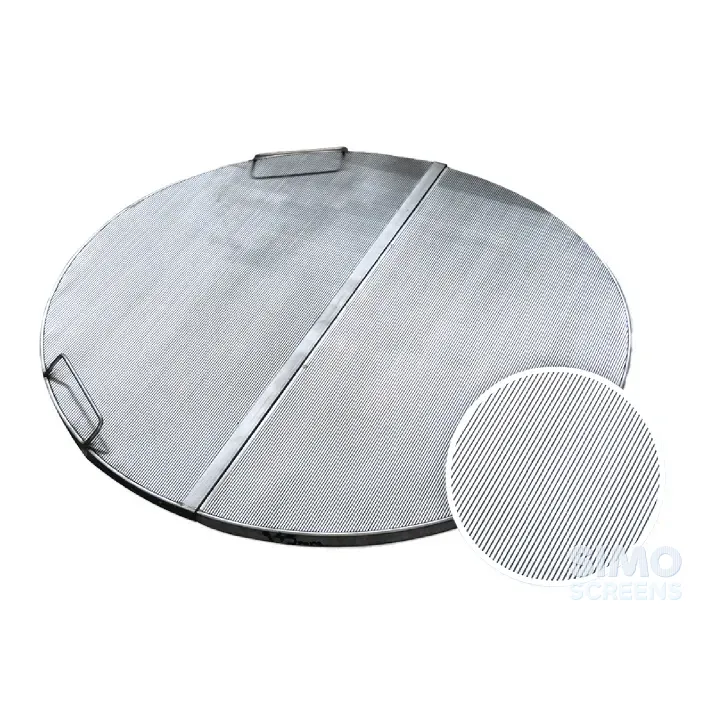
Most process screens leave the works with their fabricated parts fitted:
- Outlet baskets and resin traps with flanges to the customer's standard
- Header and lateral assemblies with hubs, headers and couplings
- Support grids with beams, clamps and segment joints
- Centrifuge baskets with rings and mounting faces to suit the machine
- Sieve bends with frames, and feed boxes and housings as an option
Services through approved agencies
Chrome plating of pressure screen baskets, dynamic balancing of centrifuge baskets, and pickling, passivation and electropolishing are arranged on request through approved agencies. Coal centrifuge baskets are usually balanced by the user.
Enquiries
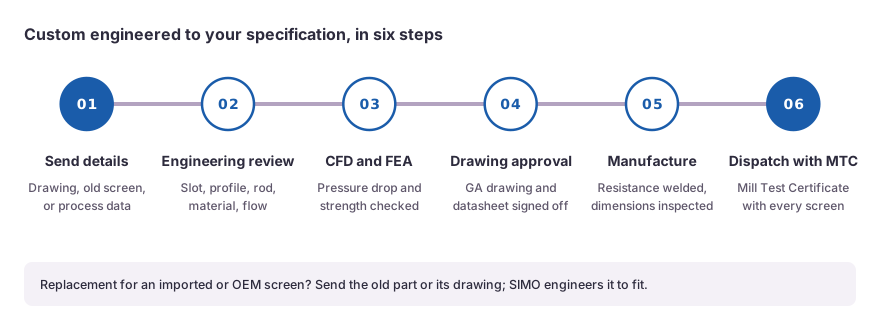
An enquiry should state what the assembly must fit, carry and connect to, with a drawing, a dimensioned sketch or a photograph of the present part. The engineering method is described under custom engineering.
 Upload a drawing