 +91 93730 08466
 Screen tubes and pipes
 Screen cylinders
 Flat panels and false bottoms
 Candle filter elements
 Water well screens
 Header and hub laterals
 Filter nozzles
 Resin traps
 Support grids
 Sieve bend (DSM) screens
 Centrifuge baskets
 Pressure screen baskets
 Screw press screens
 Rotary drum screens
 Passive intake screens
 Coanda intake screens
 Water and wastewater treatment
 Water wells and groundwater
 Sugar and distillery
 Brewing, malting and beverages
 Food processing
 Mining and minerals
 Oil, gas and petrochemicals
 Chemicals, fertilisers and pharma
 Power generation
 Pulp and paper
 Buildings and drainage

Sugar centrifugal screen overview
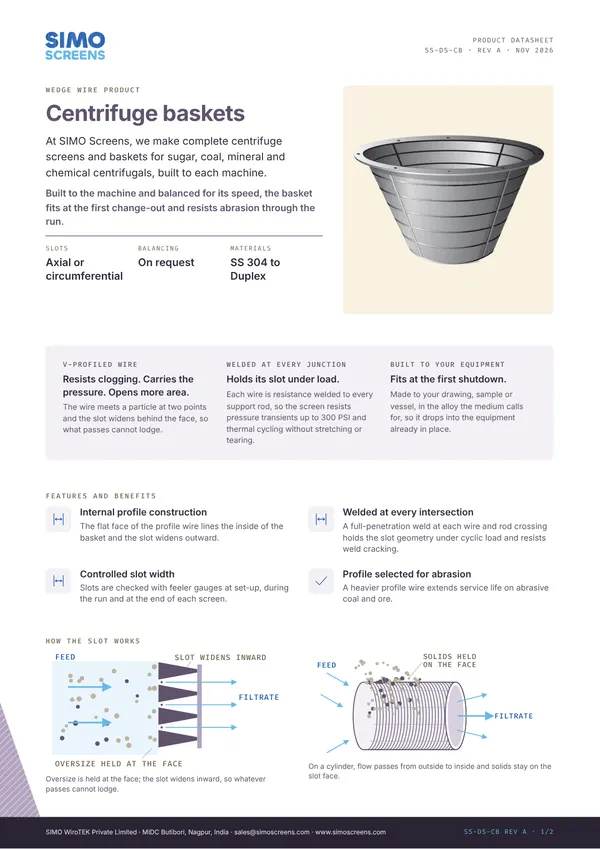
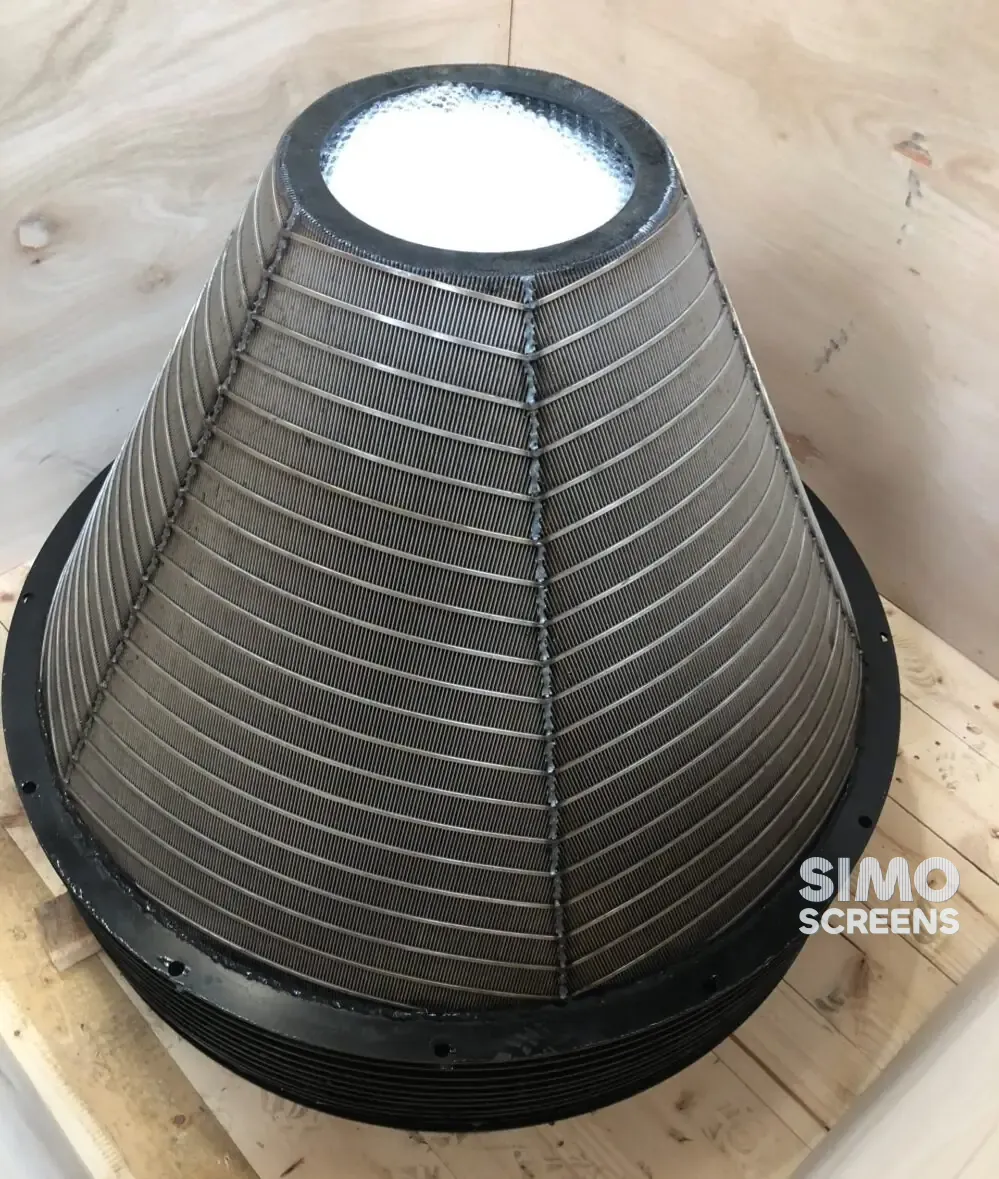
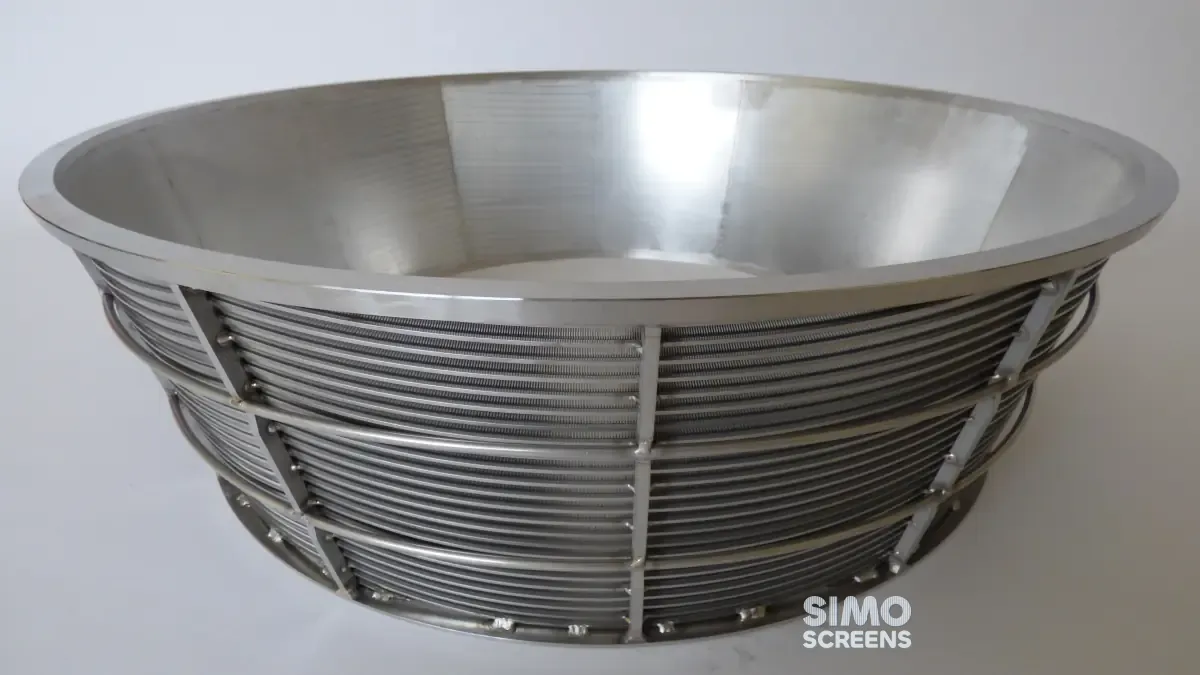
After the pans, massecuite is a mix of sugar crystals and mother liquor, and the centrifugal spins it so that molasses passes through a screen while the crystals stay behind. Batch centrifugals usually handle A massecuite for white or raw sugar in a cylindrical basket. Continuous centrifugals handle B and C massecuite, magma and affination in a conical basket.
In both machines the basket wall carries a backing screen and a working screen, and the working screen faces the massecuite and determines how much sugar is retained. A worn or torn working screen sends crystals to the molasses and raises run-off purity, load cycling cracks thin screens at edges and joints, and a distorted backing screen lets the working screen bulge and wear. The result is sugar lost to final molasses, higher wash water use and screen changes in the middle of the season.
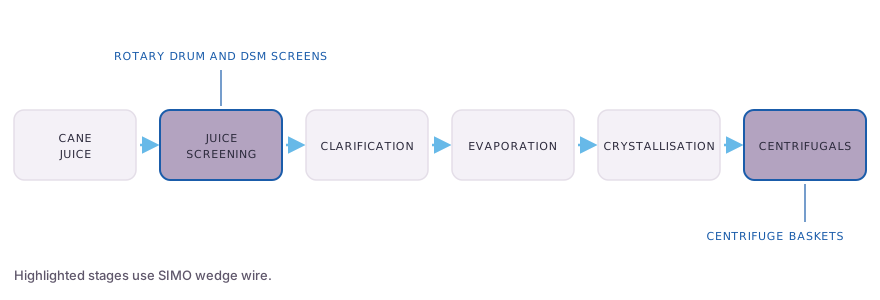
Swipe to see the full drawing.
Design considerations for a centrifugal screen
Slot. The slot follows the grain size and the massecuite grade. Continuous machines on low-grade massecuite need very fine slots, often below 0.1 mm, and the SIMO slot range starts at 25 microns, so fine working screens are within it.
Profile and open area. The V-profile slot widens behind the face, so that molasses drains freely while crystals rest on a smooth surface. Fine working screens use a light profile such as 12SB to keep open area up at small slots. Open area (%) = Slot x 100 / (Slot + Wire width), so a 0.08 mm slot on 12SB wire, 1 mm wide, gives about 7 percent. Options can be compared in the open area calculator.
Support and seating. Backing screens and full baskets use heavier wire such as 28SB or 35SB on F-series rods. A rigid backing screen keeps the working screen seated evenly against the basket wall, which prevents bulging and local wear.
Load and balance. Welding at every wire and rod intersection resists the load cycling and high speed of sugar centrifugals. Complete baskets are dynamically balanced through an approved agency on request.
Orientation. Slot direction and wire orientation follow the machine maker's design and the existing screen.
Construction and options
SIMO profile wire is formed in house and resistance welded to support rods at every intersection, with slot width checked by feeler gauge, or by optical measurement where a physical gauge cannot be used. The final inspection report records the minimum, maximum and mean slot.
- Cylindrical screens and baskets for batch centrifugals, rolled and segmented to the basket diameter.
- Conical screens and baskets for continuous centrifugals, formed to the cone angle and diameters.
- Backing screens in a heavier profile, to support the working screen and give a clear drainage path.
- Scope from working and backing screens only, to complete baskets with balancing through an approved agency.
| Item | SIMO range or typical value |
|---|---|
| Forms | Cylindrical, conical, segmented; working and backing screens; complete baskets |
| Slot opening | 25 microns (0.025 mm) to 25 mm; low-grade continuous machines often below 0.1 mm |
| Slot tolerance | Plus or minus 5% of nominal, stated on the drawing |
| Diameter | 25 to 800 mm |
| Profile wire | 12SB, 15SB for working screens; 28SB, 35SB for backing |
| Support rods | Q23, Q35, F123, F203 |
| Balancing | Dynamic balancing of complete baskets through an approved agency |
Swipe sideways to see the whole table.
Materials
SS 304 and SS 316L cover most sugar applications. In general practice, Duplex 2205 gives a longer wear life than SS 304 and SS 316L, with higher strength where screens crack or wear early. The Mill Test Certificate is supplied as standard, and a dimensional inspection report and QAP are supplied on request.
Replacement and retrofit
Most orders replace screens in existing machines, including imported and OEM centrifugal screens. SIMO Screens needs the basket size, the cone angle on continuous machines and the screen fixing: clamping rings, segment joints or a welded seam. A used screen shows the slot, the wire and the wear pattern, and a spare set held before the season starts avoids changes during the crushing period.
Our centrifuge baskets and screens page and the centrifuge basket guide cover the wider range, and sugar and distillery describes the full plant. As one of the centrifugal screen manufacturers in India with in-house profile wire, SIMO Screens builds each screen to the plant's machine.
What to send for a quotation
- Machine type, batch or continuous, with make and model.
- Basket diameter and height, and cone angle for continuous machines.
- Massecuite grade and typical grain size.
- Existing working and backing screen type and slot.
- Screen fixing method and number of segments.
- Basket speed and capacity per hour or per cycle.
- Scope: screens only, or complete basket with balancing.
- A used screen, a sample or the basket drawing, and current screen life.

 Upload a drawing