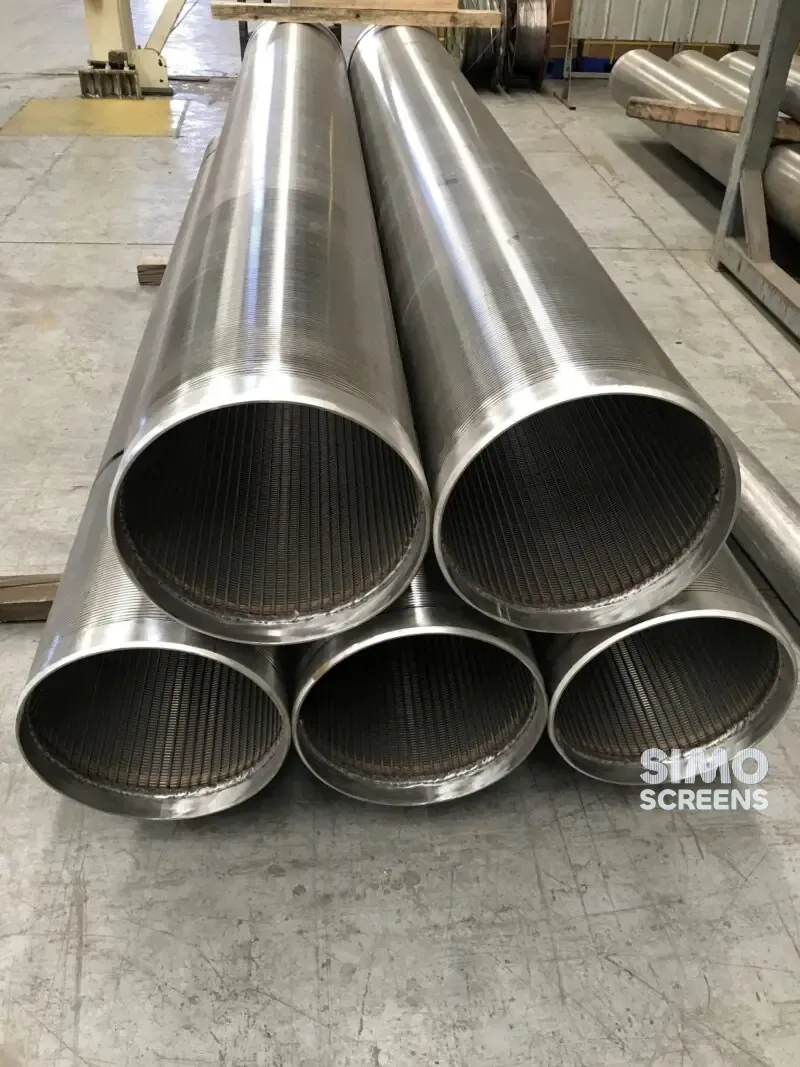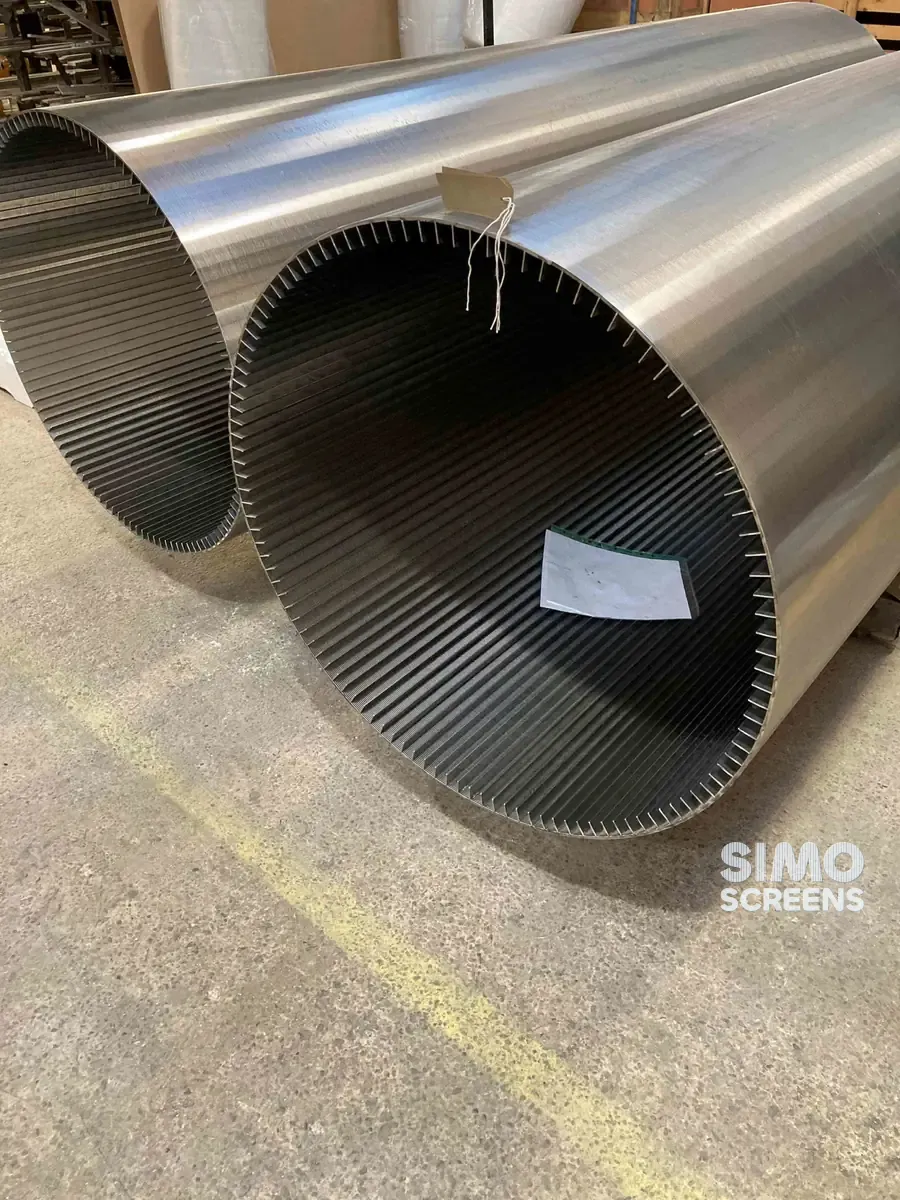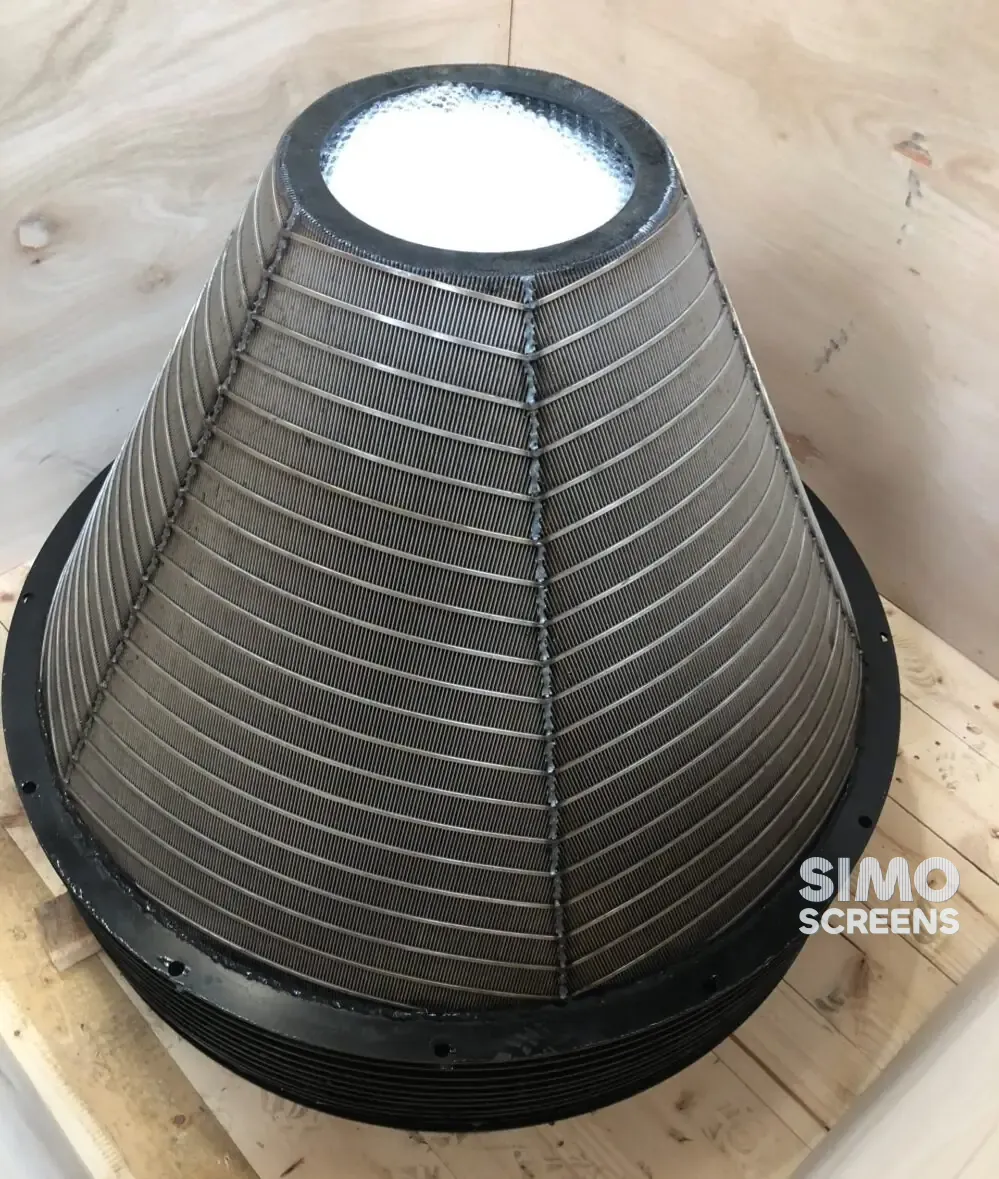
 +91 93730 08466
 Screen tubes and pipes
 Screen cylinders
 Flat panels and false bottoms
 Candle filter elements
 Water well screens
 Header and hub laterals
 Filter nozzles
 Resin traps
 Support grids
 Sieve bend (DSM) screens
 Centrifuge baskets
 Pressure screen baskets
 Screw press screens
 Rotary drum screens
 Passive intake screens
 Coanda intake screens
 Water and wastewater treatment
 Water wells and groundwater
 Sugar and distillery
 Brewing, malting and beverages
 Food processing
 Mining and minerals
 Oil, gas and petrochemicals
 Chemicals, fertilisers and pharma
 Power generation
 Pulp and paper
 Buildings and drainage
Wedge wire flow direction and the slot face
The non-clogging behaviour of wedge wire depends on one rule: flow must meet the flat head of the profile wire first, so that the slot widens in the direction of flow. A screen installed the wrong way round behaves like poor mesh, because particles enter the wide side of the V, jam at the narrow face and blind the screen.
On a cylinder, three choices follow from this rule. The designer decides which side carries the slot face, which way the fluid flows, and whether the slots run around the cylinder or along it.
The four flow configurations
SIMO Screens makes four flow configurations as standard, each described below with its usual applications.
Radial external, outside to inside
The profile wire is wound on the outside of longitudinal support rods, so the slot face is outside and flow passes from outside to inside.
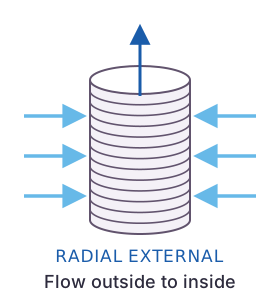
This is the most common configuration. Solids stay on the outer surface, where backwash, jetting or brushing can remove them. Typical applications include water well screens, intake screens, filter nozzles, laterals in service flow, candle filter elements and screen tubes.
External pressure pushes the wire onto the rods, and the spiral wire acts as a series of hoops, which gives good collapse resistance in wells and pressure vessels.
Radial external, inside to outside
The geometry is the same, with the slot face outside, but flow passes from inside to outside.
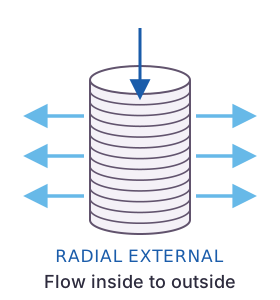
This configuration suits applications where the solids to be retained sit outside the screen while the fluid flows outward, and a media bed around a distributor is the usual case. Examples are inlet distributors, laterals and nozzles during backwash, and air or water distribution into a bed. The fluid inside should be clean, because particles carried from inside meet the narrow end of the V.
Internal pressure pushes the wire away from the rods and the welds take this load, so SIMO checks weld and wire size against the full differential pressure.
Radial internal, inside to outside
The profile wire sits on the inside of the cylinder with the support rods outside, so the slot face is inside and flow passes from inside to outside.
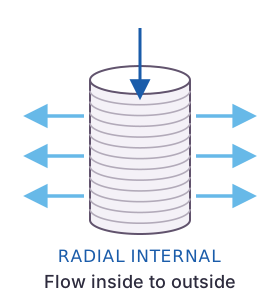
This arrangement is used when the feed is inside the cylinder and the solids must stay inside. Sugar centrifuge baskets work this way, with the molasses leaving through the wall, and internally fed rotary drum screens and pressure screen baskets fed from the inside follow the same principle. In a centrifuge, centrifugal force presses the product onto the slot face, and the rods outside carry the load back to the basket structure.
SIMO makes internal-profile cylinders and drums by two methods: by reverse rolling a flat panel with the slot face inside and seam welding the joint, or by winding on internal-profile machines.
Axial external, outside to inside
The profile wires run along the length of the cylinder and are welded to ring-shaped support rods inside. The slot face is outside, and flow passes from outside to inside.
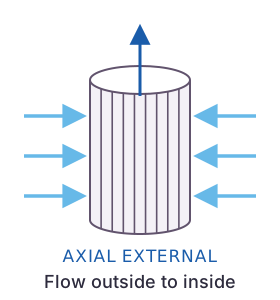
The slots run parallel to the axis instead of around it. This configuration is selected when the slot direction must line up with a scraper, a brush or the direction in which product moves across the surface, as on pressure screen baskets in stock preparation, scraped or brushed cylinders, and externally fed drums where solids are discharged along the length.
Axial construction needs careful rod design, because the ring rods carry the hoop load that the spiral wire carries in radial construction. The same axial slot arrangement, with the slot face on the inside, is typical of coal centrifuge baskets.
Comparison of flow configurations
| Configuration | Slot face | Support rods | Flow | Typical applications | Usual cleaning |
|---|---|---|---|---|---|
| Radial external, out to in | Outside | Inside, along the length | Outside to inside | Well screens, intakes, nozzles, candle filters | Backwash, jetting, brushing outside |
| Radial external, in to out | Outside | Inside, along the length | Inside to outside | Distributors, backwash of laterals and nozzles | Usually self-cleaning by reverse flow |
| Radial internal, in to out | Inside | Outside, along the length | Inside to outside | Centrifuge baskets, internally fed drums, pressure screen baskets fed from inside | Spray wash inside, product scraping |
| Axial external, out to in | Outside | Inside, as rings | Outside to inside | Scraped or brushed cylinders, slots aligned with movement | Scraper or brush along the slots |
Swipe sideways to see the whole table.
Flat panels and curved screens
Flat panels have no radial direction, but the same rule applies, so the drawing states which face is the slot face and which side the feed arrives on. Flat panels are usually cut from a welded cylinder and flattened, and they can be made with the slot face on either side.
The drawing also states the slot direction relative to the direction of material travel. On a sieve bend the wires run across the flow, so that each wire edge slices a thin layer off the slurry, while on vibrating decks the slot direction affects drainage and pegging.
Conical and segmented screens
Conical centrifuge baskets follow the radial internal rule, with the slot face on the inside of the cone, where the product travels up the wall towards the discharge lip.
Segmented decks and support grids are built from flat panels. Each segment carries its own slot face and orientation, so the drawing shows both for every piece.
Worked example: a lateral with inside to outside flow in backwash
An ion exchange vessel has hub and lateral internals at the bottom. In service, treated water flows down through the resin and into the laterals; in backwash, water flows up, out of the laterals and into the bed.
- The resin sits outside the laterals in both cases, so the slot face goes outside, which is an external profile.
- Service flow is outside to inside flow. Resin beads rest on two points at the slot face and do not wedge in.
- Backwash is inside to outside flow. The water inside is clean, so nothing jams at the narrow end of the V.
- Service flow presses the wire onto the rods, while backwash pressure acts from the rod side and loads the welds. The wire and welds are therefore checked for the higher of the two differential pressures.
The same reasoning applies to filter nozzles in a sand or carbon filter underdrain.
Common errors in specifying flow direction
The following faults are found regularly on screens that come in for replacement:
- Reversed profile. A screen made with the slot face on the wrong side blinds within a short run, and cleaning gives only a brief recovery.
- Single flow case. A screen sized only for service flow can be overloaded in backwash or during a pressure surge.
- Slot direction not stated. On flat panels and scraped cylinders, slots at the wrong angle to the flow cause pegging and wear.
- Cleaning route not considered. If the backwash or spray cannot reach the slot face, deposits build up between cleanings.
Selection method
The configuration is selected by working through these points in order:
- Identify the side that carries the solids, media or product. The slot face goes on that side.
- List every flow case: service, backwash, regeneration, air scour and start-up surge, with the direction and differential pressure of each.
- Check which way the highest pressure acts. Pressure on the slot face pushes the wire onto the rods, while pressure from the rod side loads the welds.
- Decide how the screen will be cleaned, and confirm that the backwash, spray or brush can reach the slot face.
- Confirm the slot direction for scraped or brushed screens, and for flat panels with material moving across them.
For applications outside these patterns, SIMO validates custom designs with FEA for structural load and CFD for pressure drop and flow distribution.
Related products, tools and engineering support
- Products: water well screens and wedge wire cylinders use radial external construction, and centrifuge baskets use radial internal construction.
- Tool: the open area calculator gives the open area for the selected slot and wire.
- Engineering: for an unusual flow case, see custom engineering.
- Further reading: slot size and open area.