 +91 93730 08466
 Screen tubes and pipes
 Screen cylinders
 Flat panels and false bottoms
 Candle filter elements
 Water well screens
 Header and hub laterals
 Filter nozzles
 Resin traps
 Support grids
 Sieve bend (DSM) screens
 Centrifuge baskets
 Pressure screen baskets
 Screw press screens
 Rotary drum screens
 Passive intake screens
 Coanda intake screens
 Water and wastewater treatment
 Water wells and groundwater
 Sugar and distillery
 Brewing, malting and beverages
 Food processing
 Mining and minerals
 Oil, gas and petrochemicals
 Chemicals, fertilisers and pharma
 Power generation
 Pulp and paper
 Buildings and drainage
 Datasheet
Rainwater harvesting filter overview
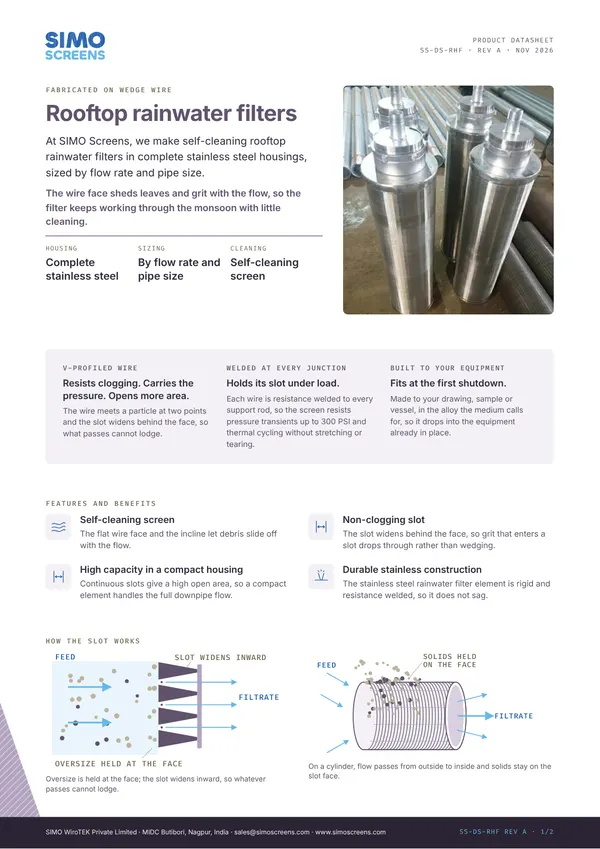
A rooftop rainwater harvesting filter sits between the roof downpipe and the storage tank or recharge structure. SIMO Screens manufactures it as a complete fabricated product: an inclined stainless wedge wire screen element inside a stainless steel housing with an inlet, a clean water outlet and a debris outlet.
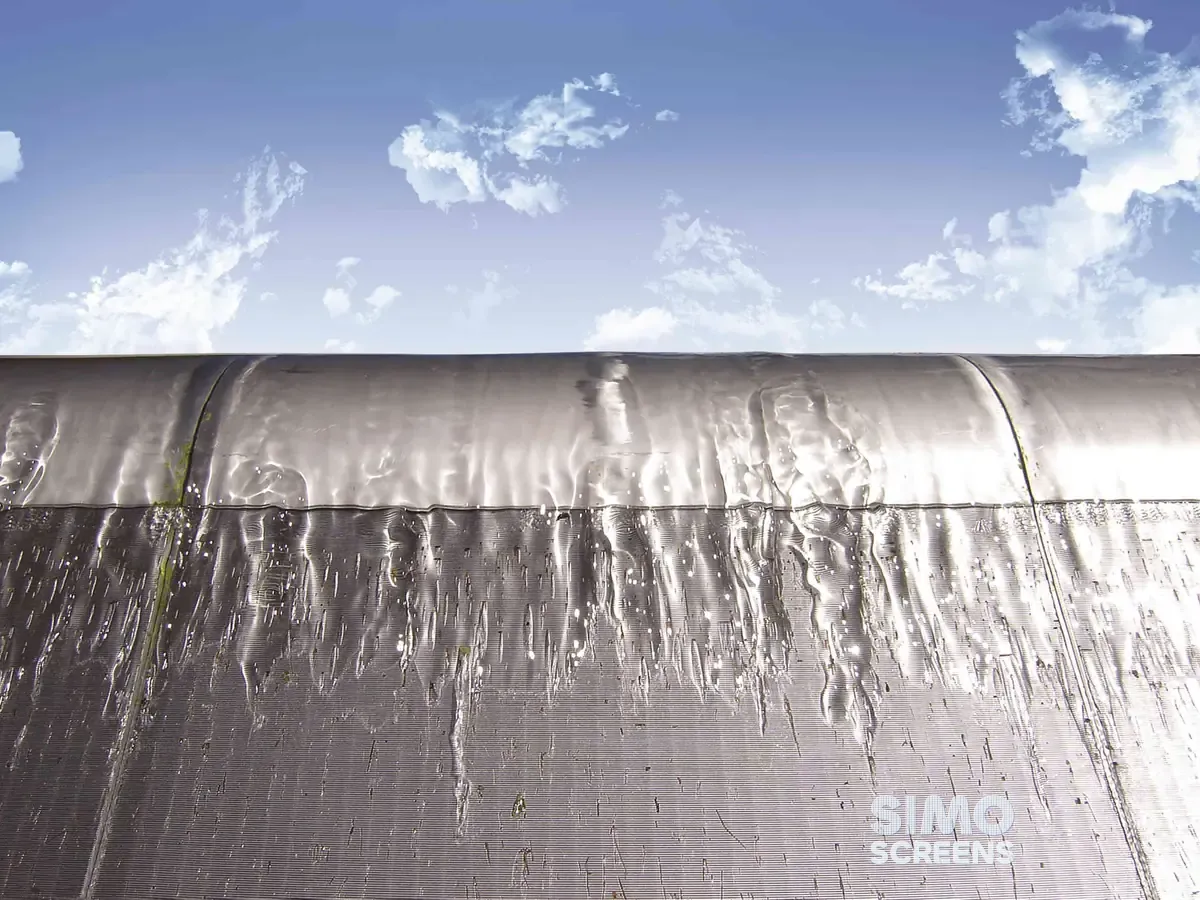
Water from the roof runs onto the screen and is drawn through the slots to the clean water outlet. Leaves, twigs, bird droppings and grit slide across the screen and leave by the waste outlet, so the flow keeps the screen clear without power or controls.
Features and benefits
- Self-cleaning screen. The flat wire face and the incline let debris slide off with the flow, whereas mesh filters catch leaves in the weave and need frequent clearing.
- Non-clogging slot. The slot widens behind the face, so grit that enters a slot drops through rather than wedging.
- High capacity in a compact housing. Continuous slots give a high open area, so a compact element handles the full downpipe flow.
- Durable stainless construction. The stainless steel rainwater filter element is rigid and resistance welded, so it does not sag, tear or rot through sun and monsoon.
- Gravity operation. The filter works on the flow from the downpipe, with no pump, motor or controls to maintain.
Applications
- Housing societies, schools, offices and factories with flat or sloping roofs
- Rooftop rainwater harvesting into storage tanks
- Recharge pits, recharge trenches and recharge wells
- Industrial roofs feeding process or utility water storage
The rainwater harvesting and stormwater page and the rooftop rainwater filters page cover these installations in more detail.
Construction and specifications
| Item | Options |
|---|---|
| Slot | Fine slots to hold back grit, coarser slots for higher flow per screen |
| Profile wire | Light profiles for fine slots and compact elements |
| Screen form | Flat inclined or curved element |
| Housing | Complete stainless steel housing with inlet, clean water outlet and debris outlet |
| Material | SS 304 or SS 316L; MS and SS 410 to client requirement |
| Connections | Downpipe sockets or flanges to suit the pipe size |
| Mounting | Inline on the downpipe, wall-mounted or in a chamber |
| Sizes | Made to the peak flow and pipe sizes of each installation; no standard range at present |
Swipe sideways to see the whole table.
SS 304 suits most roofs, while SS 316L is selected for coastal sites and industrial atmospheres.
Sizing method
Roof area. The plan area of the roof that drains to each downpipe is the starting point, and a large roof is often divided across several filters.
Design rainfall intensity. The short-duration intensity is taken from local data for the city, since Indian cities differ widely and a figure from another region can undersize the filter.
Peak flow. A common method is Q = C x i x A / 3600, where Q is flow in litres per second, i is rainfall intensity in mm per hour and A is roof area in square metres. The runoff coefficient C is commonly taken as 0.8 to 0.95 for hard roofs.
Worked example. A 500 m² roof with a design intensity of 100 mm per hour and C of 0.9 gives about 12.5 litres per second, and the rainwater filter calculator runs the same calculation for other figures.
Pipe sizes. The filter inlet is matched to the downpipe, and the clean water outlet is sized to carry the full flow without backing up. Where water goes to recharge, water well screens are used in the recharge well, and the rainwater filter guide covers the full design.
Engineering and quality
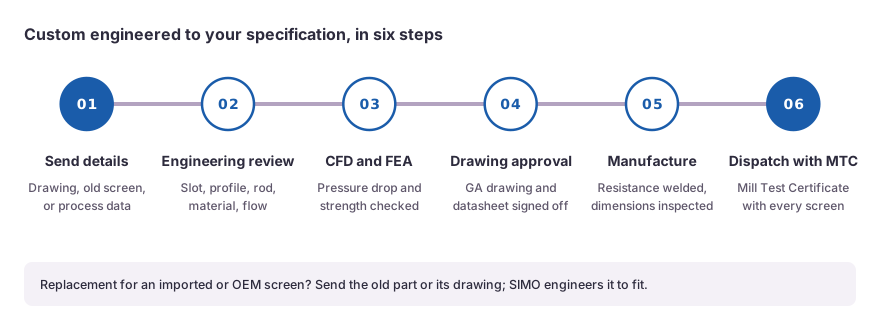
Each filter is designed from the peak flow and pipe sizes before fabrication. Housing welds are visually inspected, slots are checked with feeler gauges to a standard tolerance of plus or minus 5 percent of nominal, and every order is supplied with a Mill Test Certificate.
What to send for a quotation
- Roof area draining to each downpipe, in square metres
- Number and size of downpipes
- City or design rainfall intensity
- Where the water goes: tank, recharge pit or recharge well
- Mounting position: inline, wall-mounted or in a chamber
- Preferred material for the housing and screen
- Quantity and delivery location
 Upload a drawing