 +91 93730 08466
 Screen tubes and pipes
 Screen cylinders
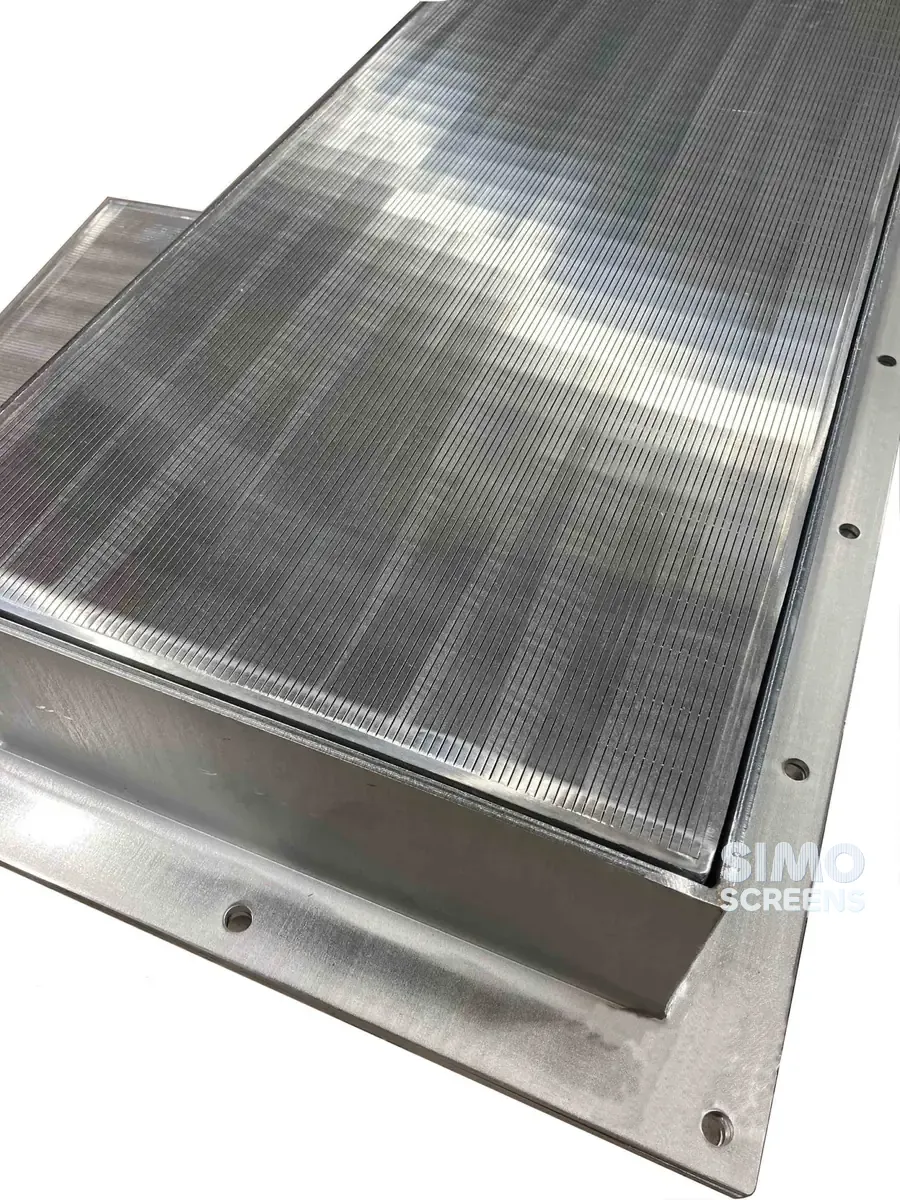
 Flat panels and false bottoms
 Candle filter elements
 Water well screens
 Header and hub laterals
 Filter nozzles
 Resin traps
 Support grids
 Sieve bend (DSM) screens
 Centrifuge baskets
 Pressure screen baskets
 Screw press screens
 Rotary drum screens
 Passive intake screens
 Coanda intake screens
 Water and wastewater treatment
 Water wells and groundwater
 Sugar and distillery
 Brewing, malting and beverages
 Food processing
 Mining and minerals
 Oil, gas and petrochemicals
 Chemicals, fertilisers and pharma
 Power generation
 Pulp and paper
 Buildings and drainage
Lauter tun false bottom design principles
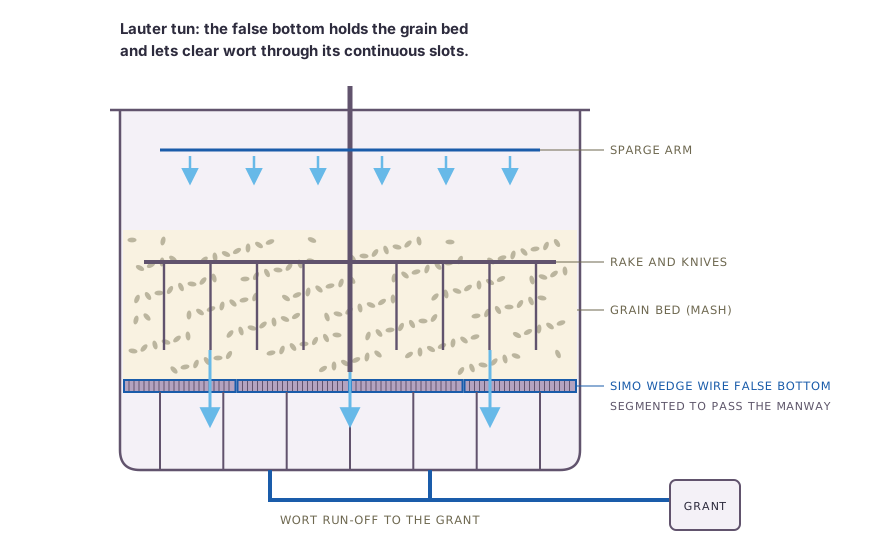
Lautering is often the slowest step in the brewhouse, and a set mash, a compacted bed or uneven run-off adds time to every brew while reducing extract and wort clarity. The grain bed is the filter. The false bottom supports the bed without sagging and drains wort evenly across the whole floor, because uneven drainage causes the bed to channel, compact in some zones and stay dry in others.
Swipe to see the full drawing.
Wedge wire vs milled false bottom and perforated plate
| Feature | Wedge wire | Milled plate | Perforated plate |
|---|---|---|---|
| How slots are made | V-profile wire welded to support rods at a set gap | Slots machined through a thick plate | Holes or slots punched in sheet |
| Slot shape | Widens downward from the grain side | Straight, or tapered by machining | Straight-sided |
| Open area | Highest of the three for a given slot | Lower, limited by plate strength | Lowest |
| Clogging tendency | Low, as particles that enter tend to pass | Moderate | Higher, as husk can wedge in holes |
| Stiffness | High, from the support rods beneath | High, from plate thickness | Needs separate stiffening |
| Cleaning from below | Effective | Effective | Less effective |
Swipe sideways to see the whole table.
Milled plates are rigid and accurate, and many tuns operate well with them. Their open area is limited, however, because enough metal must remain between slots to carry the load. Wedge wire reaches a higher open area while the support rods carry the bed. The wedge wire vs perforated vs mesh guide gives the general comparison.
Slot selection
The slot only has to retain the husk layer that forms the base of the bed. A finer slot does not produce clearer wort, since the bed provides the clarity, and a slot that is too fine slows first wort run-off and raises the risk of a set mash.
A 0.7 mm slot is the most common choice in lauter tuns, within a range of about 0.5 to 1.0 mm selected according to the mill and the grist. A roller mill set to keep husks intact produces a more open bed than a finely ground grist, and so tolerates the wider slots in that range.
The screen is laid with the flat face of the profile wire on the grain side. The slot then widens downward, so any fragment that passes the narrow opening falls through.
False bottom open area
Open area for wedge wire follows from the slot and the wire width:
Open area (%) = Slot x 100 / (Slot + Wire width)
| Slot | Wire width | Open area |
|---|---|---|
| 0.7 mm | 1.8 mm (18SB) | 28.0% |
| 0.7 mm | 2.2 mm (28SB) | 24.1% |
| 1.0 mm | 2.2 mm (28SB) | 31.3% |
Swipe sideways to see the whole table.
A higher false bottom open area lowers the pressure drop across the floor, so that the bed rather than the screen controls run-off. It also gives the wort more flow paths, which supports even drainage.
Sizing the false bottom area
False bottom area follows from the grist load and the selected specific loading:
Area (m²) = Grist per brew (kg) / Specific loading (kg/m²)
Published loadings are of the order of 150 to 300 kg of grist per square metre. Lower loadings give a shallower bed and faster lautering, while higher loadings save floor area but need careful raking and run-off control. Bed depth rises with loading, and a deeper bed filters well but compacts more easily and takes longer to run off.
Worked example: a 1,000 kg brew
Design basis: a brewhouse mashes 1,000 kg of grist per brew at a moderate loading of 200 kg/m².
Area:
- Area = 1,000 / 200 = 5.0 m²
- Tun diameter = √(4 x 5.0 / π) = 2.52 m
Screen: slot 0.7 mm with an 18SB profile wire 1.8 mm wide:
- OA = 0.7 x 100 / (0.7 + 1.8) = 28.0 percent
- Free passage area = 5.0 x 0.28 = 1.40 m²
The area occupied by the rake shaft opening and the grain-out door is then deducted. The lauter tun calculator runs this sizing for your own grist load.
Segments, supports and flatness
Segments
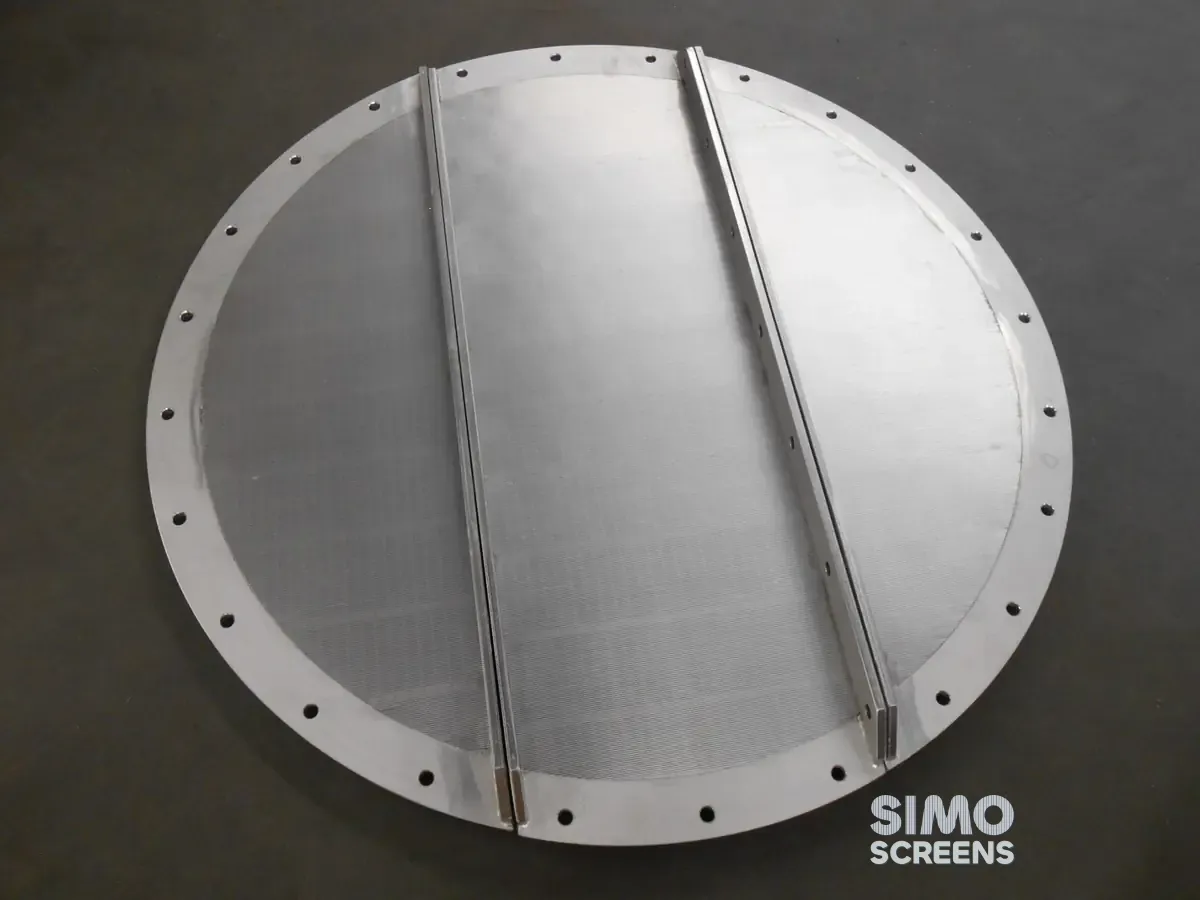
A false bottom for a tun of this size is made in segments, each of which must pass through the manway and be light enough to lift by hand. Segments for round tuns are usually pie-shaped, with cut-outs for the rake shaft and grain-out door.
Segment edges should sit flush so that no gap forms through which grain can bypass the bed. Numbering each segment and its position makes reassembly after cleaning quick and correct.
Supports
The false bottom sits a short distance above the true bottom on legs or a support ring, with support rods beneath the wedge wire carrying the load to the legs. The supports are designed for the wet grain bed, the wort above it and the downward load during raking and grain-out.
For longer spans, SIMO Screens uses support grids and heavy support rods such as F203 (3 x 20 mm) or F253 (3 x 25 mm), and FEA is used to validate the structure of a custom design.
Flatness, rakes and slot direction
Rake knives travel just above the false bottom, so the floor must be flat and level for the knives to run close without contact. We hold segment flatness to 1 to 2 mm in most cases, and the slot direction relative to rake travel is agreed with the brewhouse designer.
Slow run-off: false bottom or bed
Many slow run-offs originate in the mill, the mash or the run-off rate rather than in the screen, so the process is checked first.
| Symptom | Likely cause | What to check |
|---|---|---|
| Slow run-off from the start | Fine grist, low open area, blinded slots | Mill gap, husk condition, slot cleanliness |
| Run-off slows as lautering proceeds | Bed compaction from drawing too hard | Run-off rate, differential pressure across the bed, rake height |
| Cloudy wort in one zone | Channelling, a gap at a segment edge | Segment fit, level, seal at the wall |
| Uneven drainage across the floor | Poorly spread run-off pipes, sagging segments | Support spacing, pipe layout |
Swipe sideways to see the whole table.
Partly blinded slots usually point to incomplete cleaning below the false bottom, in which case spray coverage, pressure and the cleaning sequence are reviewed.
Retrofitting an existing tun
Many brewhouses replace a worn or damaged false bottom without changing the tun. SIMO Screens makes replacement false bottoms from a sample segment, a drawing, the general arrangement drawing (GAD) or a site visit.
The data required are the inside diameter, the floor profile, the height of the false bottom above the true bottom, and the positions of the run-off pipes, rake shaft, grain-out door and any sparge or underlet connections. Photographs of the existing segments, their weights and their fixing arrangement are also useful.
A retrofit is an opportunity to revise the slot or open area. Where run-off has always been slow, a wedge wire false bottom with higher open area can help, provided the mill and mash are correctly set.
Cleaning and hygiene
Most tuns have spray nozzles under the false bottom that flush the underside and the slots after grain-out. Because the wedge wire slot widens downward, water from below acts on the wide side and lifts particles out of the narrow opening.
SS 304 suits most brewhouses, with SS 316L used where cleaning chemicals or the chloride level of the water call for it. Welded construction at every wire and rod intersection leaves no loose wires to trap grain, and segments are lifted and inspected at planned intervals.
SIMO Screens false bottoms
SIMO Screens manufactures flat wedge wire panels and false bottoms for new lauter tuns and retrofits. Send the tun drawing, grist load, rake details and manway size, and our engineers will propose the slot, segment layout and supports.