 +91 93730 08466
 Screen tubes and pipes
 Screen cylinders
 Flat panels and false bottoms
 Candle filter elements
 Water well screens
 Header and hub laterals
 Filter nozzles
 Resin traps
 Support grids
 Sieve bend (DSM) screens
 Centrifuge baskets
 Pressure screen baskets
 Screw press screens
 Rotary drum screens
 Passive intake screens
 Coanda intake screens
 Water and wastewater treatment
 Water wells and groundwater
 Sugar and distillery
 Brewing, malting and beverages
 Food processing
 Mining and minerals
 Oil, gas and petrochemicals
 Chemicals, fertilisers and pharma
 Power generation
 Pulp and paper
 Buildings and drainage

River intake screen overview
A river, lake or reservoir intake draws raw water through a pipe to a pump house or jack well. The river intake screen sits on the submerged end of that pipe and forms the first barrier against debris, sand and fish. A passive wedge wire intake screen has no moving parts: it draws water slowly through a large slotted surface, and the ambient current carries debris past the screen.
Most intake problems first appear as falling pump suction pressure. Leaves, weed, plastic and silt blind bar screens and perforated boxes, and an undersized screen draws debris and fish hard onto its surface at high approach velocity. Floating logs and flood debris bend thin bars, monsoon sand abrades weak wires, and mild steel and galvanised screens corrode within a few seasons.
Design considerations for a raw water intake screen
Slot. The slot is set to the debris and to any fish protection requirement. Slots of about 1 to 3 mm are common on raw water intakes, with tighter slots where fish fry or fine debris must be excluded.
Through-slot velocity. Fish-protection intake screens are typically designed for a through-slot velocity of 0.15 m/s (0.5 ft/s) or less. Required open area = Flow / Through-slot velocity. For 0.1 m³/s (360 m³/h) at 0.15 m/s, about 0.67 m² of open area is needed. A 2 mm slot on 35SB wire, 3 mm wide, gives 2 x 100 / (2 + 3) = 40 percent open area, so about 1.7 m² of screen surface is required before any margin for partial blinding. The intake screen calculator runs the same method for other flows.
Orientation and flow distribution. In general practice the screen axis is set parallel to the river current, so that the current sweeps along the screen face. An internal flow modifier evens out the velocity along the screen length, and CFD is used to check distribution on custom designs.
Load. Intakes see floods and floating debris, so standard to heavy profiles such as 28SB, 35SB or 42SB are typical. Support rods are F123 or F203 flat bars on larger diameters, checked by FEA for impact and differential pressure.
Size. Single screen cylinders are built up to 800 mm diameter. Larger flows use tee screens or several screens on a manifold, each sized for the same through-slot velocity.
Cleaning. The smooth outer V-profile face lets the current slide debris off. Screens can be supplied with an air burst connection and internal air header, while the compressor, receiver and air burst system are supplied by others.
Construction and options
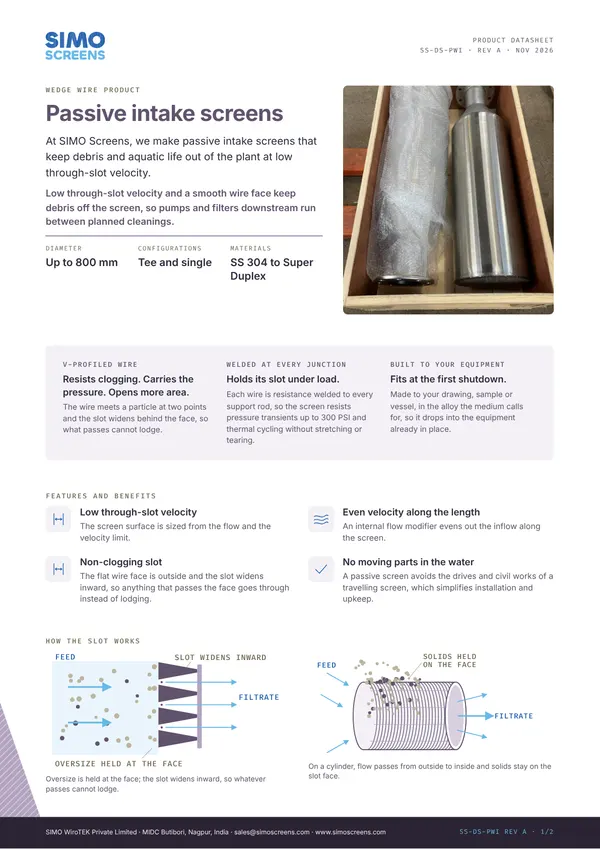
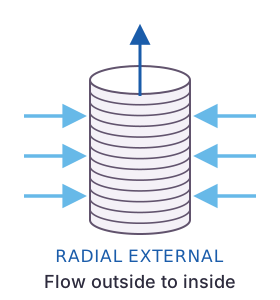
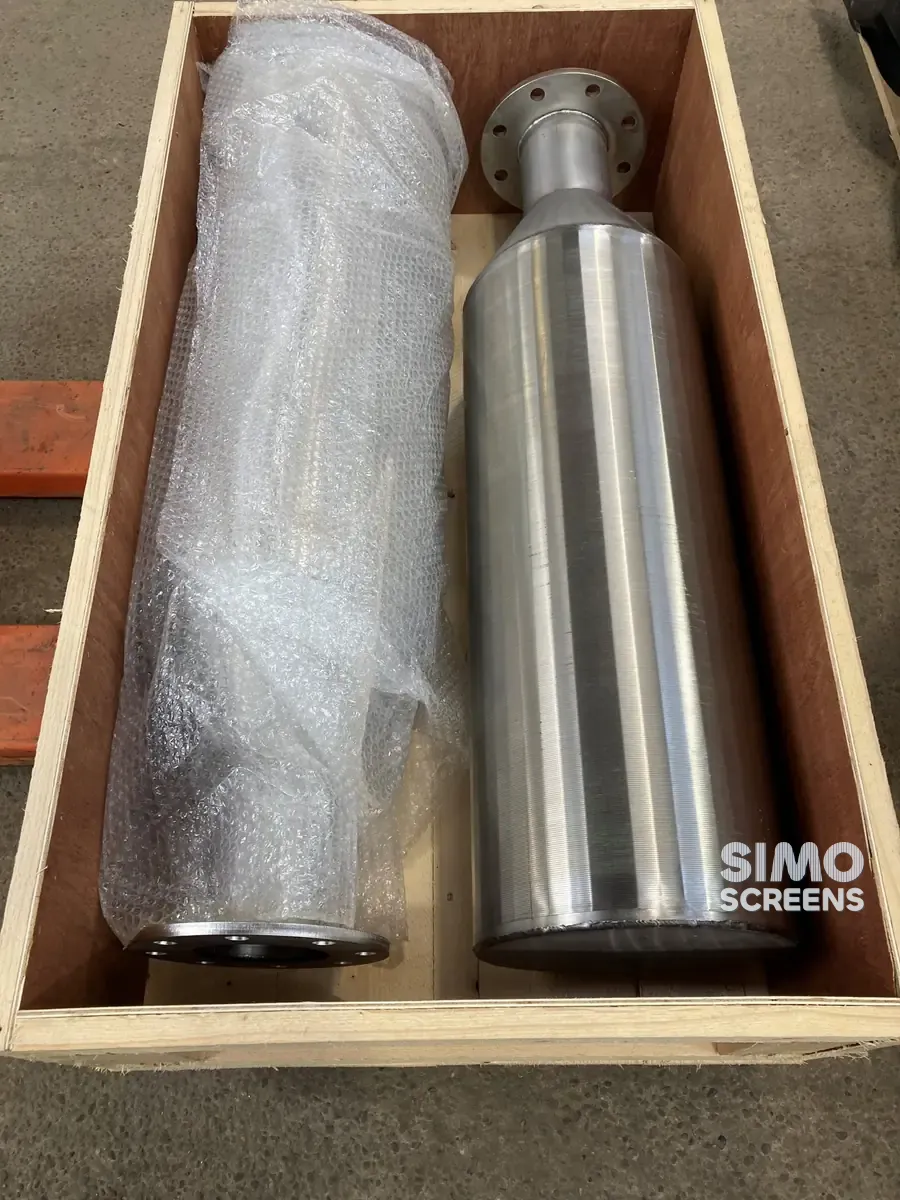
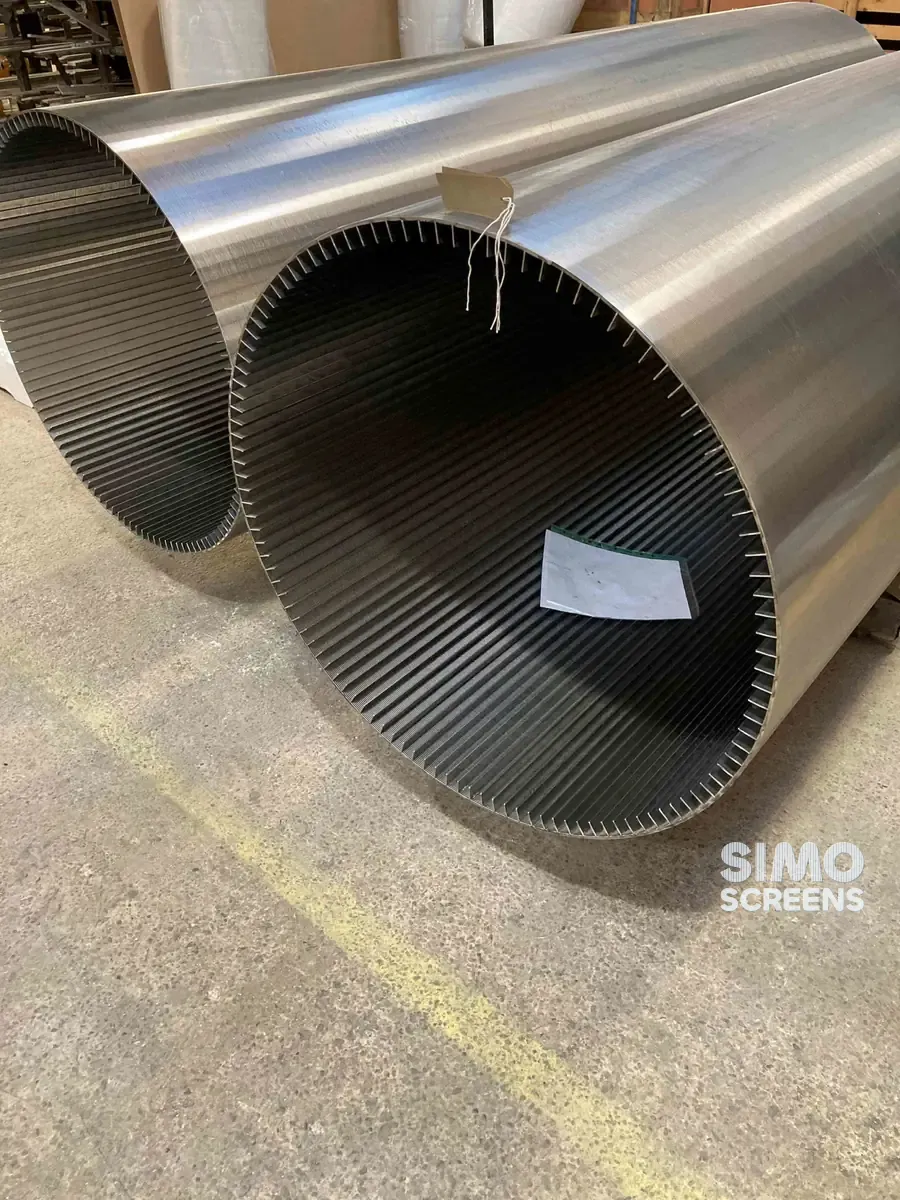
Each screen is a wedge wire cylinder with the V-profile wire on the outside and flow from outside to inside. SIMO profile wire is formed in house and resistance welded to the support rods at every intersection, and slot width is checked with feeler gauges at set-up, during the run and on the finished screen.
- Single screen: one cylinder with a closed end cap and a flanged outlet.
- Tee screen: two cylinders either side of a central flanged outlet, mounted on the end of the intake pipe.
| Item | SIMO range or typical value |
|---|---|
| Configuration | Single or tee, radial external, outside to inside |
| Slot opening | 25 microns (0.025 mm) to 25 mm; raw water intakes typically 1 to 3 mm |
| Slot tolerance | Plus or minus 5% of nominal, stated on the drawing |
| Diameter | Up to 800 mm |
| Length | Up to 6,000 mm per cylinder |
| Profile wire | 28SB, 35SB, 42SB, 55SB, 56SB |
| Support rods | F123, F203, F253, Q55 |
| Options | Internal flow modifier; air burst connection and internal air header |
Swipe sideways to see the whole table.
Materials
SS 304 suits most rivers and reservoirs, and SS 316L handles higher chlorides. Duplex 2205 or Super Duplex 2507 is selected for estuaries, brackish water and seawater cooling intakes. The Mill Test Certificate is supplied as standard, and a dimensional inspection report, QAP and pickling and passivation through approved agencies are available on request.
Replacement and retrofit
Many plants replace a bar screen box or a perforated strainer on an existing intake pipe. The flange and the pipe centreline are matched, so that the new screen bolts to the existing outlet.
The minimum water level and the clearance above the river bed should be checked before the screen is sized, because a screen exposed in summer or buried in silt after the monsoon loses capacity. Our intake screens page gives the product range, and the intake screen design guide sets out the full sizing method.
What to send for a quotation
- Design flow and number of intakes.
- Minimum and maximum water level, and depth at the intake point.
- River current velocity and direction at low and high flow.
- Debris type and any fish protection requirement.
- Intake pipe size and flange standard.
- Water quality, especially chlorides or salinity.
- Whether an air burst connection is required, and who supplies the air system.
- Installation method: divers, crane or cofferdam.

 Upload a drawing