 +91 93730 08466
 Screen tubes and pipes
 Screen cylinders
 Flat panels and false bottoms
 Candle filter elements
 Water well screens
 Header and hub laterals
 Filter nozzles
 Resin traps
 Support grids
 Sieve bend (DSM) screens
 Centrifuge baskets
 Pressure screen baskets
 Screw press screens
 Rotary drum screens
 Passive intake screens
 Coanda intake screens
 Water and wastewater treatment
 Water wells and groundwater
 Sugar and distillery
 Brewing, malting and beverages
 Food processing
 Mining and minerals
 Oil, gas and petrochemicals
 Chemicals, fertilisers and pharma
 Power generation
 Pulp and paper
 Buildings and drainage

Lauter tun false bottom overview
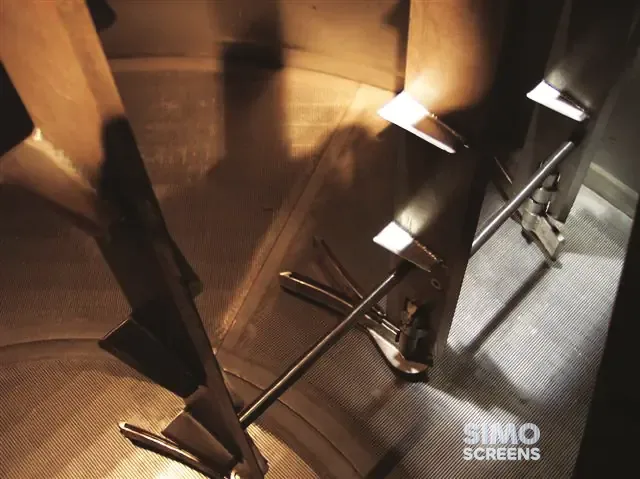
In a lauter tun the mash rests on a false bottom set a short distance above the true floor. Husks settle on the false bottom and form the filter bed, and wort drains through the bed and the slots into the space below, then out through the run-off pipes to the grant or kettle. Rakes cut the bed during run-off and sparging to keep it open, and at the end of the brew the spent grain is discharged through the grain door.
The false bottom therefore sets both the run-off rate and the clarity of the wort. Milled plates with low open area blind with fines and protein, which compresses the bed and slows run-off, while warped or worn plates let husk and fines pass to the kettle. Combined mash and lauter tuns in smaller breweries use the same type of false bottom, and the design rules for a false bottom for lauter tun service apply to both.
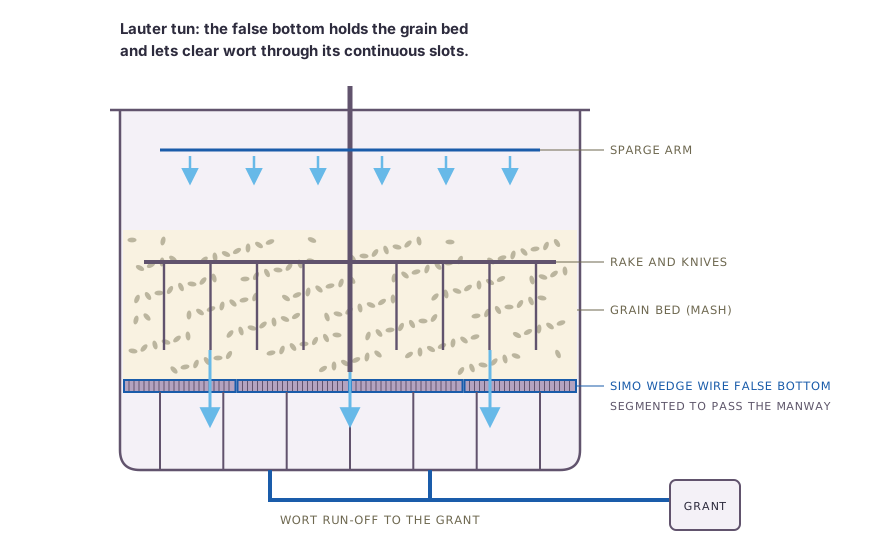
Swipe to see the full drawing.
Design considerations for a brewery false bottom
Slot. A 0.7 mm slot is the most common choice, with 0.5 to 1 mm used according to the mill and grist. A hammer mill or wet mill grist with finer husk may call for a tighter slot than a roller mill grist, and the slot is fixed with the brewer before drawings are issued.
Profile and open area. The V-profile wire presents a flat face to the grain bed and a slot that widens below the surface, so that fine particles pass through instead of wedging. Open area (%) = Slot x 100 / (Slot + Wire width). A 0.7 mm slot on 28SB wire, 2.2 mm wide, gives about 24 percent open area, and on 35SB, 3 mm wide, about 19 percent.
Flatness. Segment flatness is held to 1 to 2 mm in most cases, so that the rake arms run at a consistent height above the floor. A flat, stiff false bottom lets the brewer set rake clearance once and hold it across the full tun.
Load. Classic lauter tuns commonly carry a grist loading of about 150 to 200 kg per m² of false bottom, with higher loadings in modern designs. Profile, support bar section and support spacing are selected for the full bed weight with hot liquor, and FEA is used on custom designs where segment stiffness needs to be verified.
Wire orientation and cleaning. The wire direction is aligned to suit the rake path. Closed edge frames leave no gaps between segments, and the open underside drains fully, which keeps CIP spray coverage effective and avoids dead pockets.
The false bottom area for a given brew length can be worked out with the lauter tun calculator.
Construction and options
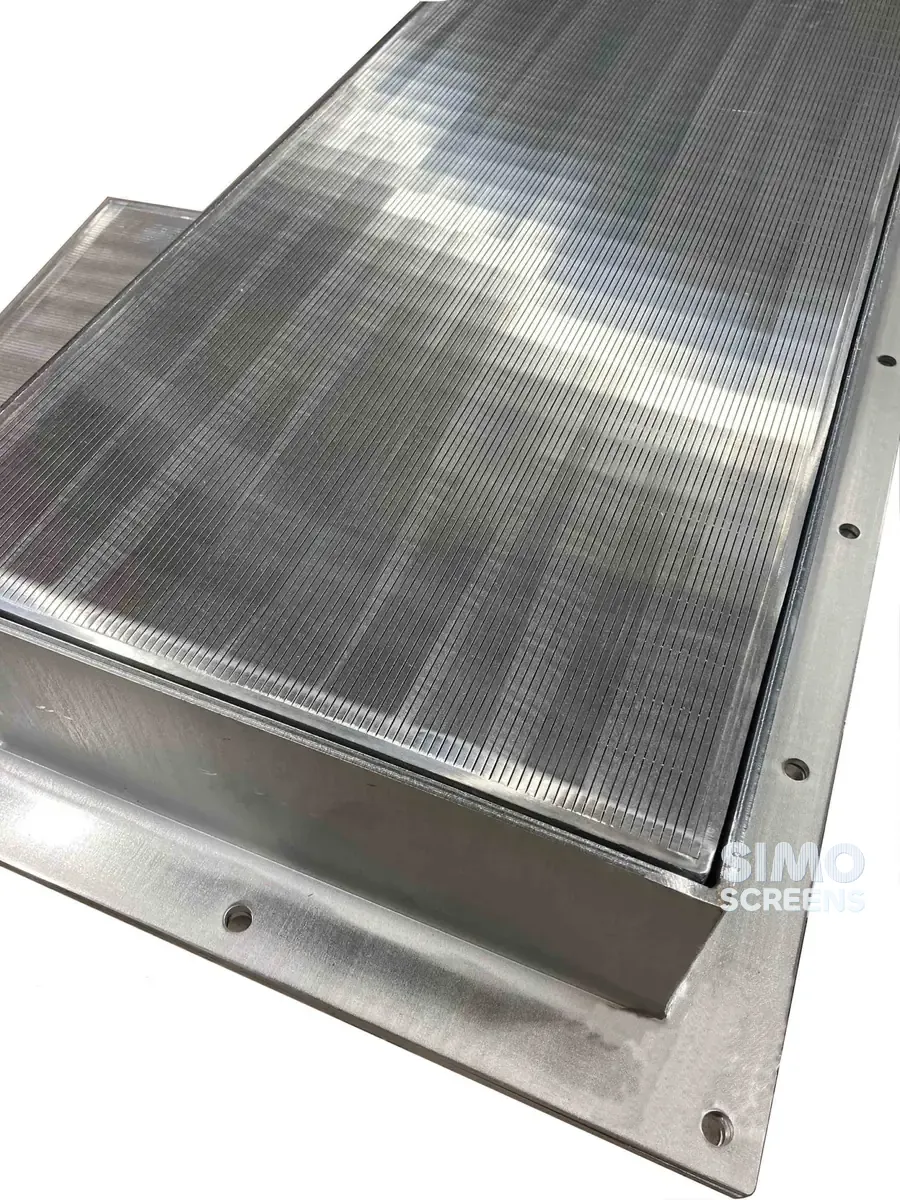
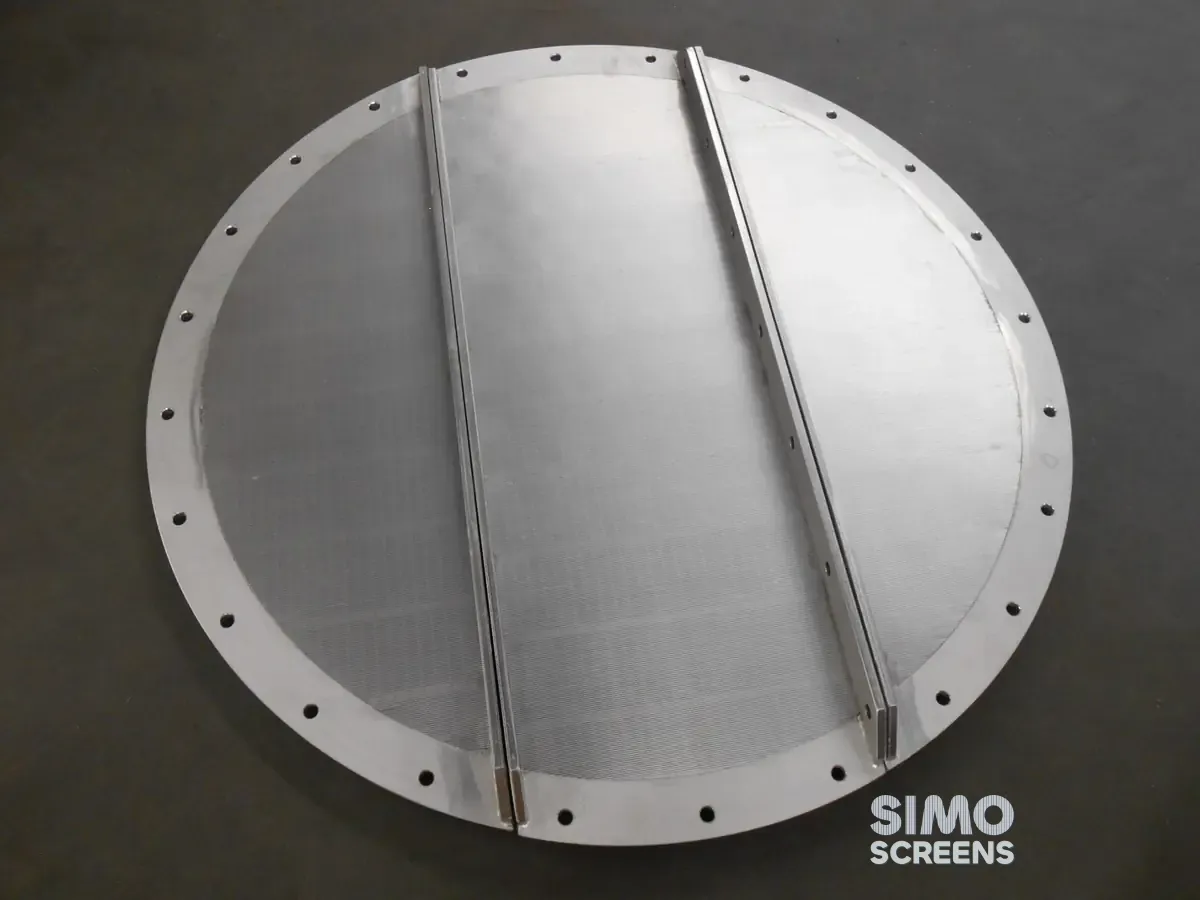
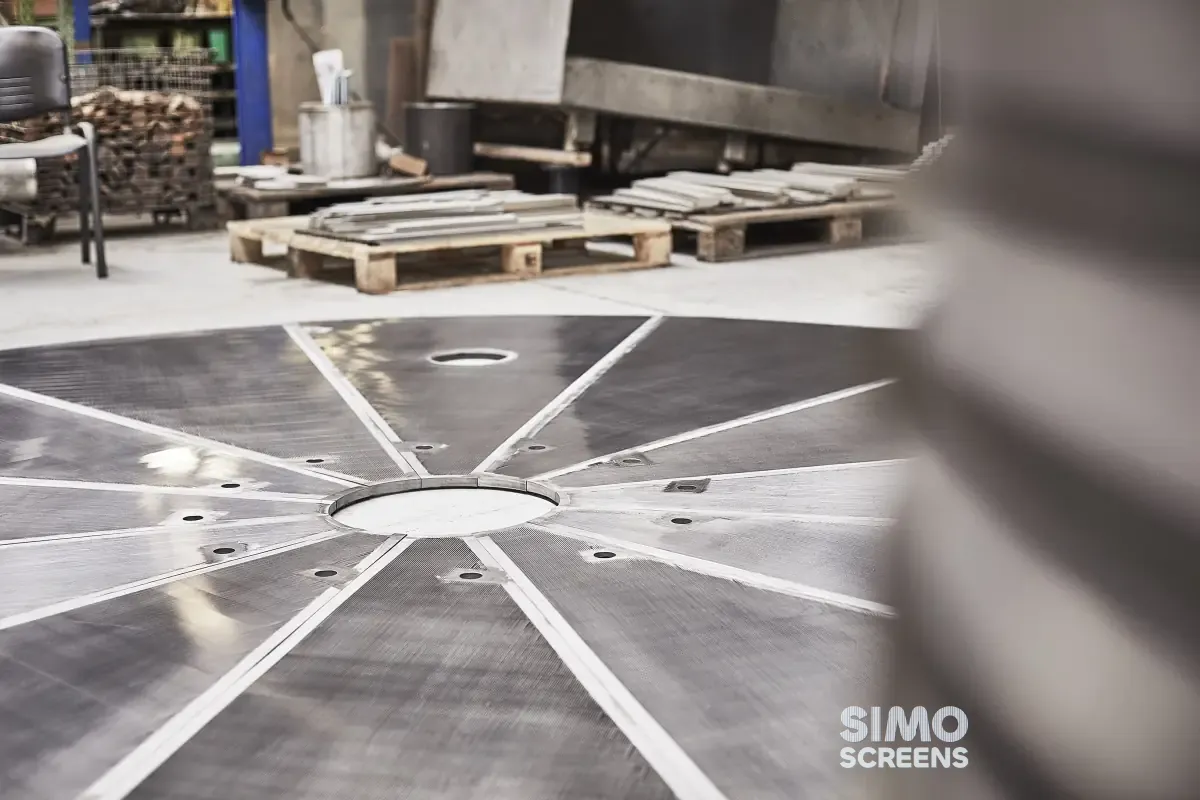
Each false bottom is a set of sector or rectangular segments that covers the full tun floor. SIMO profile wire is formed in house and resistance welded to flat support bars at every intersection, and slot width is checked with feeler gauges at set-up, during the run and on each finished segment. The centre opening is cut around the hub and rake shaft, with cut-outs for the grain door and run-off pipe positions.
Segments are sized to pass through the manway and to rest on the existing support legs or on a new support ring. Larger tuns use more segments rather than oversize panels, which keeps handling and flatness under control.
| Item | SIMO range or typical value |
|---|---|
| Form | Segmented flat wedge wire panels, sector or rectangular |
| Slot opening | 25 microns (0.025 mm) to 25 mm; lautering typically 0.7 mm |
| Slot tolerance | Plus or minus 5% of nominal, stated on the drawing |
| Flatness | 1 to 2 mm per segment in most cases |
| Profile wire | 28SB, 35SB, 42SB; lighter profiles for small tuns |
| Support bars | F123, F203, F253 |
| Grist loading | Classic tuns about 150 to 200 kg/m², higher in modern designs |
| Single panel size | Up to 2,400 mm wide and 4,000 mm long |
| Design | FEA for segment stiffness on custom designs |
Swipe sideways to see the whole table.
Standard to heavy profiles such as 28SB or 35SB on F203 or F253 bars suit production tuns, while small craft tuns can use lighter profiles on F123 bars. Segments are tagged with job number, item and position for reassembly, and laser marked where the client requires it.
Materials
SS 304 suits most breweries. SS 316L is selected for sites with aggressive CIP chemicals or chloride-rich brewing water. Pickling and passivation to ASTM A380 or A967, and electropolishing, are available through approved agencies on request. The Mill Test Certificate is supplied as standard, and a dimensional inspection report, QAP and other documents are supplied on request.
Replacement and retrofit
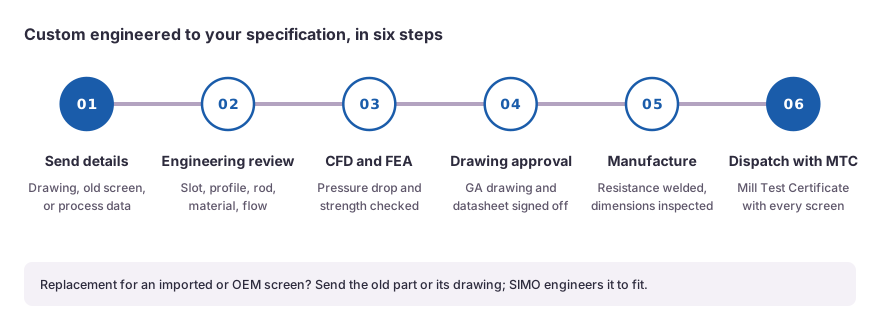
Most orders replace milled or worn slotted plates in an existing tun, including imported and OEM false bottoms. SIMO Screens works from a sample segment, the tun drawing, the GAD or a site visit where required, recording the inner diameter, hub, run-off pipes and support legs.
The rake arm height should be checked when the false bottom is changed. Our flat wedge wire panels and false bottoms and support grids pages give the panel range, and the lauter tun false bottom guide compares wedge wire with milled plate.
What to send for a quotation
- Tun inner diameter and floor shape.
- Centre hub and rake shaft diameter.
- Manway size and position.
- Grist per brew and number of brews per day.
- Bed depth and mill type: roller, hammer or wet mill.
- Run-off time target and current slot, if known.
- Rake clearance above the false bottom.
- Run-off pipe positions and existing support layout.
- A sample segment, drawing or GAD of the existing false bottom, if available.

 Upload a drawing