 +91 93730 08466
 Screen tubes and pipes
 Screen cylinders
 Flat panels and false bottoms
 Candle filter elements
 Water well screens
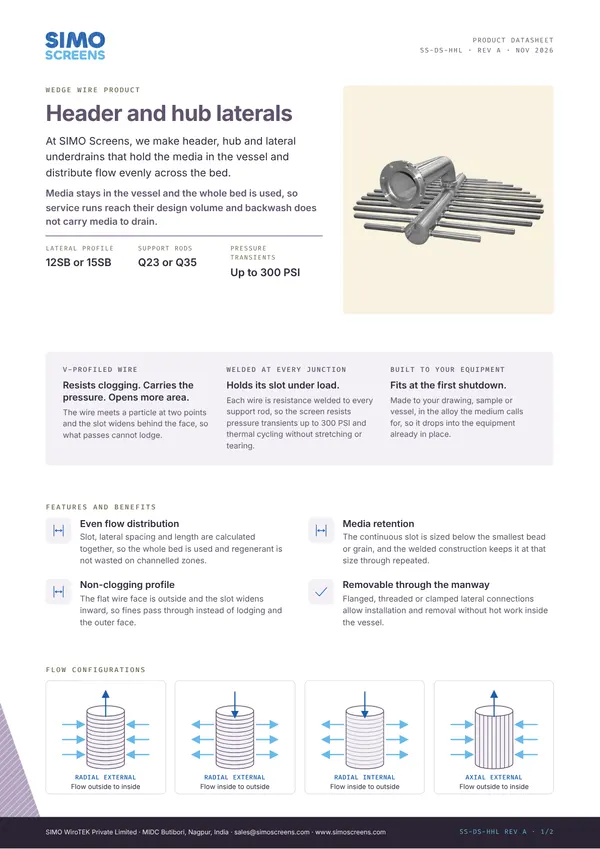
 Header and hub laterals
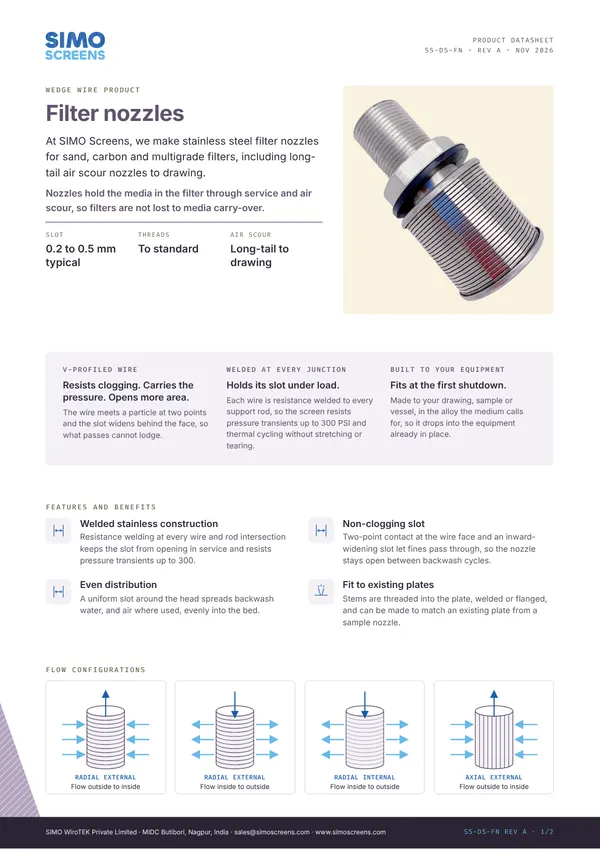
 Filter nozzles
 Resin traps
 Support grids
 Sieve bend (DSM) screens
 Centrifuge baskets
 Pressure screen baskets
 Screw press screens
 Rotary drum screens
 Passive intake screens
 Coanda intake screens
 Water and wastewater treatment
 Water wells and groundwater
 Sugar and distillery
 Brewing, malting and beverages
 Food processing
 Mining and minerals
 Oil, gas and petrochemicals
 Chemicals, fertilisers and pharma
 Power generation
 Pulp and paper
 Buildings and drainage

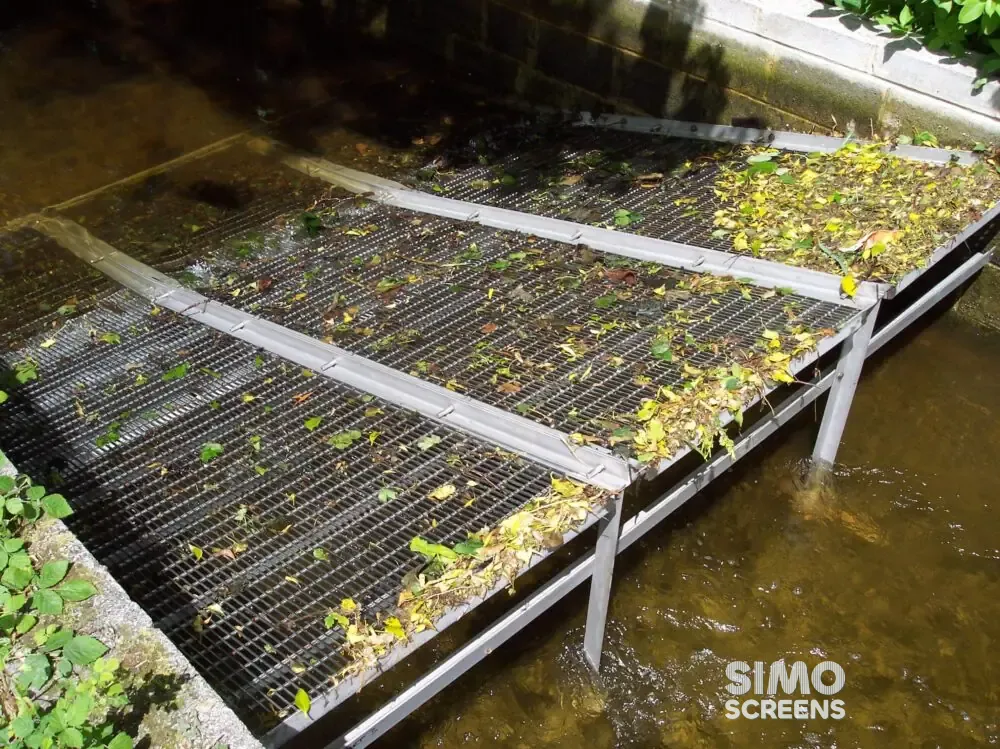
Water and wastewater screening applications
SIMO Screens supplies wedge wire screens for water treatment and wastewater plants, from the raw water intake to sludge dewatering. These screens perform two different functions. Inside a vessel, the screen retains resin, sand or carbon while passing water evenly, and at the intake and inlet works it removes debris without blinding.
Plastic nozzles can crack and release filter sand into the treated water, and a damaged mesh lateral can lose resin during regeneration. At the inlet works, perforated plate blinds with fibres and rags and needs manual cleaning.
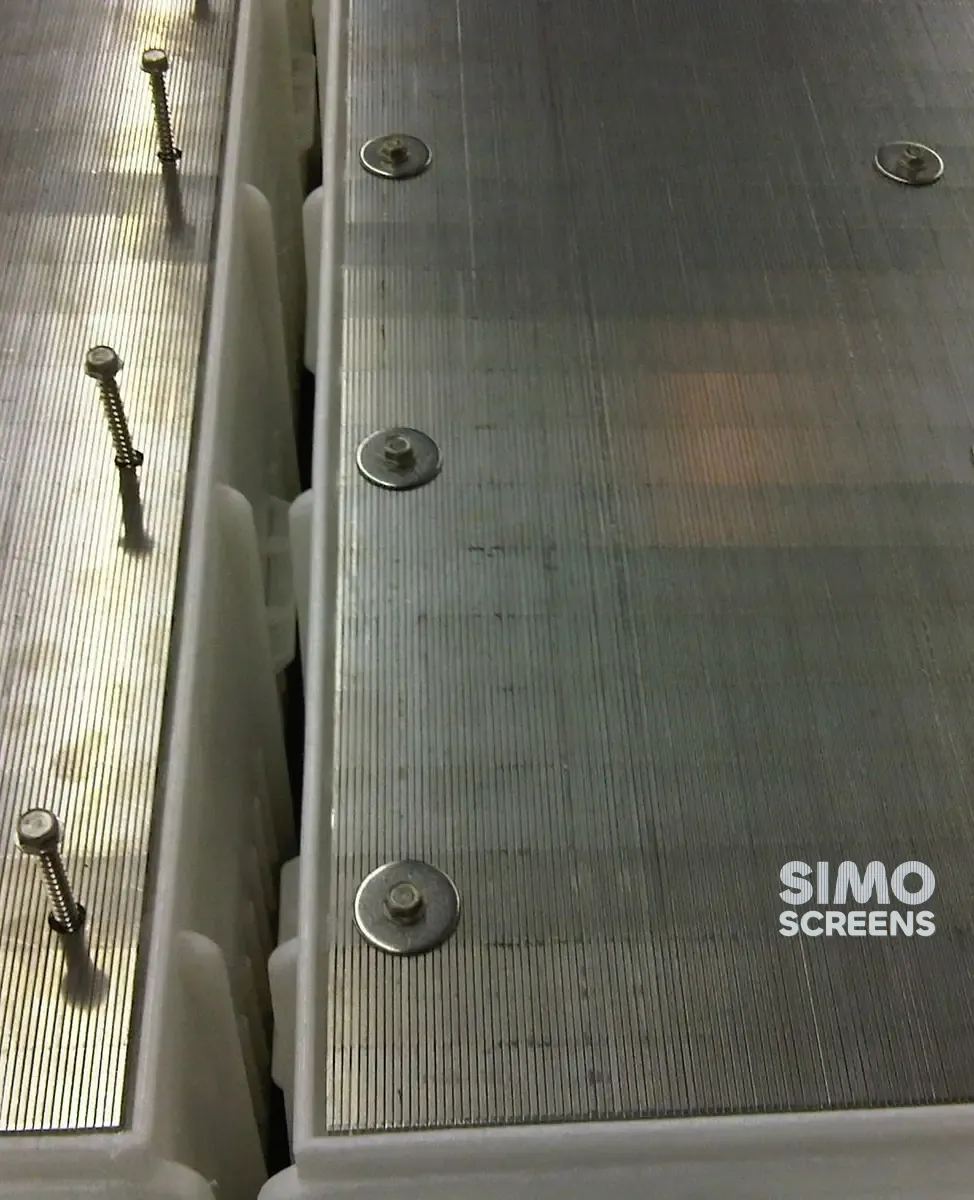
Wedge wire meets both requirements with one construction. V-profile wires are resistance welded to support rods at every intersection, giving a continuous slot that widens inward. A particle that passes the slot face does not lodge in it, so the screen keeps its open area from one run to the next.
Water treatment screens through the plant
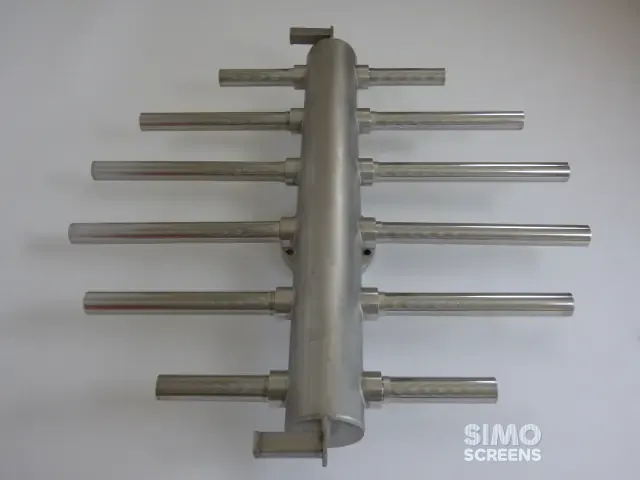
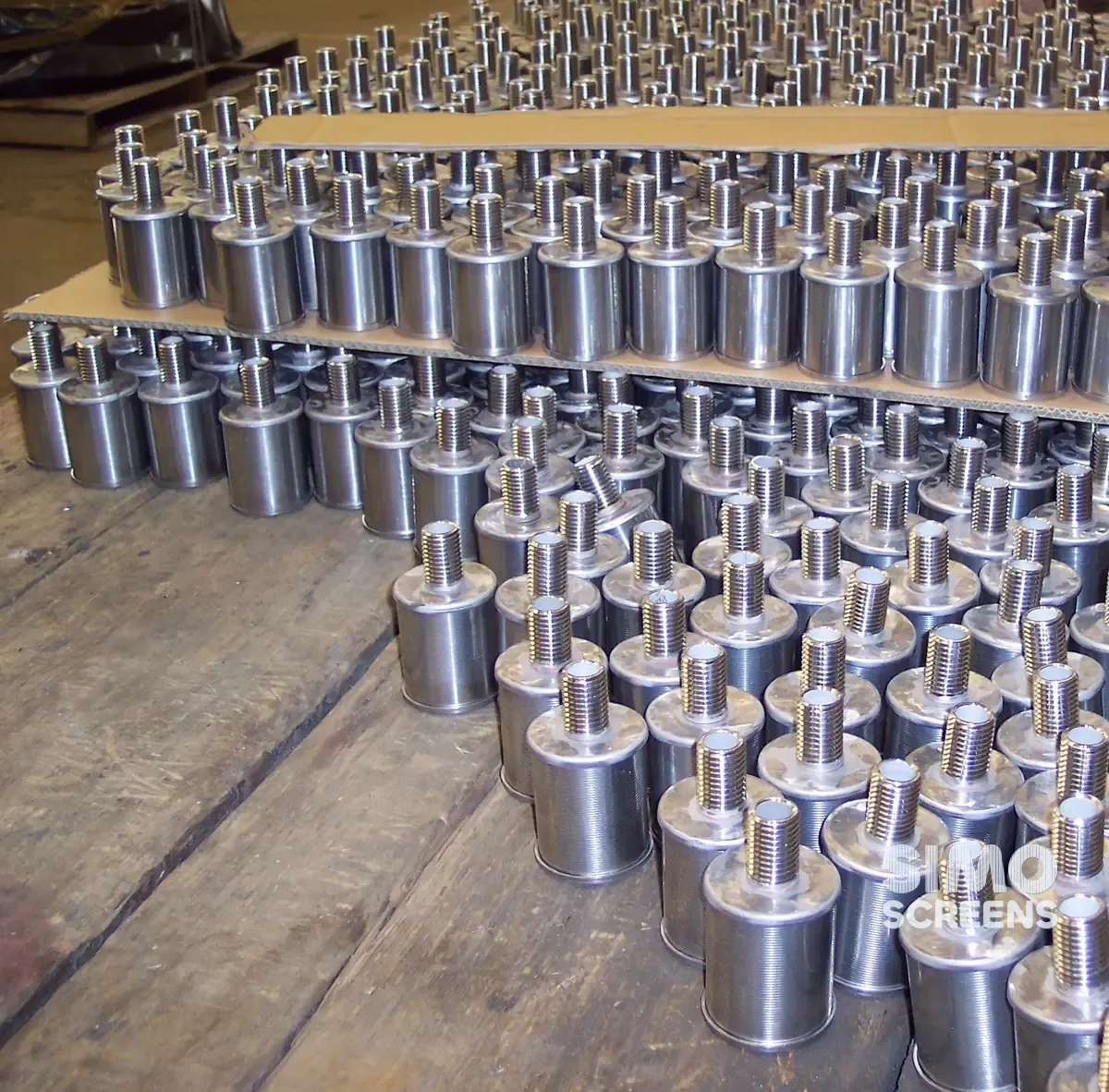
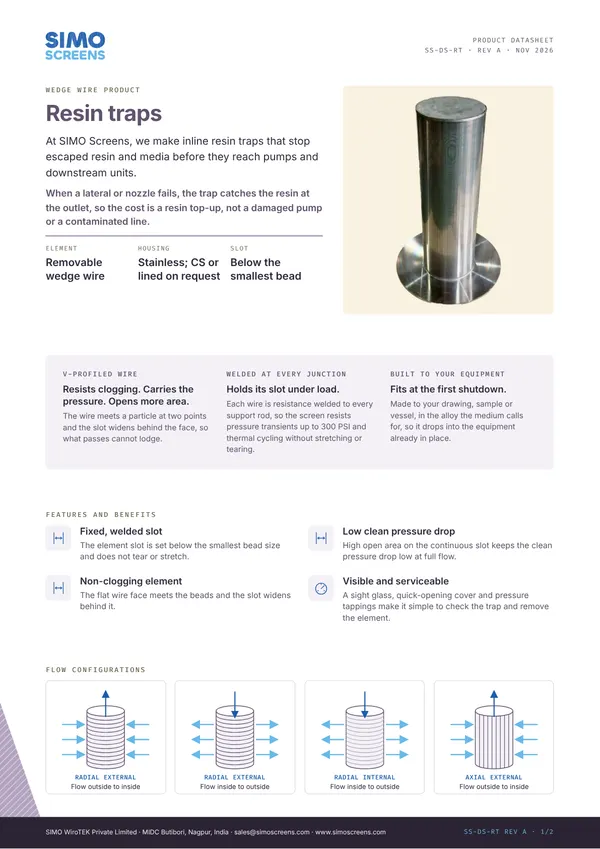
Intake screens on the river or reservoir keep out leaves, debris and fish. Filter nozzles or laterals form the underdrain of pressure sand, activated carbon and multigrade filters, while hub and lateral assemblies collect and distribute flow in softeners, DM plant cation and anion vessels and mixed beds. Resin traps on the outlet lines capture any escaped resin.
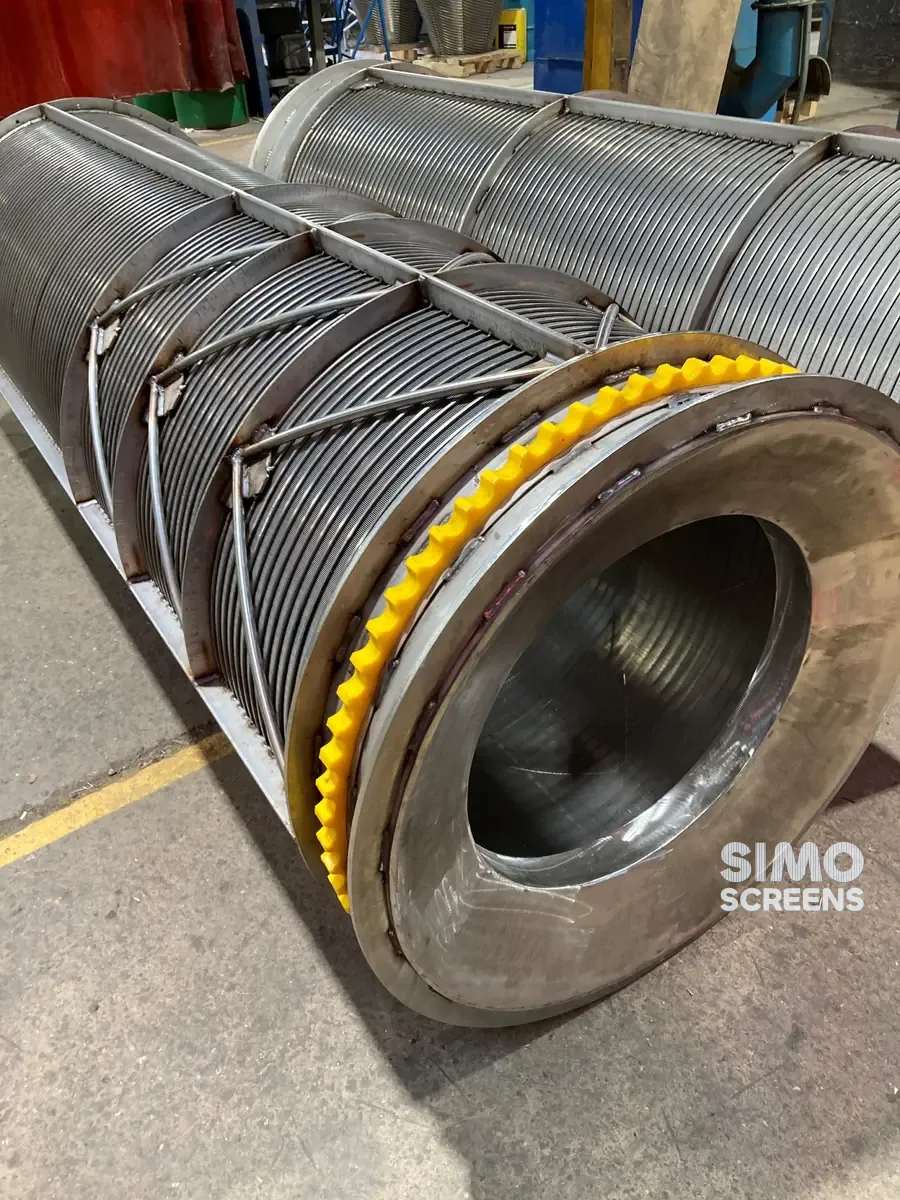
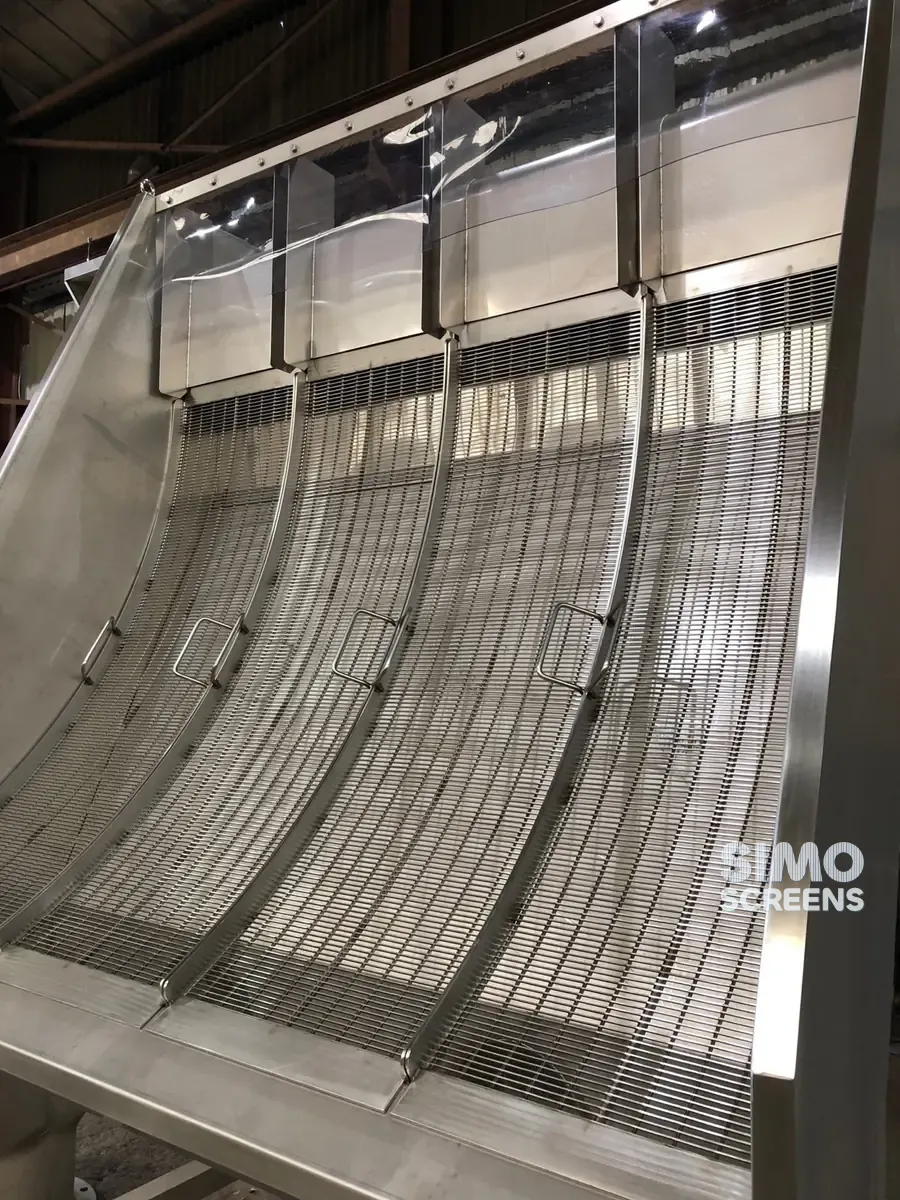
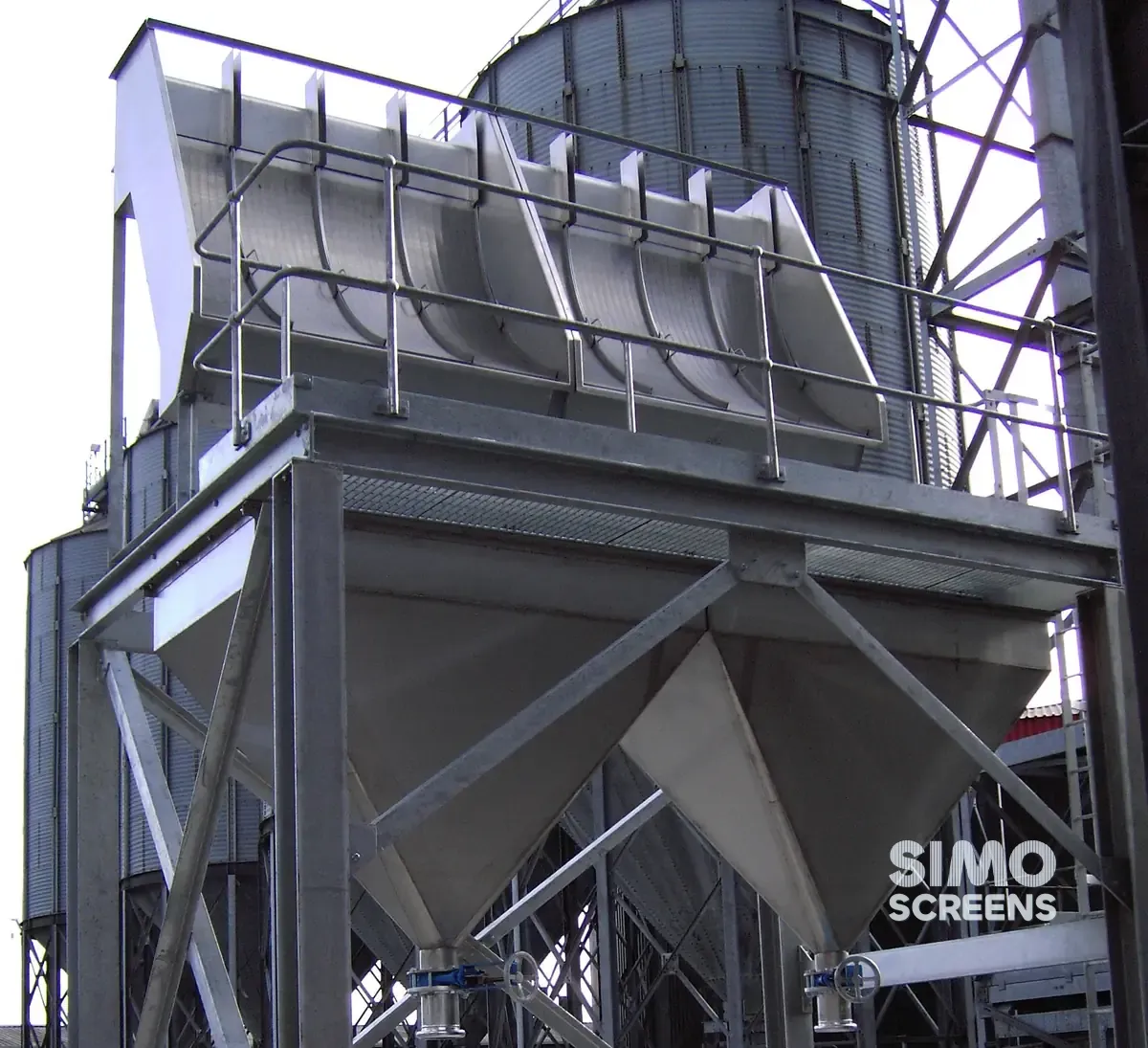
On the wastewater side, sieve bends and rotary drum screens are the usual wastewater screens at STP and ETP inlet works, and screw press screens dewater the sludge before disposal.
Swipe to see the full drawing.
Equipment and water treatment screens selection
| Equipment | Screen function | SIMO product |
|---|---|---|
| DM plant and softener vessels | Collects treated water and spreads regenerant evenly while retaining resin beads | Header and hub lateral assemblies |
| Condensate polishers | Distributes high service flow across the mixed bed and holds back fine resin | Header and hub lateral assemblies |
| DM plant, softener and polisher outlet lines | Captures resin that escapes after a lateral failure or valve fault, protecting downstream pumps | Resin traps |
| Pressure sand, activated carbon and multigrade filters | Forms the underdrain, retains filter media and spreads backwash flow | Filter nozzles, header and hub lateral assemblies |
| Filter and carbon vessel bed supports | Carries the media weight across the vessel bottom with even flow below it | Support grids |
| River, lake and reservoir intakes | Keeps debris and fish out of the pump suction at low through-slot velocity | Intake screens |
| STP and ETP inlet works | Removes fibres, fine solids and grit ahead of biological treatment | Sieve bend screens, rotary drum screens |
| Sludge dewatering | Drains filtrate under compression while retaining the sludge cake | Screw press screens |
Swipe sideways to see the whole table.
Materials and design considerations
The points below reflect general engineering practice. The final selection for each plant is confirmed during engineering review.
- Slot size follows the smallest particle to be retained. For resin, the slot is selected below the smallest bead in the size range, and for sand filters below the finest media grade.
- Lateral profiles. DM plant laterals use 12SB profile wire on Q23 support rods for low pressure and high flow, and 15SB for higher pressure at moderate flow.
- Flow balance governs bed performance. Each lateral should carry a similar flow so that the bed does not channel, so lateral length, spacing and open area are designed together with the header, as set out in the header and lateral design guide.
- Material. SS 304 suits most raw water, softener and filter applications, and SS 316L is the usual step up where chlorides are higher or where acid and caustic regenerants reach the internals. Brackish and seawater service often calls for Duplex 2205 or Super Duplex 2507, compared on PREN = %Cr + 3.3 x %Mo + 16 x %N, where a higher value indicates better pitting resistance.
- Intake screens are typically sized for a through-slot velocity of 0.15 m/s (0.5 ft/s) or less where fish protection matters, which also reduces the debris load on the screen face. SIMO river intake screens are made up to 800 mm in diameter, and the intake screen calculator gives a first size.
- Pressure surges accompany every backwash and regeneration. Welded joints hold the slot width through repeated cycles, where crimped or bonded joints can loosen.
SIMO Screens capability for water treatment
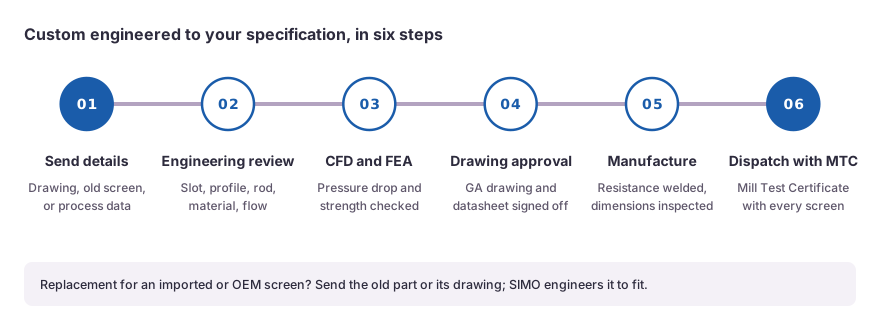
Each screen is engineered from the vessel drawing, nozzle plate layout, a sample or site measurements, and the custom engineering process ends with a drawing approved before production. CFD is used to predict pressure drop and flow balance for custom distributors and large lateral systems, and FEA checks the structure under media load and backwash surges.
Resin trap housings in carbon steel or lined construction, complete basket strainer housings and complete rotary drum screen machines are supplied on request. For drum screen machines, SIMO makes the wedge wire drum, and the drive, frame, tank and spray bar are sourced under SIMO quality control.
Slot width is checked with feeler gauges at set-up, during the run and at the end of each screen, against a standard tolerance of plus or minus 5 percent of nominal. Every product ships with a Mill Test Certificate, and the dimensional inspection report, quality assurance plan and third-party inspection are provided on request. Production is at the SIMO works in MIDC Butibori, Nagpur, under an ISO 9001:2015 quality system.
What to send for a quotation
- Equipment and service: softener, DM cation, anion or mixed bed, condensate polisher, sand or carbon filter, intake or STP inlet.
- Vessel drawing with diameter, height, nozzle positions and bottom shape: flat, dished or with a nozzle plate.
- Service flow, backwash or regeneration flow, and design pressure.
- Media type and size range: resin grade, sand or carbon size, or the solids to be removed.
- Water analysis, especially chlorides, pH and temperature, or your material specification.
- Required slot size, if you already have one, and the connection type: threaded, flanged or welded.
- Quantity, and any inspection or documents you need beyond the standard MTC.
 Upload a drawing