 +91 93730 08466
 Screen tubes and pipes
 Screen cylinders
 Flat panels and false bottoms
 Candle filter elements
 Water well screens
 Header and hub laterals
 Filter nozzles
 Resin traps
 Support grids
 Sieve bend (DSM) screens
 Centrifuge baskets
 Pressure screen baskets
 Screw press screens
 Rotary drum screens
 Passive intake screens
 Coanda intake screens
 Water and wastewater treatment
 Water wells and groundwater
 Sugar and distillery
 Brewing, malting and beverages
 Food processing
 Mining and minerals
 Oil, gas and petrochemicals
 Chemicals, fertilisers and pharma
 Power generation
 Pulp and paper
 Buildings and drainage

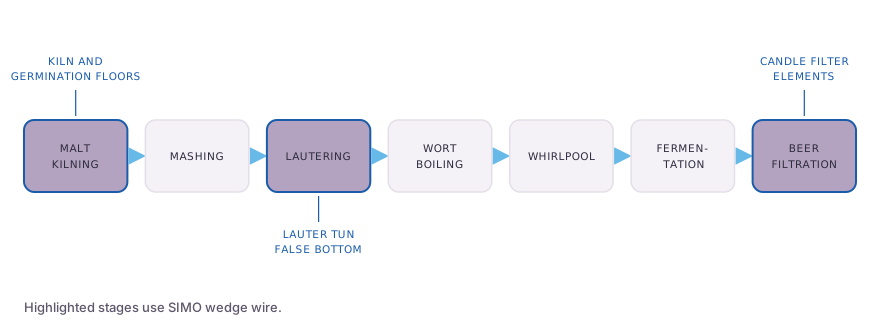
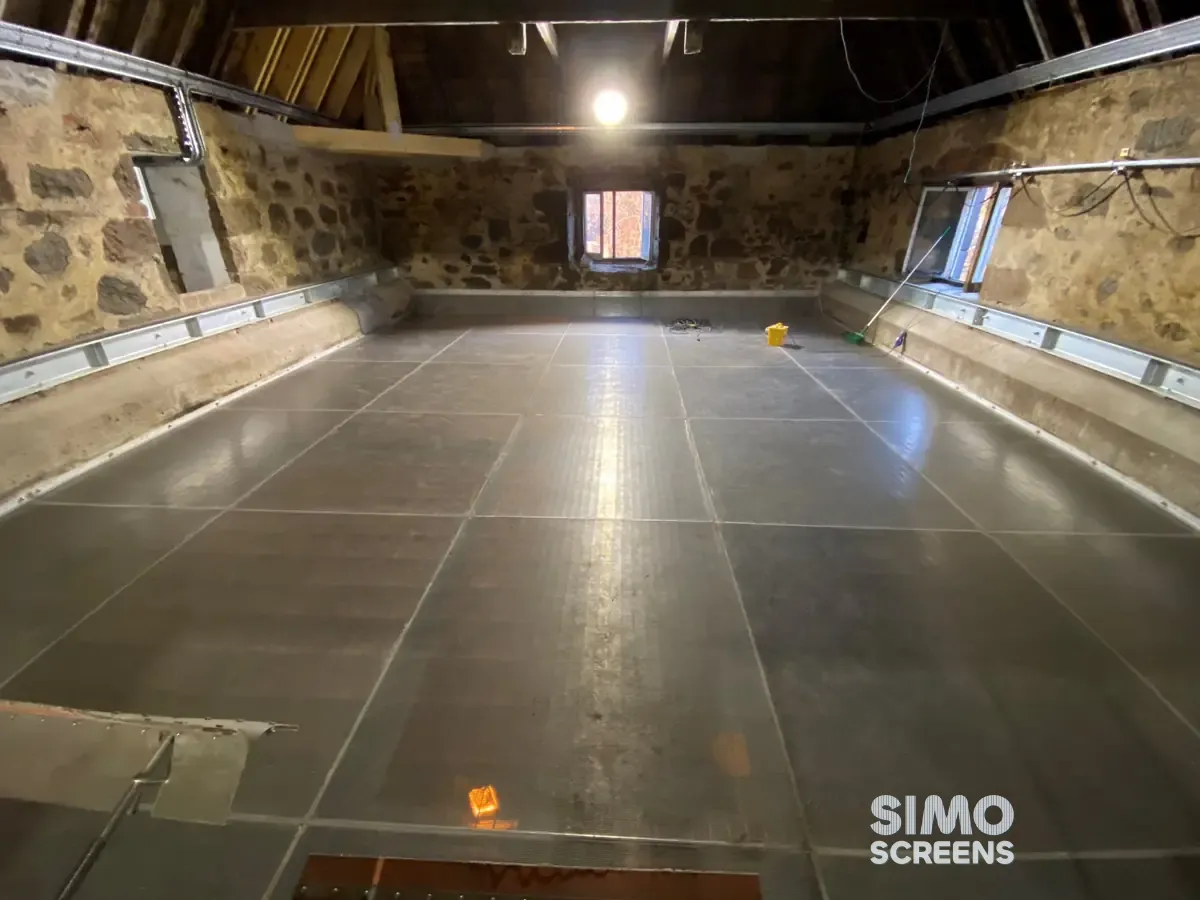
Malt kiln floor overview
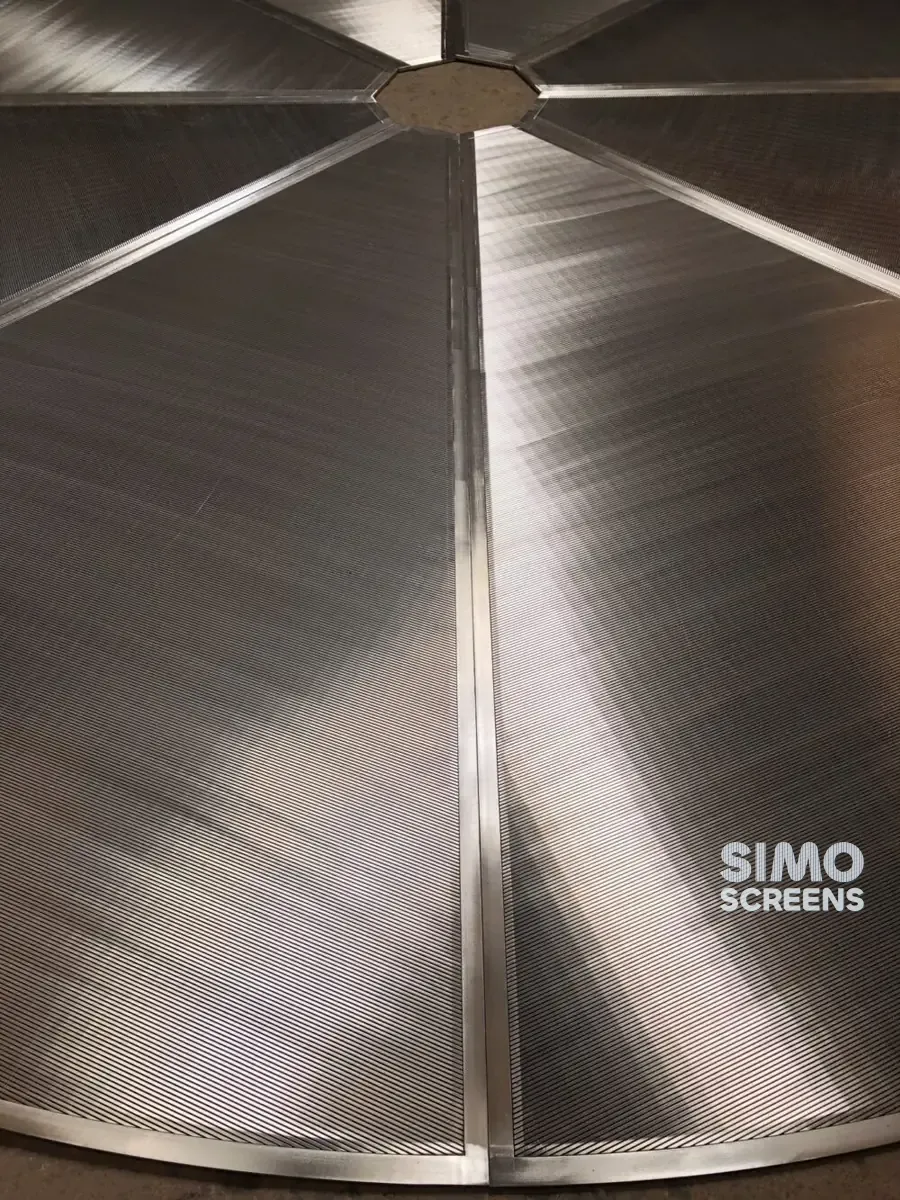
Malting has three stages, steeping, germination and kilning, and each holds the grain on a screen floor while water or air moves through the bed. In steeping, barley soaks in steep tanks while the screen holds the grain, drains the water and admits aeration air. In germination, wet grain grows in boxes or circular vessels while humidified air rises through the floor and turners keep the bed loose. On the malt kiln floor, hot air dries and cures the green malt.
Airflow through the floor must be even, or the bed dries and modifies in patches. Perforated plate floors restrict airflow, so fans work harder and air takes the easiest paths, while kernels and rootlets lodge in round holes and lengthen cleaning. A wedge wire floor addresses both through a higher open area and a flat, smooth surface.
Swipe to see the full drawing.
Design considerations for a germination floor and kiln floor screen
Slot. Malting floor slots typically start from about 0.7 mm. The slot must hold whole barley and green malt without trapping rootlets, and it is set against a sample of the plant's grain before drawings are issued.
Profile and open area. The V-profile wire presents a flat top to the bed, and the slot widens below the surface so that dust and fines drain to the plenum. Open area (%) = Slot x 100 / (Slot + Wire width). A 0.7 mm slot on 35SB wire, 3 mm wide, gives about 19 percent open area, and a 1 mm slot on the same wire about 25 percent.
Load. Floors carry the grain bed and, in most plants, a turner or unloader. Heavy profiles such as 35SB, 42SB or 55SB on F203 or F253 bars are typical, with beam spacing and bar height checked against the bed and equipment loads. FEA is used on custom designs.
Thermal cycling. Kiln curing air commonly reaches about 80 to 85°C for pale malts and higher for speciality malts. Kiln floors heat and cool every batch, so panels are fixed with expansion allowances that let them move without lifting, cracking at the fixings or opening gaps to the plenum.
Wire orientation and cleaning. The wire direction is aligned to suit turner and unloader travel. Closed panel edges, lift points and a smooth wire face keep cleaning time short and reduce the deposits where mould develops.
Construction and options
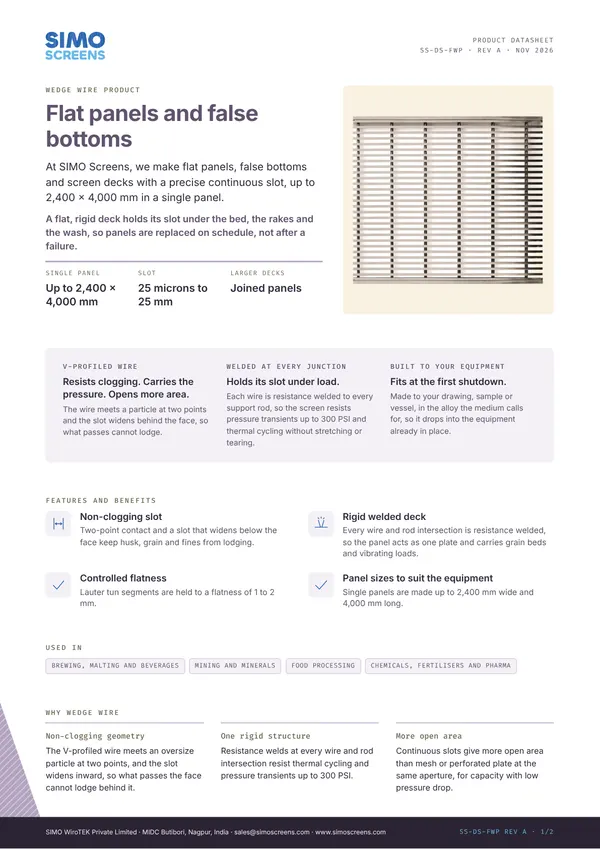
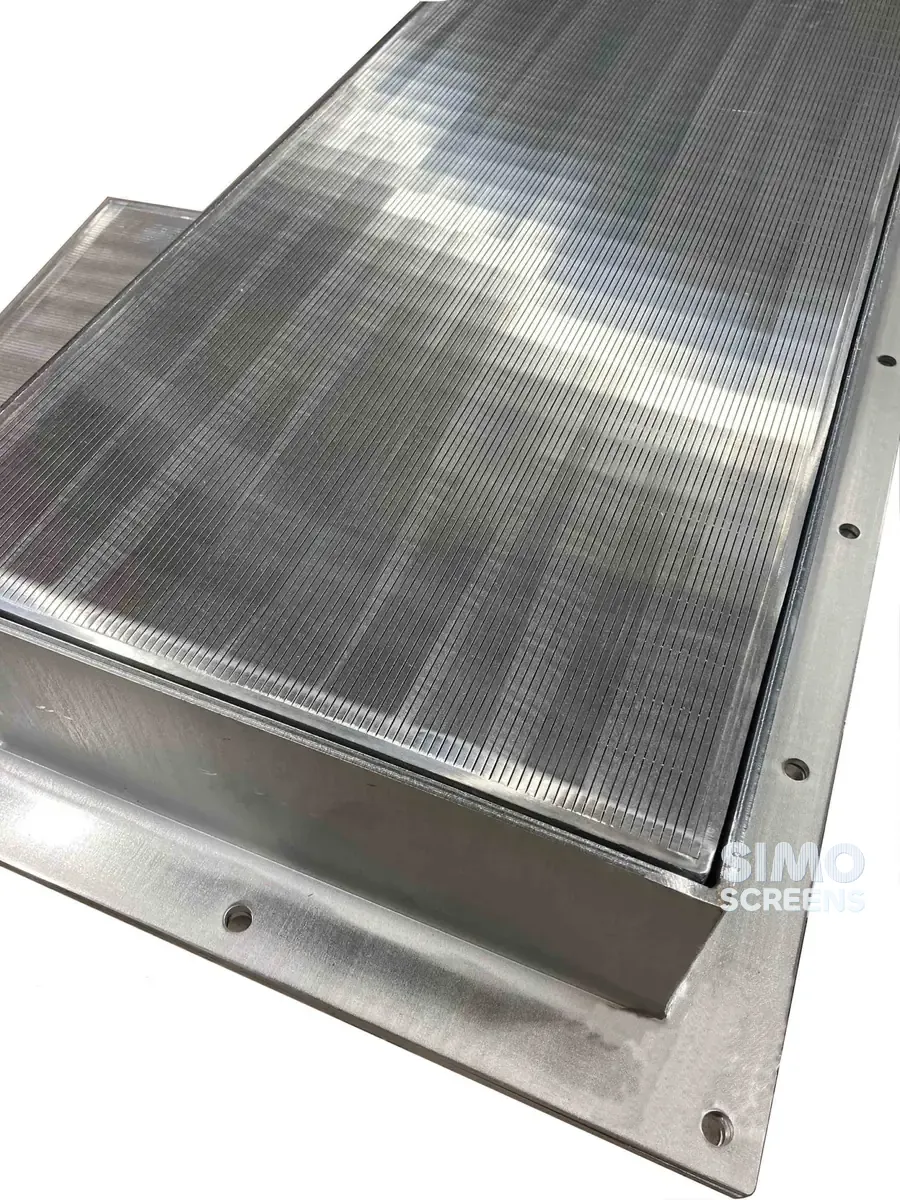
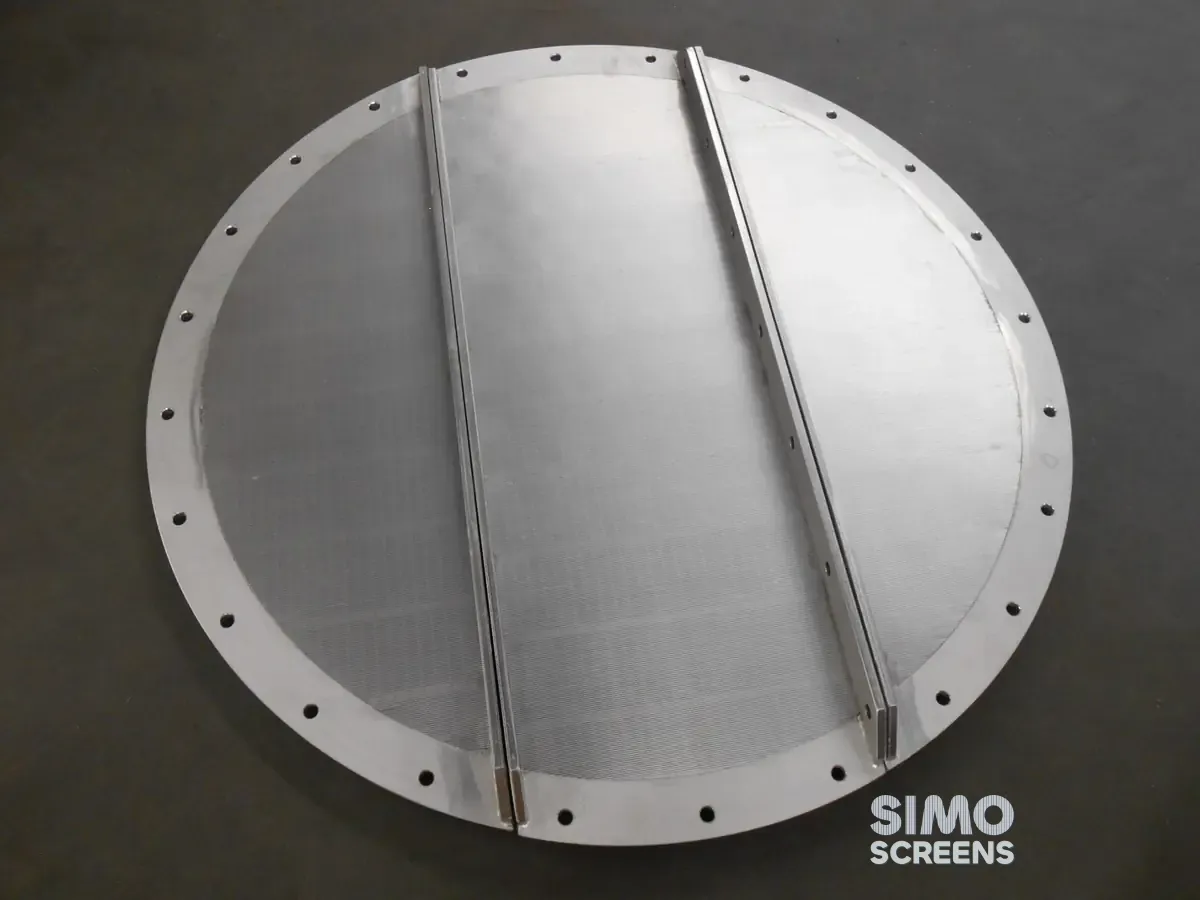
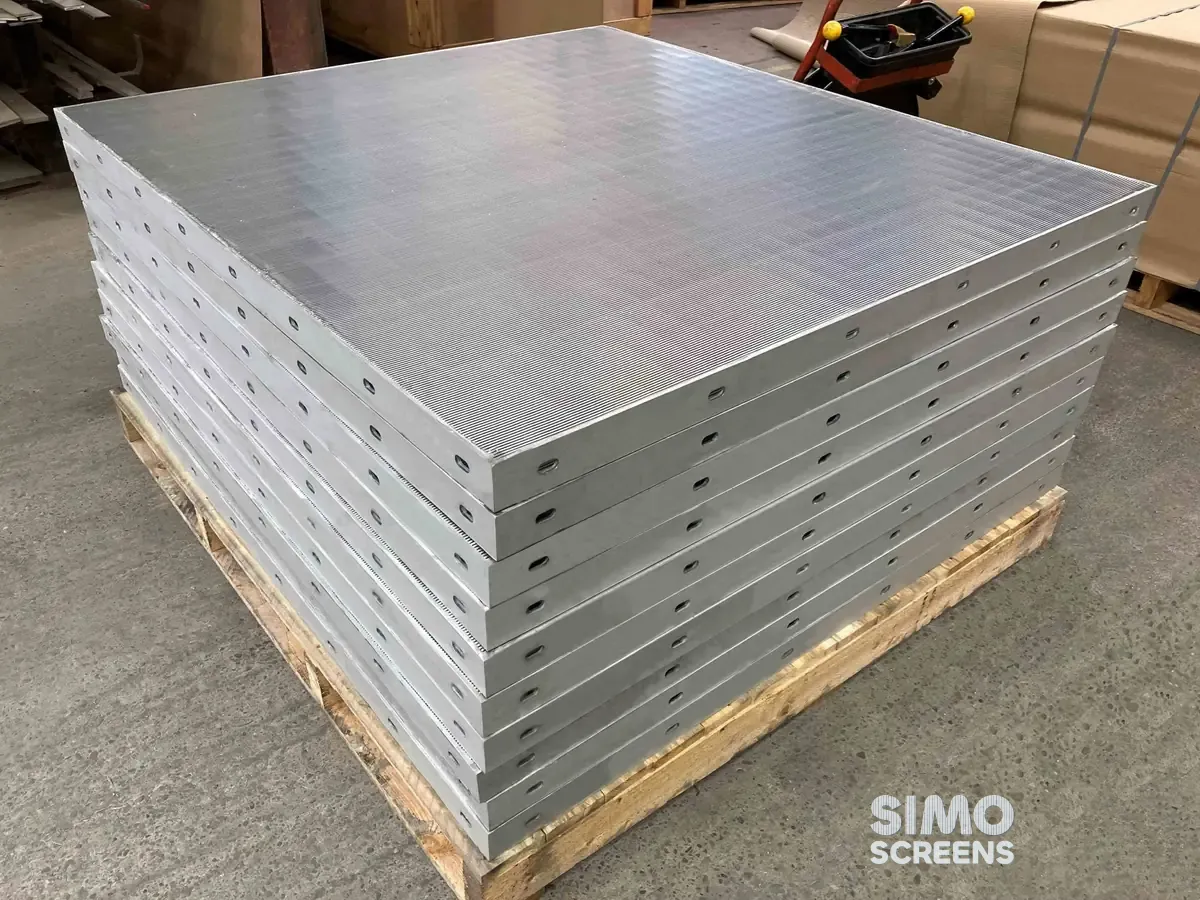
The floor is a set of flat panels laid on the plant's support beams. SIMO profile wire is formed in house and resistance welded to flat support bars at every intersection, and slot width is checked with feeler gauges at set-up, during the run and on each finished panel. Panels have closed edges, lift points for access and fixings that allow thermal movement, and they are sized for handling and for the access openings of the vessel.
| Item | SIMO range or typical value |
|---|---|
| Form | Flat wedge wire panels on support beams |
| Slot opening | 25 microns (0.025 mm) to 25 mm; malting floors from about 0.7 mm |
| Slot tolerance | Plus or minus 5% of nominal, stated on the drawing |
| Profile wire | 35SB, 42SB, 55SB, 56SB |
| Support bars | F203, F253; F123 for light floors |
| Single panel size | Up to 2,400 mm wide and 4,000 mm long; larger floors as joined panels |
| Design | FEA for bed, turner and thermal loads on custom designs |
| Related items | Flat and conical steeping tank screens |
Swipe sideways to see the whole table.
The same panels, built as a walkable deck, serve as wedge wire flooring and walkway panels elsewhere in the plant. Profiles can be compared with the open area calculator and the profile wire and support rod guide.
Materials
SS 304 suits most malting floors. SS 316L is selected for steep tanks with chemical washing or chloride-rich water. Both grades are well within their range at kiln curing temperatures. The Mill Test Certificate is supplied as standard, a dimensional inspection report and QAP are supplied on request, and pickling and passivation are available through approved agencies.
Replacement and retrofit
Most projects replace perforated floors in an existing kiln or germination box, including imported and OEM floors. SIMO Screens works from a sample panel, the floor plan or the drawing, and matches the beam layout so that new panels sit on the existing structure.
The beams and the wall seal should be checked while the floor is out, because air leaking past the edges bypasses the bed. Our flat wedge wire panels page gives the full panel range and options.
What to send for a quotation
- Vessel type: steep tank, germination box or kiln.
- Floor size and shape, round or rectangular.
- Support beam layout and spacing.
- Grain bed depth and load per m².
- Turner or unloader type, with wheel or track loads.
- Airflow rate and maximum air temperature.
- Access opening size for panel handling.
- Existing floor type, slot and panel size, for a replacement.

 Upload a drawing