 +91 93730 08466
 Screen tubes and pipes
 Screen cylinders
 Flat panels and false bottoms
 Candle filter elements
 Water well screens
 Header and hub laterals
 Filter nozzles
 Resin traps
 Support grids
 Sieve bend (DSM) screens
 Centrifuge baskets
 Pressure screen baskets
 Screw press screens
 Rotary drum screens
 Passive intake screens
 Coanda intake screens
 Water and wastewater treatment
 Water wells and groundwater
 Sugar and distillery
 Brewing, malting and beverages
 Food processing
 Mining and minerals
 Oil, gas and petrochemicals
 Chemicals, fertilisers and pharma
 Power generation
 Pulp and paper
 Buildings and drainage
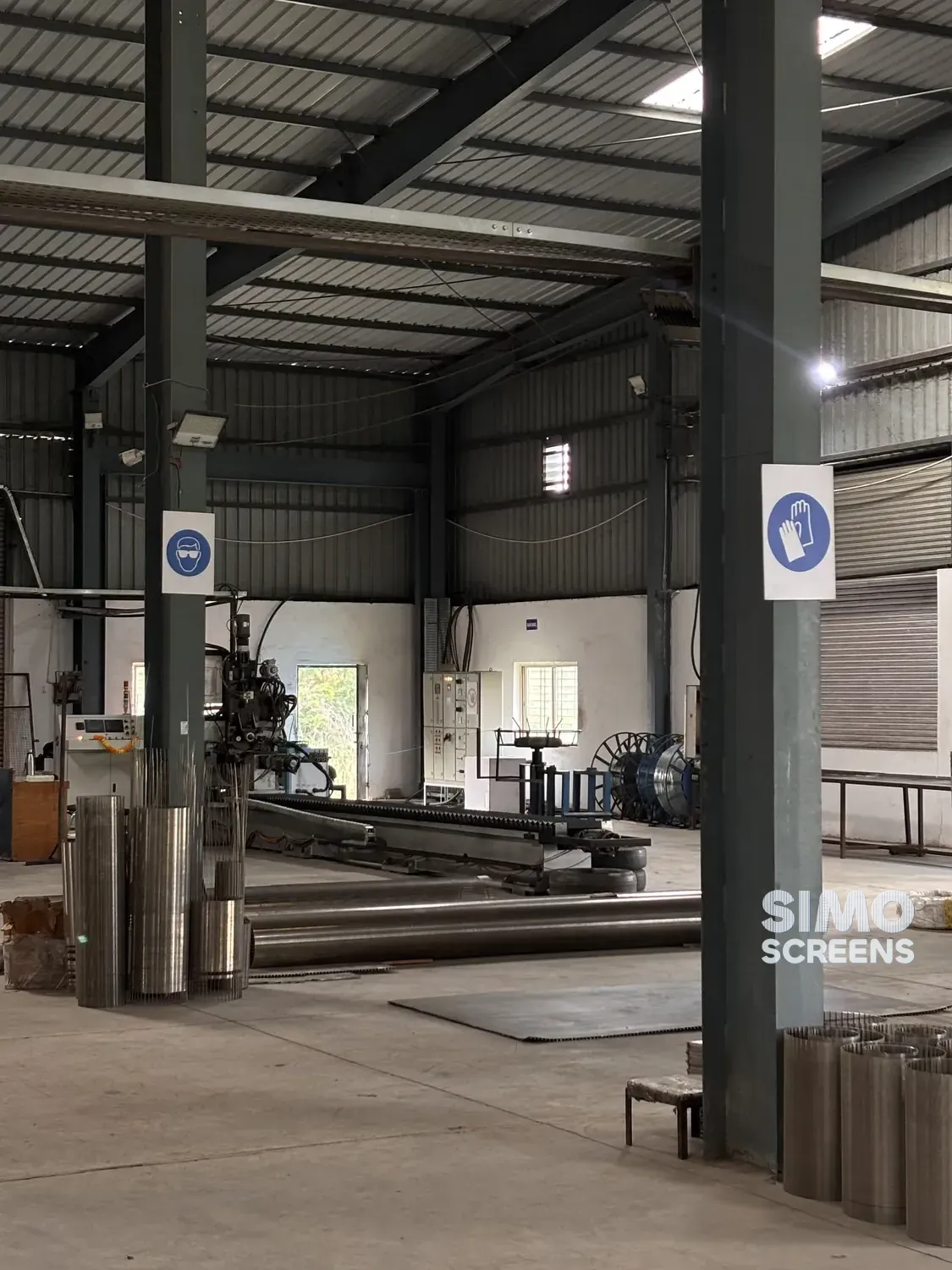
Welded wedge wire screen range
Every SIMO screen is built from the same elements: a V-profile wire, a support rod and a resistance weld at every intersection. Purchase teams comparing screening manufacturers usually begin with slot range, size limits and alloys, which the table below summarises.
| Capability | SIMO Screens range | Application note |
|---|---|---|
| Slot openings | 25 microns (0.025 mm) to 25 mm | Fine media retention through to dewatering, sizing and drainage |
| Slot tolerance | Plus or minus 5% of nominal, stated on the drawing | Minimum, maximum and mean slot recorded at final inspection |
| Diameters | 25 to 800 mm | Nozzles and well points through to large baskets and cylinders |
| Cylinder and tube lengths | Up to 6,000 mm | Long well screen and lateral sections with fewer joints |
| Flat panels | Single panels up to 2,400 mm wide and 4,000 mm long; larger decks as joined panels | False bottoms, support grids and decks of any required size |
| Forms | Flat, cylindrical, conical, curved, segmented | Panels, tubes, baskets, sieve bends and decks that pass a manway |
| Flow configurations | Radial external, outside to inside and inside to outside; radial internal, inside to outside; axial external, outside to inside | Slot face placed on the side that carries the solids |
| Profile wires | Light, standard, heavy duty and custom; nine sizes, 12SB to 56SB | Open area balanced against strength and wear allowance |
| Support rods | Nine sizes in profile, flat and round sections, Q23 to F253 | Span, stiffness and collapse resistance |
| Materials | SS 304, SS 316L, Duplex 2205, Super Duplex 2507, Hastelloy, Monel | Fresh water through seawater and strong acids |
| Construction | Resistance welded at every wire and rod intersection; resists thermal cycling and pressure transients up to 300 PSI | Slot geometry fixed; screen acts as one structure |
| Design support | CFD for pressure drop, FEA for structural validation | Flow and load verified before manufacture |
| Fabrication | Frames, flanges, end rings, housings, rolled and curved sections, brackets, segmented decks | Finished assembly, ready to install |
| Accessories | Flat panel frames and supports, header lateral fittings, candle filter fittings | Screen and fittings from one supplier |
| Quality and documents | ISO 9001:2015; Mill Test Certificate with every product; other documents on request | Material and dimensions verifiable on receipt |
| Standards | Water well screens to IS 8110:2019 | Recognised basis for well screen tenders |
| Supply | Made in India for the world, from MIDC Butibori, Nagpur | Direct from the manufacturing works |
Swipe sideways to see the whole table.
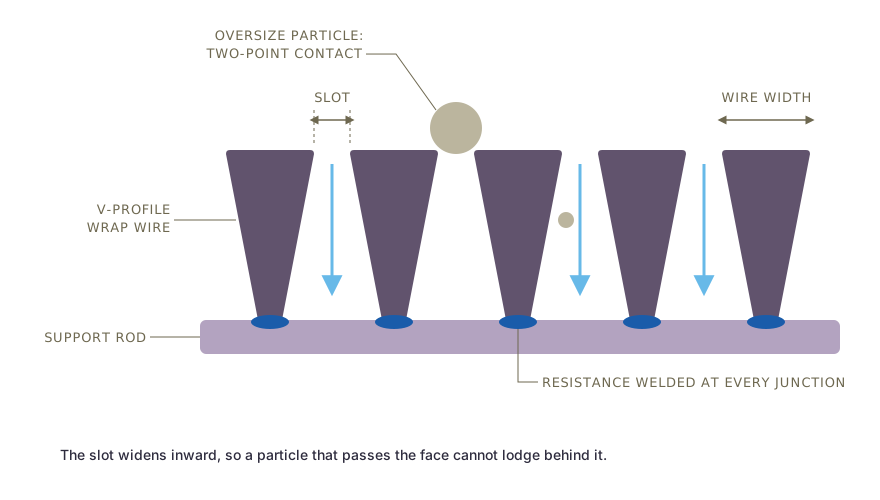
Swipe to see the full drawing.
Profile wire
Profile wire forms the screening surface. It is formed in house to SIMO profile codes, which fix shape, head width and height, and dimensions are checked with calibrated micrometers before welding. Wire width sets the open area at a given slot, while height sets stiffness and wear allowance.
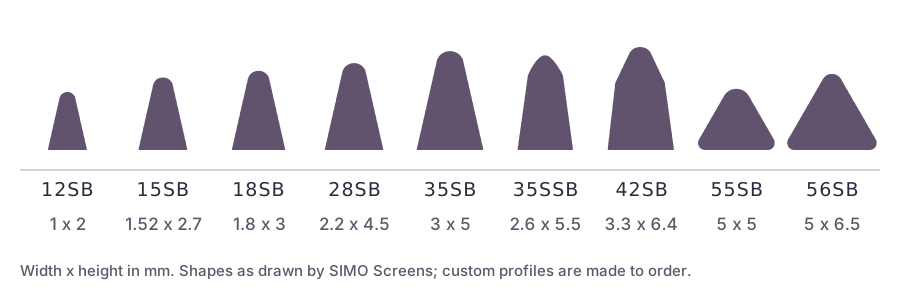
Swipe to see the full drawing.
| Profile wire no. | Width (mm) | Height (mm) |
|---|---|---|
| 12SB | 1 | 2 |
| 15SB | 1.52 | 2.7 |
| 18SB | 1.8 | 3 |
| 28SB | 2.2 | 4.5 |
| 35SB | 3 | 5 |
| 35SSB | 2.6 | 5.5 |
| 42SB | 3.3 | 6.4 |
| 55SB | 5 | 5 |
| 56SB | 5 | 6.5 |
Swipe sideways to see the whole table.
Open area follows from slot and wire width:
Open area (%) = Slot x 100 / (Slot + Wire width)
A 0.5 mm slot on a 15SB wire, 1.52 mm wide, gives about 24.8 percent open area. Other combinations can be checked in the open area calculator.
Support rods
Support rods carry the load across the span and determine the screen's resistance to collapse and bending.
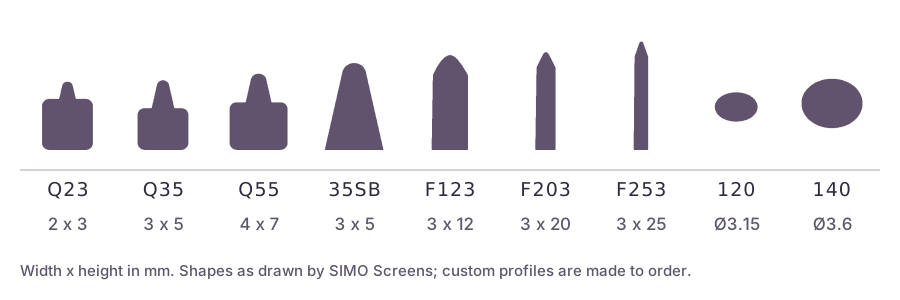
Swipe to see the full drawing.
| Support rod no. | Section | Size (mm, width x height) |
|---|---|---|
| Q23 | Profile | 2 x 3 |
| Q35 | Profile | 3 x 5 |
| Q55 | Profile | 4 x 7 |
| 35SB | Profile | 3 x 5 |
| F123 | Flat | 3 x 12 |
| F203 | Flat | 3 x 20 |
| F253 | Flat | 3 x 25 |
| 120 | Round | Dia 3.15 |
| 140 | Round | Dia 3.6 |
Swipe sideways to see the whole table.
Tall flat rods such as F203 and F253 suit long unsupported spans in support grids and false bottoms, while profile and round rods suit cylinders and fine screens. Selection is covered in the profile wire selection guide.
Materials
| Material | Typical service |
|---|---|
| SS 304 | Fresh water, wells, general process water, architectural work |
| SS 316L | Food, brewing, moderate chlorides, general chemical service |
| Duplex 2205 | Higher chlorides and higher strength, brackish water, pulp and paper |
| Super Duplex 2507 | Seawater and severe chloride service |
| Hastelloy (C-276 standard) | Strong acids and aggressive chemical service |
| Monel | Seawater, brine and selected acid and alkali service |
Swipe sideways to see the whole table.
Resistance to chloride pitting is commonly compared using PREN = %Cr + 3.3 x %Mo + 16 x %N, a higher value indicating better resistance. Hastelloy grades other than C-276 are supplied on request, subject to availability in India. The material selection guide sets out the basis for each grade.
Forms
- Flat: panels, decks, false bottoms and support grids, usually cut from a welded cylinder and flattened
- Cylindrical: screen tubes, well screens, baskets, candle elements and laterals; inside-to-outside drums by reverse rolling or winding on internal-profile machines
- Conical: centrifuge baskets and tapered elements
- Curved: sieve bends and arc screens to a set radius
- Segmented: large panels and baskets divided to pass a manway and assembled in place
Fabrication on wedge wire
Frames, flanges, end rings, housings, rolled and curved sections, brackets and segmented decks are fabricated on the screen, so that the assembly is supplied ready to install. Details are on the fabrication page.
Inspection and documents
Every product passes dimensional inspection and is supplied with a Mill Test Certificate under our ISO 9001:2015 system. Dimensional inspection reports, quality assurance plans and other documents are supplied on request, as described on the quality page.
 Upload a drawing