 +91 93730 08466
 Screen tubes and pipes
 Screen cylinders
 Flat panels and false bottoms
 Candle filter elements
 Water well screens
 Header and hub laterals
 Filter nozzles
 Resin traps
 Support grids
 Sieve bend (DSM) screens
 Centrifuge baskets
 Pressure screen baskets
 Screw press screens
 Rotary drum screens
 Passive intake screens
 Coanda intake screens
 Water and wastewater treatment
 Water wells and groundwater
 Sugar and distillery
 Brewing, malting and beverages
 Food processing
 Mining and minerals
 Oil, gas and petrochemicals
 Chemicals, fertilisers and pharma
 Power generation
 Pulp and paper
 Buildings and drainage
Wedge wire glossary and screen terminology
Terms are listed from A to Z. Each definition uses the screen terminology found on drawings, data sheets, inspection reports and quotations, and related terms are named within the definition.
A
Abrasion. Wear of the wire face by hard particles in the feed. Wider and taller profile wires give more wear allowance before the slot opens.
Approach velocity. The velocity of water approaching a screen face, measured just upstream of it. It is lower than through-slot velocity because the open area is only part of the face.
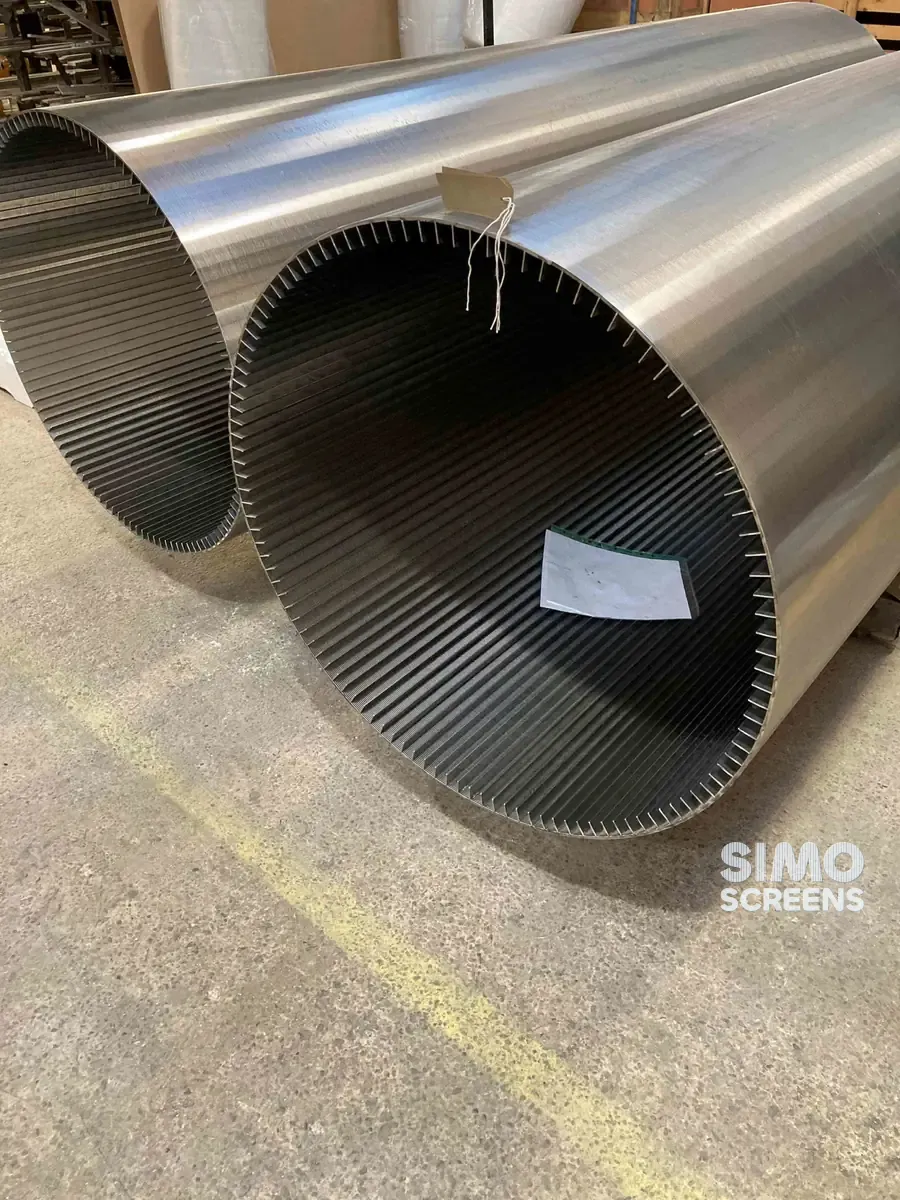
Axial flow. A cylinder construction in which the profile wires run along the length and the support rods form rings, so that the slots run parallel to the axis.
B
Backwash. Reversing flow through a screen or filter to lift retained solids off the slot face and flush them away.
Blinding. Loss of open area as particles or deposits cover or block the openings. Wedge wire resists blinding through two-point contact and its widening slot.
Bridging. Particles arching across an opening, so that it blocks even though each particle is smaller than the opening.
C
Candle filter. A tubular filter element, often wedge wire, used for fine solid-liquid separation under pressure. Elements may be precoated with a filter aid.
Centrifuge basket. A rotating screen basket that separates crystals or solids from liquid by centrifugal force, used in sugar, coal and mineral processing.
CFD. Computational fluid dynamics: numerical modelling of flow, used to predict pressure drop and flow distribution through a screen.
Coanda screen. A self-cleaning screen in which water follows the curved face over tilted wires and drops through the slots while debris slides off. Used on small hydro, irrigation and stormwater intakes.
Collapse strength. The external pressure a cylindrical screen can carry before it buckles, which is critical for water well screens and vessel internals.
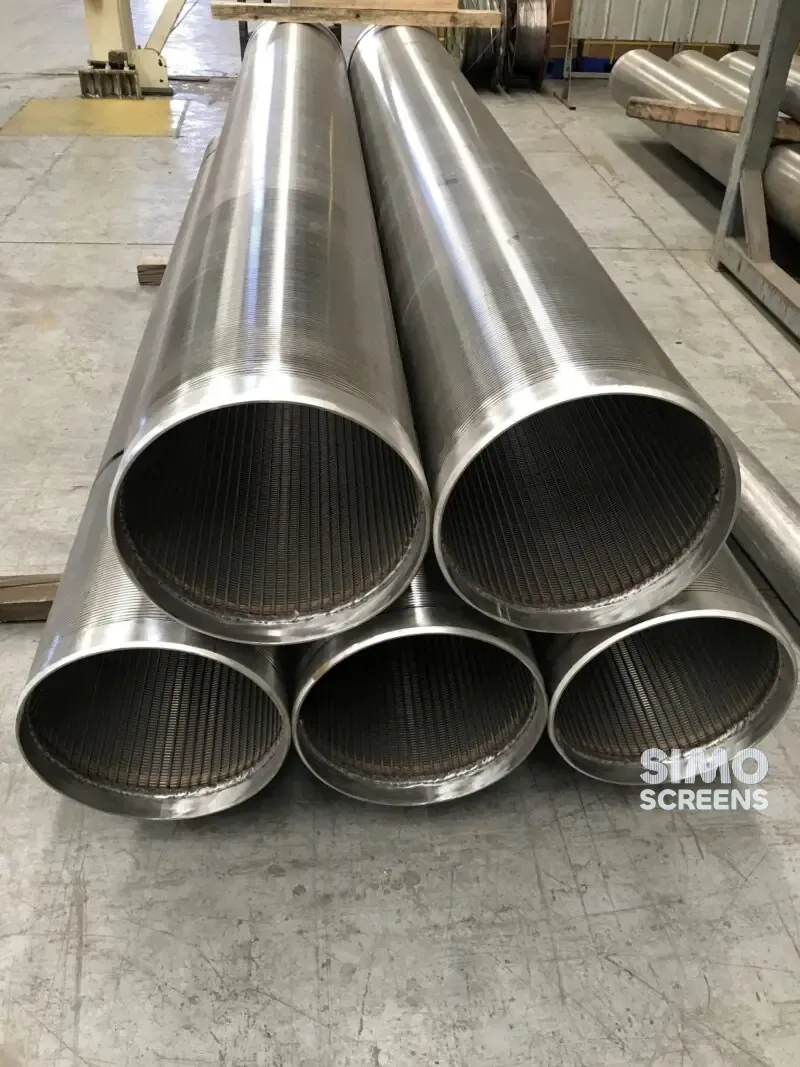
Continuous slot screen. A screen with a single slot running continuously around the cylinder, formed by spirally wound profile wire. Another name for a wedge wire well screen.
Crevice corrosion. Localised corrosion in narrow gaps, such as under deposits or at wire to rod contacts. Grades with a higher PREN resist it better.
D
Differential pressure. The pressure difference across a screen, from feed side to outlet side. A rising value indicates fouling or blinding.
Dimensional inspection report. A record of measured dimensions against the drawing, including slot, diameter, length and flatness. SIMO supplies it on request.
Distributor. A screen device that spreads incoming flow evenly across a vessel, such as an inlet basket or hub and lateral assembly.
DSM screen. Another name for a sieve bend.
Duplex stainless steel. Stainless steel with a mixed austenite and ferrite structure, such as Duplex 2205 and Super Duplex 2507, with higher strength and chloride resistance than 304 or 316L.
Dye penetrant testing. A non-destructive test that reveals surface-breaking cracks in welds. SIMO carries it out on fabrication welds wherever it is specified.
E
Effective open area. The open area that actually carries flow in service, after deducting rod shadowing, blank lengths and blockage by the bed or solids. For water well screens it is commonly taken as about 50 percent of the calculated open area.
Electropolishing. An electrochemical process that smooths and brightens a stainless steel surface, used for hygienic and decorative finishes.
End ring. A ring welded to the end of a cylindrical screen to close it, stiffen it or carry a fitting.
Entrance velocity. The velocity of water passing through the slots of a well screen. A commonly used design limit is about 0.03 m/s (3 cm/s).
F
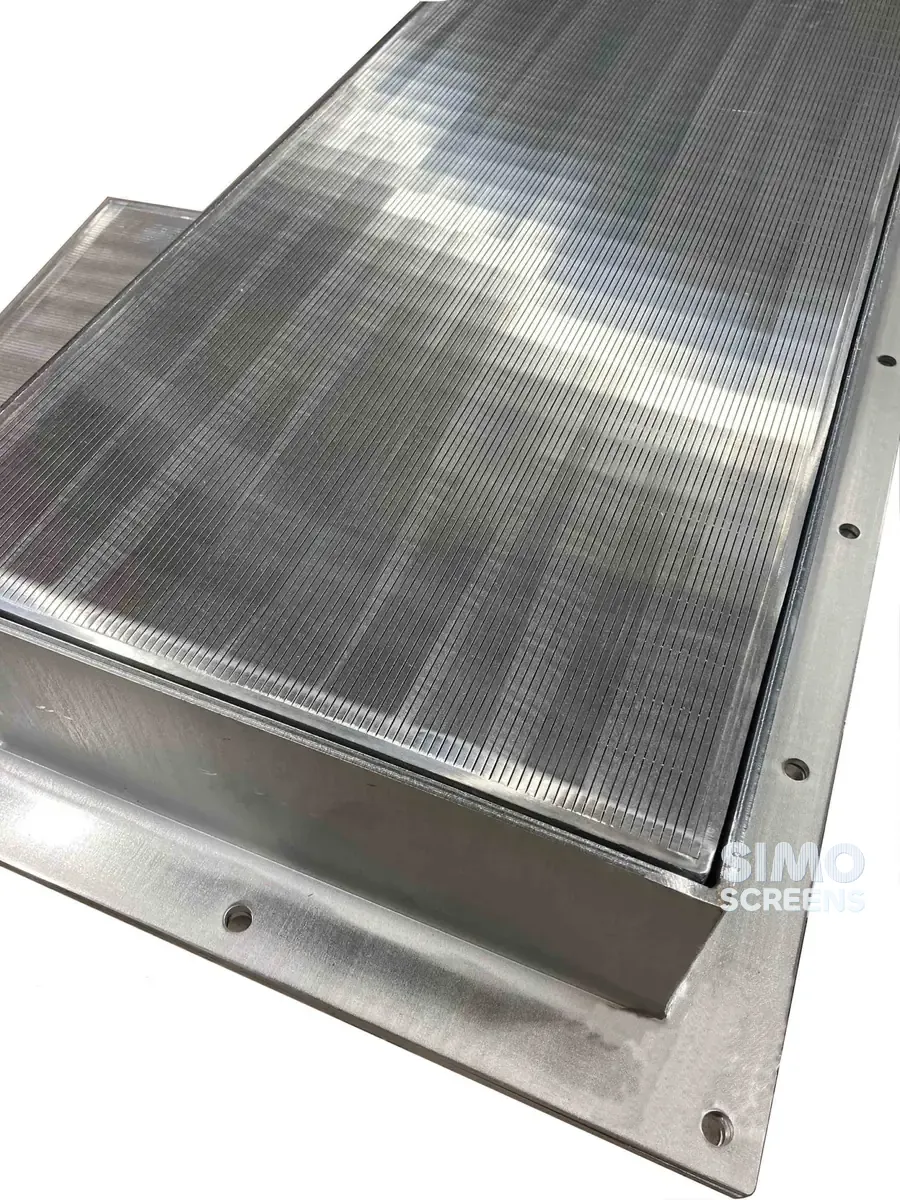
False bottom. A slotted floor raised above the base of a vessel, such as a lauter tun or mash tun, which holds the grain bed while the wort drains through.
FEA. Finite element analysis: numerical modelling of stress and deflection, used to check a screen against its structural loads.
Feeler gauge. A set of precision blades of known thickness, used to check the slot of a wedge wire screen at the face.
Filter nozzle. A small slotted strainer fitted into the floor plate of a filter vessel, which retains sand, carbon or resin and spreads backwash flow. Also called a strainer.
Flat panel. A flat wedge wire screen section, used for decks, false bottoms, floors and framed panels. Usually cut from a welded cylinder and flattened.
Flow configuration. The combination of slot face position and flow direction on a screen, for example radial external, outside to inside.
Full-penetration weld. A weld that fuses the full contact between profile wire and support rod, so the two act as one piece.
G
GAD. General arrangement drawing, showing the overall dimensions, connections and layout of a screen or assembly.
Gravel pack. Graded gravel or coarse sand placed around a well screen, between the screen and the borehole wall, which holds back the formation and allows a larger slot.
H
Header and lateral. An underdrain or distributor made of a central header pipe with slotted lateral pipes branching from it. A hub and lateral uses a central hub instead of a header.
Heat tint. Oxide colouring left on stainless steel by welding. It lowers local corrosion resistance and is usually removed by pickling.
I
Inside to outside. Flow direction in which fluid passes from the inside of a cylindrical screen to the outside.
Intake screen. A screen at a river, lake, canal or sea intake that keeps debris and fish out of the pumped flow, usually sized for a maximum through-slot velocity.
IS 8110. The Indian Standard for well screens and slotted pipes. SIMO water well screens are made to IS 8110:2019.
J
Johnson screen. A trade name of Johnson Screens (Aqseptence Group), often used generically for a continuous slot, wire-wrapped well screen. The generic terms are wedge wire screen or continuous slot screen; SIMO Screens is not affiliated with the trade name owner.
L
Lauter tun. A brewing vessel that separates sweet wort from spent grain. The grain bed rests on a slotted false bottom, often wedge wire.
M
Mesh. The number of openings per linear inch in woven wire cloth. For test sieves, a sieve number tied to a fixed opening, as in ASTM E11.
Micron. One thousandth of a millimetre (0.001 mm), also written µm. Fine slots are usually stated in microns.
Mill Test Certificate (MTC). The document recording the chemistry and mechanical properties of the material heat used. SIMO supplies one with every product as standard.
O
Open area. The share of a screen surface that is open, in percent. For wedge wire: Open area (%) = Slot x 100 / (Slot + Wire width).
Outlet basket. A cylindrical screen at a vessel outlet that retains media or protects downstream pumps and equipment. Also called an outlet collector.
Outside to inside. Flow direction in which fluid passes from the outside of a cylindrical screen to the inside.
P
Passivation. Chemical treatment that restores the protective chromium oxide film on stainless steel after fabrication, commonly to ASTM A380 or A967.
Pegging. Particles close to the opening size lodging in the openings of a screen deck and blocking them.
Pickling. Acid treatment that removes heat tint and scale from stainless steel welds.
Pitch. The centre-to-centre spacing of wires (wire pitch) or rods (rod pitch). Wire pitch equals wire width plus slot.
PMI. Positive material identification: a check of alloy composition on the finished item, usually by portable analyser.
PREN. Pitting resistance equivalent number: %Cr + 3.3 x %Mo + 16 x %N, used to rank stainless steels for chloride pitting resistance.
Pressure screen. A screen basket in a closed, pressurised housing, used in pulp and paper stock preparation to remove contaminants from fibre.
Profile code. The manufacturer's designation for a profile wire, such as 12SB or 42SB, which fixes its shape, head width and height.
Profile wire. The V-shaped wire that forms the face and slot of a wedge wire screen. Also called V-wire, surface wire or wrap wire.
Q
QAP. Quality assurance plan: a document listing the inspections, tests, acceptance criteria and records for an order. SIMO supplies it on request.
R
Radial flow. A cylinder construction in which the profile wire is wound around the support rods, so the slots run around the circumference.
Relief angle. The angle at which the sides of the V-profile taper away from the face, which makes the slot widen behind the face.
Resin trap. An inline strainer that captures ion exchange resin or other media escaping from a vessel, protecting downstream pumps and plant.
Resistance welding. Welding by passing a high current through the contact between wire and rod, so that the heat generated fuses the joint. SIMO welds on high-frequency transformer machines.
Reverse rolling. Rolling a flat panel with the slot face inside, to form an internal-profile drum for inside to outside flow.
S
Screen tube. A wedge wire cylinder, often with end fittings, used as a pipe-like filter element or well screen.
Seam welding. Continuous resistance welding along a joint, used to close rolled cylinders and where the design calls for it.
Sieve bend. A static, curved wedge wire screen. Slurry flows across the wires, and each wire edge slices off a thin layer of liquid and fines. Also called a DSM screen.
Slot. The clear gap between adjacent profile wires at the screen face, stated in microns or millimetres.
Slot face. The flat head of the profile wire at the slot side, which meets the feed.
Slot tolerance. The permitted variation of the slot from nominal, stated on the drawing. The SIMO standard is plus or minus 5 percent of nominal.
Support grid. A load-bearing wedge wire structure that supports a bed of catalyst, media or grain inside a vessel.
Support rod. The bar to which profile wire is welded at every intersection, which carries the load of the screen. Also called a support wire.
T
Third-party inspection (TPI). Inspection by an independent agency appointed by the buyer, usually against an approved QAP.
Through-slot velocity. The average velocity of flow through the open area of a screen. Fish-protection intakes are typically designed for 0.15 m/s (0.5 ft/s) or less.
Two-point contact. The way an oversize particle rests on a wedge wire face, touching only the two wire edges, so that it cannot wedge into the slot.
U
Underdrain. The collection system at the bottom of a filter or ion exchange vessel, such as filter nozzles in a plate or header and lateral pipes.
V
V-wire. Another name for profile wire, and for a wedge wire screen.
W
Wedge wire screen. A screen made of V-shaped profile wire welded to support rods, forming precise slots that widen behind the face.
Wire width. The width of the flat head of the profile wire, which with the slot sets the open area.
Wrap wire. Another name for profile wire, used mainly for wound cylinders and well screens.
Related products, tools and engineering support
- Overview: the wedge wire screen guide shows how these terms fit together.
- Products: wedge wire cylinders and flat wedge wire panels are the two base forms behind most of these terms.
- Tools: the open area calculator and the mesh to micron converter.
- Engineering: for a screen engineered to the customer's process conditions, see custom engineering.