 +91 93730 08466
 Screen tubes and pipes
 Screen cylinders
 Flat panels and false bottoms
 Candle filter elements
 Water well screens
 Header and hub laterals
 Filter nozzles
 Resin traps
 Support grids
 Sieve bend (DSM) screens
 Centrifuge baskets
 Pressure screen baskets
 Screw press screens
 Rotary drum screens
 Passive intake screens
 Coanda intake screens
 Water and wastewater treatment
 Water wells and groundwater
 Sugar and distillery
 Brewing, malting and beverages
 Food processing
 Mining and minerals
 Oil, gas and petrochemicals
 Chemicals, fertilisers and pharma
 Power generation
 Pulp and paper
 Buildings and drainage

Pressure sand filter nozzle overview
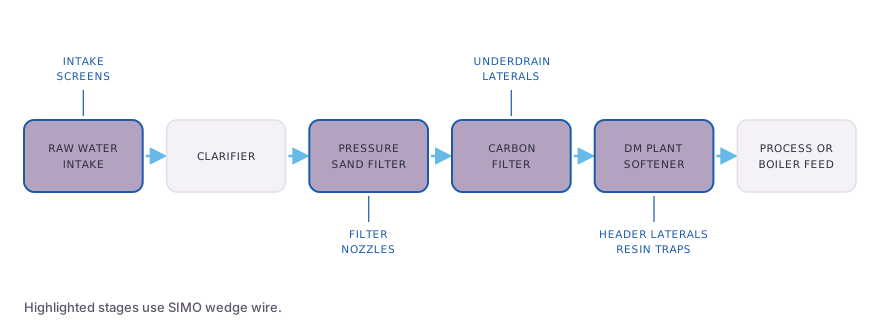
Pressure sand filters (PSF), activated carbon filters (ACF) and multigrade filters (MGF) need an underdrain below the media. Two layouts are common: a nozzle plate with nozzles screwed in at a set pitch, or a header and lateral system. In service, water passes down through the media and leaves through the nozzle slots, and in backwash, water and often air rise through the same nozzles to lift and clean the bed.
Plastic nozzles are widely fitted for their low first cost, and they are also a frequent reason for a filter to be emptied and opened. Polypropylene and ABS nozzles crack at the thread or stem under backwash shock and air scour surges, which lets media pass to the outlet. Plastic slots widen with age and warm water, while iron, biological growth and carbon fines block narrow slots, so backwash channels through a few paths and mud balls form in the dead zones.
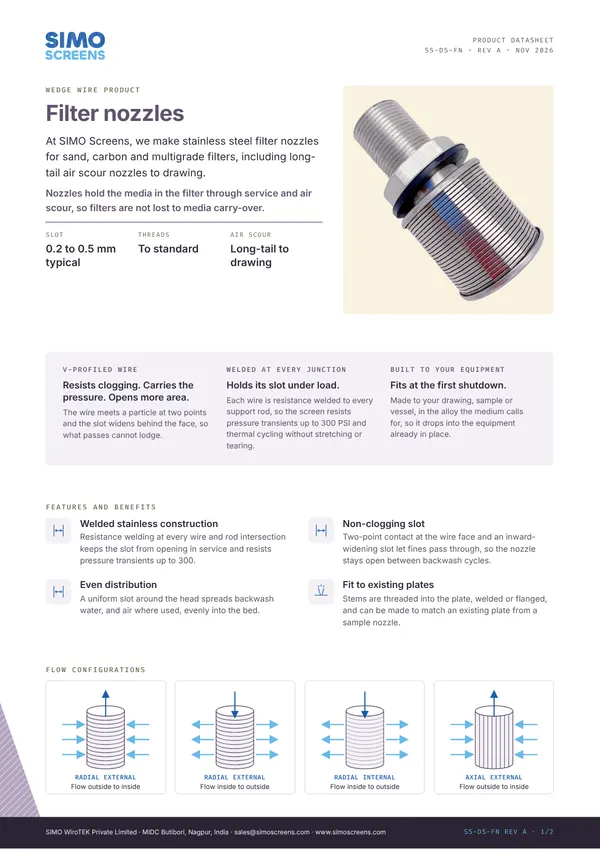
Swipe to see the full drawing.
Design considerations for a sand filter nozzle
Slot. The slot is set to retain the media layer that touches the nozzle. With a gravel or coarse sand support layer, the slot only needs to retain that layer. Where fine sand, anthracite or carbon sits directly on the plate, the slot follows that grain size with a margin, and in general practice slots of about 0.2 to 0.5 mm cover most sand and carbon filters.
Profile and open area. Light profiles such as 12SB or 15SB on Q23 or round 120 rods give a high open area on small heads, while larger heads and high backwash rates use stiffer wire and rods. Open area (%) = Slot x 100 / (Slot + Wire width), so a 0.3 mm slot on 12SB wire, 1 mm wide, gives about 23 percent. Other combinations can be checked in the open area calculator.
Backwash and air scour. Filters with combined air and water backwash use long-tail nozzles with an air hole in the stem, which forms an air cushion below the plate and spreads air evenly across the bed. Stem length is made to the filter drawing.
Strength. Each nozzle head is welded at every wire and rod intersection, and the welded construction resists pressure transients up to 300 PSI, so that heads hold their shape and slot under backwash shock.
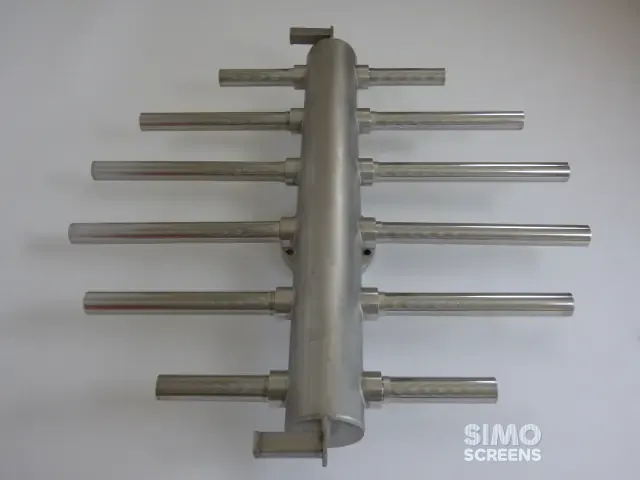
Layout. For filters without a nozzle plate, wedge wire laterals on a header can replace nozzles altogether, which removes the plate and its welds from the design.
Construction and options
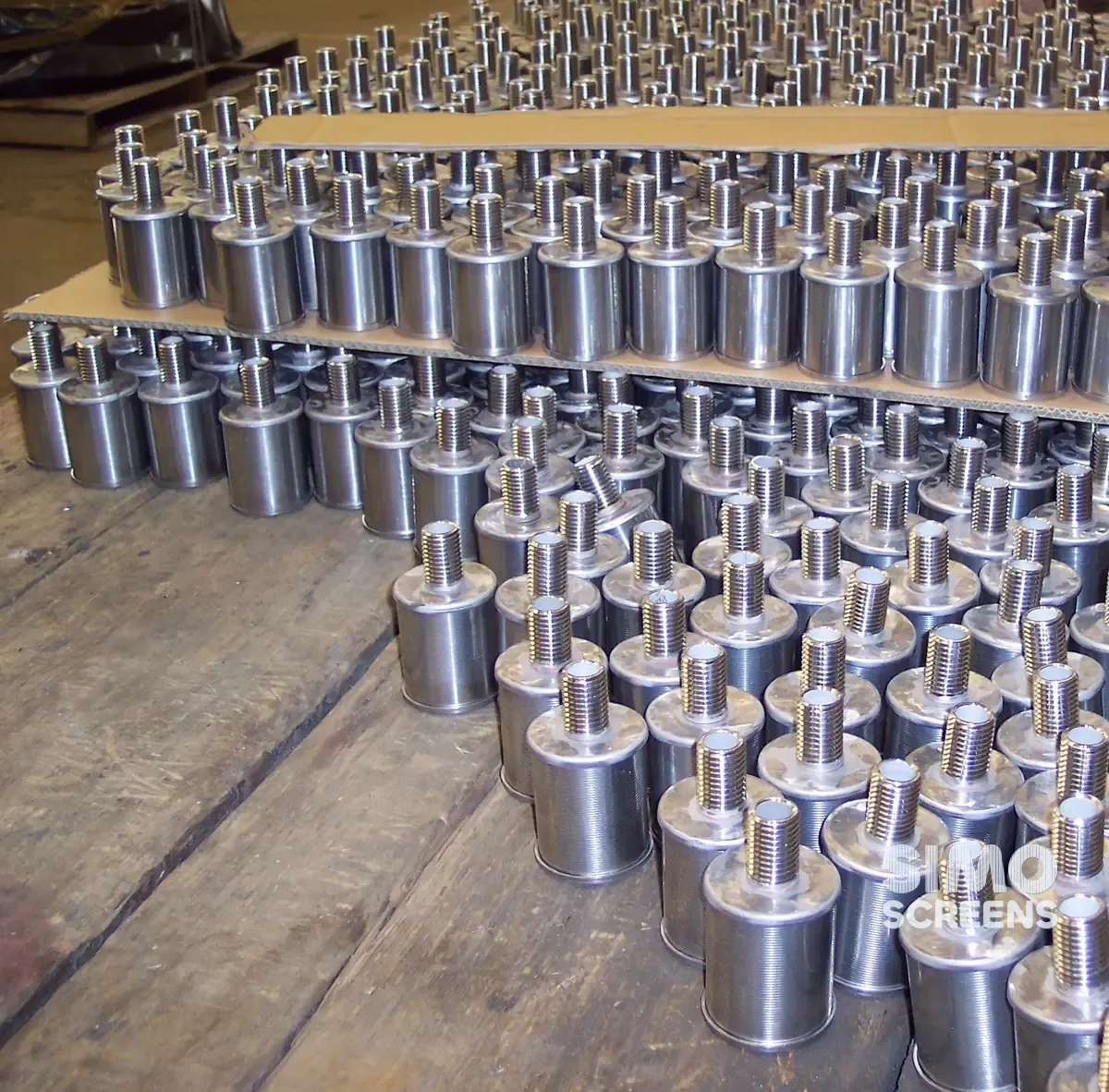
Each nozzle head is a short wedge wire screen of SIMO profile wire, formed in house and wound on support rods, closed with a cap and welded to a threaded stem. Dome and cylindrical heads are supplied with a nut and gasket to suit the nozzle plate, and stem threads follow standard thread sizes and types.
| Item | SIMO range or typical value |
|---|---|
| Slot opening | 25 microns (0.025 mm) to 25 mm; sand and carbon filters typically 0.2 to 0.5 mm |
| Slot tolerance | Plus or minus 5% of nominal, stated on the drawing |
| Head form | Dome or cylindrical, with threaded stem, nut and gasket |
| Stem | Short tail, or long tail with air hole; length as per drawing |
| Thread | Standard thread sizes and types |
| Profile wire | 12SB, 15SB, 18SB |
| Support rods | Q23, Q35, round 120, round 140 |
| Pressure | Welded construction resists pressure transients up to 300 PSI |
Swipe sideways to see the whole table.
Slot width is checked with feeler gauges at set-up, during the run and on finished heads, and a batch of nozzles is supplied with the Mill Test Certificate as standard.
Materials
SS 304 suits most raw and municipal water. SS 316L is used where chlorides or chlorine dosing are present, and Duplex 2205 or Super Duplex 2507 is selected for seawater pretreatment filters. A dimensional inspection report and QAP are supplied on request.
Replacement and retrofit
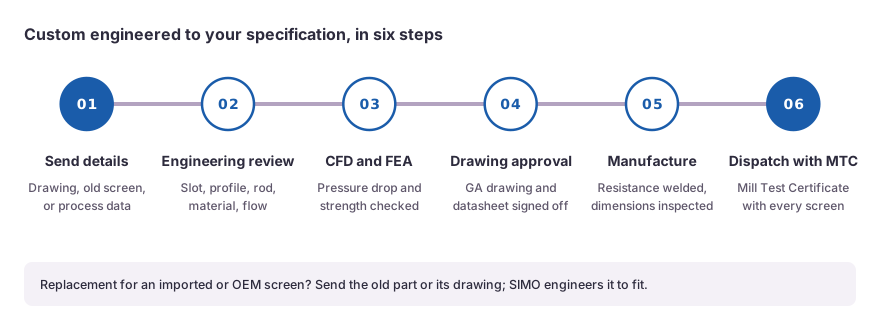
A change from plastic to stainless nozzles is the most common order, and plastic, imported and OEM nozzles are replaced from a sample or a drawing. The thread, stem length and nozzle count are matched, so that new nozzles fit the existing plate holes.
The nozzle plate should be inspected while the filter is empty, because a bowed or cracked plate continues to break nozzles, and a header and lateral underdrain may be the better long-term solution. Media is usually replaced at the same visit, since migrated media has mixed between layers. Our filter nozzles page gives the product range, and the slot and open area guide covers slot choice.
What to send for a quotation
- Filter type (PSF, ACF or MGF) and vessel diameter.
- Underdrain layout: nozzle plate or header and lateral, with nozzle count and pitch.
- Nozzle thread size and type, and plate thickness.
- Media layers from the bottom up, with the grain size of the layer that touches the nozzle.
- Service flow, and backwash rates for water and air.
- Water analysis: chlorides, chlorine dosing and iron.
- A sample or drawing of the existing nozzle, with stem length.

 Upload a drawing