 +91 93730 08466
 Screen tubes and pipes
 Screen cylinders
 Flat panels and false bottoms
 Candle filter elements
 Water well screens
 Header and hub laterals
 Filter nozzles
 Resin traps
 Support grids
 Sieve bend (DSM) screens
 Centrifuge baskets
 Pressure screen baskets
 Screw press screens
 Rotary drum screens
 Passive intake screens
 Coanda intake screens
 Water and wastewater treatment
 Water wells and groundwater
 Sugar and distillery
 Brewing, malting and beverages
 Food processing
 Mining and minerals
 Oil, gas and petrochemicals
 Chemicals, fertilisers and pharma
 Power generation
 Pulp and paper
 Buildings and drainage

Interstage screens overview
A carbon-in-leach (CIL) or carbon-in-pulp (CIP) circuit is a train of agitated tanks. Pulp flows down the train while activated carbon adsorbs dissolved gold, carbon is advanced up the train against the pulp, and loaded carbon leaves from the first tank. Each tank needs a screen that lets pulp leave while keeping carbon in, which is the function of interstage screening.
A screen that fails affects recovery directly. A broken wire or worn slot passes carbon, and every lost granule carries gold downstream or to the tails. A blinded screen holds pulp back so that levels rise and tanks overflow, while too little screen area crowds carbon against the face and raises attrition and fines.
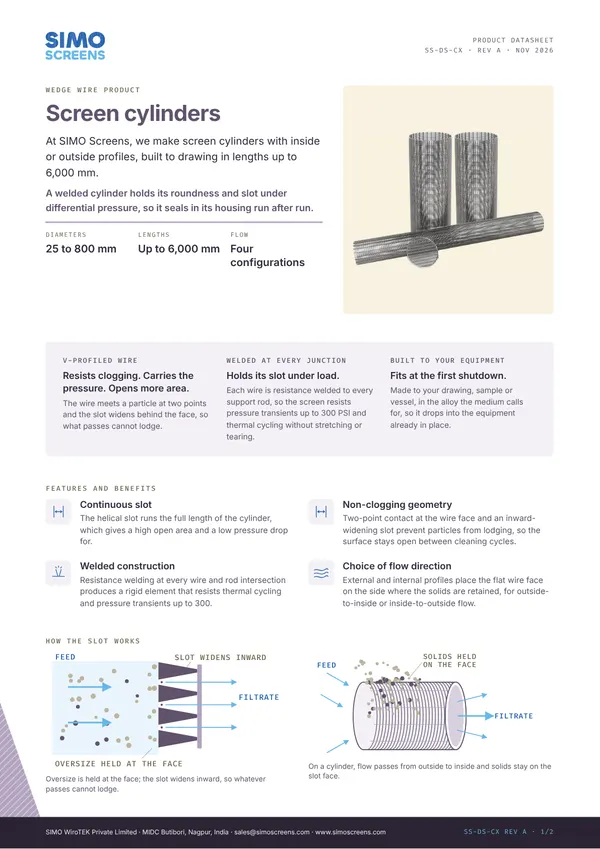
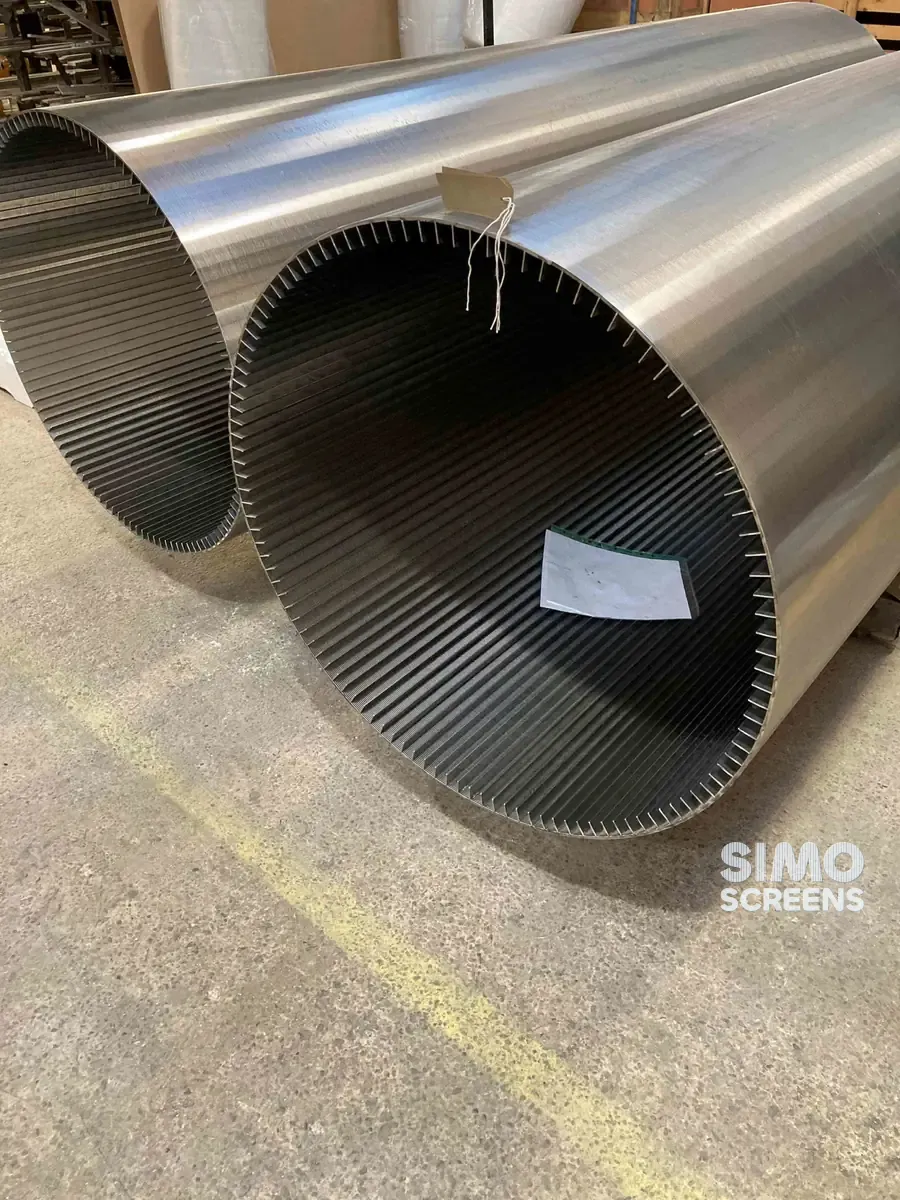
SIMO Screens builds interstage screen cylinders for CIL and CIP circuits to the customer's drawing or process data. See our wedge wire cylinders for the cylinder range.
Design considerations for an interstage screen
Slot selection against carbon size
The slot is set by the carbon size and must sit below the smallest carbon particle to be retained, with a margin for wear. Many plants use 6 x 12 or 6 x 16 mesh carbon, which on the US standard sieve series is about 3.35 to 1.70 mm or 3.35 to 1.18 mm, and slots of about 0.6 to 0.8 mm are common practice for these sizes.
A slot that is too wide passes carbon fines and the gold they carry, while a slot that is too narrow loses flux and blinds with near-size grit. Carbon breaks down in service, so the size of carbon in the tanks should be checked as well as the new carbon. The slot and open area guide explains the trade-off.
Open area and flux
Screen capacity depends on open area and on the pulp, and dense or viscous pulp, high carbon loading and fine grind all reduce the flow each square metre will pass. Open area (%) = Slot x 100 / (Slot + Wire width). A 0.8 mm slot on 28SB wire, 2.2 mm wide, gives about 27 percent open area, and a 0.6 mm slot on 18SB, 1.8 mm wide, gives 25 percent. Options can be checked in the open area calculator.
A lighter wire gives more open area with less wear allowance, while a heavier wire lasts longer but needs more screen area for the same flow. Screen area is sized from the pulp flow, the density and the margin required for surges.
Wear and blinding
Abrasive pulp wears the top of each wire, and the slot widens slowly until it passes carbon, with wiper or impeller contact adding local wear. Blinding comes from near-size carbon chips, grit and trash, typically wood fibre and plastic where upstream trash screening is weak. Welding at every wire and rod intersection keeps wires from lifting or breaking loose, and the slot should be measured and recorded at each planned shutdown.
Construction and options
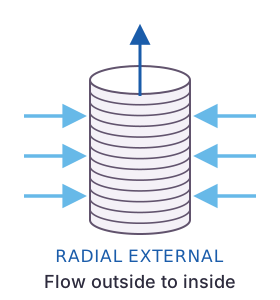
Most interstage screens are wedge wire cylinders with pulp flowing from outside to inside. The wire profile faces the pulp and the slot widens inward, so that particles which pass the face do not wedge.
Vertical swept or wiped screens. A vertical cylinder stands in the tank or in a box at the tank wall, and rotating blades or wipers sweep the outer face to move carbon away from the wire. Wiper clearance is small, so the cylinder must stay round under pulp load and wiper contact.
Horizontal or pumped screens. A horizontal cylinder sits in the tank and carries an internal impeller that draws pulp through the wire and lifts it to the next tank, so that the screen also works as a low-head pump. The cylinder carries torque and cyclic load as well as pulp pressure, which makes rod size, ring spacing and end connections critical.
Scope of supply is agreed per order, from the wedge wire cylinder with frames and flanges to a wider scope that includes wipers, impellers and drive parts. Cylinders are built in diameters from 25 to 800 mm and lengths up to 6,000 mm, with slot tolerance of plus or minus 5 percent of nominal stated on the drawing.
Materials
Leach pulp is alkaline, but process water chlorides vary widely between sites. SS 304 and SS 316L suit many circuits, Duplex 2205 adds strength and hardness where wear limits life, and Duplex 2205 or Super Duplex 2507 is recommended on high-chloride process water. Each screen is supplied with a Mill Test Certificate, and a dimensional inspection report and PMI through an approved agency are available on request. See material selection and our mining and mineral processing page.
Replacement and retrofit
Imported and OEM interstage screens are replaced from a sample or a drawing. A used screen is measured for diameter, length, end connections, slot and wire, and the cylinder is matched to the existing wiper or impeller mechanism. One spare cylinder per screen allows a change to be made as a planned job.
What to send for a quotation
- Circuit type, CIL or CIP, and the screen type: vertical swept, horizontal pumped or other.
- Drawing of the current screen, or a used screen for measurement.
- Cylinder diameter, length and end connection details.
- Carbon size, new and in service.
- Pulp flow per tank, solids density and grind size.
- Current slot, wire and screen life, with the failure mode.
- Process water pH and chlorides.
- Scope required, and the wiper, impeller or drive details the cylinder must suit.
Send these through our request a quote page.

 Upload a drawing