 +91 93730 08466
 Screen tubes and pipes
 Screen cylinders
 Flat panels and false bottoms
 Candle filter elements
 Water well screens
 Header and hub laterals
 Filter nozzles
 Resin traps
 Support grids
 Sieve bend (DSM) screens
 Centrifuge baskets
 Pressure screen baskets
 Screw press screens
 Rotary drum screens
 Passive intake screens
 Coanda intake screens
 Water and wastewater treatment
 Water wells and groundwater
 Sugar and distillery
 Brewing, malting and beverages
 Food processing
 Mining and minerals
 Oil, gas and petrochemicals
 Chemicals, fertilisers and pharma
 Power generation
 Pulp and paper
 Buildings and drainage
 Datasheet

Stainless steel drainage grate overview
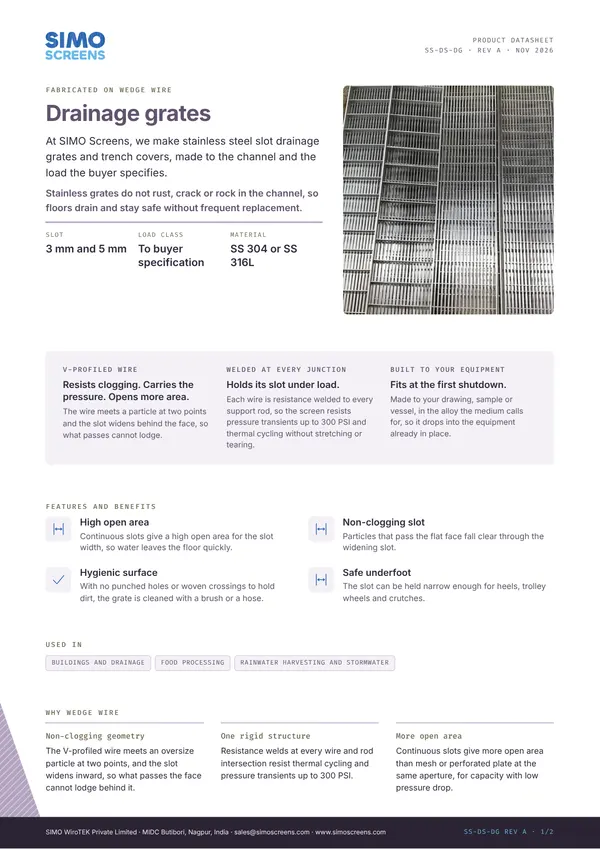
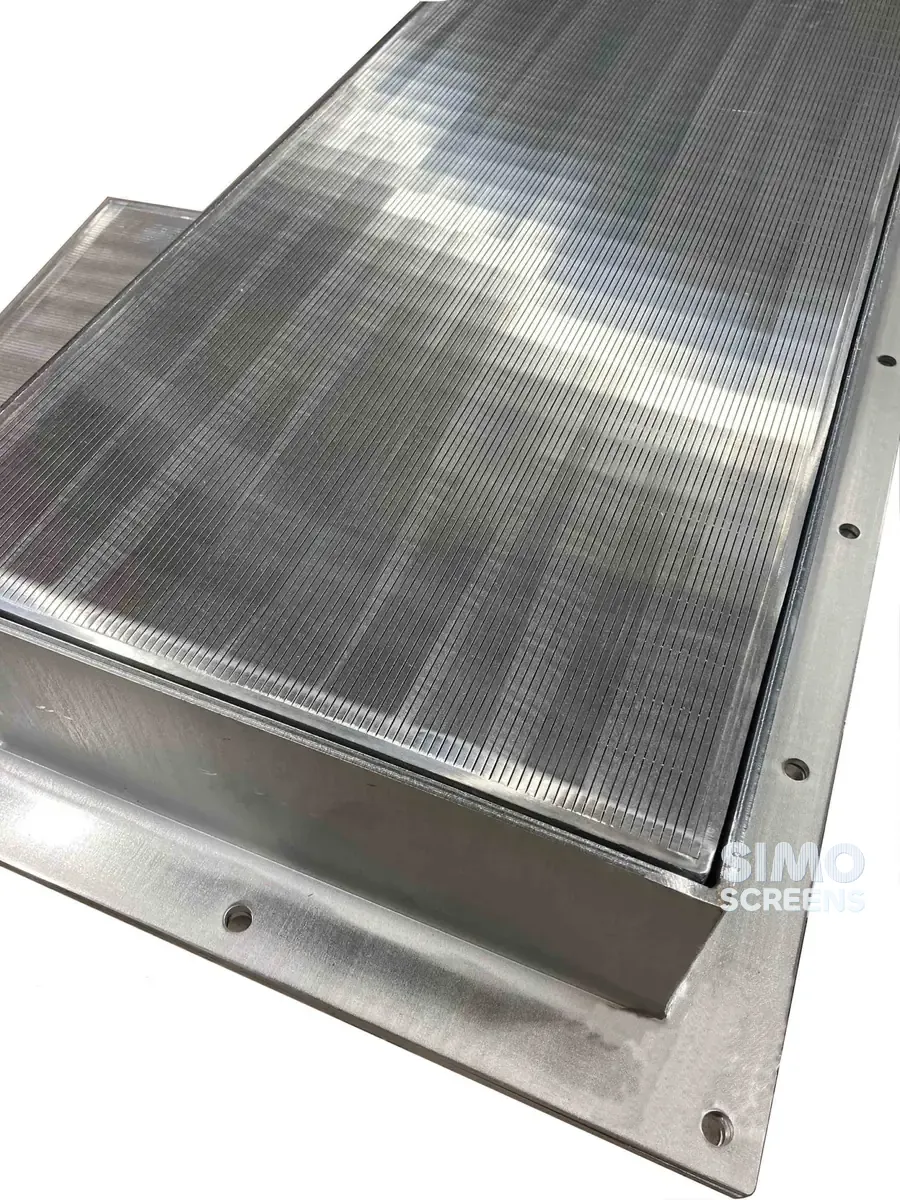
SIMO Screens stainless steel drainage grates cover floor channels and trench drains, with V-profile wire resistance welded to support rods in a stainless frame that seats on the channel ledge. Specifications also call them trench drain grates or slot drain grates.
The flat face of the profile wire forms the walking surface, while the slot between wires widens below that face. Water and fine solids pass straight through instead of lodging, so the grate drains quickly and stays clean between washdowns.
Features and benefits
- High open area. Continuous slots give a high open area for the slot width, so water leaves the floor quickly; the open area calculator works it out for any profile.
- Non-clogging slot. Particles that pass the flat face fall clear through the widening slot, which keeps food waste and grit from wedging and decaying in the grate.
- Hygienic surface. With no punched holes or woven crossings to hold dirt, the grate is cleaned with a brush or a hose.
- Safe underfoot. The slot can be held narrow enough for heels, trolley wheels and crutches; accessibility codes such as the US ADA standards limit floor openings to 13 mm.
- Rigid welded construction. Every wire and rod intersection is resistance welded, so each grate is a single rigid piece.
Applications
- Commercial kitchens and canteens, where floors are washed down several times a day, usually with 3 mm or 5 mm slots running along the grate; see commercial kitchen drainage grates.
- Food and dairy plants, where drains must be easy to clean and inspect, as described under food and beverage.
- Hospitals and laboratories, where hygiene and trolley traffic both matter.
- Car parks, ramps and service yards, where vehicles cross the drain.
- Entrances, plazas and podiums, where heel safety and appearance count; see buildings, architecture and drainage.
Construction and specifications
| Item | Options |
|---|---|
| Slot | Heel-safe to coarse outdoor slots; 3 mm and 5 mm common in kitchens |
| Profile wire | Light, standard or heavy duty, from 12SB to 56SB |
| Support rod | Flat rods F123, F203 or F253, selected for span and load |
| Wire direction | Along the length of the grate or across it, to suit the traffic |
| Panel size | Single panels up to 2,400 mm wide and 4,000 mm long, divided into liftable sections |
| Material | SS 304 or SS 316L |
| Frame | Loose angle frame, cast-in frame and seating angles, or an existing ledge |
| Fixings | Loose lay, lifting slots or locking fixings |
| Finish | Pickled and passivated, brushed or electropolished |
Swipe sideways to see the whole table.
SS 316L is selected over SS 304 where salt, chlorides or chlorinated cleaners are present; the material selection guide compares the grades.
Sizing and load design
Channel and seating. The clear width of the channel and the depth to the seating ledge fix the grate size, and the grate is made to sit flush to avoid a trip edge.
Load. Load capacity is set by the support rod height, rod spacing and the clear span across the channel. Load class requirements are specific to the buyer and the country, so each grate is designed to the class in the specification, such as an EN 1433 or EN 124 class, taken as the buyer's requirement and not as a SIMO certification.
Slot and wire direction. Wires laid across the main direction of travel keep slots from catching wheels and heels, while the slot is checked against the expected debris so that it passes water and holds back larger items.
Layout. Sections are made in lengths one person can lift, with corners, tees and end pieces to suit the channel.
Engineering and quality
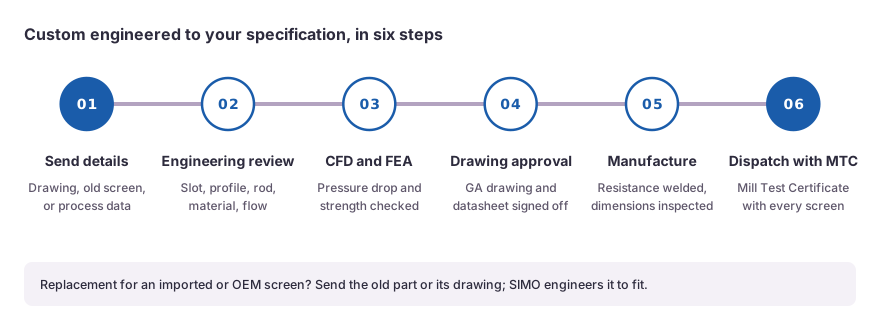
Each order is reviewed for slot, span and load before production, with FEA where a heavy traffic class needs structural validation. Slots are checked with feeler gauges during production to a standard tolerance of plus or minus 5 percent of nominal, and frame welds are visually inspected, with dye penetrant testing wherever specified.
Every order is supplied with a Mill Test Certificate; a dimensional inspection report and a quality assurance plan are available on request.
What to send for a quotation
- Where the grate will be used: kitchen, food plant, hospital, car park or outdoor area
- Clear width of the channel, depth to the seating ledge and total run length
- A layout drawing showing corners, tees, ends and outlets
- Traffic type and the load class in your specification, if one applies
- Maximum slot width allowed and the preferred wire direction
- Material, SS 304 or SS 316L, and the finish
- Frames for a new channel, or grates for an existing one
- Fixing requirements, such as lifting slots or locking fixings
- Quantity and delivery location
 Upload a drawing