 +91 93730 08466
 Screen tubes and pipes
 Screen cylinders
 Flat panels and false bottoms
 Candle filter elements
 Water well screens
 Header and hub laterals
 Filter nozzles
 Resin traps
 Support grids
 Sieve bend (DSM) screens
 Centrifuge baskets
 Pressure screen baskets
 Screw press screens
 Rotary drum screens
 Passive intake screens
 Coanda intake screens
 Water and wastewater treatment
 Water wells and groundwater
 Sugar and distillery
 Brewing, malting and beverages
 Food processing
 Mining and minerals
 Oil, gas and petrochemicals
 Chemicals, fertilisers and pharma
 Power generation
 Pulp and paper
 Buildings and drainage
 Datasheet

Intake screen overview
Open intakes draw in leaves, weed, plastic, sand and fish. Debris blocks pump suctions and strainers, and fish losses can breach environmental conditions. Travelling band screens and bar screens address the problem but need civil works, drives and regular attention.
A SIMO Screens passive intake screen sits in the water body itself. Water enters through a continuous slot at low velocity, so most debris and aquatic life are not drawn onto the screen, and the ambient current carries material past it. The screen has no moving parts in the water, which keeps maintenance low.
Features and benefits
- Low through-slot velocity. The screen surface is sized from the flow and the velocity limit, which protects aquatic life and keeps debris from being held against the face.
- Even velocity along the length. An internal flow modifier evens out the inflow along the screen, so the whole surface works at the design velocity instead of the area nearest the outlet.
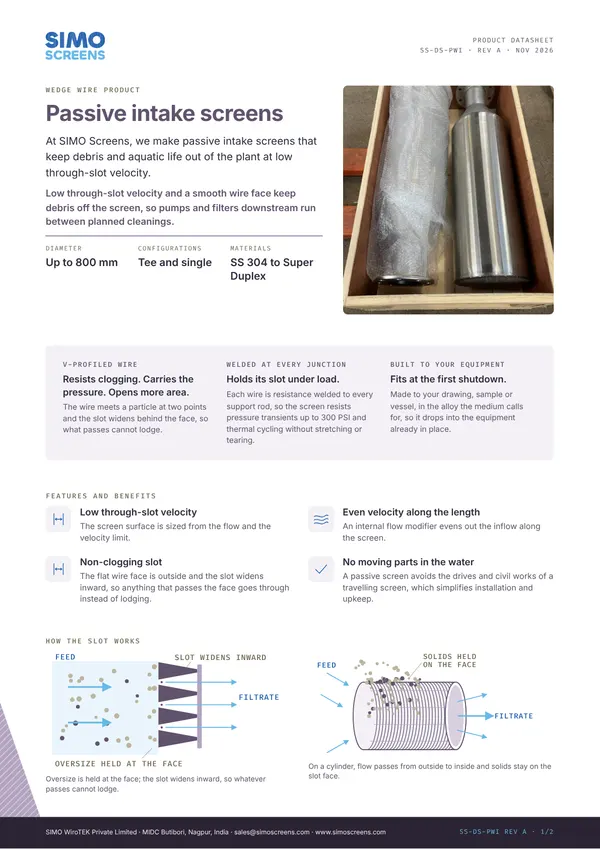
- Non-clogging slot. The flat wire face is outside and the slot widens inward, so anything that passes the face goes through instead of lodging.
- No moving parts in the water. A passive screen avoids the drives and civil works of a travelling screen, which simplifies installation and upkeep.
- Corrosion-resistant construction. Stainless steel and duplex grades are selected by water chemistry for long service life in fresh, brackish and sea water.
Applications
- River, lake and reservoir intakes for municipal and industrial water supply. See river intake screens.
- Cooling water intakes in power generation.
- Raw water intakes for process plants, sugar mills and irrigation schemes.
- Fish protection at canals and pumping stations in aquaculture and fisheries.
- Seawater intakes for desalination and cooling.
Construction and specifications
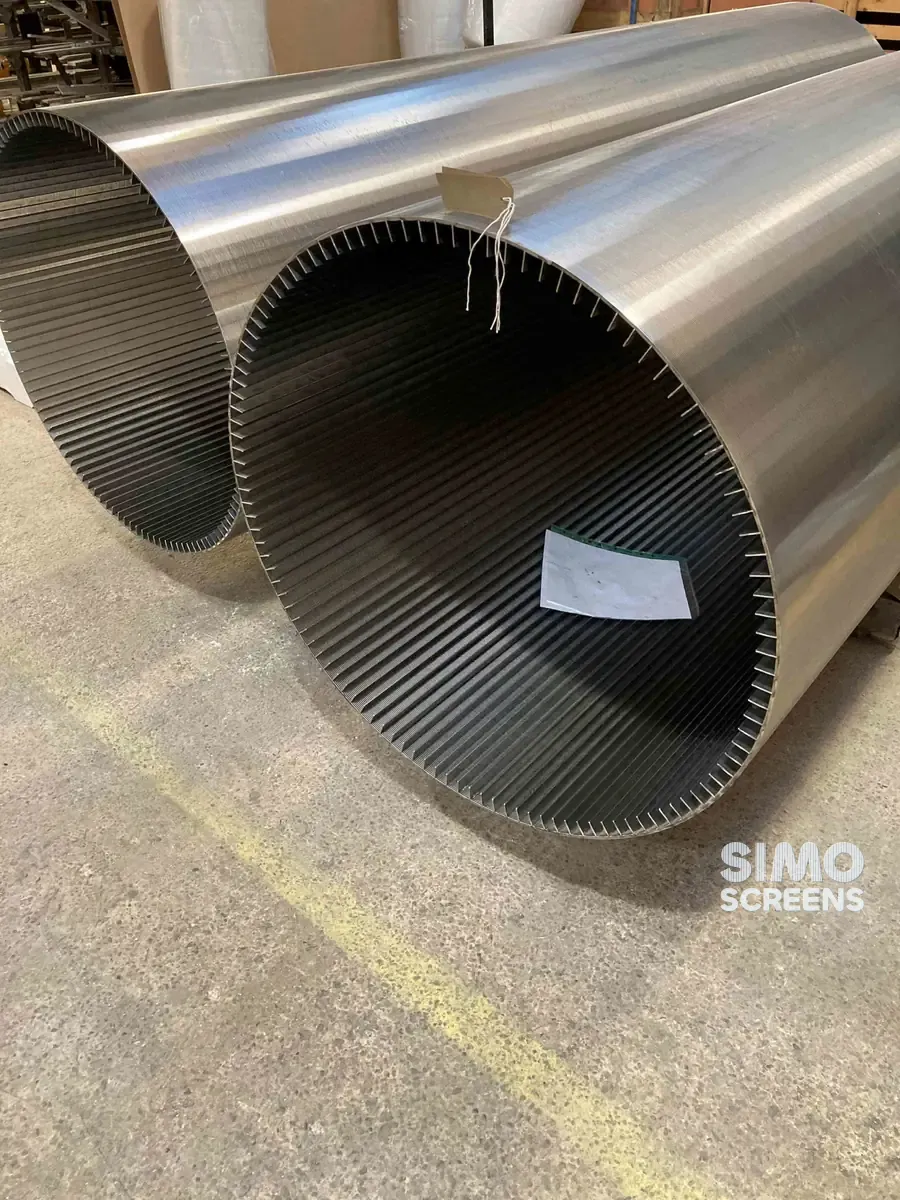
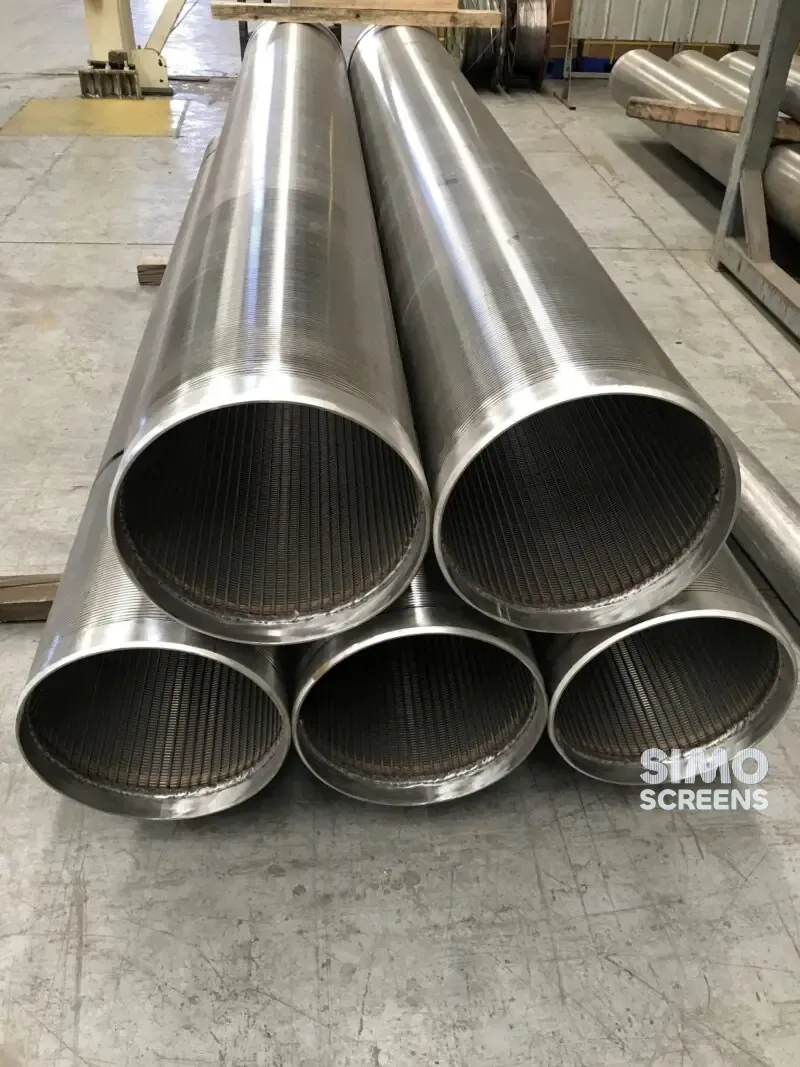
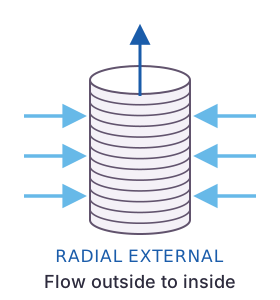
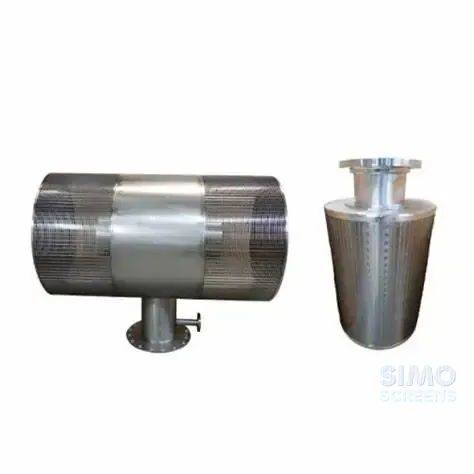
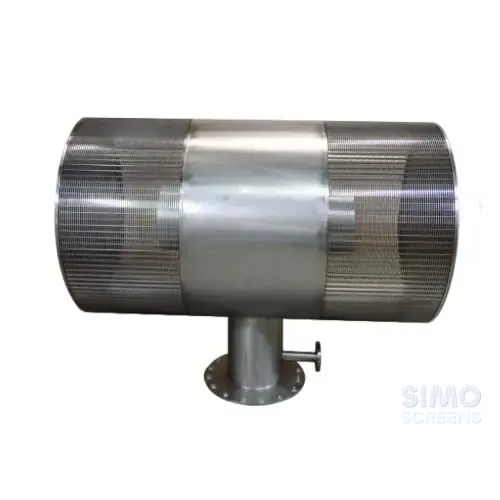
The screen is a wedge wire cylinder with the flat wire face outside, operating in radial flow from outside to inside.
Two main types are built:
- Tee intake screen. Two screen cylinders on either side of a central outlet, drawing water from both directions, for larger flows in a compact layout.
- Single screen. One cylinder with an end outlet, for smaller flows and end-of-pipe suctions.
Each screen has an outlet flange to suit the pipe, closed end caps, lifting lugs and an internal flow modifier. Mounting saddles, skids and support frames are supplied by SIMO to suit the installation.
| Parameter | SIMO range |
|---|---|
| Type | Tee or single |
| Slot opening | 25 microns (0.025 mm) to 25 mm |
| Slot tolerance | Plus or minus 5% of nominal, stated on the drawing |
| Screen diameter | Up to 800 mm |
| Screen length | Up to 6,000 mm |
| Profile wire | Light, standard, heavy duty or custom: 12SB to 56SB |
| Support rods | Q23, Q35, Q55, 35SB, F123, F203, F253, round 120, round 140 |
| Materials | SS 304, SS 316L, Duplex 2205, Super Duplex 2507, Hastelloy, Monel |
| Flow configuration | Radial, external profile, outside to inside |
| Internals and mounting | Internal flow modifier; saddle, skid or support frame |
| Construction | Resistance welded at every wire and rod intersection; resists pressure transients up to 300 PSI |
Swipe sideways to see the whole table.
Sizing water intake screens
Size is set by flow and through-slot velocity. Where fish protection matters, intake screens are typically designed for a through-slot velocity of 0.15 m/s (0.5 ft/s) or less. Open area links slot and velocity: Open area (%) = Slot x 100 / (Slot + Wire width), and the required screen surface follows from the flow, the open area and the velocity limit.
The intake screen design guide and the intake screen calculator set out the method. The installation should leave enough water depth above and around the screen, and enough current past it, for debris to clear.
Materials
SS 316L suits most fresh water. For brackish water and seawater, the grade is selected by pitting resistance: PREN = %Cr + 3.3 x %Mo + 16 x %N. Duplex 2205 and Super Duplex 2507 have a much higher PREN than SS 316L and are the usual choices for seawater.
Engineering and quality
Each passive screen is designed from the flow, water level and velocity limit, with CFD used for pressure drop prediction and FEA for structural validation of custom designs. Slots are checked with feeler gauges through production, the final inspection report records the minimum, maximum and mean slot, and the Mill Test Certificate is supplied as standard. Where airburst cleaning is specified, SIMO provides the air connection and internal air header, and the compressed air system is supplied by others.
What to send for a quotation
- Design flow, normal and maximum.
- Water body: river, lake, reservoir, canal or sea.
- Water depth at low level, and current speed if known.
- Through-slot velocity limit, if specified.
- Debris type and any fish protection requirement.
- Outlet pipe size and flange standard.
- Water analysis, especially chlorides.
- Mounting arrangement required: flange to pipe, saddle, skid or support frame.
 Upload a drawing