 +91 93730 08466
 Screen tubes and pipes
 Screen cylinders
 Flat panels and false bottoms
 Candle filter elements
 Water well screens
 Header and hub laterals
 Filter nozzles
 Resin traps
 Support grids
 Sieve bend (DSM) screens
 Centrifuge baskets
 Pressure screen baskets
 Screw press screens
 Rotary drum screens
 Passive intake screens
 Coanda intake screens
 Water and wastewater treatment
 Water wells and groundwater
 Sugar and distillery
 Brewing, malting and beverages
 Food processing
 Mining and minerals
 Oil, gas and petrochemicals
 Chemicals, fertilisers and pharma
 Power generation
 Pulp and paper
 Buildings and drainage
How to clean wedge wire screens: the principles
Wedge wire resists blinding because of its geometry: each particle touches the slot at two points, and the slot widens behind the face. That geometry does not prevent scale, biofilm, fats or fibre from building up on the surface, so every wedge wire screen still needs planned cleaning and inspection.
A fouled screen shows as longer run-off times, rising differential pressure, sand in a well or wet product from a centrifuge. Correct cleaning restores the open area the screen was designed with, while incorrect cleaning can drive particles into the slot or damage the passive film on the stainless steel.
Identifying the deposit
The cleaning method depends on the deposit, which should be identified before any treatment is chosen.
| Deposit | Typical source | Signs |
|---|---|---|
| Near-size particles | Sand, crystals, resin fines, grain husk | Particles resting on the slot face |
| Mineral scale | Hard water, carbonate or sulphate precipitation, heating | Hard white or brown crust |
| Iron and manganese deposits | Groundwater, iron bacteria | Orange or black slime and crust |
| Biofilm | Warm water, nutrients, stagnant periods | Slippery film, odour |
| Fats, oils and proteins | Food, brewing, dairy, edible oil | Greasy film, residue in the slots |
| Fibre stapling | Pulp, food, wastewater | Fibres draped across the wires |
Swipe sideways to see the whole table.
Condition monitoring
Cleaning is most effective when it follows the condition of the screen. The following measures show when a screen is loading:
- differential pressure across filters, strainers, resin traps and pressure screens;
- flow or specific capacity for wells and intakes;
- run-off time for lauter tuns and dewatering decks;
- product moisture from centrifuges and dewatering screens;
- sand or media in the outlet for wells, laterals and resin traps.
A clean baseline is recorded after installation, and every later reading is compared with it so that a loading trend is seen before it affects the process.
Screen cleaning methods
| Method | How it works | Suits | Cautions |
|---|---|---|---|
| Backwash | Reverse flow lifts solids off the slot face | Nozzles, laterals, candle filters, strainers | Backwash pressure must be within the screen design |
| Air scour or air burst | Air released behind the screen dislodges deposits | Intake screens, media filters | Air volume and pressure must suit the screen and bed |
| Water jetting | A spray nozzle washes the surface | Panels, sieve bends, baskets, drums | Keep a stand-off distance and jet along the slots |
| Brushing | Soft brush along the wires | Panels, false bottoms, sieve bends | Nylon or stainless brushes only, never across the wires |
| Alkaline cleaning | Hot detergent removes organics and fats | Food, brewing, dairy and edible oil service | Rinse thoroughly after cleaning |
| Acid cleaning | Dissolves scale and mineral deposits | Wells, heat-exposed screens, hard water | The acid must suit the alloy |
| Steam cleaning | Heat and moisture loosen residue | Food and hygienic service | Avoid sudden thermal shock on heavy fabrications |
| Ultrasonic cleaning | Cavitation in a bath removes fine deposits | Candle elements and small filter elements | The bath is sized to the element |
Swipe sideways to see the whole table.
Cleaning direction and slot geometry
Cleaning works with the slot geometry when it starts behind the slot face, where the opening is widest.
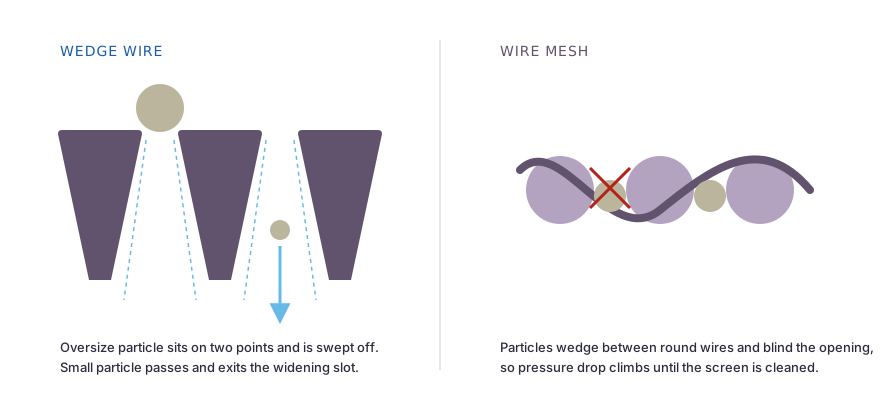
Swipe to see the full drawing.
- Outlet side first. Backwash or jet from behind the slot face, so that particles resting on the face lift away.
- Slot face second. Wash or brush along the wires to remove the material that has lifted.
- No hard jet at the face. A high-pressure jet aimed straight at the face can drive near-size particles into the slot and wedge them there.
For a radial external screen the outlet side is the inside, while for a radial internal screen such as a centrifuge basket it is the outside. The flow configuration guide describes the four arrangements.
Chemical cleaning and stainless steel
Most wedge wire screens are made in stainless steel or a nickel alloy, so the cleaning chemical must not damage the passive film. The following points are general practice for stainless steel.
- Alkaline detergents are widely used for fats, oils, proteins and organics.
- Nitric, citric and phosphoric acid cleaners are widely used for scale, and nitric acid solutions are also used for passivation.
- Hydrochloric acid is avoided on stainless steel because it attacks the passive film and causes pitting.
- Hypochlorite is limited to low disinfection doses, since strong solutions or long contact cause pitting, particularly in warm water.
- A thorough rinse with clean, low-chloride water follows every clean, because drying residues concentrate chlorides on the surface.
For well rehabilitation the acid must also suit the screen alloy. Sulphamic acid is commonly used and is less aggressive to stainless steel than hydrochloric acid, with strength and contact time set by the chemical supplier. Grades with a higher PREN tolerate harsher cleaning, as explained in the material selection guide.
Cleaning by application
Water wells
Loss of yield usually comes from incrustation or biofouling at the screen and in the gravel pack. Rehabilitation combines chemical treatment with mechanical surging or jetting to clear both.
Intake screens
Passive intake screens are commonly cleaned by an air burst system, supplied by others, which blows debris off the screen face. Periodic inspection checks for biofouling and for damage from floating debris.
Lauter tun false bottoms
The false bottom is cleaned in place after each brew. Inspections look for husk lodged under the segments and for segments lifting at their supports, since either affects run-off and rake clearance.
Centrifuge baskets
The basket is washed as the machine cycle allows, and slot wear is checked at regular intervals, because abrasive crystals or coal gradually widen the slot.
Sieve bends
The face is sprayed along the wires to clear fibre and fines. The upstream edges of the wires make the separation and round off as they wear, which reduces the liquid passed and changes the cut. Where the design allows, the screen is reversed end for end to present fresh edges.
DM plant laterals and resin traps
Laterals and nozzles are inspected whenever the vessel is opened for resin change. Resin found in the resin trap indicates a damaged lateral, nozzle or valve upstream.
Wedge wire screen maintenance checklist
The following checks are made at each planned shutdown and recorded against the previous inspection.
- Measure the slot with a feeler gauge at several points along the length and around the circumference.
- Inspect for broken welds and for wires lifting from the support rods.
- Check the wire face for wear, which appears as a flattened or rounded face and a wider slot.
- Check for deformation: dents, out-of-round cylinders and sagging panels.
- Inspect for corrosion at welds, in crevices and under deposits.
- Check fittings, gaskets, clamps and segment joints.
- Record the findings and compare them with the last inspection.
Handling and storage
The slot face is protected throughout handling. A screen is never lifted by its wires, and heavy items are not stacked on panels.
Stainless screens are kept away from carbon steel dust, slings and tools, because iron contamination rusts and can start corrosion, and they are stored dry and covered. Before reinstallation, gaskets and clamps are checked and the flow direction marking is confirmed so that the slot face meets the feed, since a screen fitted the wrong way round blinds quickly.
Repair or replacement
A screen is repaired or replaced when the slot is wider than the process can accept, when welds or wires have failed, or when the screen is deformed. Local damage on a large panel can often be repaired, whereas a slot worn across the whole screen usually calls for replacement.
For a replacement, SIMO Screens needs the measured slot, the profile wire and support rod sizes, and a note of how the old screen failed, so that our engineers can address the cause of the failure as well as reproduce the part. The open area calculator shows how much open area a worn or partly blocked screen retains. Replacement water well screens, intake screens and flat wedge wire panels are made to the original drawing or to a revised design, and screens that foul or wear faster than expected can be reviewed through custom engineering.