 +91 93730 08466
 Screen tubes and pipes
 Screen cylinders
 Flat panels and false bottoms
 Candle filter elements
 Water well screens
 Header and hub laterals
 Filter nozzles
 Resin traps
 Support grids
 Sieve bend (DSM) screens
 Centrifuge baskets
 Pressure screen baskets
 Screw press screens
 Rotary drum screens
 Passive intake screens
 Coanda intake screens
 Water and wastewater treatment
 Water wells and groundwater
 Sugar and distillery
 Brewing, malting and beverages
 Food processing
 Mining and minerals
 Oil, gas and petrochemicals
 Chemicals, fertilisers and pharma
 Power generation
 Pulp and paper
 Buildings and drainage
 Datasheet

Coanda screen overview
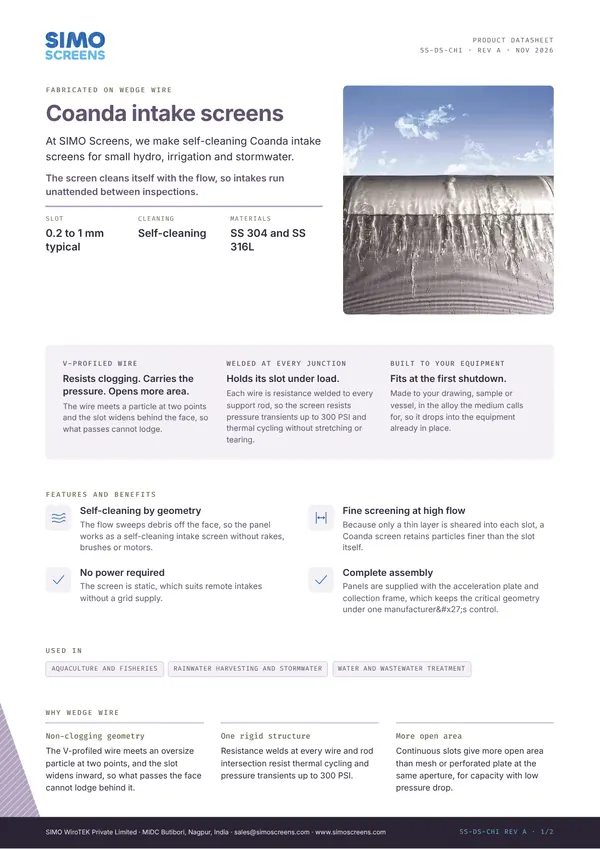
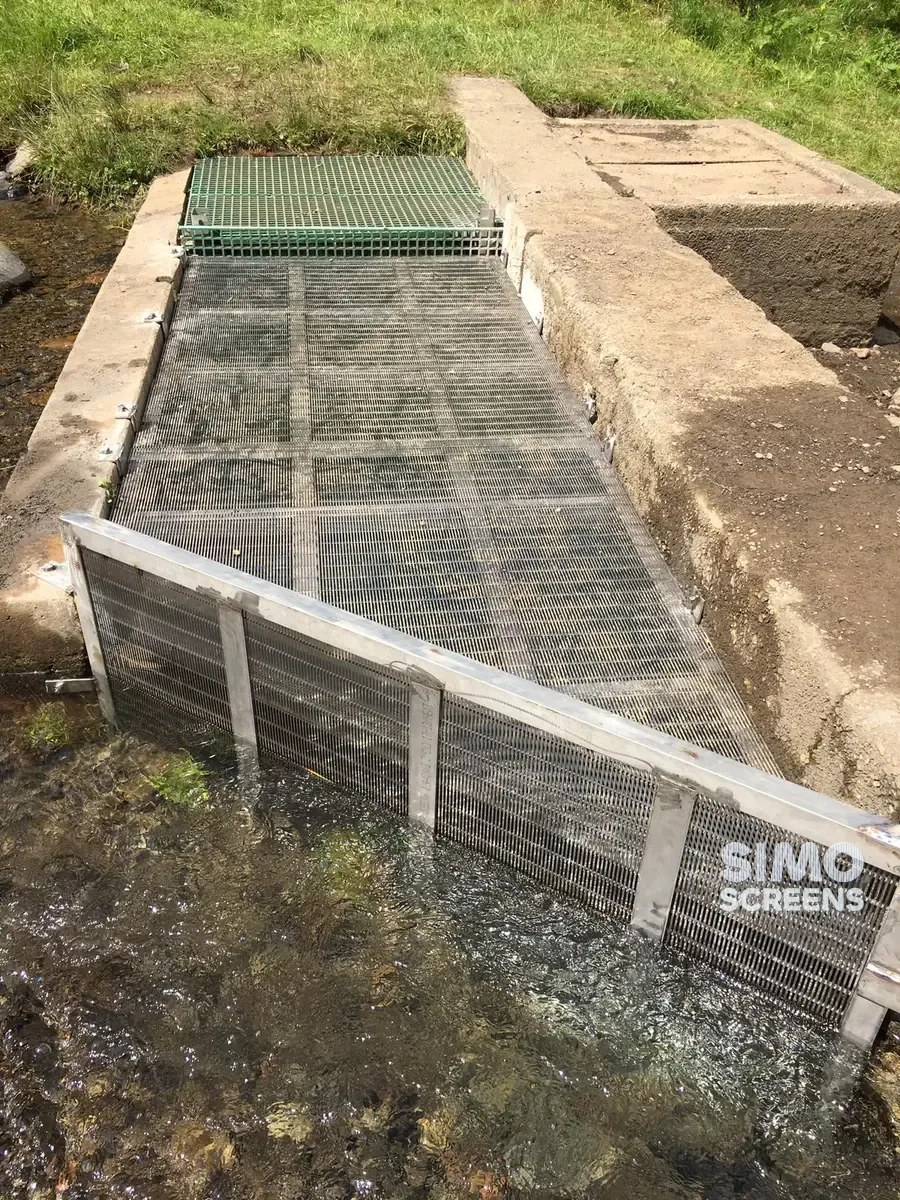
SIMO Screens Coanda screens are static wedge wire panels set on the downstream face of a weir. Water passes over the crest, accelerates down a smooth acceleration plate and then runs across the screen, where the wires lie across the direction of flow.
Each wire is tilted so that its upstream edge stands slightly proud of the one before it. As water clings to the wire face, that edge shears a thin layer into the slot below, and the screened water collects in a channel beneath. Debris, sediment and the remaining flow pass over the face and return to the watercourse.
Features and benefits
- Self-cleaning by geometry. The flow sweeps debris off the face, so the panel works as a self-cleaning intake screen without rakes, brushes or motors.
- Fine screening at high flow. Because only a thin layer is sheared into each slot, a Coanda screen retains particles finer than the slot itself, while the widening slot prevents wedging.
- No power required. The screen is static, which suits remote intakes without a grid supply.
- Complete assembly. Panels are supplied with the acceleration plate and collection frame, which keeps the critical geometry under one manufacturer's control.
- Rigid welded construction. Every wire and rod intersection is resistance welded, so the panel holds its shape under water, sediment and floating debris.
Applications
- Small hydro, on Tyrolean (bottom) intakes and side intakes on hill streams
- Irrigation, on canal offtakes and lift irrigation intakes carrying leaves and sediment
- Stormwater, removing litter and grit from drains before outfalls or detention basins
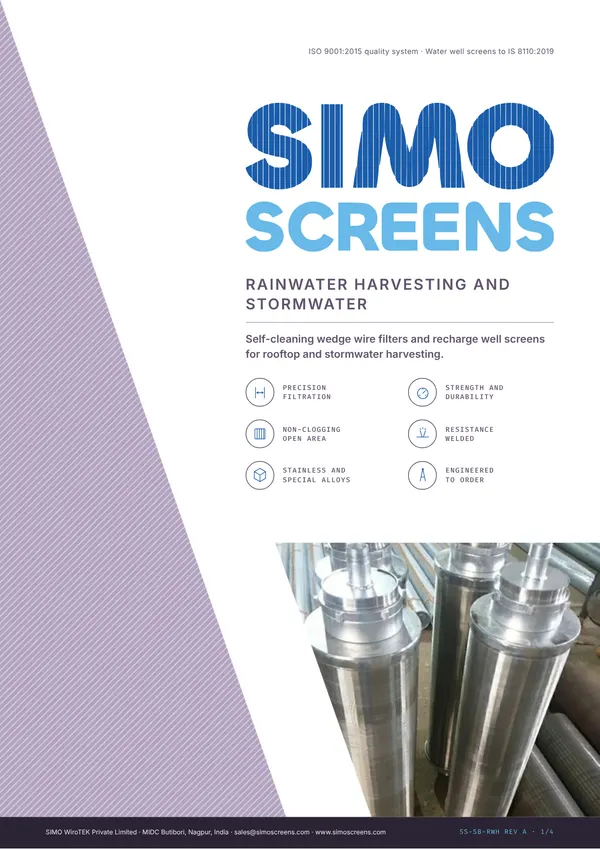
- Rainwater harvesting, for high flows from large catchments before storage or recharge
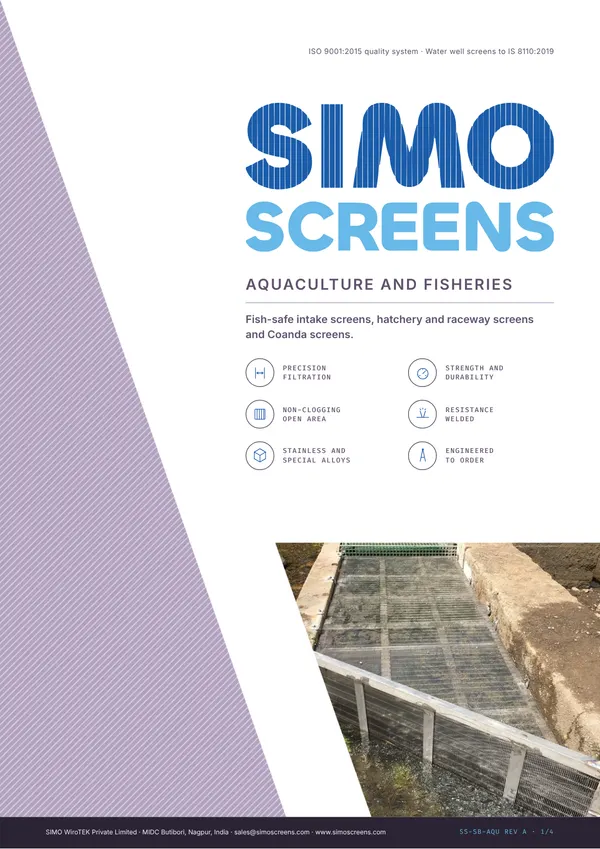
- Fish-friendly intakes, where fish must pass over the screen rather than into it
Related intake products include passive intake screens and wedge wire fish screens.
Construction and specifications
| Item | Options |
|---|---|
| Slot | Fine slots for sediment, coarser slots for leaf and litter removal |
| Wire tilt | Designed together with the slot for the flow and the material to be removed |
| Profile wire | Light, standard or heavy duty to suit sediment load and abrasion |
| Panel form | Curved or flat panels, in modules to suit the intake width |
| Material | SS 304 for fresh water; SS 316L or Duplex 2205 for brackish or aggressive water |
| Frame | Stainless frame with acceleration plate and fixing to the weir |
| Collection | Collection frame, with a fabricated channel or trough below the screen |
Swipe sideways to see the whole table.
Design considerations
Design flow and width. Coanda screens are sized by flow per metre of screen width, so the intake width follows from the flow to be diverted.
Available head. A Coanda intake needs a vertical drop from crest to toe, and a low-head site may be better served by another screen type.
Slot. The slot is set by what must be kept out of the system: sediment ahead of turbines, seeds and leaves for irrigation, or fish life stages at protected sites.
Bypass flow and flow range. Some water must pass over the screen to carry debris away, and performance is checked at both low and flood flows. At very low flows nearly all the water may pass through the screen, while flood flows bring heavy debris loads.
The intake screen design guide and the intake screen calculator cover the related sizing methods.
Engineering and quality
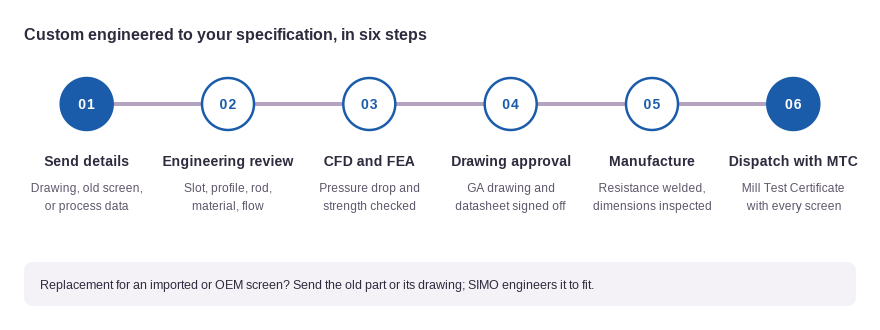
Each design is reviewed for slot, wire tilt, panel span and load before production. Slots are checked with feeler gauges, or by optical measurement where a gauge cannot be used, to a standard tolerance of plus or minus 5 percent of nominal. Every order is supplied with a Mill Test Certificate, with a dimensional inspection report on request.
What to send for a quotation
- Application: hydro, irrigation, stormwater, rainwater or fish-friendly intake
- Design flow to be screened, and the range of river or channel flows
- Available head from the weir crest to the collection channel
- Intake width available and a sketch or drawing of the weir
- What must be removed: sediment size, leaves, litter or fish
- Water quality, fresh or brackish
- Preferred material and panel form, curved or flat
- Number of panels and delivery location
 Upload a drawing