 +91 93730 08466
 Screen tubes and pipes
 Screen cylinders
 Flat panels and false bottoms
 Candle filter elements
 Water well screens
 Header and hub laterals
 Filter nozzles
 Resin traps
 Support grids
 Sieve bend (DSM) screens
 Centrifuge baskets
 Pressure screen baskets
 Screw press screens
 Rotary drum screens
 Passive intake screens
 Coanda intake screens
 Water and wastewater treatment
 Water wells and groundwater
 Sugar and distillery
 Brewing, malting and beverages
 Food processing
 Mining and minerals
 Oil, gas and petrochemicals
 Chemicals, fertilisers and pharma
 Power generation
 Pulp and paper
 Buildings and drainage
 ISO 9001:2015
 IS 8110:2019 well screens
 CFD and FEA design support
 Made in Nagpur, India
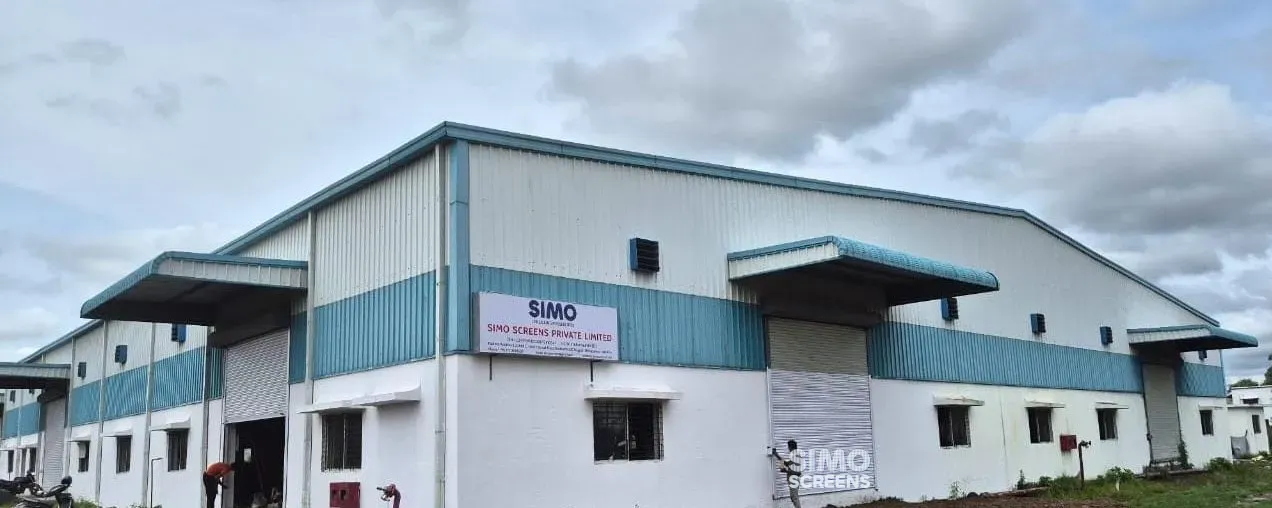
Wedge wire manufacturing plant
SIMO Screens designs, welds, fabricates and inspects its screens at its own wedge wire manufacturing plant in Nagpur. The production line comprises in-house profile wire forming, automated resistance welding on a rotating mandrel for cylinders, flat panel production, a fabrication bay and an inspection area.
With every stage on one site, the engineering team that prepares the drawing works alongside the line that builds the screen, and a single team is responsible for the finished assembly.
Works at MIDC Butibori
Works: Shed C, Plot No. 12, GSP Pyramid, Saigaon Road, MIDC Butibori, Nagpur, Maharashtra 441122.
Registered office: 504 Brij Bhumi, Plot 263/264, CA Road, Near Telephone Exchange Square, Nagpur, Maharashtra 440008.
Butibori is the MIDC industrial area south of Nagpur. Its central position gives road access to plants in every region of India, and screens made at the works are supplied to customers in India and abroad.
Production sequence
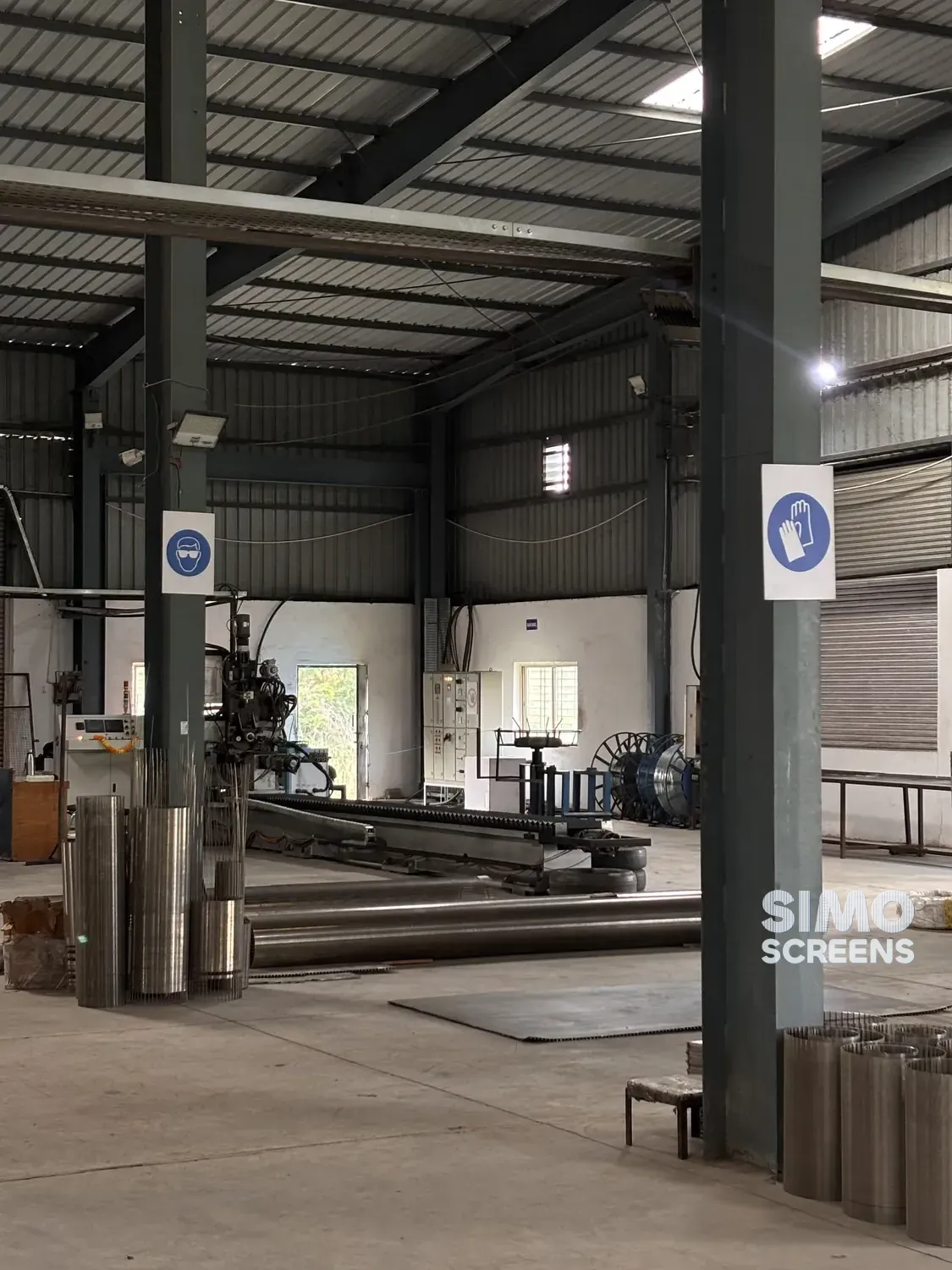
Each screen passes through seven stages, and each stage closes with an inspection point before work moves on.
1. Material receipt
Wire, rod, plate and pipe are received with mill certificates. Inspection point: grade checked against the certificate, then marked and stored apart by grade.
2. Profile wire forming
Profile wire is formed in house to SIMO profile codes, which fix the shape, head width and height of each wire, and is made and stocked by code. The range runs from the light 12SB to the heavy 56SB, with custom profiles made subject to order quantity and frequency. Inspection point: width and height checked against the profile code with a calibrated micrometer before welding.
3. Welding
For cylinders, screen tubes and well screens, support rods are set around a rotating mandrel and the profile wire is wound over them in a continuous spiral. Resistance welding on high-frequency transformer machines fuses the wire to the rod at every intersection, with seam welding where the design calls for it, and the pitch of the spiral sets the slot along lengths up to 6,000 mm.
Flat panels are usually cut from a welded cylinder and flattened. Inside-to-outside drums are made by reverse rolling flat panels or by winding on internal-profile machines. Inspection point: slot checked with feeler gauges on the first length and during each welding run.
4. Fabrication
Frames, flanges, end rings, housings and brackets are added, curved sections are rolled and large panels are divided into segments that pass a manway, as described under fabrication on wedge wire. Inspection point: fit, alignment, ovality and flange squareness against the approved drawing.
5. Cleaning and finishing
Weld discolouration and shop soiling are removed. Pickling and passivation to ASTM A380 or ASTM A967, and electropolishing, are carried out through approved agencies where the specification calls for them. Inspection point: visual check of welds and surface finish.
6. Final inspection
Every finished screen passes dimensional inspection against the approved drawing, with slot held to plus or minus 5 percent of nominal. The checks at each stage are listed on the quality page.
7. Marking, packing and dispatch
Each screen carries a QR-coded tag with its job number, item and slot, and is laser marked as well where the client requires it. Screens are packed to protect the slot face and dispatched with the Mill Test Certificate. Inspection point: marking and contents checked against the order and packing list.
Materials
The works processes SS 304, SS 316L, Duplex 2205, Super Duplex 2507, Hastelloy and Monel. Each grade is identified from receipt to dispatch, so that the alloy recorded on the Mill Test Certificate is the alloy in the screen.
Manufacturing range
| Capability | Range |
|---|---|
| Slot openings | 25 microns (0.025 mm) to 25 mm |
| Diameters | 25 to 800 mm |
| Cylinder and tube lengths | Up to 6,000 mm |
| Single flat panels | Up to 2,400 mm wide and 4,000 mm long; larger decks as joined panels |
| Forms | Flat, cylindrical, conical, curved, segmented |
Swipe sideways to see the whole table.
Profile wire and support rod tables are given under manufacturing capabilities, and the manufacturing method is explained in how wedge wire screens are made.
Works visits
Customers and their inspectors are welcome to witness manufacture or to audit the works before an order. Visits are arranged by appointment through the contact page.
 Upload a drawing