 +91 93730 08466
 Screen tubes and pipes
 Screen cylinders
 Flat panels and false bottoms
 Candle filter elements
 Water well screens
 Header and hub laterals
 Filter nozzles
 Resin traps
 Support grids
 Sieve bend (DSM) screens
 Centrifuge baskets
 Pressure screen baskets
 Screw press screens
 Rotary drum screens
 Passive intake screens
 Coanda intake screens
 Water and wastewater treatment
 Water wells and groundwater
 Sugar and distillery
 Brewing, malting and beverages
 Food processing
 Mining and minerals
 Oil, gas and petrochemicals
 Chemicals, fertilisers and pharma
 Power generation
 Pulp and paper
 Buildings and drainage
 Datasheet

Basket strainer overview
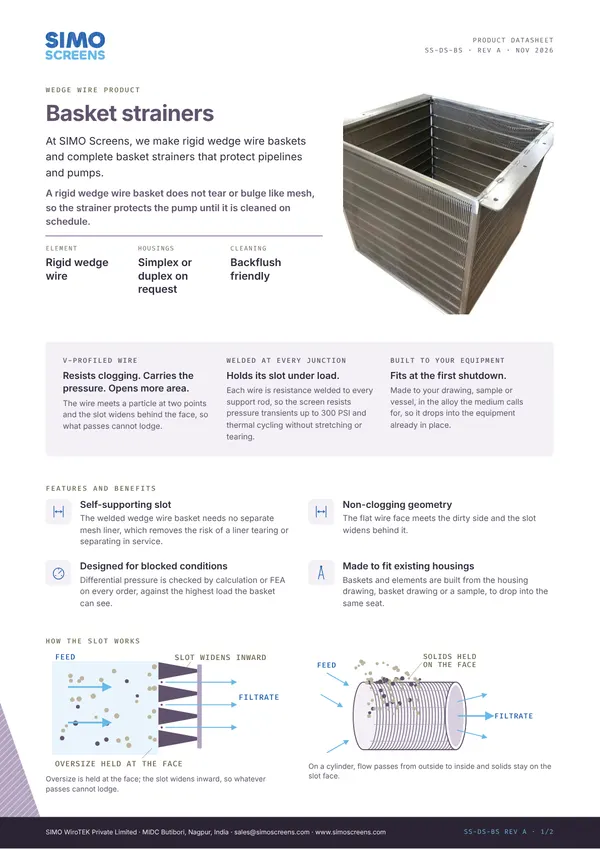
A basket strainer protects the pumps, valves, meters and nozzles downstream of it, and a basket failure sends the collected debris straight into that equipment. Mesh-lined baskets are the usual weak point, because the mesh can tear, separate from the backing plate or blind with fibre and scale.
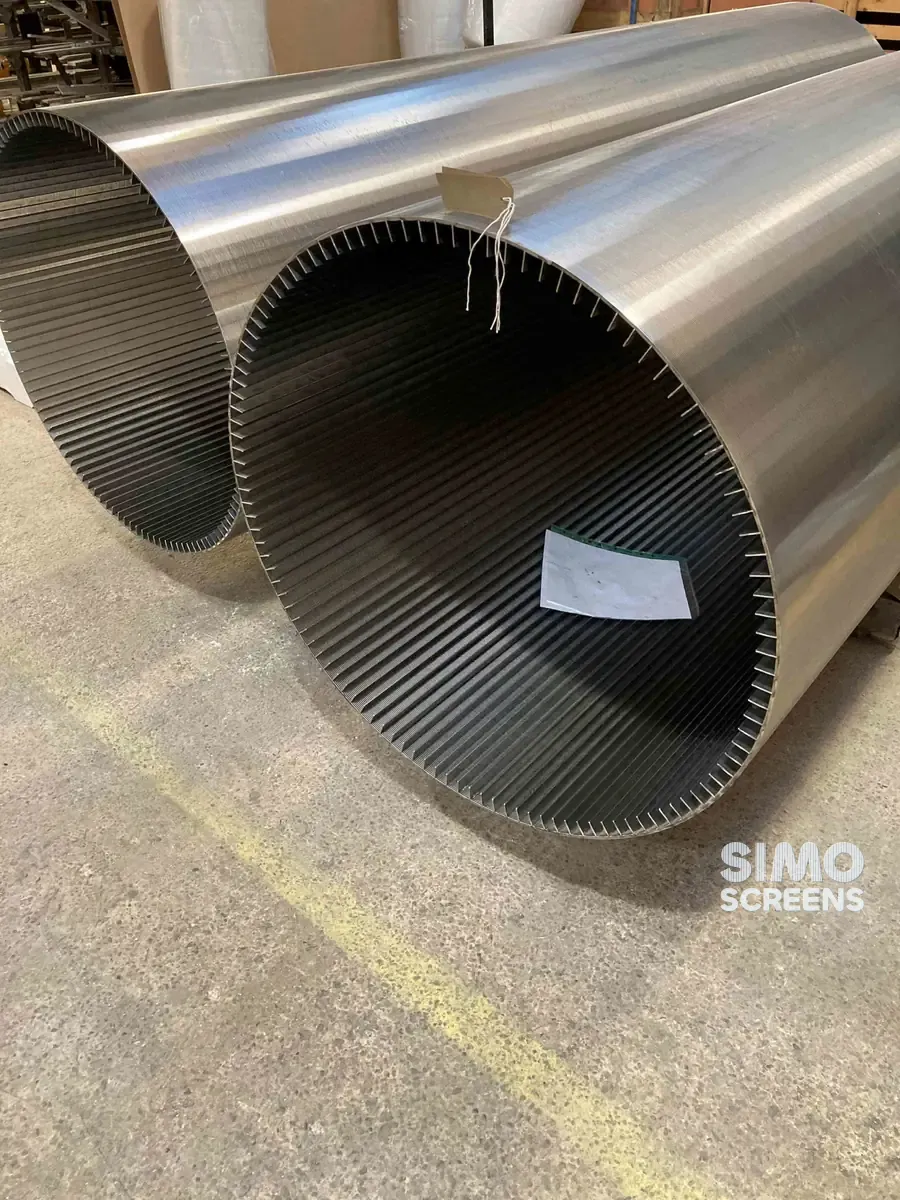
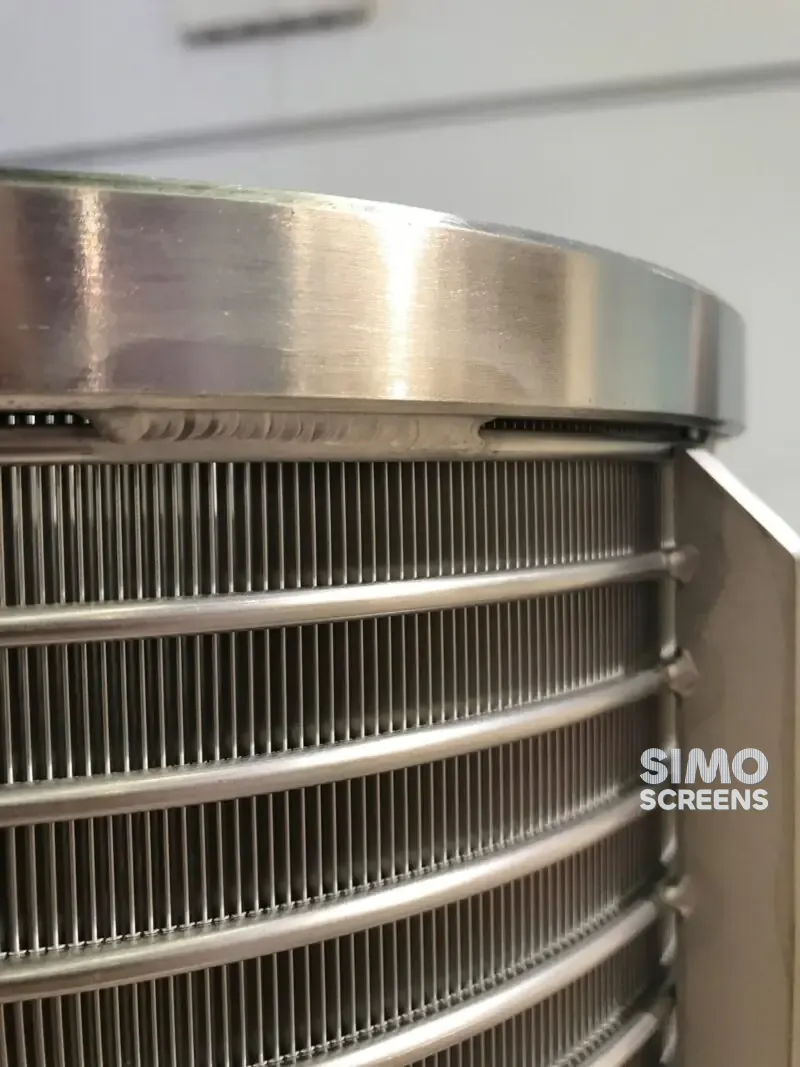
A SIMO Screens wedge wire strainer basket has no liner. The slot is formed by V-profile wire resistance welded to support rods at every crossing, so it holds its width under load, and the V-shaped slot widens in the direction of flow so that particles which enter it pass through instead of wedging.
Features and benefits
- Self-supporting slot. The welded wedge wire basket needs no separate mesh liner, which removes the risk of a liner tearing or separating in service.
- Non-clogging geometry. The flat wire face meets the dirty side and the slot widens behind it, so the basket blinds more slowly and cleans more easily.
- Designed for blocked conditions. Differential pressure is checked by calculation or FEA on every order, against the highest load the basket can see.
- Made to fit existing housings. Baskets and elements are built from the housing drawing, basket drawing or a sample, to drop into the same seat.
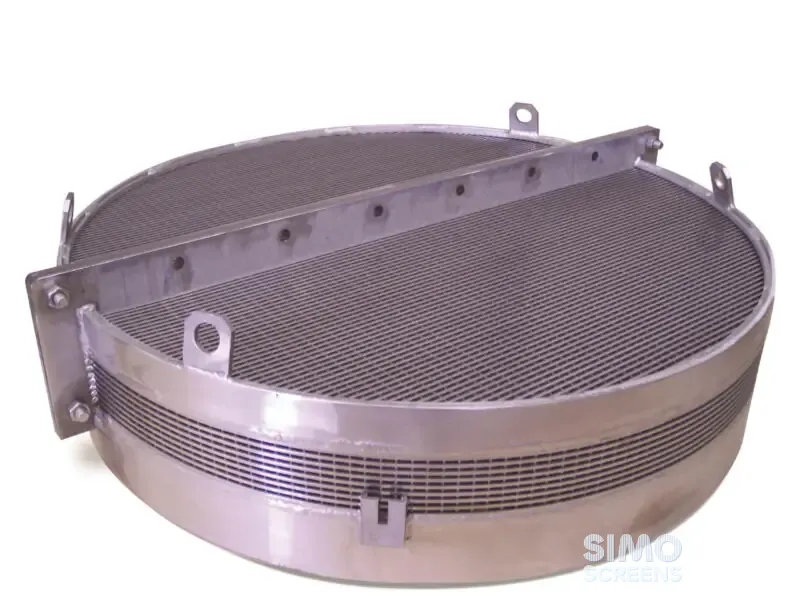
- Options to suit the strainer. Reinforcing rings, a perforated or bar backing, lifting handles and gasketed top rings are available as required.
Applications
- Simplex basket strainers on pump suctions, cooling water lines and transfer lines.
- Duplex basket strainer units, where flow cannot stop and one basket is cleaned while the other is in service.
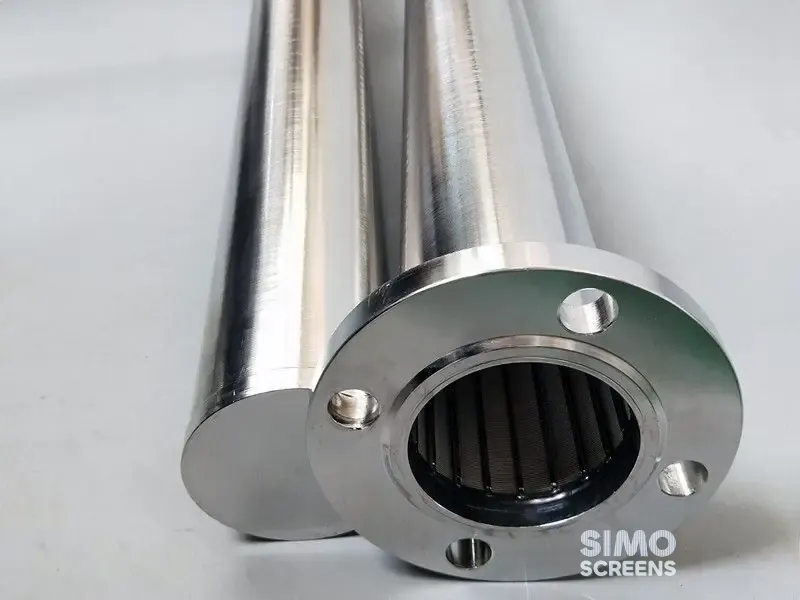
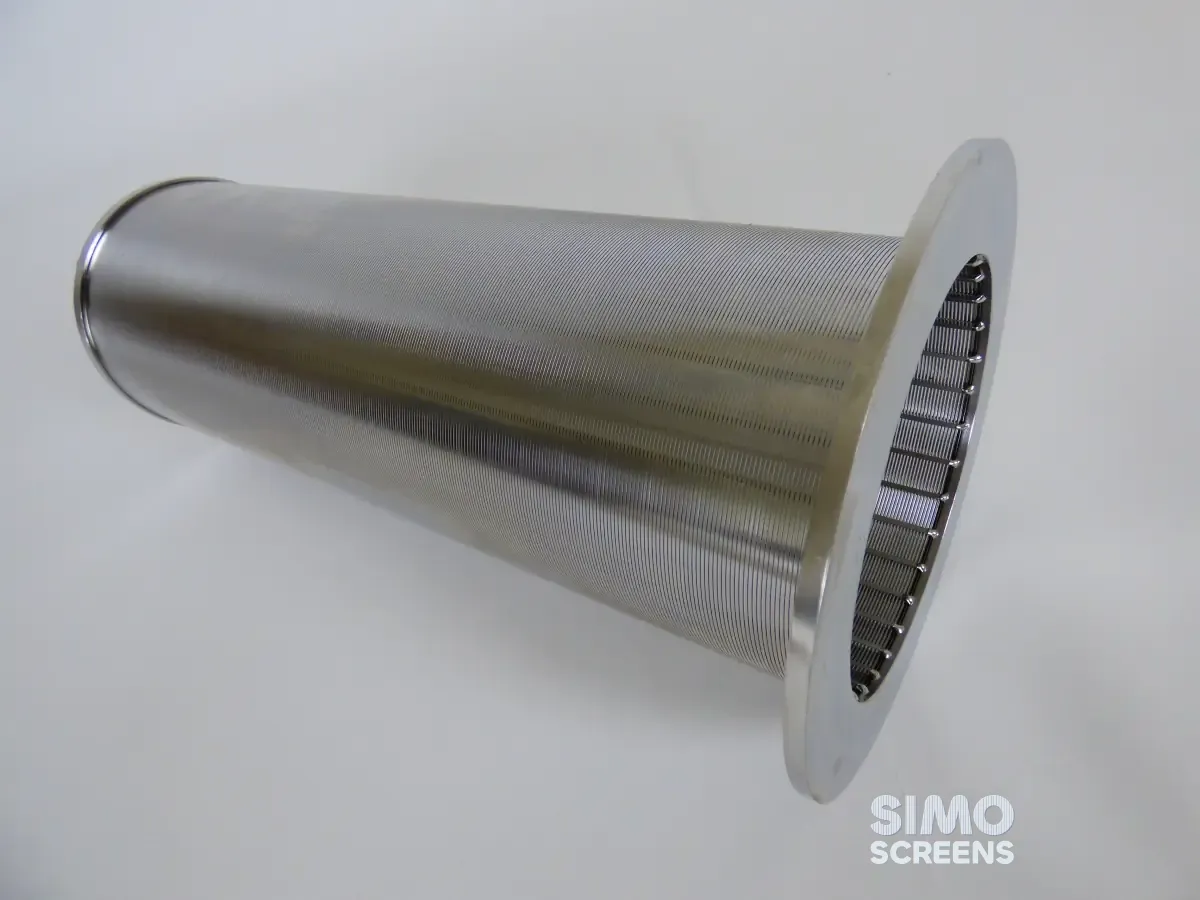
- Inline and T-type strainers, with a cylindrical strainer element in the line.
- Process lines in water treatment, power, chemical, food and sugar plants.
For media escaping an ion exchange vessel, a resin trap is the dedicated inline strainer, and for a screen over a vessel or tank outlet nozzle, see outlet baskets.
Slot selection and flow direction
The slot is selected below the smallest particle that must not pass. A mesh aperture and a slot of the same size retain the same round grain, although long, thin particles pass a slot more easily than a square opening, so particle shape should be considered. Where a mesh liner is in use, the mesh to micron guide and the mesh to micron converter give the equivalent opening.
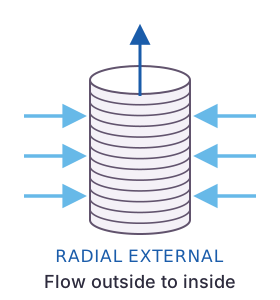
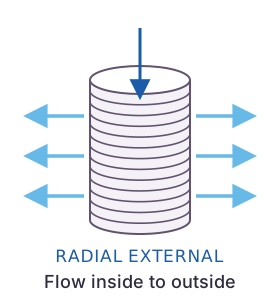
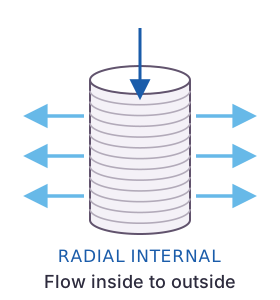
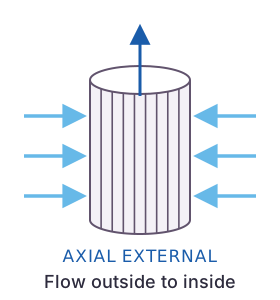
In most simplex and duplex basket strainers, flow enters the top of the basket and leaves through its wall, so the debris lifts out with the basket. These baskets are built radial internal, inside to outside, with the wire on the inside face. Many inline and T-type strainer elements are fed from outside and are built radial external, outside to inside. In both cases the flat face of the wire meets the dirty side, as explained in the flow configuration guide.
Construction and specifications
A clean basket carries little load, while a blocked basket carries the full differential pressure. The design is therefore based on the highest differential the basket can meet, such as the pump shut-off head or the alarm setting. Support rods carry the load along the basket and reinforcing rings hold its shape, with additional rings or a heavier profile on large or high differential baskets.
| Parameter | SIMO range |
|---|---|
| Slot opening | 25 microns (0.025 mm) to 25 mm |
| Slot tolerance | Plus or minus 5% of nominal, stated on the drawing |
| Diameter | 25 mm to 800 mm |
| Length | Up to 6,000 mm |
| Flow configuration | Radial internal, inside to outside; or radial external, outside to inside |
| Materials | SS 304, SS 316L, Duplex 2205, Super Duplex 2507, Hastelloy, Monel |
| Options | Reinforcing rings, perforated or bar backing, lifting handles, gasketed top rings |
| Construction | Resistance welded; resists thermal cycling and pressure transients up to 300 PSI |
| Scope | Baskets and elements, or complete strainers to client requirement |
Swipe sideways to see the whole table.
Materials
| Service | Typical grade |
|---|---|
| Fresh and cooling water | SS 304 |
| Food, brewing, many chemicals | SS 316L |
| Seawater, brine, high chlorides | Duplex 2205, Super Duplex 2507 |
| Aggressive acids and chemicals | Hastelloy C-276, Monel |
Swipe sideways to see the whole table.
The basket grade is matched to the fluid rather than to the housing, as set out in the material selection guide.
Engineering and quality
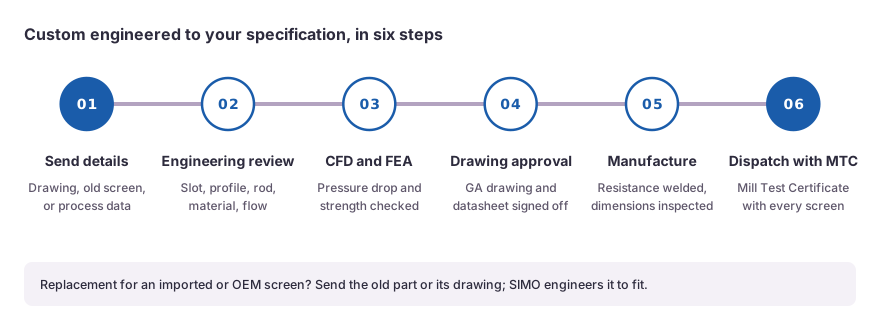
For a replacement, the seat diameter, top ring or flange, gasket face, length, bottom shape and handle are recorded and issued on a drawing for approval before manufacture. Slots are checked with feeler gauges through production, and the final inspection report records the minimum, maximum and mean slot. The Mill Test Certificate is standard, and the dimensional inspection report and QAP are supplied on request. Cleaning methods are covered in the cleaning and maintenance guide.
What to send for a quotation
- Strainer type: simplex, duplex, inline or T-type, and the housing make and model if known.
- Housing or basket drawing, or a sample basket.
- Line size, flow rate and fluid.
- Debris to be caught, and the slot or mesh used now.
- Operating pressure and temperature, and the highest differential pressure.
- Housing material and preferred basket material.
- Quantity, including spare baskets.
- Whether you need baskets only or a complete strainer, with its pressure rating, design code and flange standard.
 Upload a drawing