 +91 93730 08466
 Screen tubes and pipes
 Screen cylinders
 Flat panels and false bottoms
 Candle filter elements
 Water well screens
 Header and hub laterals
 Filter nozzles
 Resin traps
 Support grids
 Sieve bend (DSM) screens
 Centrifuge baskets
 Pressure screen baskets
 Screw press screens
 Rotary drum screens
 Passive intake screens
 Coanda intake screens
 Water and wastewater treatment
 Water wells and groundwater
 Sugar and distillery
 Brewing, malting and beverages
 Food processing
 Mining and minerals
 Oil, gas and petrochemicals
 Chemicals, fertilisers and pharma
 Power generation
 Pulp and paper
 Buildings and drainage
 Datasheet

Sieve bend screen overview
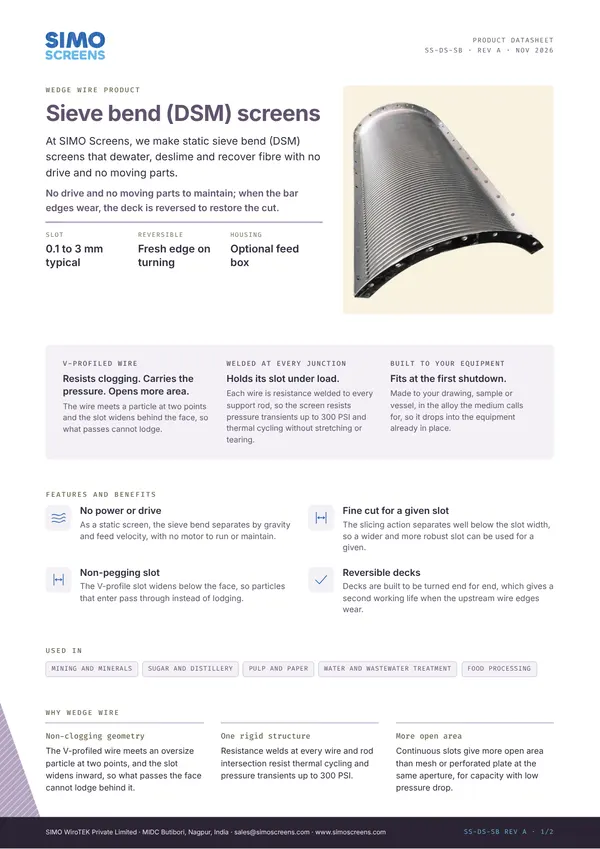
Many plants must remove water and fines from a slurry before the next machine, and doing this on a vibrating screen alone adds power, wear and floor space. A sieve bend makes the first cut by gravity, as a static screen with no drive or moving parts, and sits ahead of the vibrating screen, centrifuge or press to take much of the liquid load off it.
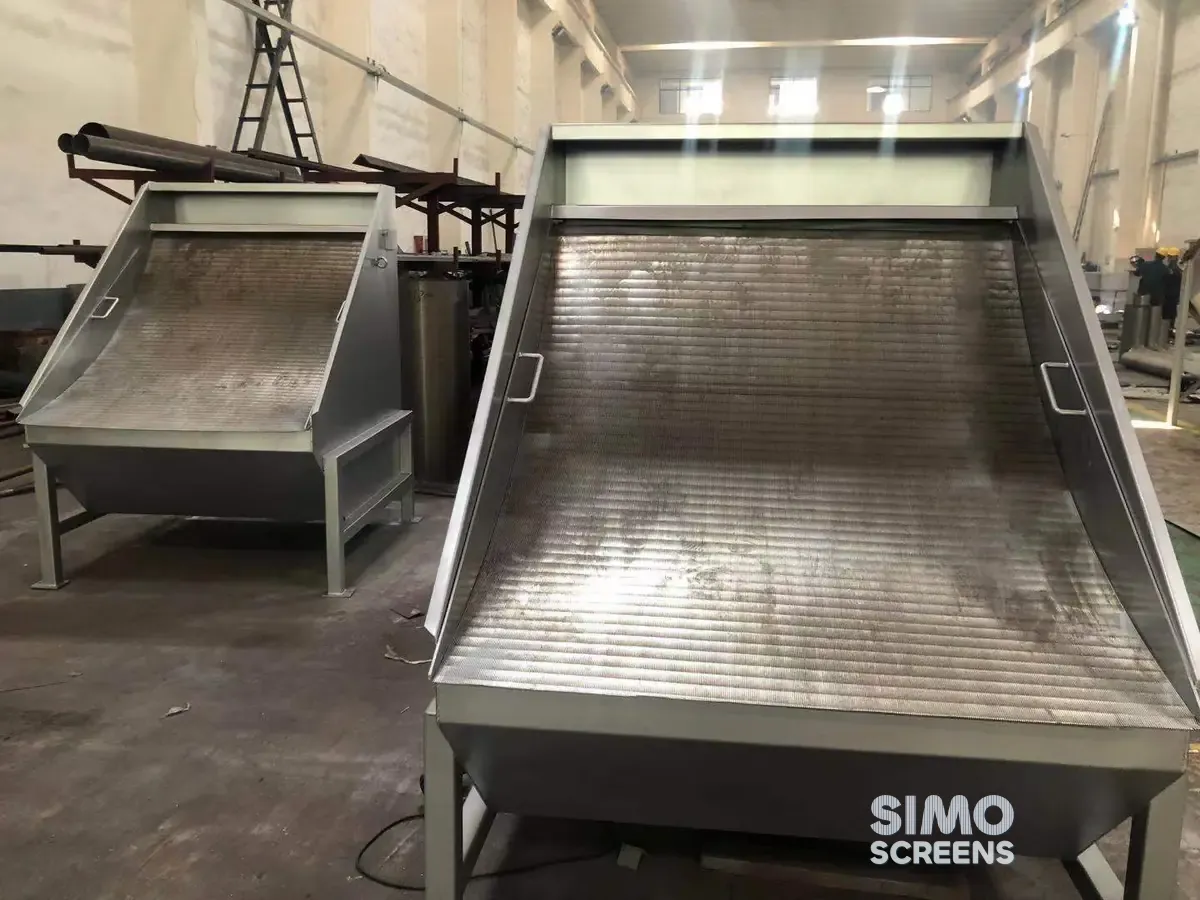
Feed enters at the top through a feed box and flows down the concave face of the screen, with the wires running across the flow. As the stream crosses each slot, the upstream wire edge slices off a thin layer that carries liquid and fine particles through the slot, while coarser particles ride over the wires and leave at the bottom. As general practice, the cut is taken as roughly half the slot width.
Features and benefits
- No power or drive. As a static screen, the sieve bend separates by gravity and feed velocity, with no motor to run or maintain.
- Fine cut for a given slot. The slicing action separates well below the slot width, so a wider and more robust slot can be used for a given cut size.
- Non-pegging slot. The V-profile slot widens below the face, so particles that enter pass through instead of lodging.
- Reversible decks. Decks are built to be turned end for end, which gives a second working life when the upstream wire edges wear.
- Profile choice. Heavier profiles resist abrasion in coal and ore, while lighter profiles give more open area for fibre and juice.
Applications
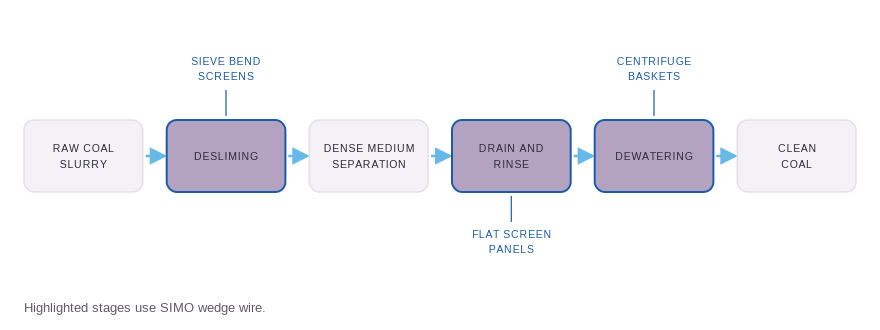
- Coal washery desliming, typically at about 0.5 mm slot, ahead of drain and rinse screens and centrifuges, as described under coal washery screens.
- Iron ore and sand classification and dewatering in mineral plants.
- Mill house juice screening in sugar plants, removing bagacillo before clarification, as described under juice screens.
- Distillery spent wash screening in sugar and distillery plants.
- Starch and corn wet milling fibre washing, and process and vegetable wash water in food plants.
- White water fibre recovery in pulp and paper mills, and STP and ETP inlet works as a fine screen ahead of treatment.
Swipe to see the full drawing.
Construction and specifications
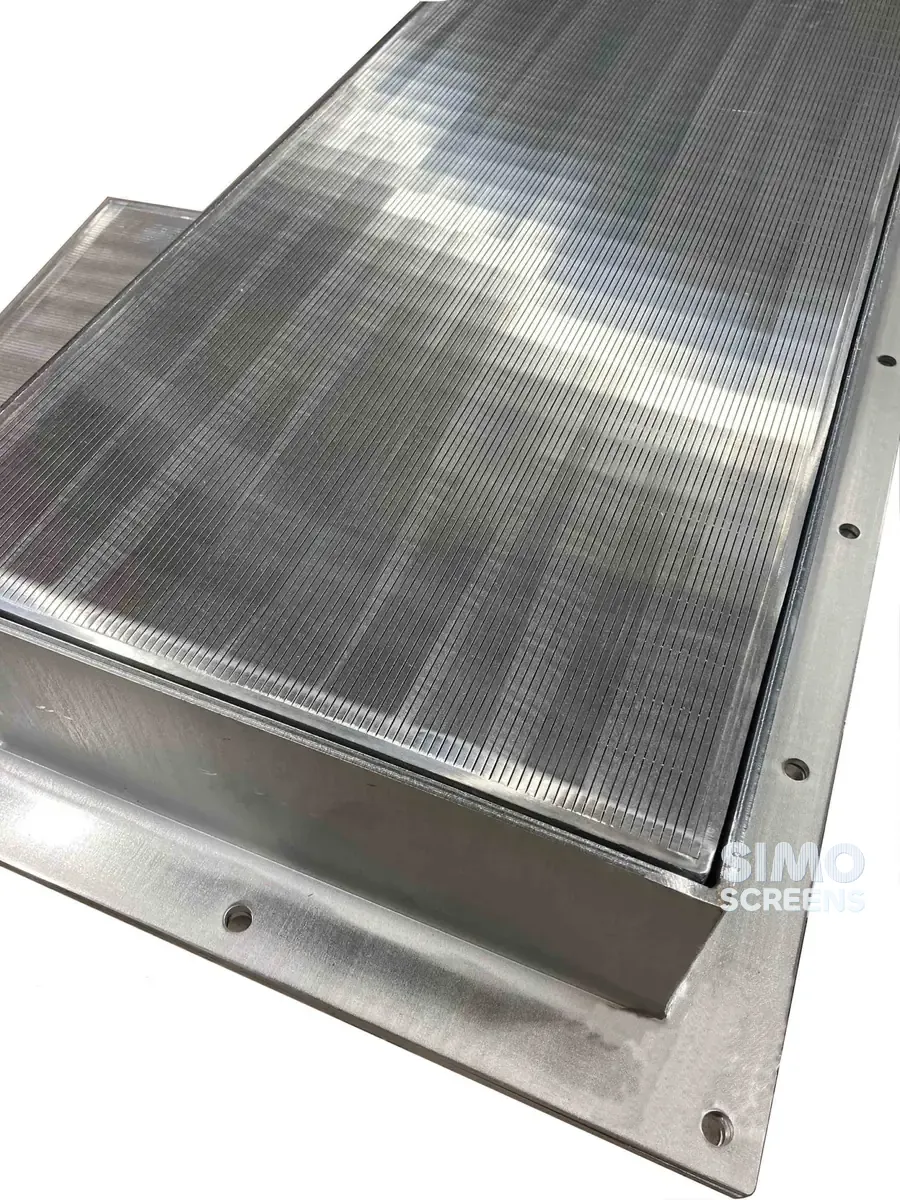
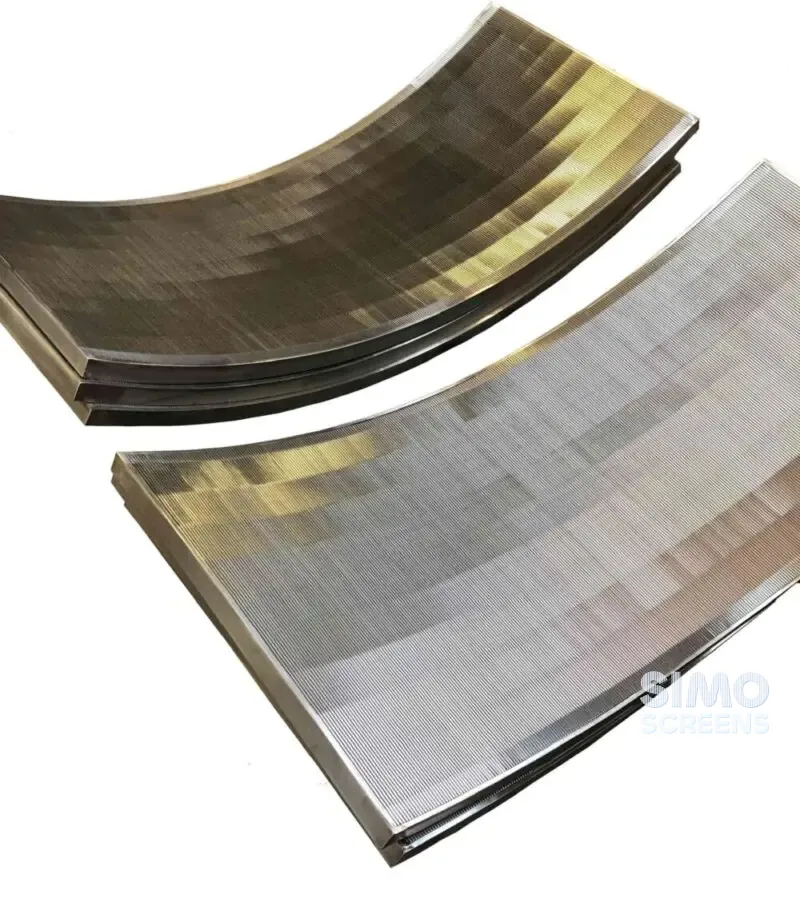
Each wedge wire DSM screen deck is made from profile wire resistance welded to curved support rods at every intersection, then rolled to the radius and arc the application requires. Side plates and end bars are fabricated to sit in the existing housing, or a new frame is made to the purchaser's drawing, with a feed box and housing available as an option.
| Parameter | SIMO range |
|---|---|
| Slot opening | 25 microns (0.025 mm) to 25 mm, tolerance plus or minus 5% of nominal |
| Width, radius and arc | To the application or the existing housing |
| Profile wire | Light, standard, heavy duty or custom, 12SB to 56SB |
| Support rods | Q23, Q35, Q55, 35SB, F123, F203, F253, round 120, round 140 |
| Materials | SS 304, SS 316L, Duplex 2205, Super Duplex 2507, Hastelloy C-276, Monel |
| Deck design | Reversible end for end |
| Supply options | Deck only, deck in frame, or complete unit with feed box and housing |
| Construction | Resistance welded at every intersection |
Swipe sideways to see the whole table.
SS 304 suits most juice, fibre and water applications, and SS 316L is selected where chlorides or acidic process liquors are present. In abrasive coal and ore slurry, the profile size usually matters more than the alloy, so the profile is reviewed before a material upgrade is considered.
Engineering and quality
The slot width is chosen from the cut size required, the arc and radius set the screen length the slurry travels across, and the screen width is set by the feed rate per metre of width. The sieve bend guide covers sizing in more detail, and CFD and FEA are used for custom designs where required.
Slot is checked with feeler gauges at welding set-up, during the run and at the end of each deck, and the final inspection report records the minimum, maximum and mean slot. Each deck is identified with job number, item and slot on a QR-coded tag, and laser marked where the client requires it. The Mill Test Certificate is supplied as standard, with a dimensional inspection report and quality assurance plan on request.
What to send for a quotation
- Application: desliming, juice screening, spent wash, starch, fibre recovery, effluent or other.
- Feed rate and solids concentration.
- Particle size distribution of the feed, or the cut size you need.
- Current slot and screen dimensions, if you are replacing an existing deck.
- Radius, arc and width, or a drawing of the housing.
- Slurry chemistry and temperature.
- Material grade if specified, and whether you need a feed box and housing.
 Upload a drawing