 +91 93730 08466
 Screen tubes and pipes
 Screen cylinders
 Flat panels and false bottoms
 Candle filter elements
 Water well screens
 Header and hub laterals
 Filter nozzles
 Resin traps
 Support grids
 Sieve bend (DSM) screens
 Centrifuge baskets
 Pressure screen baskets
 Screw press screens
 Rotary drum screens
 Passive intake screens
 Coanda intake screens
 Water and wastewater treatment
 Water wells and groundwater
 Sugar and distillery
 Brewing, malting and beverages
 Food processing
 Mining and minerals
 Oil, gas and petrochemicals
 Chemicals, fertilisers and pharma
 Power generation
 Pulp and paper
 Buildings and drainage
 Datasheet

Wedge wire flooring panels overview
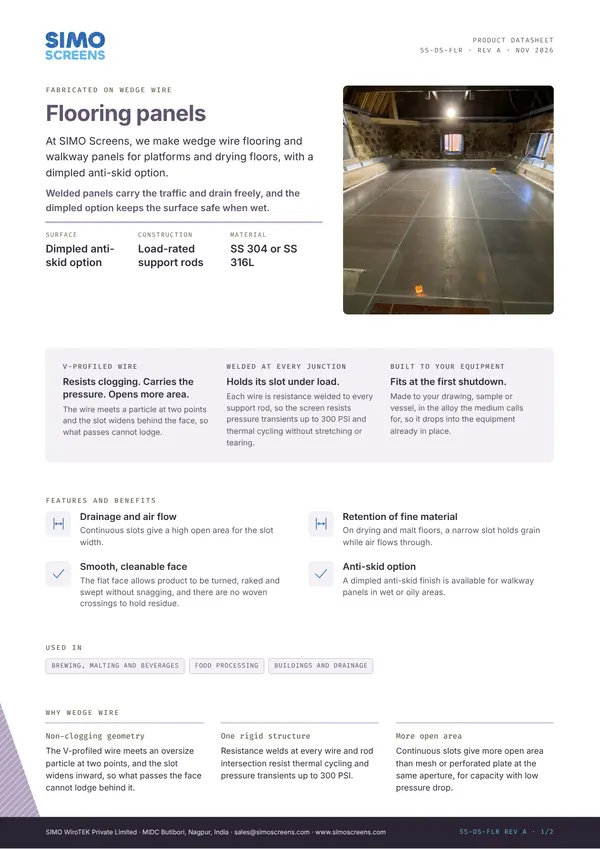
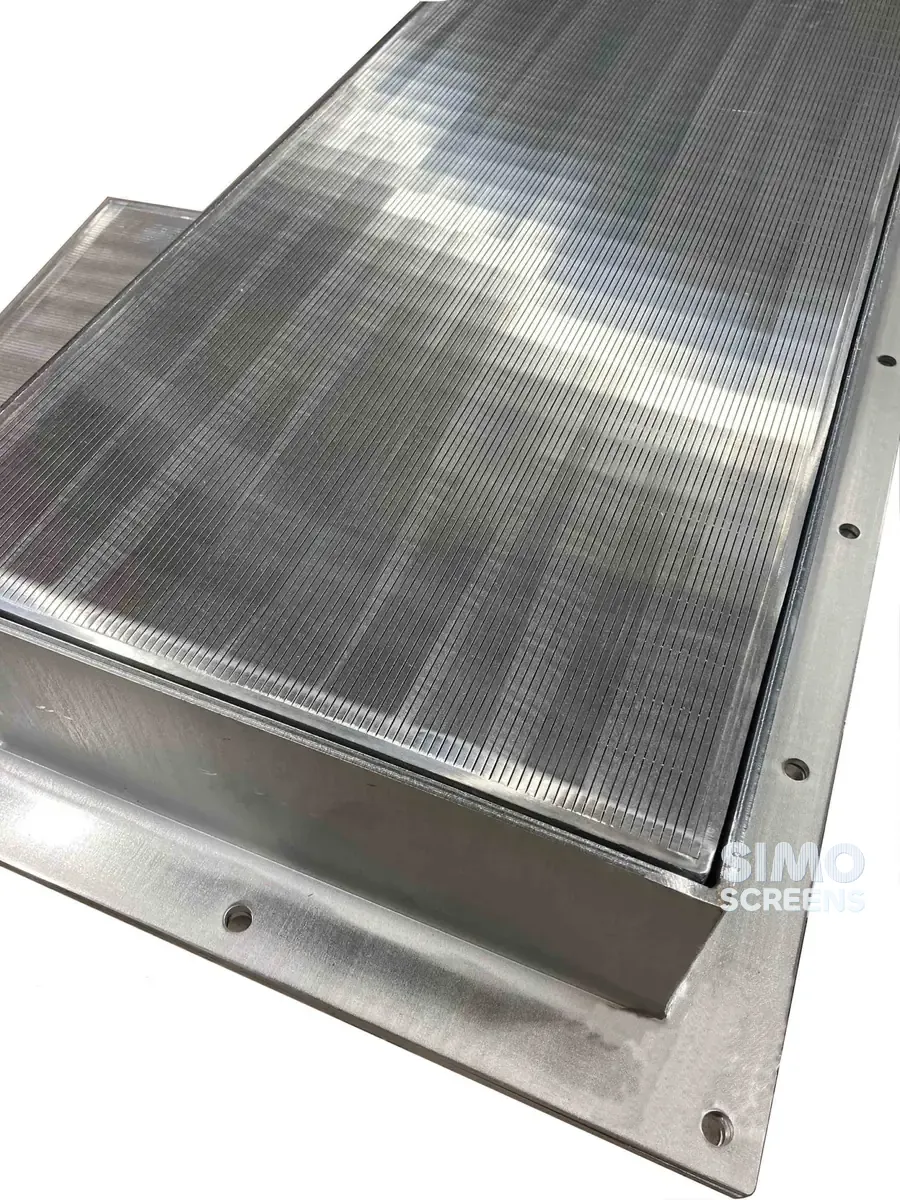
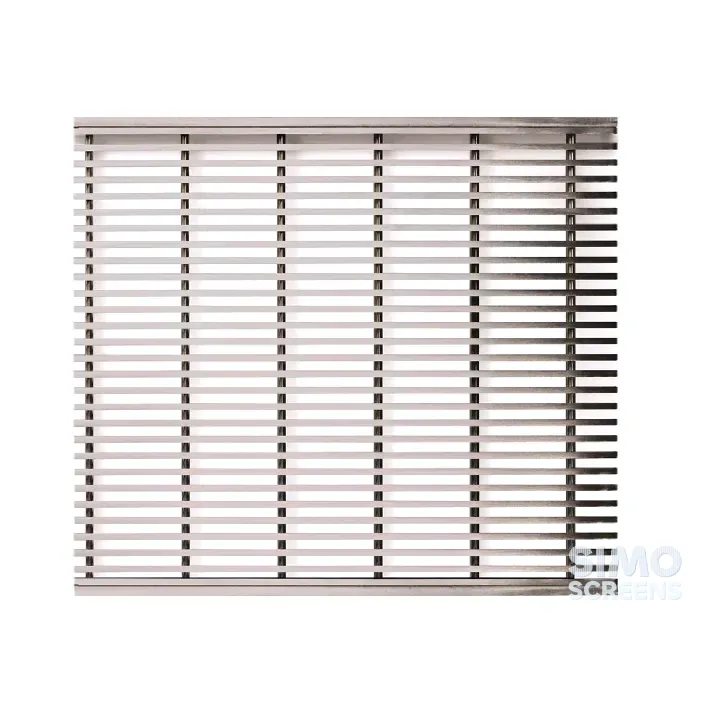
SIMO Screens wedge wire flooring panels are flat decks of V-profile wire resistance welded to deep support rods. The flat face of the wire forms the walking or working surface, while the support rods carry the load across the span to the beams or frames below.
Below the face, each slot widens, so water, grit and fine material fall through instead of collecting on the floor. The same construction lets air pass freely, so the panels serve drying floors and malt kiln floors as well as walkways.
Features and benefits
- Drainage and air flow. Continuous slots give a high open area for the slot width, so water drains and air passes through the floor with a low pressure drop.
- Retention of fine material. On drying and malt floors, a narrow slot holds grain while air flows through, and kernels that enter the widening slot do not jam.
- Smooth, cleanable face. The flat face allows product to be turned, raked and swept without snagging, and there are no woven crossings to hold residue.
- Anti-skid option. A dimpled anti-skid finish is available for walkway panels in wet or oily areas.
- Rigid welded construction. Every wire and rod intersection is resistance welded, and deep flat support rods give stiffness across the span.
Applications
- Industrial walkways and platforms around tanks, filters and process equipment where floors get wet
- Mezzanines in plants that need light and air to pass between levels
- Drying floors for grain, seeds, spices and other produce dried by air from below
- Malt floors, including germination and kiln floors; see malt kiln and germination floors
- Wash-down areas in food and beverage plants that are hosed clean
Vessel bed supports under heavier process loads are covered by the wedge wire support grids range.
Construction and specifications
| Item | Options |
|---|---|
| Slot | Narrow slots for grain and heels; about 0.7 mm upward for kiln and germination floors; wider for drainage and air flow |
| Profile wire | Standard to heavy duty, such as 35SB, 42SB, 55SB or 56SB |
| Support rod | Flat rods F123, F203 or F253, selected for span and load |
| Wire direction | Across the direction of travel for walkways |
| Panel size | Single panels up to 2,400 mm wide and 4,000 mm long; larger floors as joined panels |
| Material | SS 304 or SS 316L |
| Frame | Banded edges or perimeter frames, with kick plates where needed |
| Surface | Standard flat wire face, or dimpled anti-skid finish |
| Fixings | Clamps or bolted fixings to the support structure, supplied with the panels |
Swipe sideways to see the whole table.
Design considerations
Span and load. Support rod height and spacing set the load a panel can carry over a given span. The design starts from the beam spacing, the uniformly distributed load and any point loads, with FEA used where needed.
Deflection. A walkway that bounces feels unsafe, so any deflection limit in the specification is taken into the rod selection.
Slot and air flow. Walkway slots are kept narrow enough for heels and dropped tools, while drying and malt floor slots are sized to hold the smallest grain. On kiln floors, open area governs the air pressure drop, which the open area calculator helps to estimate.
Wear. Heavier profiles resist the wear of raking and turning, as explained in the profile wire selection guide.
Engineering and quality
Panel designs are reviewed for slot, open area and structural load before production. Profile wire is formed in house to SIMO profile codes, and slots are checked with feeler gauges to a standard tolerance of plus or minus 5 percent of nominal. Every order is supplied with a Mill Test Certificate, with a dimensional inspection report on request.
What to send for a quotation
- Application: walkway, mezzanine, drying floor or malt floor
- Floor area and a layout drawing with beam positions and spacing
- Design loads, uniform and point, and any deflection limit
- Traffic type: foot, trolleys or machinery
- For drying and malt floors, the product held and its smallest size
- Required slot, if specified, wire direction and surface finish
- Material, SS 304 or SS 316L
- Sizes of access openings that panels must pass through
- Quantity and delivery location
 Upload a drawing