 +91 93730 08466
 Screen tubes and pipes
 Screen cylinders
 Flat panels and false bottoms
 Candle filter elements
 Water well screens
 Header and hub laterals
 Filter nozzles
 Resin traps
 Support grids
 Sieve bend (DSM) screens
 Centrifuge baskets
 Pressure screen baskets
 Screw press screens
 Rotary drum screens
 Passive intake screens
 Coanda intake screens
 Water and wastewater treatment
 Water wells and groundwater
 Sugar and distillery
 Brewing, malting and beverages
 Food processing
 Mining and minerals
 Oil, gas and petrochemicals
 Chemicals, fertilisers and pharma
 Power generation
 Pulp and paper
 Buildings and drainage
 Datasheet

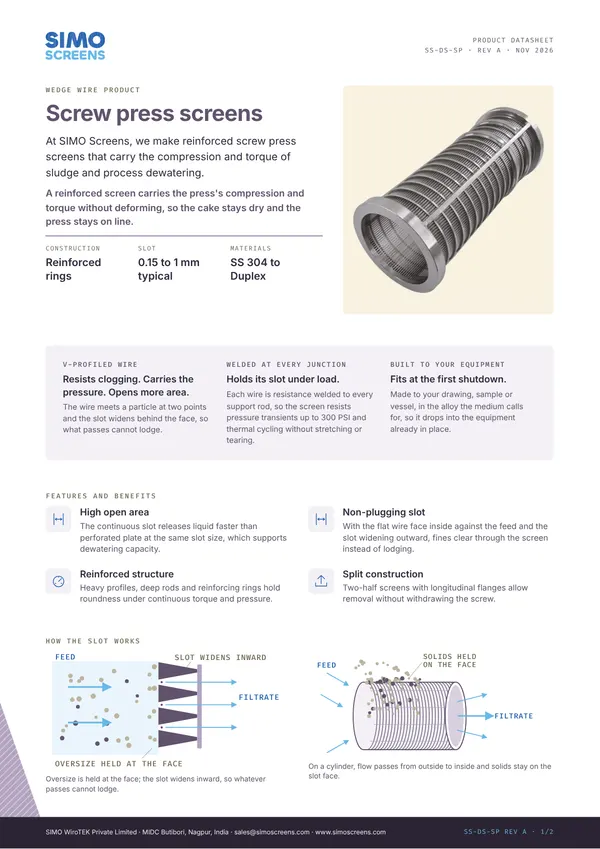
Screw press screen overview
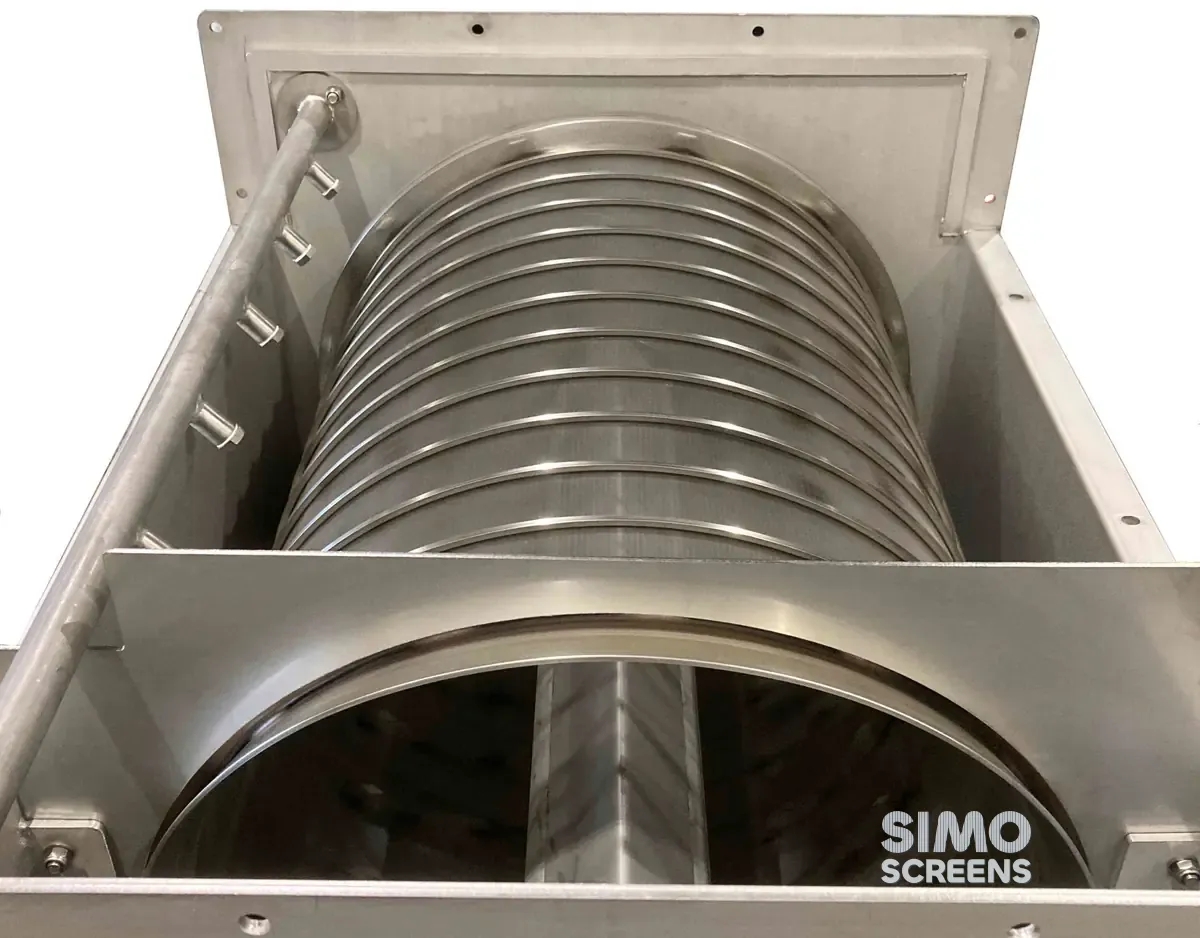
A screw press removes water from sludge, fibre or food waste by compressing the feed against a cylindrical dewatering screen. The screw turns inside the screen and carries the feed forward, and as the flights close up or the shaft diameter increases, the feed is compressed and liquid is forced outward through the slots. The dewatered cake leaves at the discharge end.
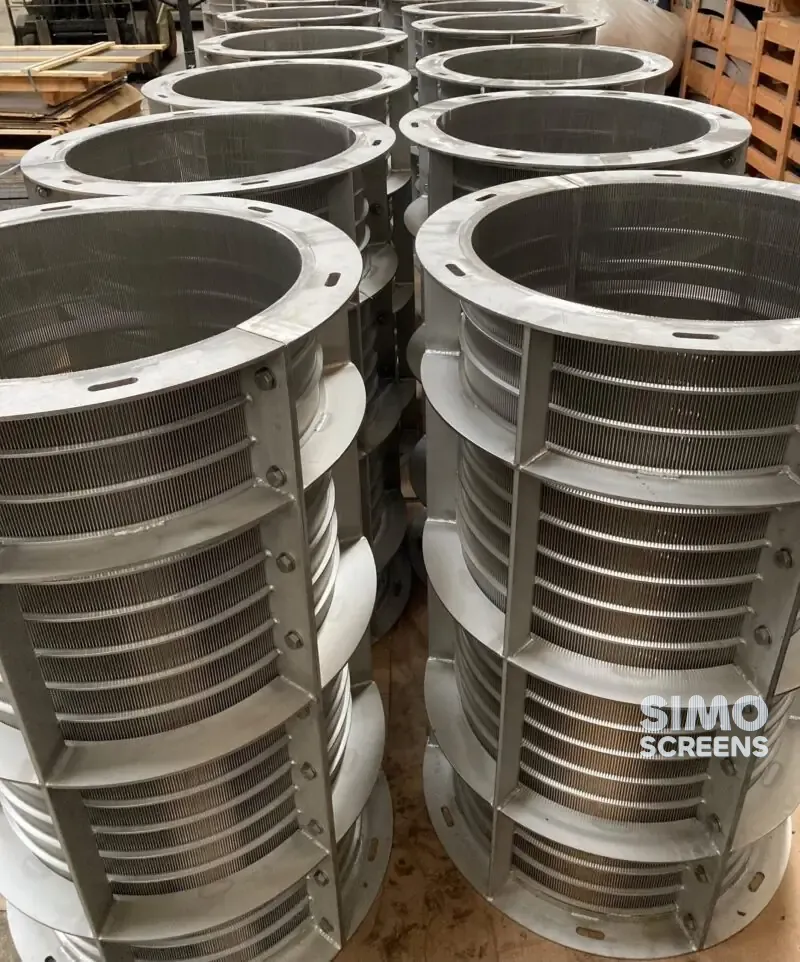
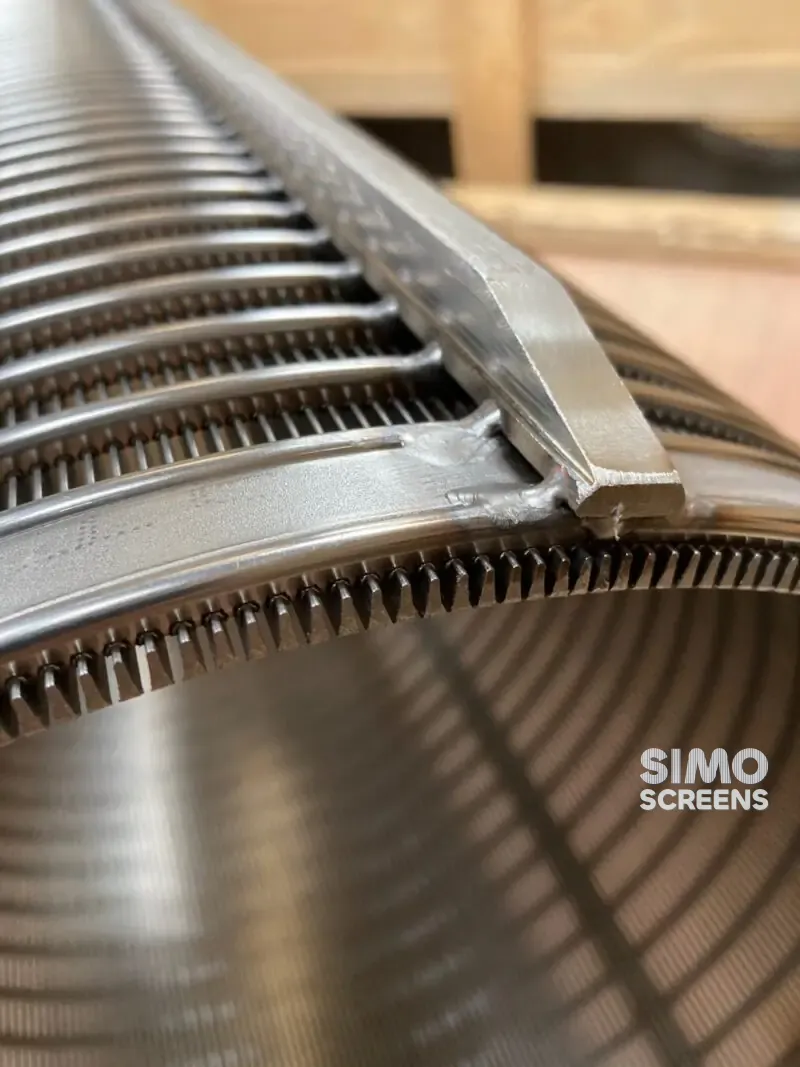
The screen carries the full compression load throughout operation, and light or perforated screens can deform, crack at welds or wear open, after which solids escape with the filtrate. SIMO Screens screw press screens are built for this load, with heavy profile wire resistance welded to deep support rods and reinforced with rings and flanges.
Features and benefits
- High open area. The continuous slot releases liquid faster than perforated plate at the same slot size, which supports dewatering capacity.
- Non-plugging slot. With the flat wire face inside against the feed and the slot widening outward, fines clear through the screen instead of lodging.
- Reinforced structure. Heavy profiles, deep rods and reinforcing rings hold roundness under continuous torque and pressure.
- Split construction. Two-half screens with longitudinal flanges allow removal without withdrawing the screw.
- Zoned slots. Different slots along the length match the progressive dewatering of the feed.
Applications
- STP and ETP sludge dewatering in water and wastewater treatment.
- Reject and fibre dewatering in pulp and paper mills.
- Food waste, fruit and vegetable pulp, and spent grain dewatering in food and beverage plants.
- Bio-solids and mechanical dewatering in other process industries.
Construction and specifications
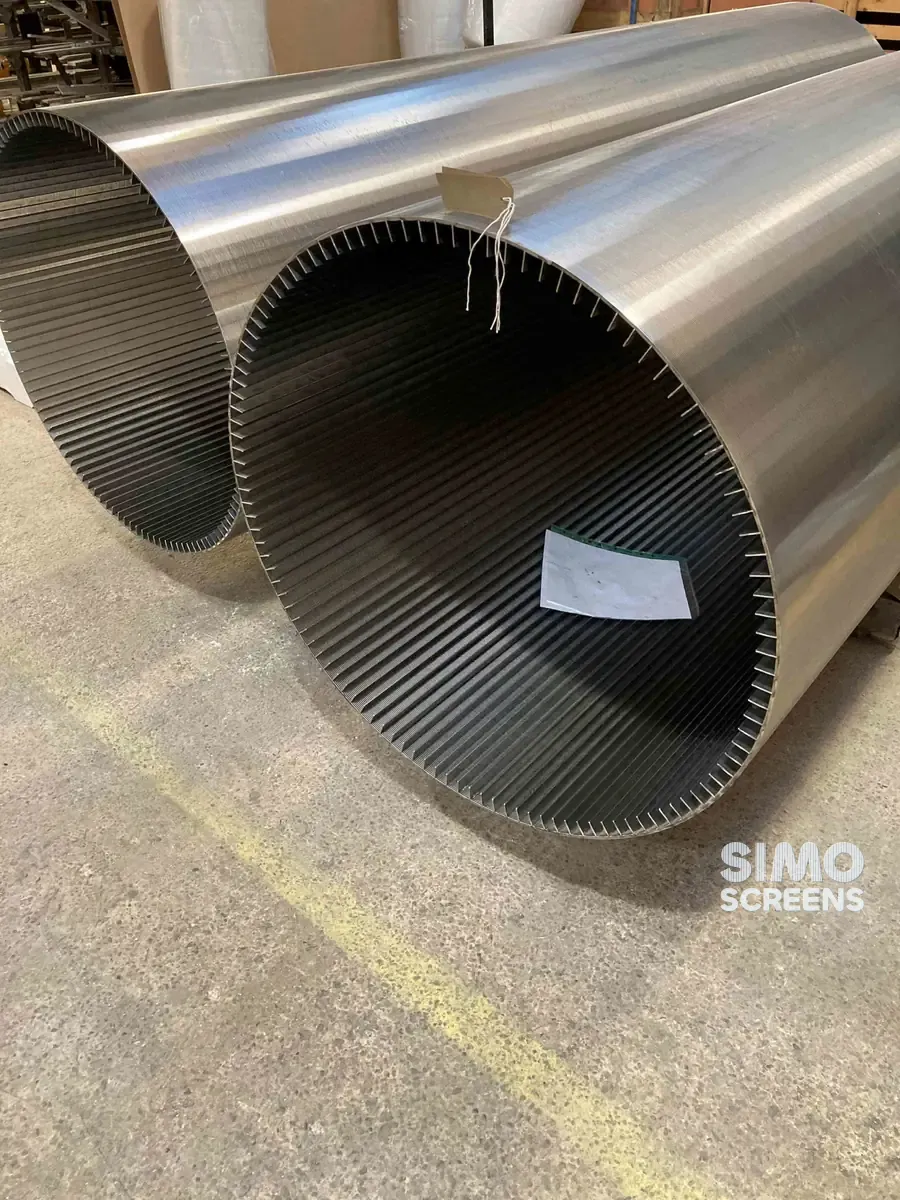
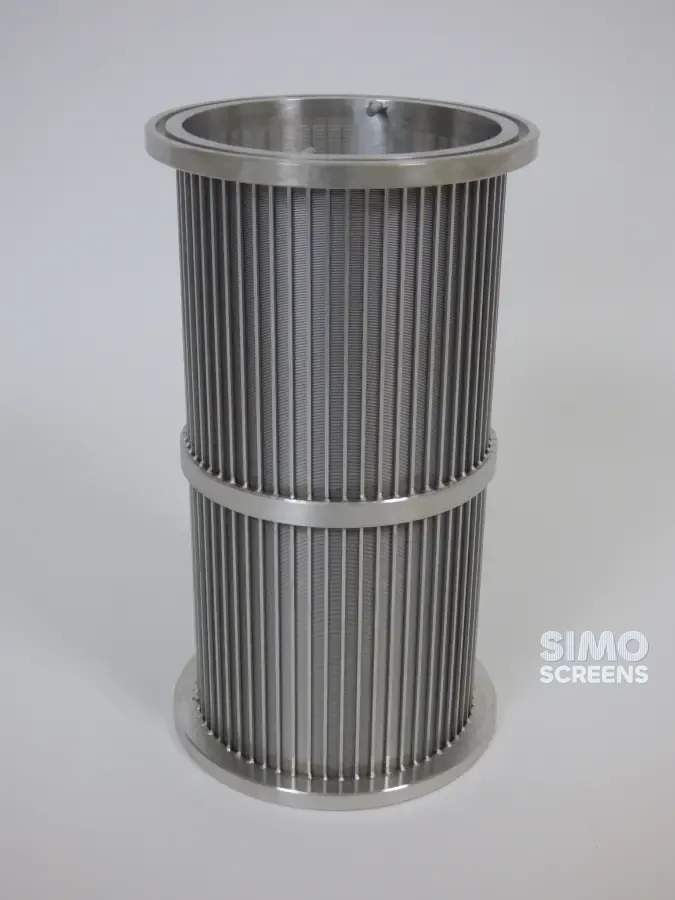
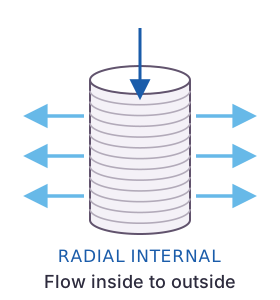
The screen is a heavily reinforced wedge wire cylinder in radial flow with an internal profile, from inside to outside. Inside-to-outside cylinders are wound on internal-profile machines or made by reverse rolling flat panels, and end flanges are machined to the press.
| Parameter | SIMO range |
|---|---|
| Slot opening | 25 microns (0.025 mm) to 25 mm, tolerance plus or minus 5% of nominal |
| Screen diameter | 25 to 800 mm |
| Screen length | Up to 6,000 mm |
| Profile wire | Heavy duty or custom, from 12SB to 56SB as the load allows |
| Support rods | Q23, Q35, Q55, 35SB, F123, F203, F253, round 120, round 140 |
| Flow configuration | Radial, internal profile, inside to outside |
| Construction options | One piece or split in two halves; uniform or zoned slot |
| Reinforcement | Rings along the length and machined end flanges |
| Construction | Resistance welded at every intersection |
Swipe sideways to see the whole table.
Materials
SS 304 suits most municipal sludge and food applications. SS 316L is selected for industrial sludge with chlorides or acidic conditions, and Duplex 2205 combines higher strength with better chloride resistance, which benefits heavily loaded presses.
Engineering and quality
The slot is set by the solids to be retained and the filtrate quality required, and the profile wire and rods by the torque, pressure and wear expected in service. FEA is used for structural validation of custom designs, so that ring spacing and rod size suit the press loads, and the profile wire selection guide explains the trade-off between open area and strength.
Slot is checked with feeler gauges at welding set-up, during the run and at the end of each screen, and the final inspection report records the minimum, maximum and mean slot. Each screen is identified with job number, item and slot on a QR-coded tag, laser marked where the client requires it, and heat numbers trace from the Mill Test Certificate to the finished screen. The MTC is supplied as standard, with a dimensional inspection report and quality assurance plan on request. Guidance on keeping the screen open in service is given in the cleaning and maintenance guide.
What to send for a quotation
- Press make, model and size, or the press drawing.
- Feed: sludge type, fibre, food waste or other.
- Feed rate, and solids content in and out.
- Screen inside diameter and length, and the slot now used.
- Flange and fixing details, or the worn screen.
- One piece or split, and uniform or zoned slot.
- Feed chemistry, temperature and material grade.
 Upload a drawing