 +91 93730 08466
 Screen tubes and pipes
 Screen cylinders
 Flat panels and false bottoms
 Candle filter elements
 Water well screens
 Header and hub laterals
 Filter nozzles
 Resin traps
 Support grids
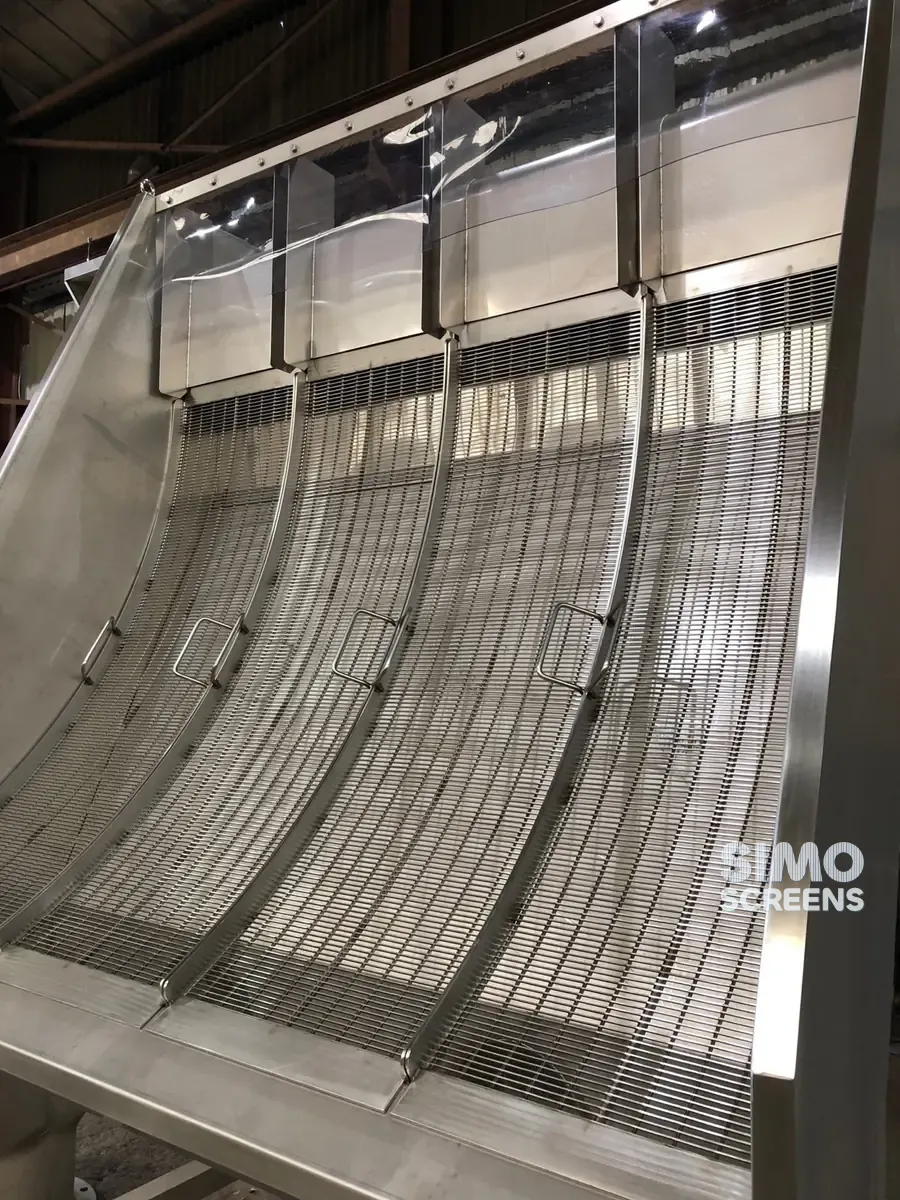
 Sieve bend (DSM) screens
 Centrifuge baskets
 Pressure screen baskets
 Screw press screens
 Rotary drum screens
 Passive intake screens
 Coanda intake screens
 Water and wastewater treatment
 Water wells and groundwater
 Sugar and distillery
 Brewing, malting and beverages
 Food processing
 Mining and minerals
 Oil, gas and petrochemicals
 Chemicals, fertilisers and pharma
 Power generation
 Pulp and paper
 Buildings and drainage

Pulp screens overview
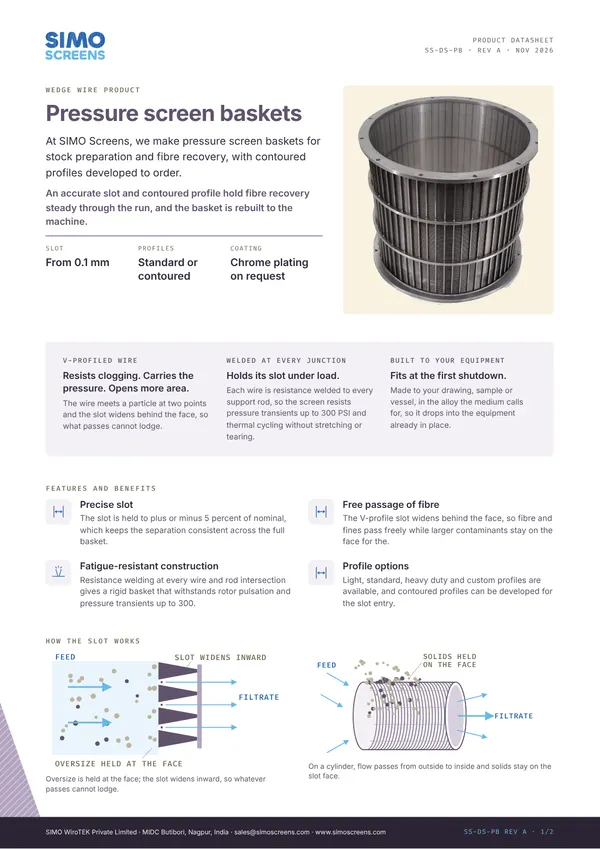
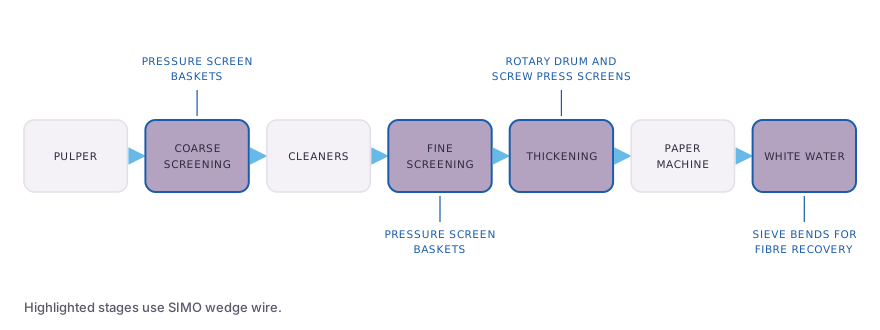
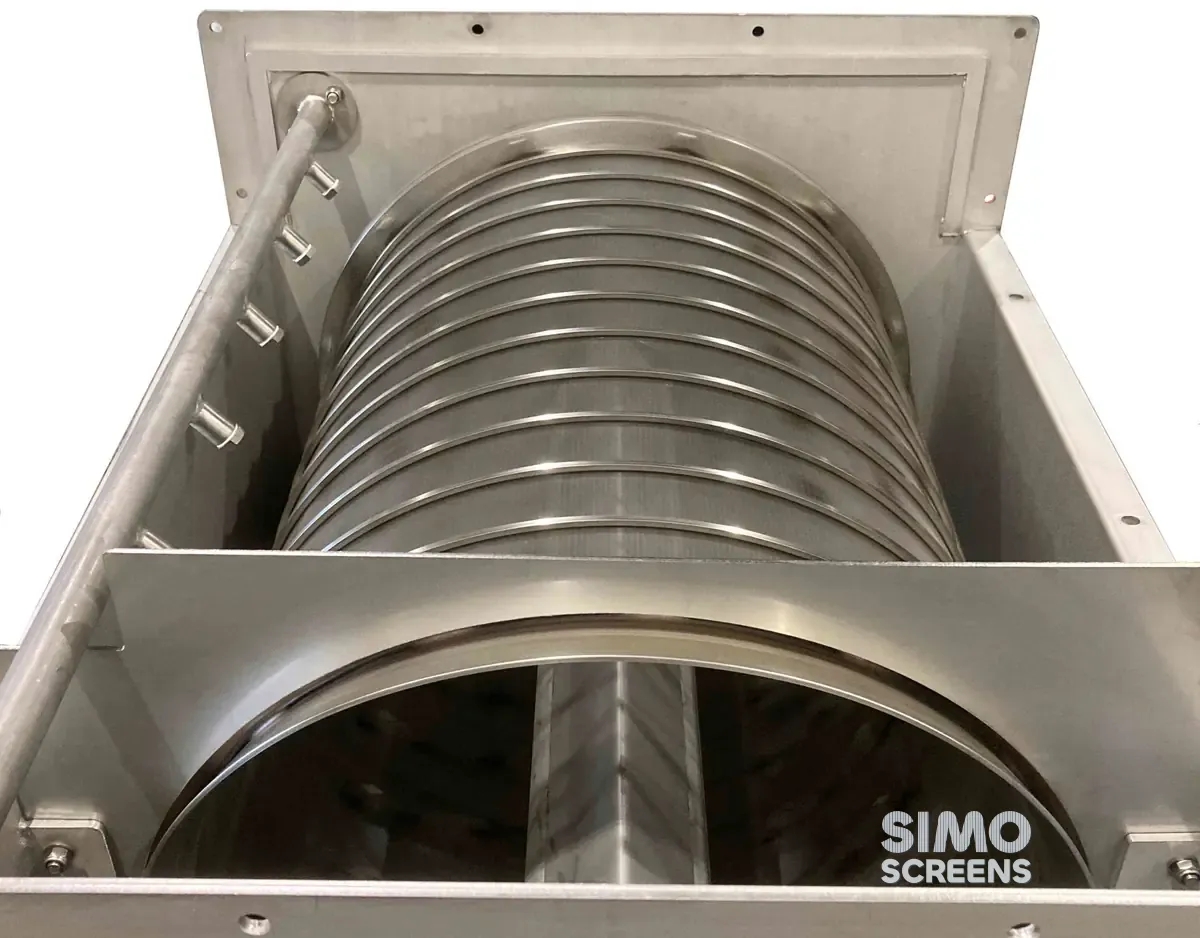
Pressure screens are the main stock preparation screens, and they also clean pulp in the approach flow ahead of the headbox. Stock enters the screen housing, and a rotor with foils or bumps sweeps the basket face. Accepted fibre passes through the basket slots, while stickies, shives, sand and plastic stay on the feed side and leave as rejects, with the rotor pulses keeping the slots clear.
A failing basket shows as dirt in the sheet, breaks on the machine or lost screen capacity. Sand and the rotor wear the wire surface and widen the slot, and rotor pulses fatigue light rods and partial welds, where a failed basket can also damage the rotor. Machined slot baskets have limited open area, so the screen runs near its hydraulic limit.
Swipe to see the full drawing.
Design considerations for a pulp screen basket
Slot. Fine screening commonly uses slots of about 0.1 to 0.4 mm in general practice, with recycled fibre and OCC fine screening at the lower end. A finer slot removes more contaminants while lowering capacity, so the slot is set with the mill's process engineer.
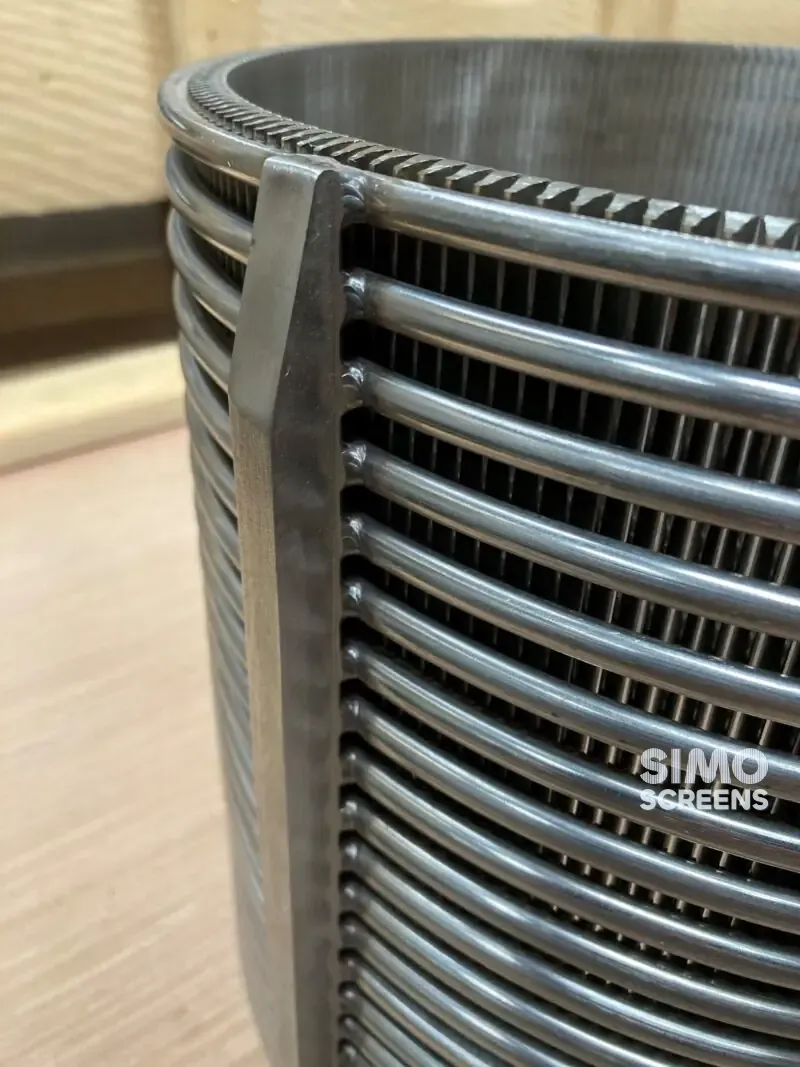
Profile and open area. The V-profile slot widens behind the face, so that accepted fibre clears quickly. Fine slots on a light profile such as 12SB or 15SB give the highest open area. Open area (%) = Slot x 100 / (Slot + Wire width): a 0.15 mm slot on 12SB wire, 1 mm wide, gives about 13 percent, and a 0.2 mm slot on 15SB, 1.52 mm wide, about 12 percent. Options can be compared in the open area calculator.
Contoured profiles. Contoured profile wire can be developed for baskets where the screen maker uses a contoured wire, subject to order quantity.
Load and fatigue. Rotor pulsation calls for close rod spacing and stiff rods such as Q35 or Q55. FEA is used on custom designs to check the basket under pulsation and differential pressure.
Flow direction. Most pressure screens feed from the inside, with accepts leaving outside, which calls for a radial internal basket with flow from inside to outside and the profile on the inside face. Outflow designs use radial external baskets.
Construction and options
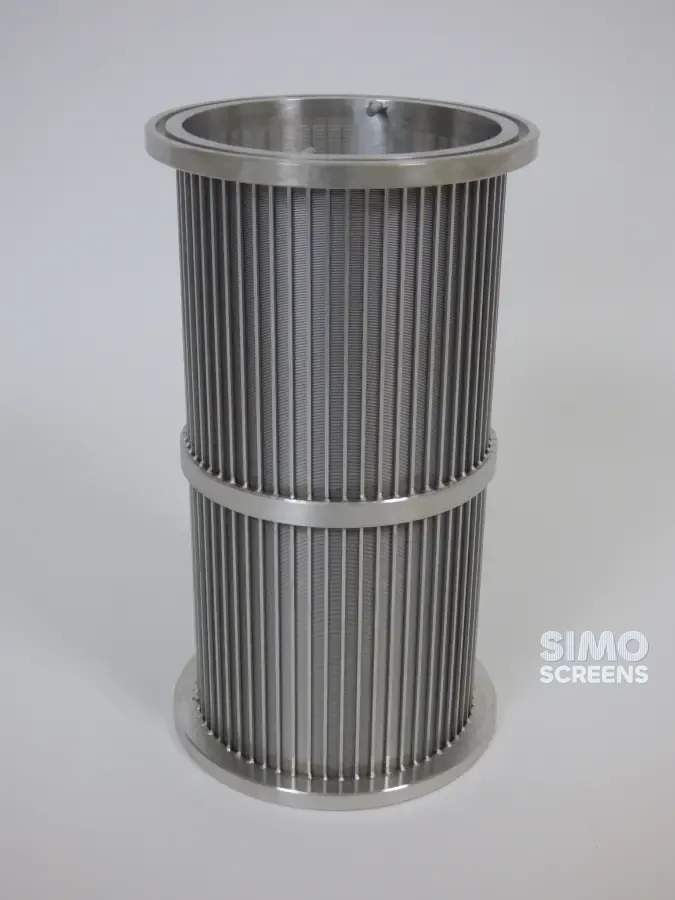
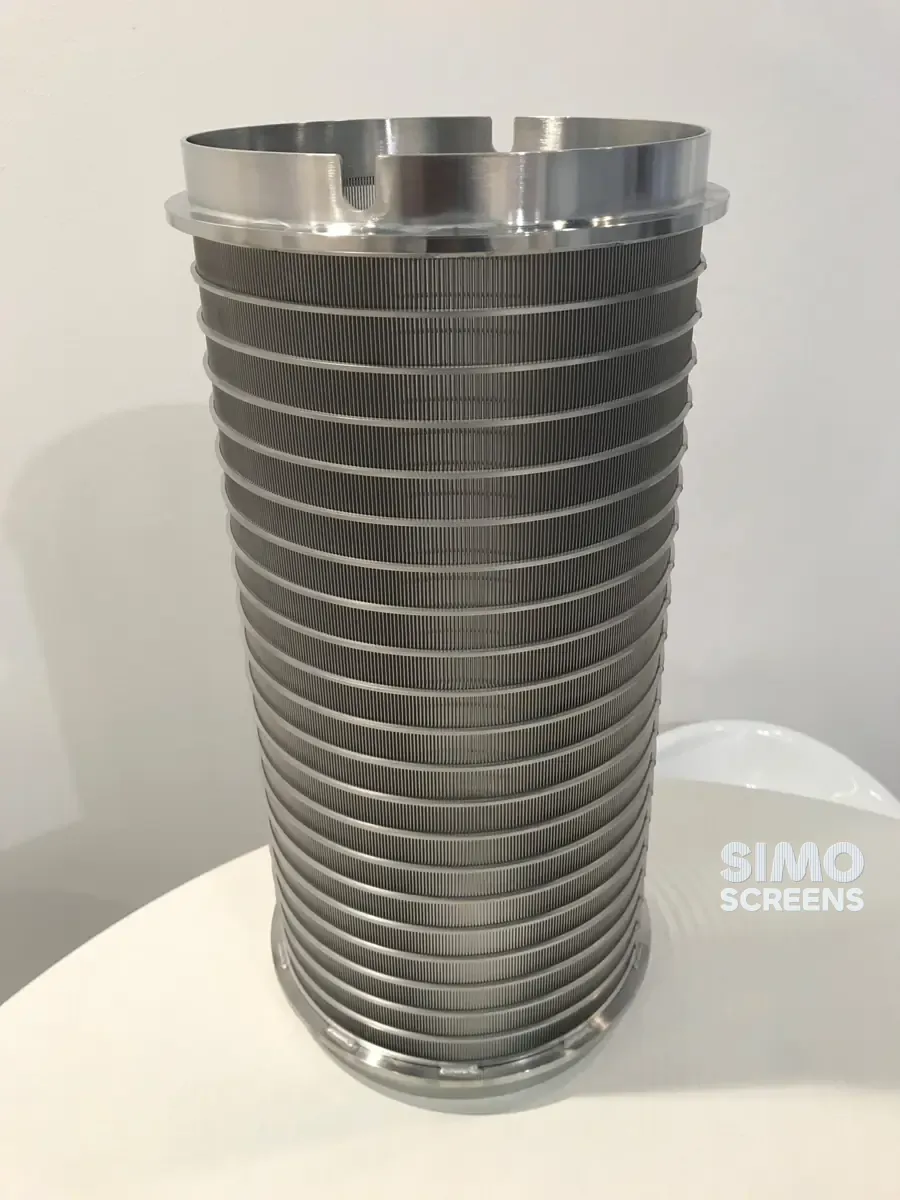
SIMO profile wire is formed in house and resistance welded to support rods at every intersection, forming a rigid cylinder with a continuous slot. Inside-profile baskets are made by reverse rolling flat panels or by winding on internal-profile machines. End rings are welded to the cylinder and machined to the housing, with sealing faces and bolt holes as drawn.
| Item | SIMO range or typical value |
|---|---|
| Form | Cylindrical basket with machined end rings |
| Flow direction | Radial internal, inside to outside, or radial external |
| Slot opening | 25 microns (0.025 mm) to 25 mm; fine screening typically 0.1 to 0.4 mm |
| Slot tolerance | Plus or minus 5% of nominal, stated on the drawing |
| Diameter | 25 to 800 mm |
| Length | Up to 6,000 mm |
| Profile wire | 12SB, 15SB, 18SB; contoured profiles can be developed |
| Support rods | Q35, Q55, F123 |
| Surface treatment | Chrome plating through an approved agency, on request |
Swipe sideways to see the whole table.
Slot width is checked with feeler gauges at set-up, during the run and on the finished basket, with optical measurement where a physical gauge cannot be used. The final inspection report records the minimum, maximum and mean slot.
Materials
SS 316L suits most stock and white water. Duplex 2205 gives higher strength and fatigue resistance for high-load screens, and Super Duplex 2507 is selected for very high chloride systems. The Mill Test Certificate is supplied as standard, and a dimensional inspection report and QAP are supplied on request.
Replacement and retrofit
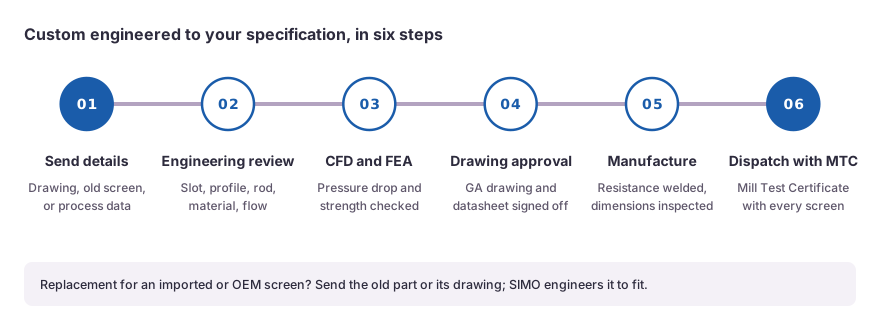
Most baskets replace imported or OEM baskets in existing screens. SIMO Screens works from the basket drawing, or measures a used basket for inside diameter, length, end rings, seals and bolt pattern.
Rotor foil wear and clearance should be checked when a new basket is fitted, because a worn rotor plugs a new basket as quickly as an old one. Our pressure screen baskets page covers the product range, our sieve bend screens serve white water fibre recovery, and the slot and open area guide explains the trade-off between slot and capacity.
What to send for a quotation
- Screen make, model and position: coarse, fine or approach flow.
- Basket inside diameter, length and end ring details.
- Flow direction, inflow or outflow.
- Current slot, wire profile and open area.
- Furnish type and feed consistency.
- Throughput, rotor type and rotor speed.
- Current basket life, failure mode and any wear treatment required.
- Basket drawing or a used basket.

 Upload a drawing