 +91 93730 08466
 Screen tubes and pipes
 Screen cylinders
 Flat panels and false bottoms
 Candle filter elements
 Water well screens
 Header and hub laterals
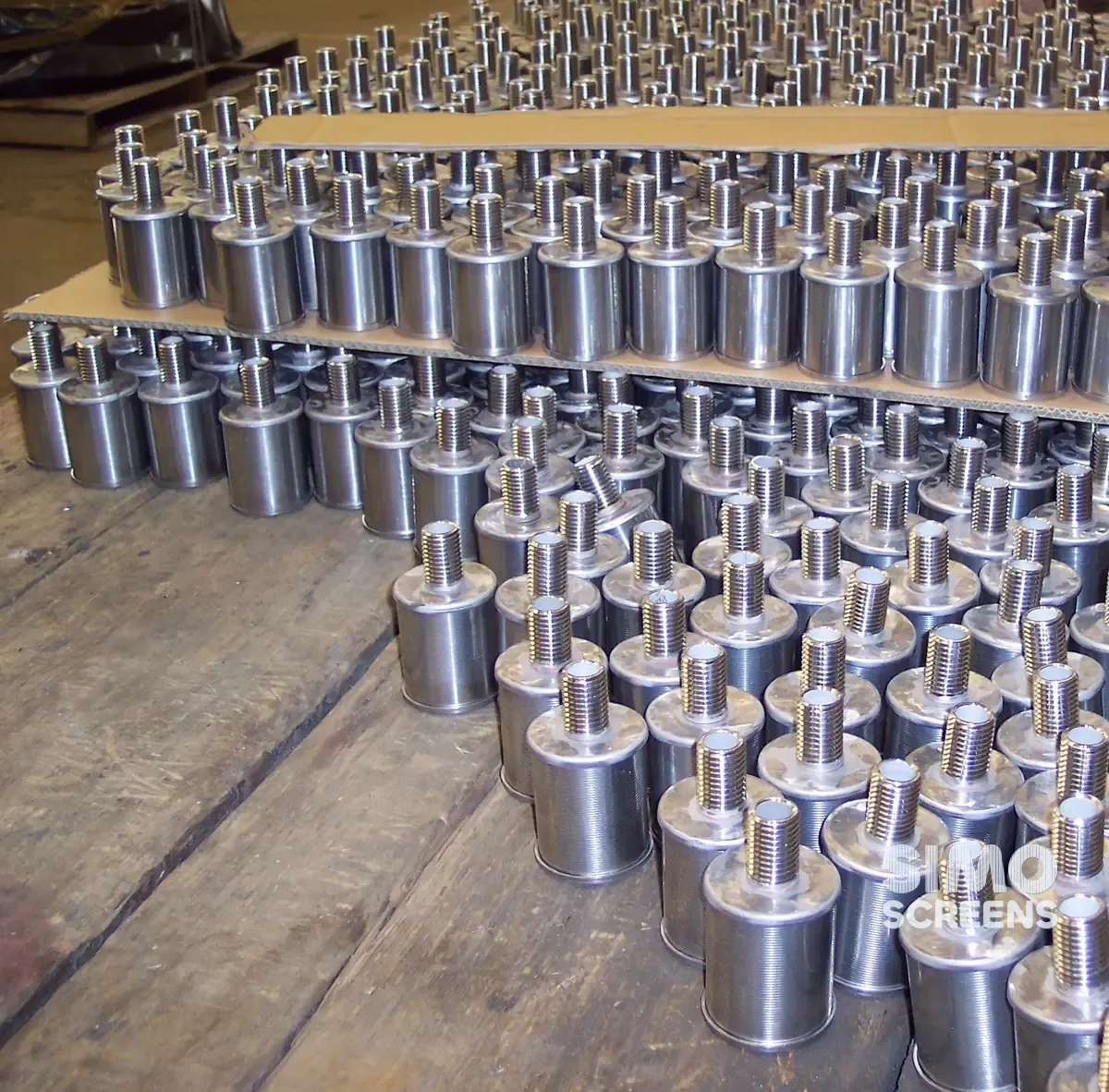
 Filter nozzles
 Resin traps
 Support grids
 Sieve bend (DSM) screens
 Centrifuge baskets
 Pressure screen baskets
 Screw press screens
 Rotary drum screens
 Passive intake screens
 Coanda intake screens
 Water and wastewater treatment
 Water wells and groundwater
 Sugar and distillery
 Brewing, malting and beverages
 Food processing
 Mining and minerals
 Oil, gas and petrochemicals
 Chemicals, fertilisers and pharma
 Power generation
 Pulp and paper
 Buildings and drainage

DM plant lateral overview
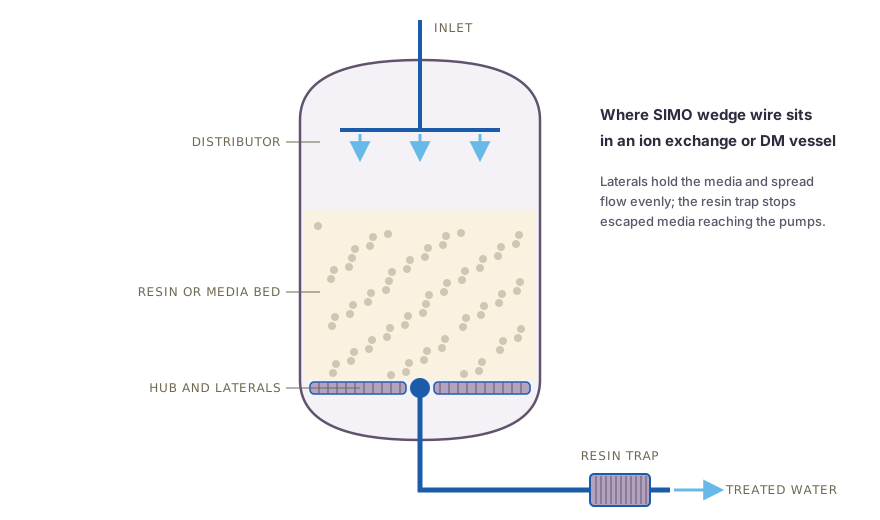
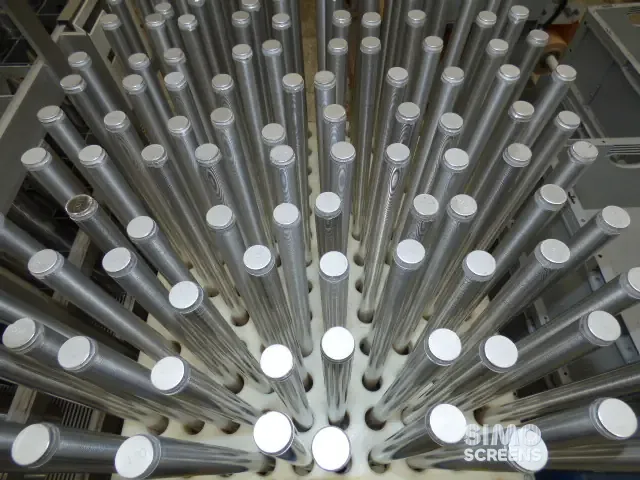
Every cation, anion and mixed bed vessel in a DM plant needs an underdrain that retains the resin and distributes the flow, and a central hub or header with radial or parallel laterals performs both functions. In service, treated water passes down through the bed and enters the laterals through the slots. During backwash and regeneration the flow reverses, so the same laterals must distribute water and chemical evenly without disturbing the resin.
Softeners and condensate polishers use the same ion exchange lateral arrangement, and many vessels also carry a top distributor and, in counter-current units, a middle collector for regenerant. Lateral problems typically show as resin in the outlet line or a falling run length. Slotted PVC or PP pipe loses slot control as it ages and swells, plastic laterals crack under backwash shock or water hammer, and too few laterals leave dead zones where channelling reduces usable resin capacity.
Swipe to see the full drawing.
Design considerations for DM plant internals
Slot. The slot sits below the smallest resin bead to be retained, with a margin. For standard gel and macroporous resins, about 0.2 to 0.25 mm is common practice, and fine mesh or uniform particle size resins may need a tighter slot, which is checked against the resin data sheet.
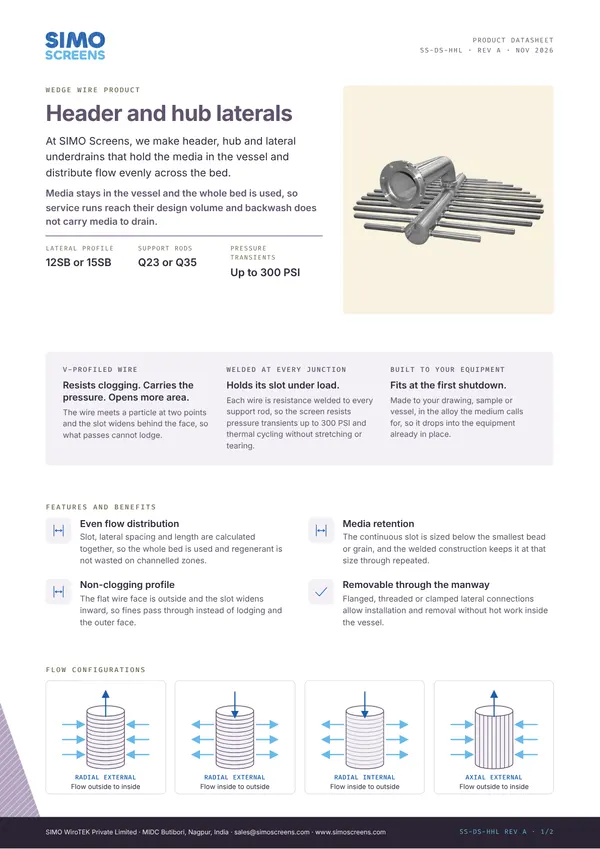
Profile and support rod. 12SB wire on Q23 rods suits low pressure and high flow rates, giving a high open area for a given slot. 15SB wire is selected for higher pressure at moderate flow. Long laterals and high backwash rates move to heavier rods, checked by FEA on custom designs.
Open area. The continuous V-profile slot widens inward, so that a bead touches the screen at two points and does not wedge. Open area (%) = Slot x 100 / (Slot + Wire width): a 0.25 mm slot on 12SB wire, 1 mm wide, gives 20 percent, and on 15SB, 1.52 mm wide, about 14 percent. Profiles can be compared in the open area calculator.
Distribution. Lateral spacing and length are set from the vessel diameter and flow, so that each lateral collects a similar share. CFD is used to check pressure drop and distribution on custom layouts.
Pressure. The welded construction resists thermal cycling and pressure transients up to 300 PSI, which protects the laterals against backwash shock and incorrect valve sequences.
Construction and options
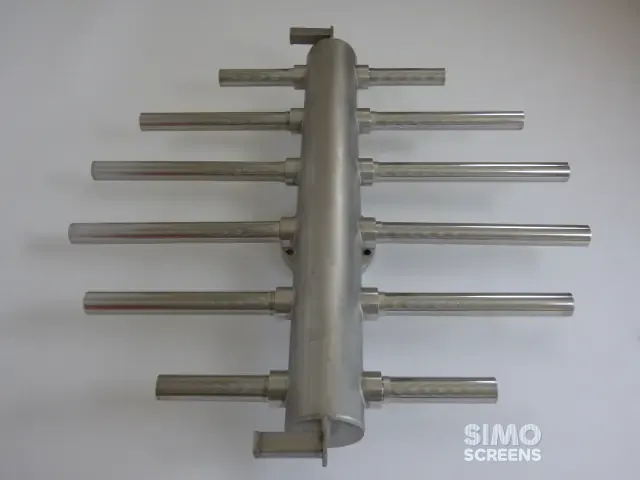
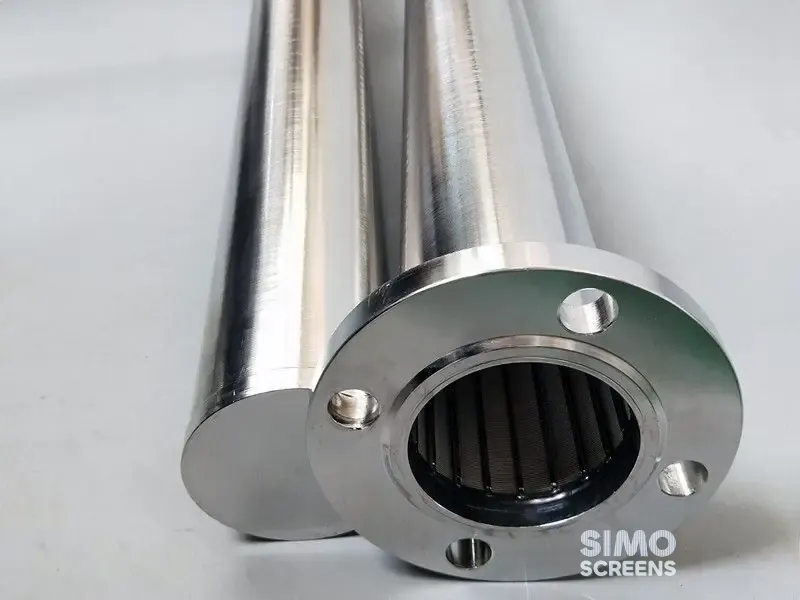
SIMO profile wire is formed in house and wound over longitudinal support rods, with resistance welding at every intersection, to give a rigid tube with a continuous slot. Laterals are straight screen tubes with an end cap and a threaded or flanged root. They are supplied as a complete hub and lateral or header and lateral assembly, or as loose laterals for an existing header, with hub and lateral segments designed for assembly inside the vessel through the manway.
| Item | SIMO range or typical value |
|---|---|
| Slot opening | 25 microns (0.025 mm) to 25 mm; DM and softener laterals typically 0.2 to 0.25 mm |
| Slot tolerance | Plus or minus 5% of nominal, stated on the drawing |
| Lateral diameter | 25 to 800 mm, sized to flow and vessel |
| Lateral length | Up to 6,000 mm in one piece |
| Profile wire | 12SB on Q23 for low pressure and high flow; 15SB for higher pressure, moderate flow |
| Support rods | Q23, Q35, Q55, round 120 or round 140 |
| Flow direction | Radial external, outside to inside in service, reversed in backwash |
| Pressure | Welded construction resists pressure transients up to 300 PSI |
Swipe sideways to see the whole table.
Slot width is checked with feeler gauges at set-up, during the run and at the end of each lateral, and each lateral is identified with job number, item and slot on a QR-coded tag, or laser marked where the client requires it.
Materials
SS 304 suits most cation and anion service on clean water. SS 316L is the usual step up for regenerant contact, chlorides and condensate service, and Duplex 2205 or Super Duplex 2507 is selected for brackish or high-chloride water. Hastelloy C-276 and Monel are available for special process streams. The Mill Test Certificate is supplied as standard, and a dimensional inspection report and QAP are supplied on request.
Replacement and retrofit
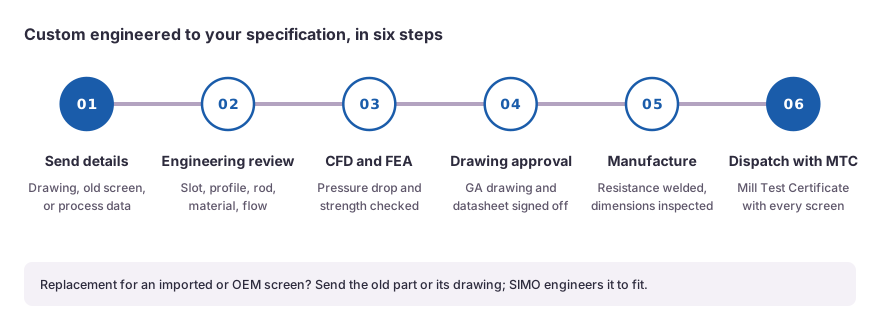
Most retrofits replace slotted PVC or PP laterals, OEM laterals or a nozzle plate with wedge wire laterals on the existing header. SIMO Screens works from the vessel drawing and the header connection detail, or from a sample lateral, so that new laterals fit the same sockets. Where the drawing is not available, photographs, the lateral count and length, the root thread and the manway size are sufficient to start.
The resin trap should be inspected at the same time, because it protects the outlet line if a lateral fails. Our header and hub lateral assemblies and resin traps pages give the product range, and the header and lateral underdrain design guide covers spacing and layout.
What to send for a quotation
- Vessel type: cation, anion, mixed bed, softener or polisher, and co-current or counter-current regeneration.
- Vessel diameter, straight height and dished end details.
- Service, backwash and regeneration flow rates, and design pressure.
- Resin type and data sheet, including the smallest bead size.
- Header or hub arrangement, lateral count and root connection (thread or flange size).
- Manway size and position.
- Water analysis, chloride level and regenerant chemicals, for material choice.
- Drawing, sample or photographs of the existing internals, for a retrofit.

 Upload a drawing