 +91 93730 08466
 Screen tubes and pipes
 Screen cylinders
 Flat panels and false bottoms
 Candle filter elements
 Water well screens
 Header and hub laterals
 Filter nozzles
 Resin traps
 Support grids
 Sieve bend (DSM) screens
 Centrifuge baskets
 Pressure screen baskets
 Screw press screens
 Rotary drum screens
 Passive intake screens
 Coanda intake screens
 Water and wastewater treatment
 Water wells and groundwater
 Sugar and distillery
 Brewing, malting and beverages
 Food processing
 Mining and minerals
 Oil, gas and petrochemicals
 Chemicals, fertilisers and pharma
 Power generation
 Pulp and paper
 Buildings and drainage
 Datasheet

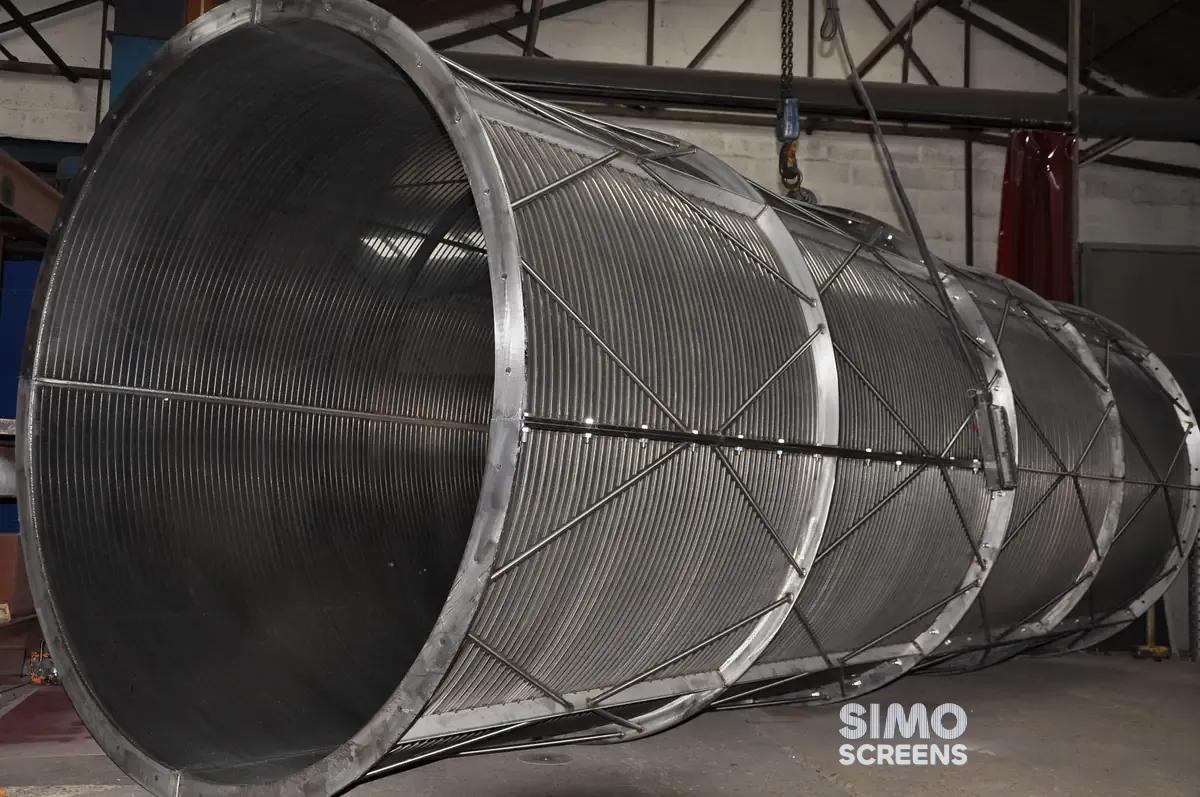
Rotary drum screen overview
Inlet works, wash water and process streams carry solids that foul downstream equipment. Static screens can blind under heavy solids loads, and manual cleaning ties up operators.
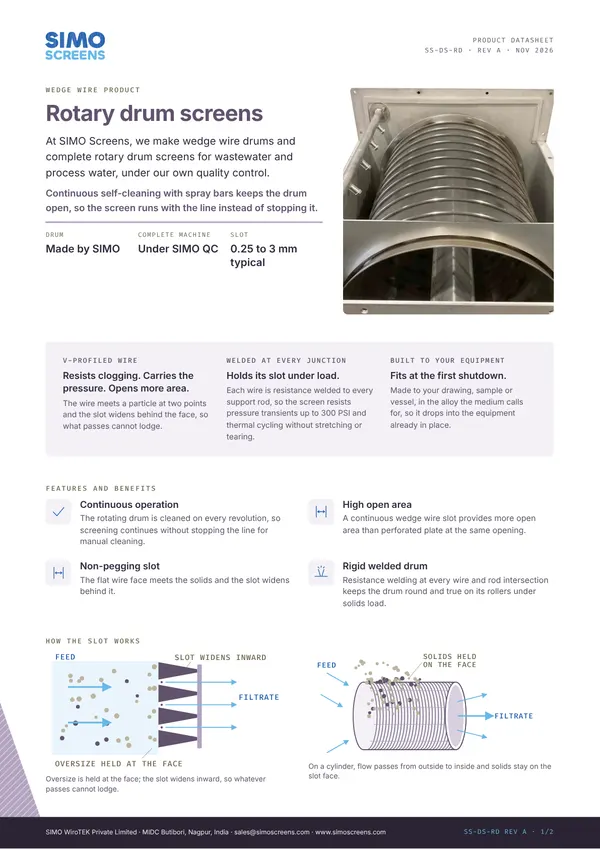
A SIMO Screens rotary drum screen runs continuously. The drum turns slowly, the screen face is washed on every revolution and the solids leave the machine without manual handling. Wedge wire gives the drum high open area and a slot that resists pegging, so it handles more flow per metre of drum.
Features and benefits
- Continuous operation. The rotating drum is cleaned on every revolution, so screening continues without stopping the line for manual cleaning.
- High open area. A continuous wedge wire slot provides more open area than perforated plate at the same opening, which reduces drum size for a given flow.
- Non-pegging slot. The flat wire face meets the solids and the slot widens behind it, so fibres and particles clear through or stay on the face for removal.
- Rigid welded drum. Resistance welding at every wire and rod intersection keeps the drum round and true on its rollers under solids load.
- Drum or complete machine. SIMO supplies the wedge wire drum alone or a complete machine, with all bought-out parts inspected under SIMO quality control.
Applications
- STP and ETP inlet works, as fine screening ahead of treatment, in water and wastewater treatment.
- Sludge thickening ahead of dewatering.
- Process and vegetable wash water in food plants.
- Mill house juice screening in sugar plants, typically with 0.45 to 0.8 mm slots on 15SB or 18SB profile wire. See juice screens.
- Thickening and fibre recovery in pulp and paper.
Internally and externally fed drums
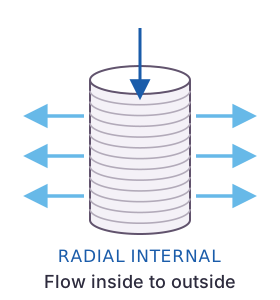
Internally fed drums. Feed enters inside the drum at one end, the liquid passes outward through the slots, and internal flights move the solids along the drum to the discharge end. The flat wire face is on the inside, which is radial flow with an internal profile, inside to outside. These drums are made by reverse rolling flat panels or by winding on internal-profile machines.
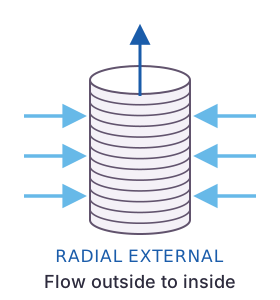
Externally fed drums. Feed spreads from a headbox onto the outer face, the liquid passes inward and leaves through the drum ends, and a doctor blade scrapes the solids off the outside. The flat wire face is on the outside, which is radial flow with an external profile, outside to inside.
Construction and specifications
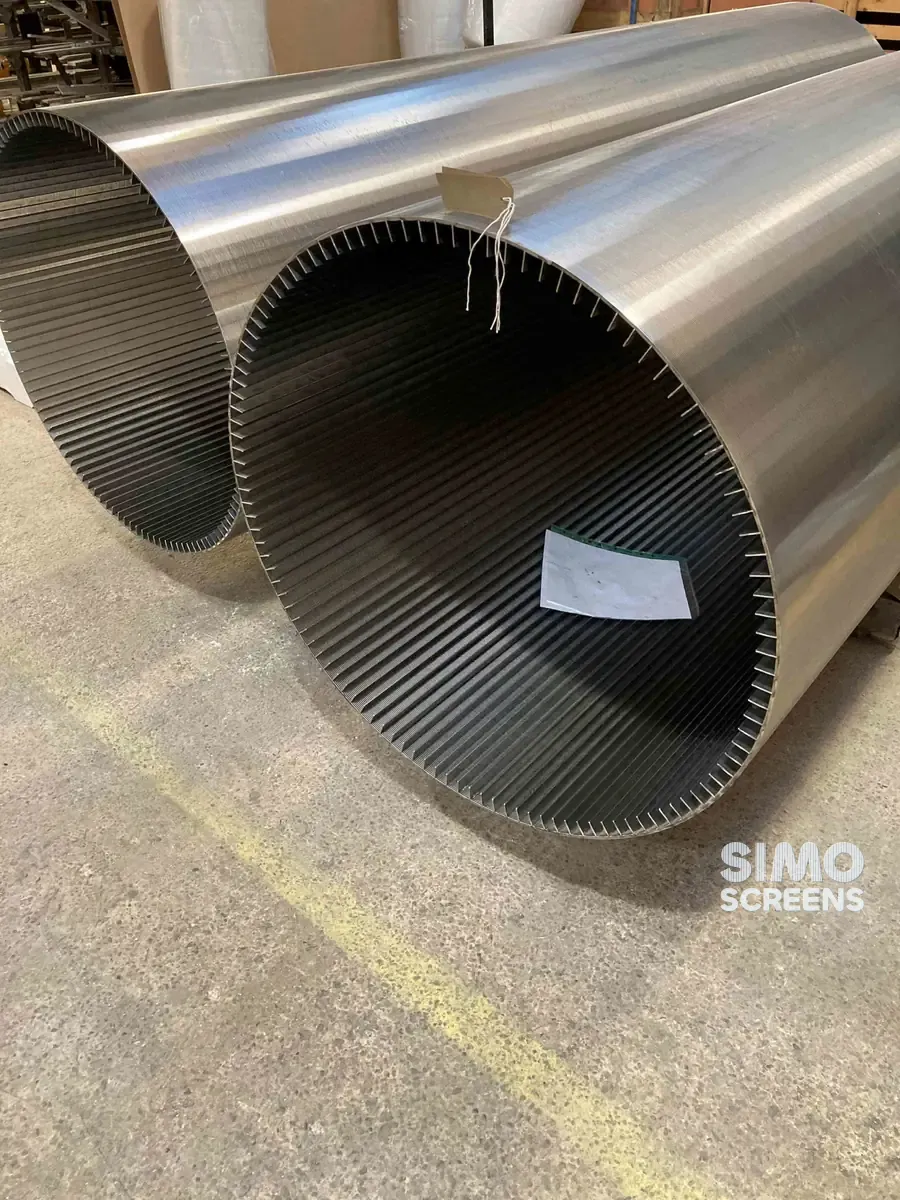
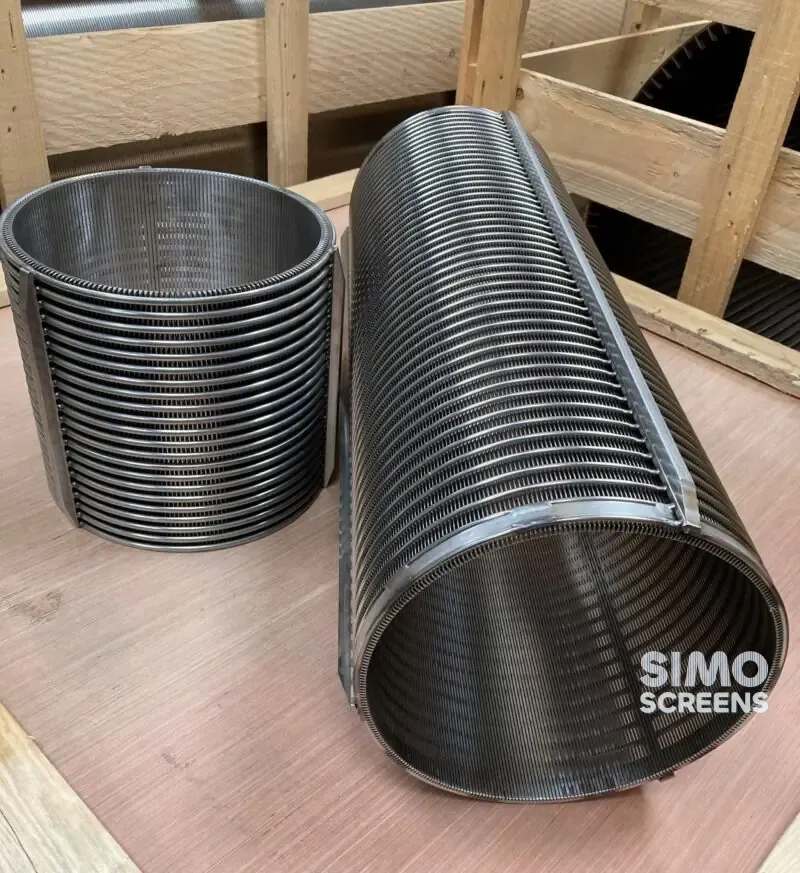
The drum is a wedge wire cylinder, resistance welded at every wire and rod intersection. SIMO fabricates the end rings, reinforcing rings and, for internally fed drums, the internal flights, with rings made to suit the drive and support rollers of the machine.
| Parameter | SIMO range |
|---|---|
| Slot opening | 25 microns (0.025 mm) to 25 mm |
| Slot tolerance | Plus or minus 5% of nominal, stated on the drawing |
| Drum diameter | 25 mm to 800 mm |
| Drum length | Up to 6,000 mm |
| Feed arrangement | Internally fed or externally fed |
| Profile wire | Light, standard, heavy duty or custom: 12SB to 56SB |
| Support rods | Q23, Q35, Q55, 35SB, F123, F203, F253, round 120, round 140 |
| Materials | SS 304, SS 316L, Duplex 2205, Super Duplex 2507, Hastelloy, Monel |
| Flow configuration | Radial internal inside to outside, or radial external outside to inside |
| Scope | Wedge wire drum, or complete machine with drive, frame, tank and spray bar |
Swipe sideways to see the whole table.
Materials
SS 304 suits most food wash water and municipal sewage. SS 316L is selected for industrial effluent with chlorides and for acidic or hot process streams, while Duplex 2205 suits saline effluent and higher mechanical loads.
Engineering and quality
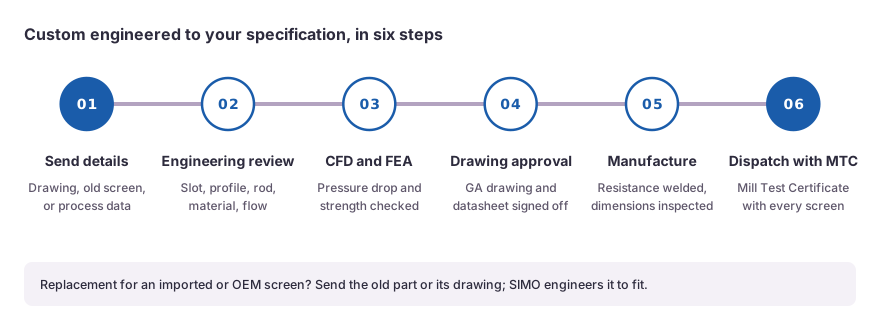
Drum diameter, length, slot and profile wire are selected from the hydraulic and solids load, with heavier profiles for abrasive grit and lighter profiles where open area governs; the flow configuration guide explains the profile direction. A drawing is issued for approval, and slot, diameter, roundness and ring dimensions are checked against it before dispatch.
Slots are checked with feeler gauges through production, the final inspection report records the minimum, maximum and mean slot, and each drum ships with a Mill Test Certificate. On complete machines, the sourced drive, frame, tank and spray bar are inspected by SIMO before assembly and dispatch.
What to send for a quotation
- Application: inlet works, wash water, juice, fibre recovery or other.
- Flow rate, peak and average.
- Solids concentration and type: fibrous, gritty, greasy or mixed.
- Preferred feed arrangement, or the existing machine type.
- Drum dimensions and slot, if replacing an existing drum.
- Liquid chemistry and temperature.
- Whether you need the drum only or a complete machine.
 Upload a drawing