 +91 93730 08466
 Screen tubes and pipes
 Screen cylinders
 Flat panels and false bottoms
 Candle filter elements
 Water well screens
 Header and hub laterals
 Filter nozzles
 Resin traps
 Support grids
 Sieve bend (DSM) screens
 Centrifuge baskets
 Pressure screen baskets
 Screw press screens
 Rotary drum screens
 Passive intake screens
 Coanda intake screens
 Water and wastewater treatment
 Water wells and groundwater
 Sugar and distillery
 Brewing, malting and beverages
 Food processing
 Mining and minerals
 Oil, gas and petrochemicals
 Chemicals, fertilisers and pharma
 Power generation
 Pulp and paper
 Buildings and drainage
The role of a DSM screen
Many plants must remove fine solids from a large flow of slurry or water without blinding and without power. Vibrating screens can do this but need drives, springs and regular repair, while fine flat screens blind quickly when the slot is close to the particle size.
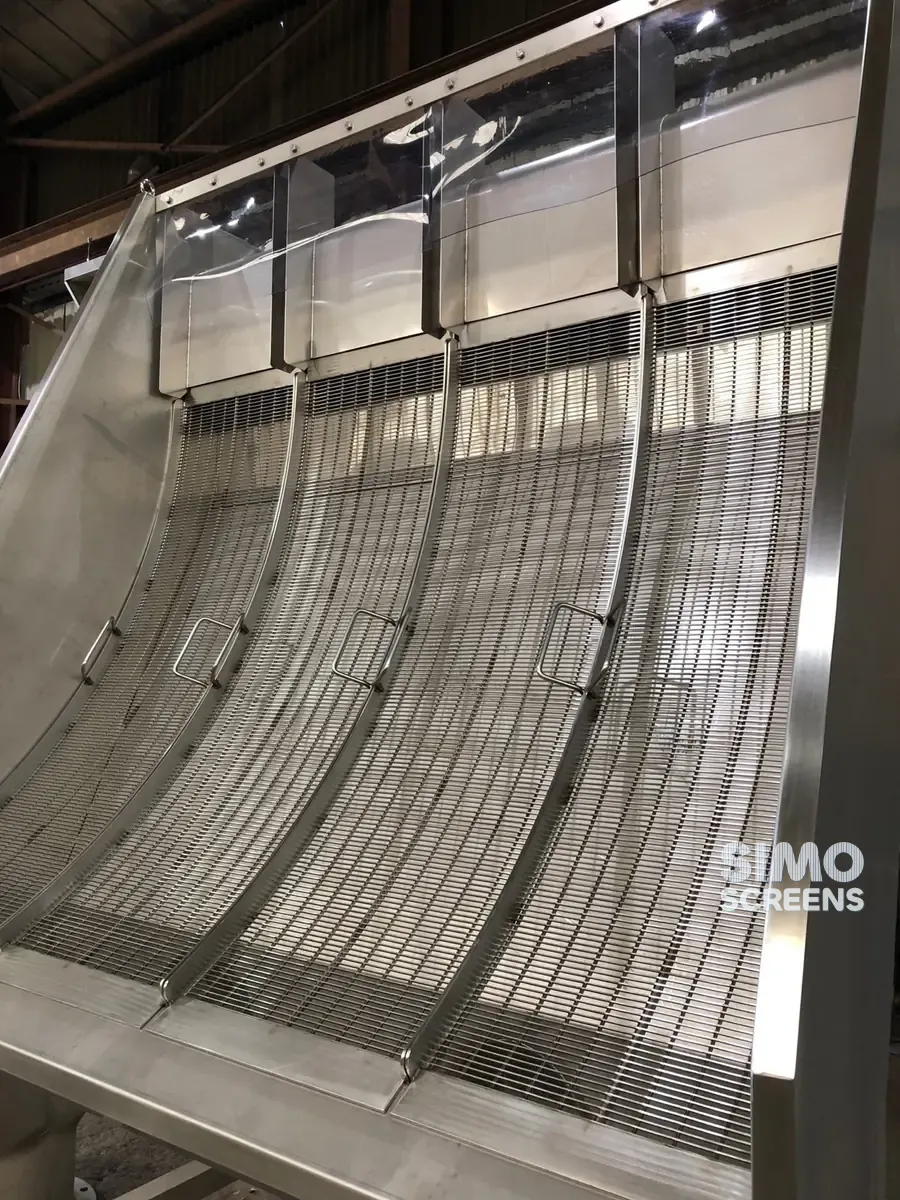
A sieve bend makes the separation with no moving parts. It is a curved wedge wire screen fed from the top, which is compact, quiet and simple to maintain.
How a DSM screen works
The screen surface is a curved wedge wire panel with the bars running across the direction of flow, so that the slots are transverse, and the flat face of each profile wire facing the slurry.
Feed enters tangentially at the top of the arc, spread evenly across the full width. As the slurry runs down the curve it meets the upstream edge of each bar in turn, and each edge slices a thin layer from the bottom of the stream, which turns through the slot and drops away as underflow.
The particles that pass are much smaller than the slot, so a sieve bend makes a finer cut than a flat screen with the same opening. A commonly cited rule is that the cut size is about half the slot width. Material that is not sliced off continues down the screen and leaves at the bottom edge as overflow, partly dewatered on the way.
The role of the V-slot
The wedge wire slot widens below the screen face, so a particle that enters the slot falls clear instead of jamming. Together with the slicing action, this keeps the screen open on sticky or fibrous feeds.
Sieve bend applications
| Industry | Application | Function of the screen |
|---|---|---|
| Coal washeries | Desliming ahead of dense medium circuits, typically on about a 0.5 mm slot | Removes fines that would load the medium |
| Coal and minerals | Dewatering and sizing | Drains water and splits size fractions without power |
| Sugar mills | Mill house juice screening, typically on 0.45 to 0.8 mm slots | Removes bagacillo from raw juice |
| Pulp and paper | White water fibre recovery | Recovers fibre for reuse |
| Effluent and process water | Fine screening at inlet works | Removes fibre, hair and fine solids |
| Food processing | Wash water screening | Separates peel, pulp and fines |
Swipe sideways to see the whole table.
In each case the sieve bend makes a fine cut in a small footprint, with no drive and little operator attention.
Sieve bend screen design variables
| Variable | Effect |
|---|---|
| Slot width | Sets the cut at roughly half the slot; a wider slot gives more capacity and a coarser cut |
| Arc angle | A longer arc gives more slicing edges and more dewatering; gravity units commonly use about 45 to 60 degrees |
| Radius | With the arc, sets the screen length along the flow |
| Screen width | Capacity scales roughly with width for a given slot and feed |
| Feed velocity | Higher velocity increases the centrifugal effect and capacity, with more wear |
| Profile wire | Wire width sets open area, while wire height and section set stiffness and wear life |
Swipe sideways to see the whole table.
Arc angle
Gravity-fed sieve bends commonly use arcs of about 45 to 60 degrees. Pressure-fed units, in which a nozzle drives the feed at higher velocity, can use larger arcs of up to about 270 degrees. A longer arc dewaters the overflow further but adds height, which matters when a screen is fitted into an existing plant.
Feed box
The feed box largely determines screen performance, since it must deliver slurry across the full width at even depth and velocity, flowing tangent to the curve.
- Weir feed. Slurry overflows a weir onto the top of the screen, which is simple and common on gravity units.
- Nozzle feed. An adjustable gap or nozzle injects slurry at a set velocity, as used on pressure-fed units and for finer cuts.
- Distribution. A baffle or distribution pipe inside the box spreads the feed, since uneven feed leaves dry and overloaded areas side by side.
Coarse tramp material is kept out of the feed box by a trash screen ahead of the sieve bend, which prevents blockages at the feed lip. SIMO Screens supplies feed boxes and housings with the screen on request.
Open area and panel construction
Open area follows from the slot and the wire width:
Open area (%) = Slot x 100 / (Slot + Wire width)
On a sieve bend, open area governs how much underflow each bar can pass, while the wire section matters equally because the wire must stay stiff across the width and resist wear.
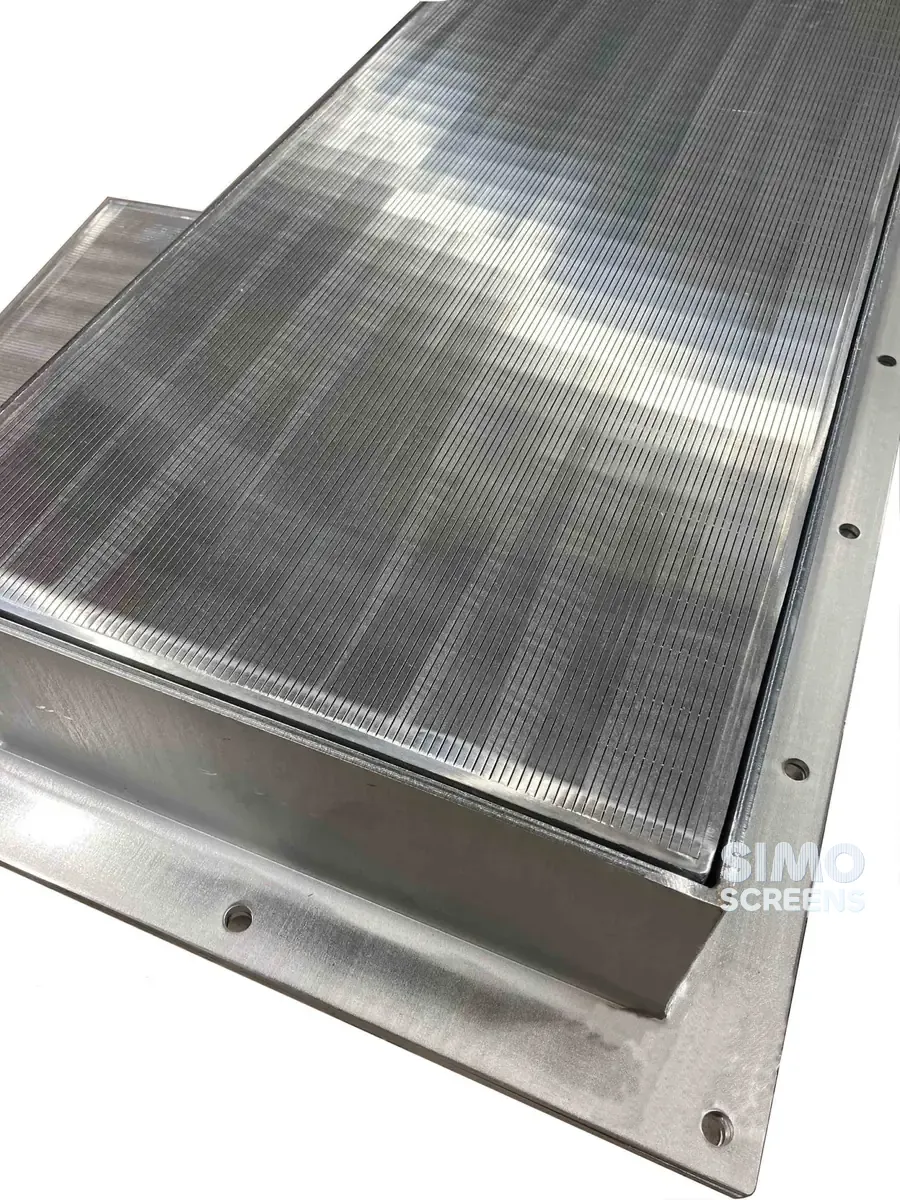
The slot, profile wire and support rod are therefore specified together. A heavier wire provides more wear material before the panel is replaced, and closer support rod spacing prevents a wide panel from flexing under the slurry load. Because wear on the top face of a V-profile gradually widens the slot, slot width is checked as the screen wears.
Wear and reversing
The cutting action depends on a sharp upstream bar edge, and abrasive feeds such as coal and mineral slurries round these edges over time. As the edges wear, less flow is sliced off at each bar, capacity falls and more fine material reports to overflow.
The usual remedy is to reverse the screen. Turning the panel end for end, through 180 degrees, presents the other edge of each bar as the new upstream edge, and most sieve bend panels are made reversible so that one panel gives two wear lives. A screen is due for reversal when:
- underflow volume falls at the same feed;
- more water or fines report to overflow;
- the bar edges at the top of the arc appear visibly rounded or polished.
When both edges are worn, the panel is replaced. Measuring the slot at several points at each shutdown builds a wear record for the application.
Material selection
SS 304 suits most water, fibre and juice service, and SS 316L is used where chloride or process chemicals are present. For abrasive coal and mineral slurries, Duplex 2205 offers higher strength and hardness than the austenitic grades, which can extend wear life. The material selector narrows the choice by application.
Worked example: coal washery desliming
Design basis: a coal washery desliming sieve bend ahead of a dense medium circuit, with a feed of 300 m³/h of raw coal slurry.
Slot and cut:
- Slot = 0.5 mm, the slot commonly used on coal desliming sieve bends
- Expected sieve bend cut by the half-slot rule = 0.5 / 2 = about 0.25 mm
Open area: with an 18SB profile wire 1.8 mm wide:
- OA = 0.5 x 100 / (0.5 + 1.8) = 21.7 percent
With a heavier 28SB wire 2.2 mm wide, for longer wear life:
- OA = 0.5 x 100 / (0.5 + 2.2) = 18.5 percent
Width: sieve bend screen capacity per metre of width depends on slot, feed velocity and solids, and is taken from test work or from screens already running in similar service. Using an illustrative figure of 100 m³/h per metre of width at this slot, which is not a design value, the 300 m³/h feed needs 3.0 m of width. Three 1.0 m screens would allow one to be reversed while the others run.
Arc: a gravity-fed 50 degree arc suits desliming where height is limited.
After commissioning, the cut is confirmed by sampling the underflow and the overflow. The open area calculator tests other slot and wire combinations.
Sieve bend installation and supply
For sieve bend installation, the screen is set so that the feed meets the top of the arc tangentially and evenly, with clear access for spraying, inspection and reversal. SIMO Screens manufactures sieve bend (DSM) screens for coal washeries, sugar mill juice screening, pulp and paper and process water. Send the feed rate, solids content, particle size data, target cut and available height, and our engineers will propose the slot, arc, width and profile wire.