 +91 93730 08466
 Screen tubes and pipes
 Screen cylinders
 Flat panels and false bottoms
 Candle filter elements
 Water well screens
 Header and hub laterals
 Filter nozzles
 Resin traps
 Support grids
 Sieve bend (DSM) screens
 Centrifuge baskets
 Pressure screen baskets
 Screw press screens
 Rotary drum screens
 Passive intake screens
 Coanda intake screens
 Water and wastewater treatment
 Water wells and groundwater
 Sugar and distillery
 Brewing, malting and beverages
 Food processing
 Mining and minerals
 Oil, gas and petrochemicals
 Chemicals, fertilisers and pharma
 Power generation
 Pulp and paper
 Buildings and drainage
Centrifuge basket guide: service conditions
A centrifuge basket operates under severe conditions. It spins at several hundred g, carries an abrasive cake and is subject to vibration throughout its running hours. When the screen fails, product passes to the effluent, the cake discharges wet and the machine is taken out of service.
Most basket failures arise from blinding, wear or fatigue. Wedge wire addresses each of these: the V-slot resists blinding, the profile wire height provides wear depth and the welded joints resist cracking. The sections below cover the machine types, followed by slot, orientation, wear, material and inspection.
How a wedge wire basket separates
In a filtering centrifuge the solids form a cake against the screen, and centrifugal force drives the liquid through the cake and out through the slots. The screen retains the product while liquid and fines pass freely.
The flat face of each profile wire faces the cake, and the slot widens behind it, so a particle that enters falls clear instead of jamming. This keeps the open area steady through a long run.
Three basket types
Batch centrifugals
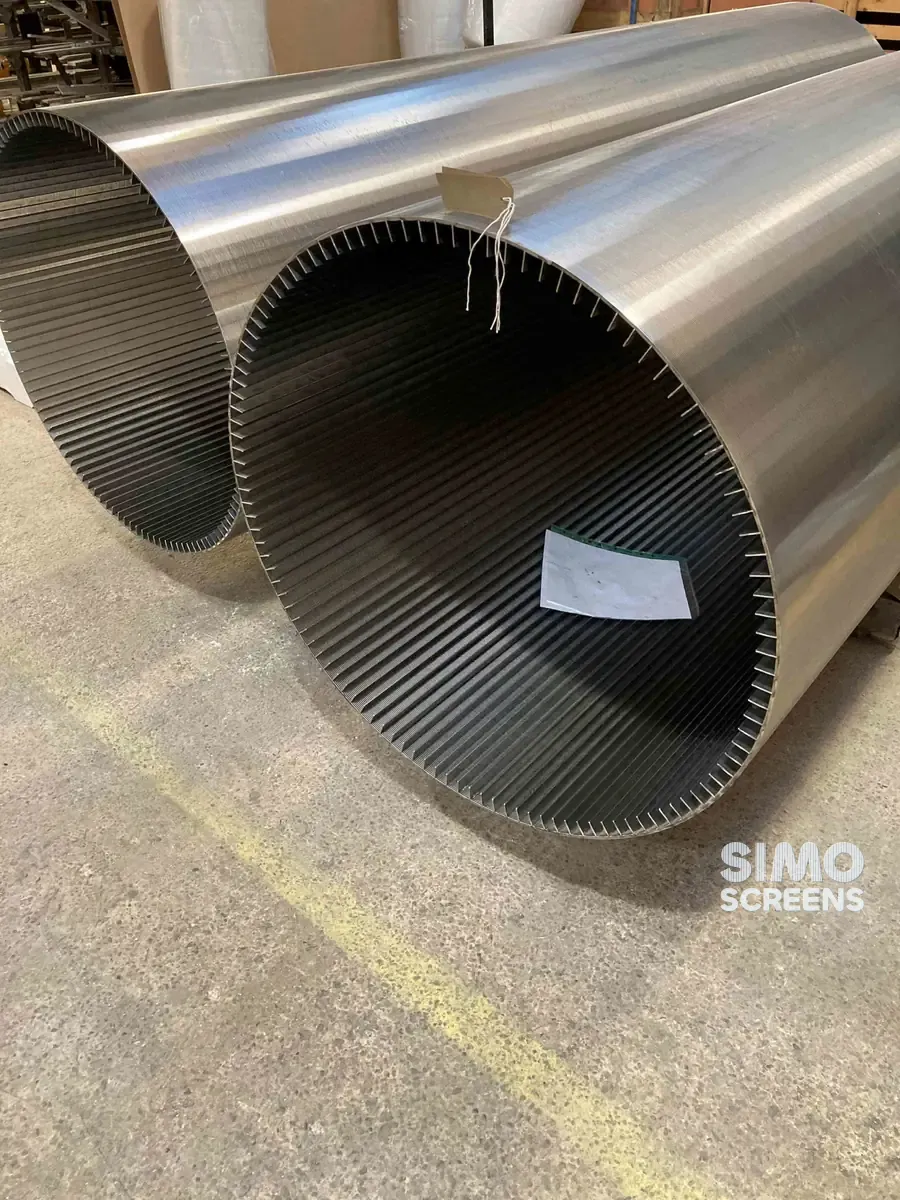
Batch machines operate in cycles of loading, spinning, washing, spin drying and discharge. They are common in sugar refining, for high-grade massecuite and for chemical crystal slurries, and their baskets are cylindrical.
In sugar batch centrifugals the basket shell carries a backing or support screen behind a fine working screen. Wedge wire is used for the backing screen and, where the slot suits the crystal, as the working screen itself.
Continuous centrifugals
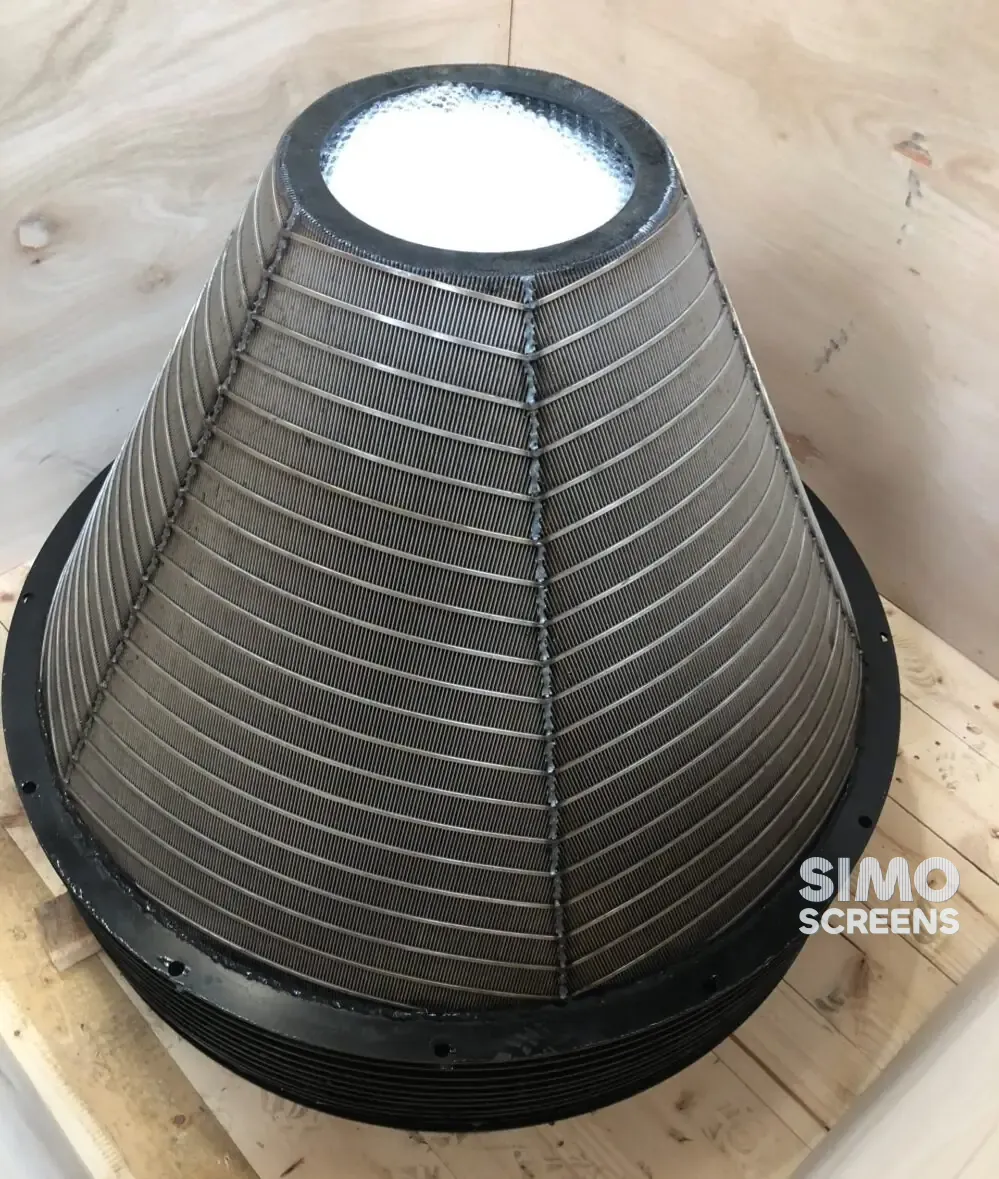
Continuous machines use a conical basket. Feed enters at the small end, centrifugal force spreads it over the cone, liquid passes through the screen, and the solids climb the cone and leave over the large end.
In sugar mills, continuous centrifugals are widely used for low-grade massecuite and for affination, with wedge wire forming the support screen and, in some designs, the working screen. In coal and minerals, screen scroll centrifuges use a conical wedge wire basket with an internal scroll that conveys the cake.
Vibrating basket centrifuges
A vibrating basket centrifuge has a conical wedge wire basket that spins and oscillates along its axis, so that the vibration moves the cake towards the discharge without a scroll. These machines are common for dewatering coarse coal and some minerals. Because the basket carries combined rotating and vibrating loads, weld quality and support rod design are as important as slot accuracy.
| Feature | Batch | Continuous (conical) | Vibrating basket |
|---|---|---|---|
| Basket shape | Cylindrical | Conical | Conical |
| Cake movement | Plough or scraper at the end of the cycle | Climbs the cone under centrifugal force | Moved by axial vibration |
| Typical industries | Sugar refining, chemicals | Sugar, coal, minerals | Coal, minerals |
| Main screen loads | Steady cake pressure, cyclic loading | Steady, with wear at the feed zone | Rotating plus vibrating, abrasive wear |
Swipe sideways to see the whole table.
Perforated and non perforated basket centrifuges
Basket centrifuges fall into two families, and only one of them uses a screen.
- Perforated basket centrifuge. The basket wall is open and lined with a screen or filter cloth, against which the cake builds while the liquid filters out. This is a filtering centrifuge, and the batch, continuous and vibrating machines above are all of this type.
- Non perforated basket centrifuge. The wall is solid, so it is also called an imperforate basket. Solids sediment against the wall under centrifugal force and the clarified liquid is skimmed from the inner surface, which suits solids too fine or soft to form a draining cake.
Wedge wire applies to the perforated, filtering type, as the working screen or as the backing screen behind a finer working screen. An imperforate basket has no screen and therefore no wedge wire element.
Basket slot selection
The slot is set below the smallest product particle to be recovered, so that liquid and fines below that size pass to the effluent.
An allowance is then made for wear. On a V-profile wire, wear on the top face gradually widens the slot because the wire narrows below its face, so the starting slot leaves a margin before the process limit is reached. Open area follows from the slot and the wire width:
Open area (%) = Slot x 100 / (Slot + Wire width)
Slot orientation
Slots run either around the basket, as circumferential slots, or along it, as axial slots.
- Circumferential slots. Solids moving along the basket cross the slots, so each wire edge meets the moving cake, which aids drainage while concentrating wear on the edges.
- Axial slots. Solids slide along the wire tops in line with the slots, which spreads wear along the wire length. Coal centrifuge baskets typically use axial slots.
Orientation affects drainage, cake transport and the wear pattern, and machine designers work to one arrangement or the other. A replacement basket normally matches the original orientation unless a clear process reason justifies a change.
Wear: location and causes
Wear is heaviest where the feed first meets the screen, at the small end of a conical basket. Abrasive feeds such as coal, iron ore and sand cut the wire tops, while in sugar the crystal abrasion is lower but long running hours still wear the screen. Wear life is extended by the following measures:
- a heavier profile wire with more height, such as 35SB or 42SB, where open area allows;
- a higher strength alloy such as Duplex 2205 for abrasive and high-stress service;
- even feed distribution, so that wear does not concentrate in one band;
- slot measurement at fixed points at every shutdown, with the trend recorded.
The profile wire selection guide lists the profile wire and support rod sizes SIMO Screens makes.
Material selection
| Material | Typical use |
|---|---|
| SS 304 | General sugar and coal service with low chloride |
| SS 316L | Higher chloride process water, mild chemicals |
| Duplex 2205 | High-speed or high-stress baskets, abrasive service, chloride |
| Super Duplex 2507 | Severe chloride, higher temperature |
| Hastelloy C-276 | Aggressive chemical crystal slurries |
Swipe sideways to see the whole table.
Duplex 2205 has roughly twice the yield strength of SS 304 or SS 316L, which provides a useful margin in a spinning basket, where stress rises with the square of speed.
Worked example: g-force and open area
Machine: a basket with an inside diameter of 1,000 mm running at 1,000 rpm.
Angular speed:
- ω = 2 x π x N / 60 = 2 x π x 1,000 / 60 = 104.7 rad/s
Centrifugal acceleration at the screen (r = 0.5 m):
- a = ω² x r = 104.7² x 0.5 = 5,483 m/s²
- Relative to gravity: 5,483 / 9.81 = 559 g
Each kilogram of wet cake therefore presses on the screen with about 5.5 kN, and doubling the speed would raise this load four times.
Slot and wire: the product must be retained above 0.5 mm, so a 0.4 mm slot is selected to leave a wear margin.
| Wire | Width | Open area |
|---|---|---|
| 15SB | 1.52 mm | 0.4 x 100 / 1.92 = 20.8% |
| 28SB | 2.2 mm | 0.4 x 100 / 2.6 = 15.4% |
Swipe sideways to see the whole table.
The 28SB wire gives more wear life and stiffness at about a quarter less open area. Where drainage is the limiting factor, the 15SB wire with closer support rod spacing can be the better choice, and the final selection draws on the machine maker's data and plant experience. The open area calculator tests other combinations.
Inspection at each shutdown
A short, regular inspection identifies most basket defects before they affect the process.
- Clean and dry the basket so that the slots are visible.
- Measure the slot with feeler gauges at marked points in the feed zone, the middle and the discharge end.
- Inspect for cracked welds, loose or broken wires and bent support rods.
- Check flange faces and fixing holes for wear or distortion.
- Compare the results with the previous inspection and record the trend.
A sudden rise in solids in the effluent between inspections usually indicates local damage rather than general wear, and the machine should be stopped and inspected without waiting for the next planned shutdown.
Replacement baskets and balancing
A replacement basket must fit the machine exactly and run in balance. SIMO Screens makes replacement baskets for imported and OEM centrifuges from a sample or a drawing, working from the OEM drawing where available or from the key dimensions of the worn basket: diameters, cone angle, length, flange details, slot, profile wire and orientation.
Balancing requirements follow the machine maker's specification and are stated on the enquiry so that they are built into the drawing. Dynamic balancing is arranged through approved agencies on request, while coal centrifuge baskets are usually balanced by the user.
SIMO Screens centrifuge baskets
SIMO Screens manufactures centrifuge baskets and screens for sugar mill centrifugals, coal and mineral centrifuges and chemical crystal slurries. Send the machine make and model, the basket drawing or dimensions, the feed and the target slot, and our engineers will propose the design, validated with FEA where required.