 +91 93730 08466
 Screen tubes and pipes
 Screen cylinders
 Flat panels and false bottoms
 Candle filter elements
 Water well screens
 Header and hub laterals
 Filter nozzles
 Resin traps
 Support grids
 Sieve bend (DSM) screens
 Centrifuge baskets
 Pressure screen baskets
 Screw press screens
 Rotary drum screens
 Passive intake screens
 Coanda intake screens
 Water and wastewater treatment
 Water wells and groundwater
 Sugar and distillery
 Brewing, malting and beverages
 Food processing
 Mining and minerals
 Oil, gas and petrochemicals
 Chemicals, fertilisers and pharma
 Power generation
 Pulp and paper
 Buildings and drainage
 Datasheet

Fish screen overview
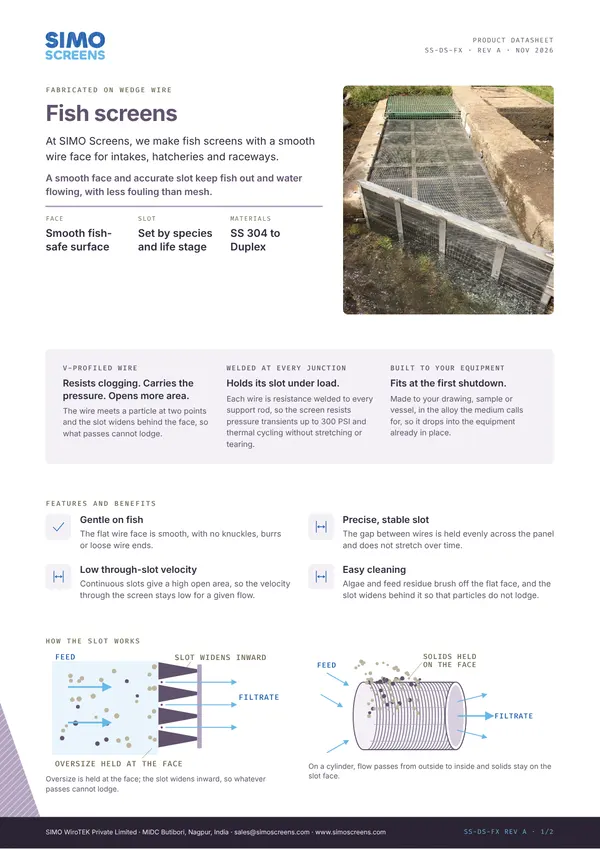
A fish screen is a barrier that passes water while holding fish back. On a farm it keeps stock within a tank or raceway, while at an intake it keeps wild fish out of a canal, pump or cooling water system.
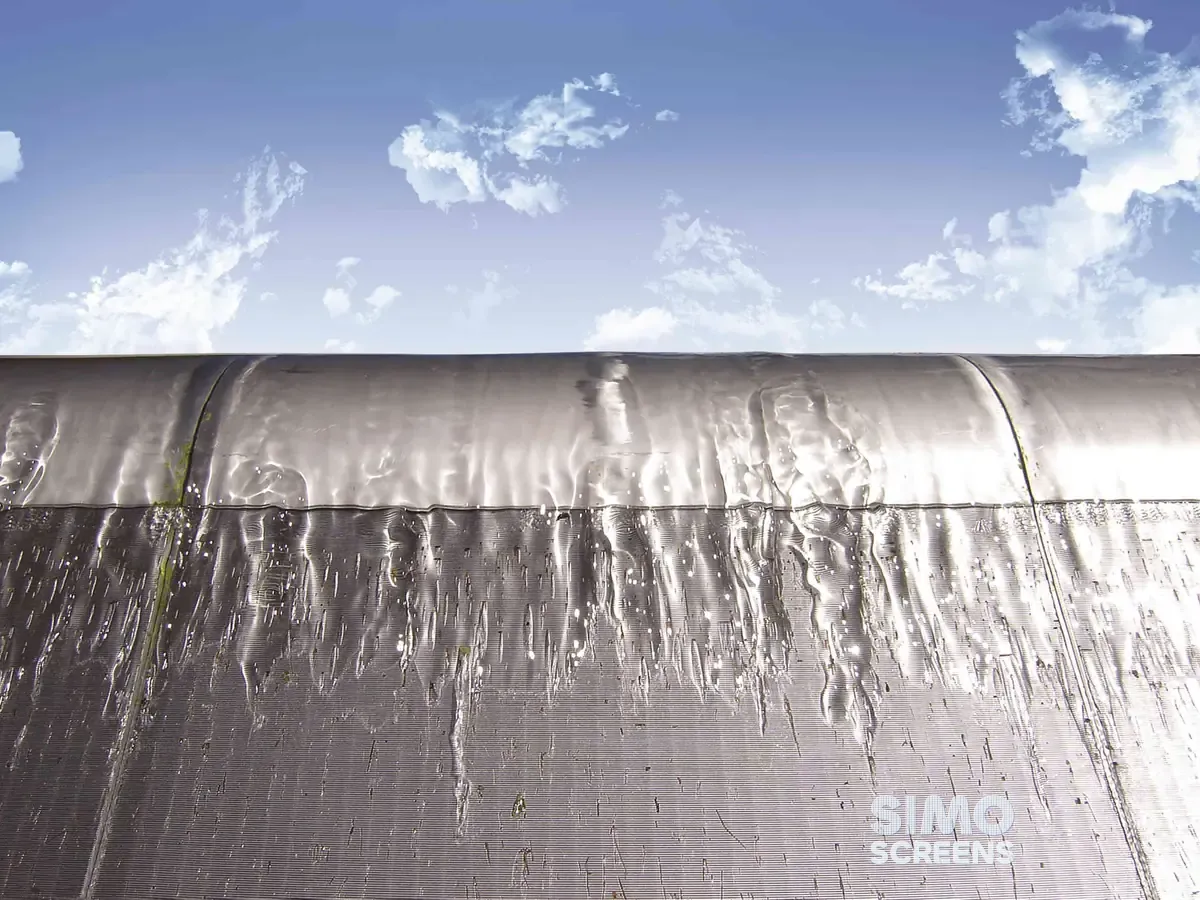
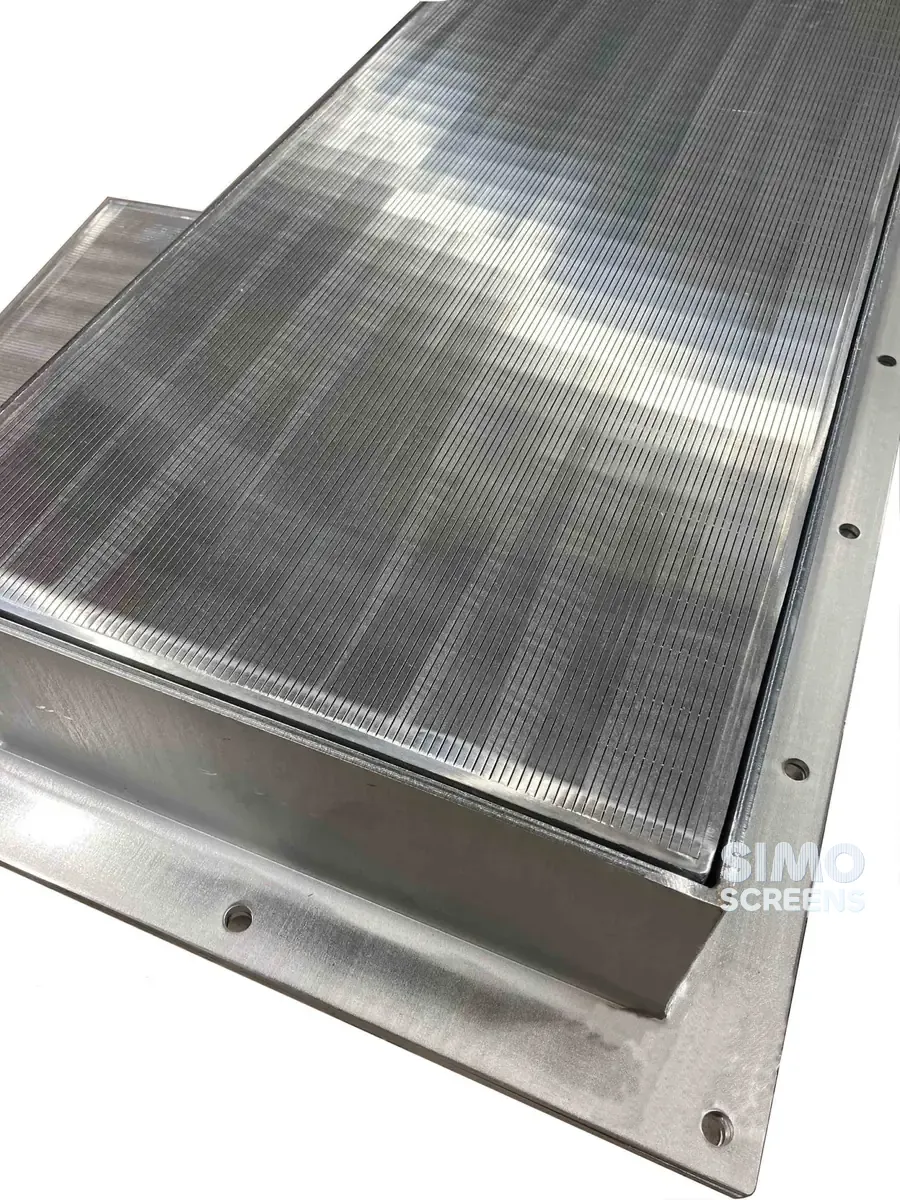
SIMO Screens wedge wire fish screens are built from V-profile stainless wire resistance welded to support rods, with the flat face of the wire towards the fish. They are framed as panels, cylinders or standpipe screens to suit the installation.
Features and benefits
- Gentle on fish. The flat wire face is smooth, with no knuckles, burrs or loose wire ends, so fish that touch the screen slide along it without injury.
- Precise, stable slot. The gap between wires is held evenly across the panel and does not stretch over time, which matters where the margin between fry size and slot is small.
- Low through-slot velocity. Continuous slots give a high open area, so the velocity through the screen stays low for a given flow.
- Easy cleaning. Algae and feed residue brush off the flat face, and the slot widens behind it so that particles do not lodge.
- Rigid welded construction. Resistance welds at every wire and rod intersection keep the screen rigid against debris load and the pull of a cleaning brush.
Applications
- Hatcheries, with tank outlet screens, standpipe screens and incubation tray screens
- Raceways and ponds, with tail, divider and inlet raceway screens
- Fish diversion, with angled panels that guide fish to a bypass at canals and offtakes
- Intake fish protection at pumping stations, canal intakes and cooling water intakes
The aquaculture and fisheries page covers the sector in more detail, and river and canal intakes are also served by passive intake screens.
Construction and specifications
| Item | Options |
|---|---|
| Slot | Set by the smallest fish life stage to retain or exclude |
| Profile wire | Light profiles for fine hatchery slots, heavier profiles for intakes |
| Wire direction | Vertical or horizontal, to suit cleaning and fish behaviour |
| Form | Flat panels, cylinders, standpipe screens or curved panels |
| Material | SS 304, SS 316L, Duplex 2205 or Super Duplex 2507 |
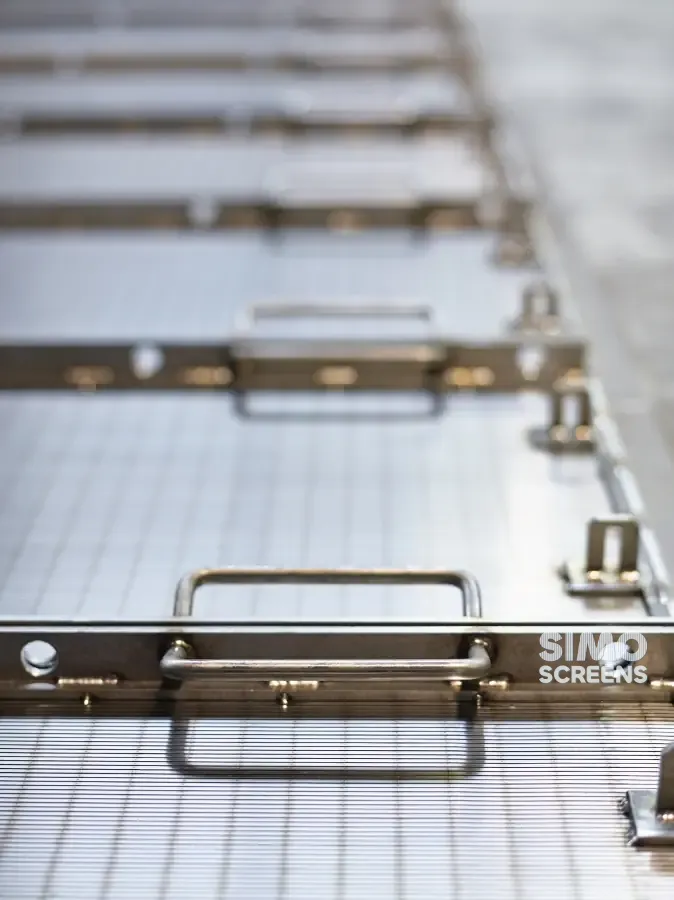
| Frame | Slide-in frames for raceway guides, bolted frames for intakes |
| Fittings | Handles, lifting points, seals and standpipe connections |
Swipe sideways to see the whole table.
Design considerations
Slot. The design starts from the smallest fish to be held back or excluded. At intakes, the permit or the fisheries authority usually sets the slot.
Velocity. Fish-protection intake screens are typically designed for a through-slot velocity of 0.15 m/s (0.5 ft/s) or less, and the screen area follows from the flow, that velocity and the open area. The intake screen calculator and the intake screen design guide set out the method.
Open area. Open area (%) = Slot x 100 / (Slot + Wire width), so a fine slot on a wide wire leaves little open area and the profile is chosen with care. The slot and open area guide explains the trade-off.
Water and fouling. Fresh, brackish and seawater call for different alloys, and biofouling in warm water affects the cleaning interval.
Fit. For existing raceways, the guide slot width and the water depth fix the frame, so that the screen slides in and seals.
Engineering and quality
Slots are checked with feeler gauges at set-up, during the run and at the end of each screen, to a standard tolerance of plus or minus 5 percent of nominal, and the final inspection report records the minimum, maximum and mean slot. Every order is supplied with a Mill Test Certificate, with a dimensional inspection report on request.
What to send for a quotation
- Application: hatchery, raceway, diversion or intake protection
- Species and smallest life stage to retain or exclude, or the slot required
- Flow rate through each screen
- Velocity limit, if your authority has set one
- Screen size, or channel width, water depth and guide slot dimensions
- Water type: fresh, brackish or seawater
- Preferred form: flat panel, cylinder or standpipe
- Quantity and delivery location
 Upload a drawing