 +91 93730 08466
 Screen tubes and pipes
 Screen cylinders
 Flat panels and false bottoms
 Candle filter elements
 Water well screens
 Header and hub laterals
 Filter nozzles
 Resin traps
 Support grids
 Sieve bend (DSM) screens
 Centrifuge baskets
 Pressure screen baskets
 Screw press screens
 Rotary drum screens
 Passive intake screens
 Coanda intake screens
 Water and wastewater treatment
 Water wells and groundwater
 Sugar and distillery
 Brewing, malting and beverages
 Food processing
 Mining and minerals
 Oil, gas and petrochemicals
 Chemicals, fertilisers and pharma
 Power generation
 Pulp and paper
 Buildings and drainage
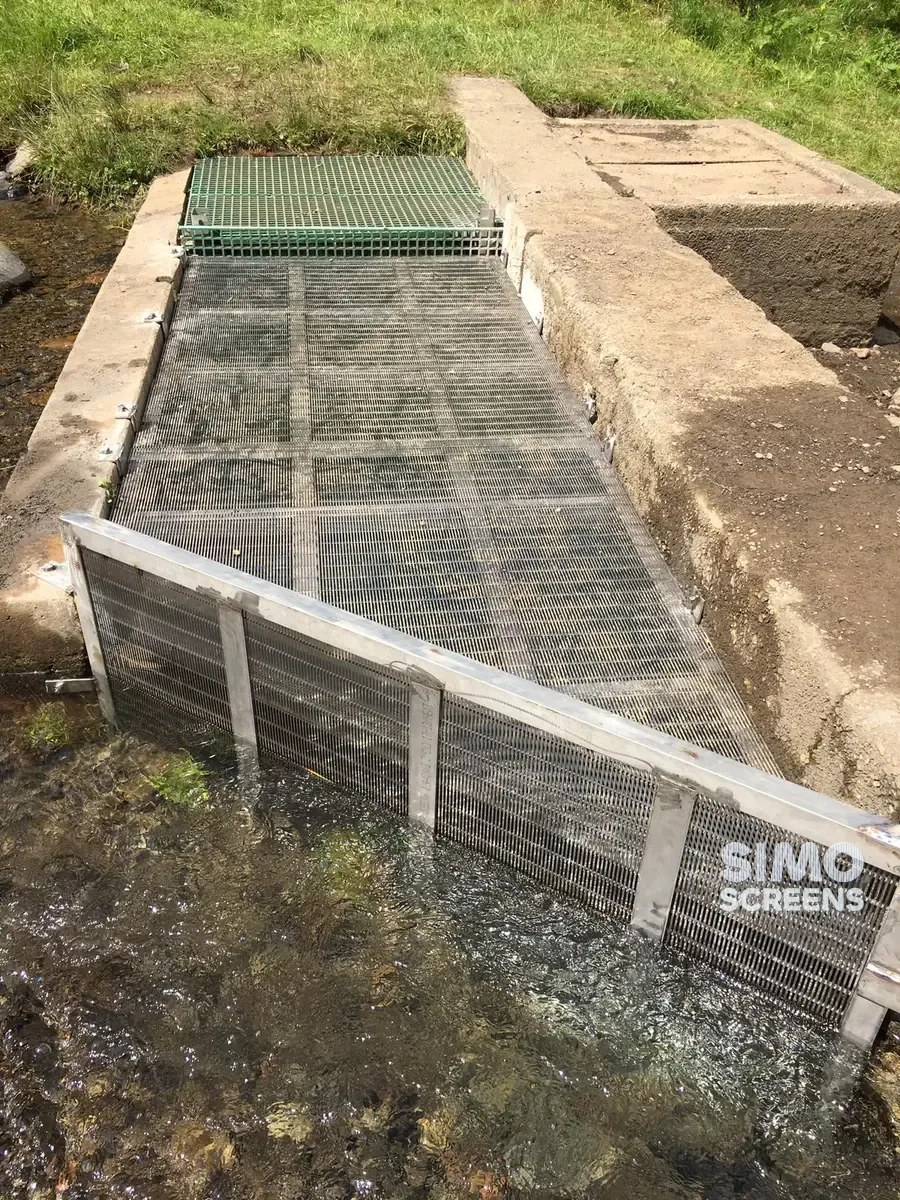
Aquaculture screening applications
SIMO Screens supplies wedge wire screens for hatcheries, fish farms and the intakes of canals and pumping stations. In each case the screen must pass water while protecting the fish on either side of it: retaining eggs, larvae and fry in a hatchery, or keeping wild fish out of a pump suction or diversion channel.
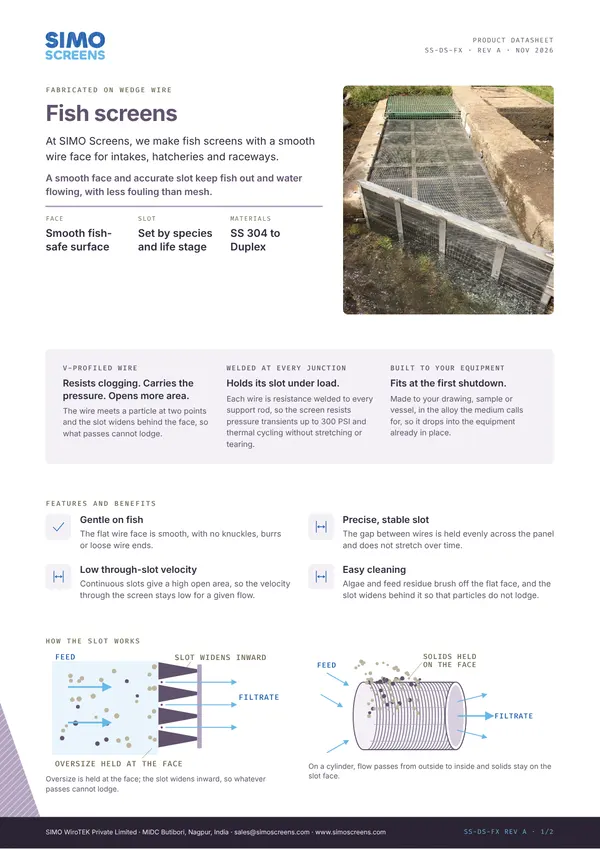
In a hatchery, hatchery screens sit at the outlets of incubators, nursery tanks and rearing tanks, where the slot holds the stock while water flows on. In raceways, fish farm screens divide the sections and close each end so that each batch stays apart. These screens are lifted out regularly for cleaning and grading, so they are framed and sized for handling.
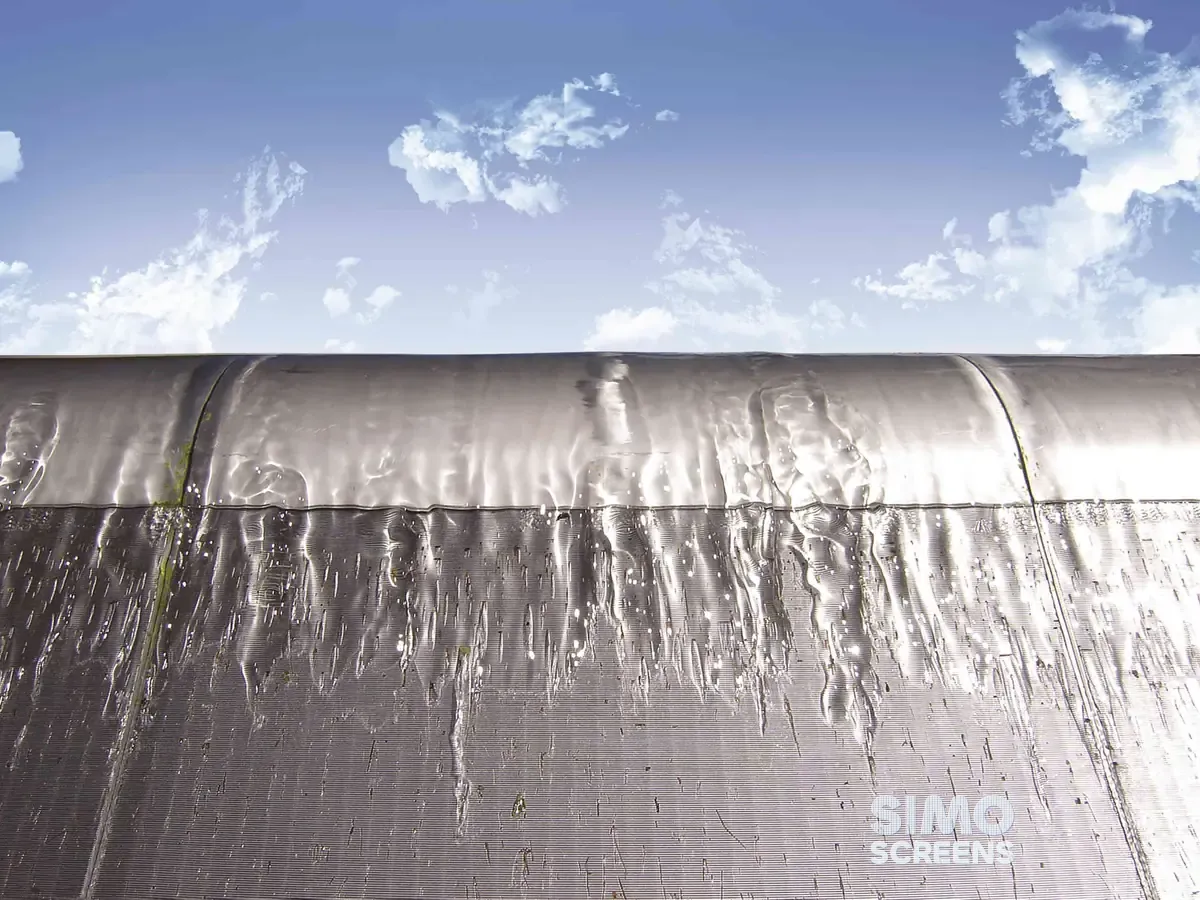
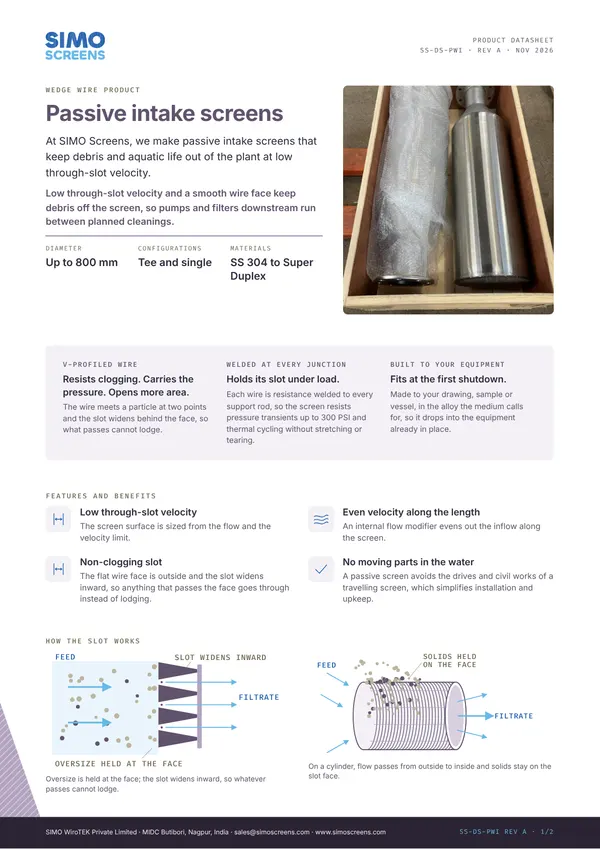
At canals, irrigation offtakes and pumping stations, fish diversion panels guide fish away from the diverted flow, and intake screens on the pump suction keep fish and debris out at a low through-slot velocity. Coanda screens draw clean water from a channel while fish and debris pass over the top.
The screening medium largely determines how well these requirements are met. Woven mesh has knuckles that can damage scales and fins, and it blinds with leaves and algae until the velocity through the remaining open area pins fish against it. Perforated plate has a low open area, which raises the approach velocity for a given flow. Wedge wire has a flat, smooth face and a slot that widens inward, so it resists blinding and keeps the approach velocity low and even.
Swipe to see the full drawing.
Equipment and aquaculture screen selection
| Equipment | Screen function | SIMO product |
|---|---|---|
| Hatchery incubators, nursery and rearing tanks | Holds eggs, larvae and fry while water flows out | Fish and aquaculture screens |
| Raceways and grading channels | Divides sections and retains stock on a smooth wire face | Fish and aquaculture screens |
| Fish diversion at canals and irrigation offtakes | Guides fish away from the diverted flow and back to the river or canal | Fish and aquaculture screens |
| Pumping station and canal intakes | Keeps fish and debris out of the pump suction at low through-slot velocity | Intake screens |
| Channel and Tyrolean intakes carrying fish and debris | Draws clean water through an inclined self-cleaning screen while fish and debris pass over | Coanda screens |
Swipe sideways to see the whole table.
Materials and design considerations
The points below reflect general engineering practice. The design for each site is confirmed during engineering review.
Slot and velocity
For hatchery and raceway screens, the slot is set below the smallest life stage that must be retained, and the open area then follows from the slot and the wire width. Fish-protection intake screens are typically designed for a through-slot velocity of 0.15 m/s (0.5 ft/s) or less, although the local fisheries authority may set a stricter limit. The intake screen design guide and the intake screen calculator set out the sizing method.
Fouling and cleaning
Algae and biofouling reduce the open area and raise the local velocity at the screen face. The smooth face of wedge wire is easy to brush or spray clean, and lift-out panels with guides or frames should be planned at the design stage so that cleaning does not interrupt operation.
Material
SS 304 suits most freshwater hatcheries and inland intakes, while SS 316L is used in brackish water. Marine hatcheries and seawater intakes generally call for Duplex 2205 or Super Duplex 2507, compared on the pitting resistance equivalent number, PREN = %Cr + 3.3 x %Mo + 16 x %N, where a higher value indicates better resistance in chloride water.
Structure
Large diversion panels and intake screens carry water load, debris load and handling loads. Support rods, panel frames and fixings are sized together, and large designs are checked with FEA. Single flat panels are made up to 2,400 mm wide and 4,000 mm long, and larger screens are engineered as joined panels.
SIMO Screens capability for aquaculture
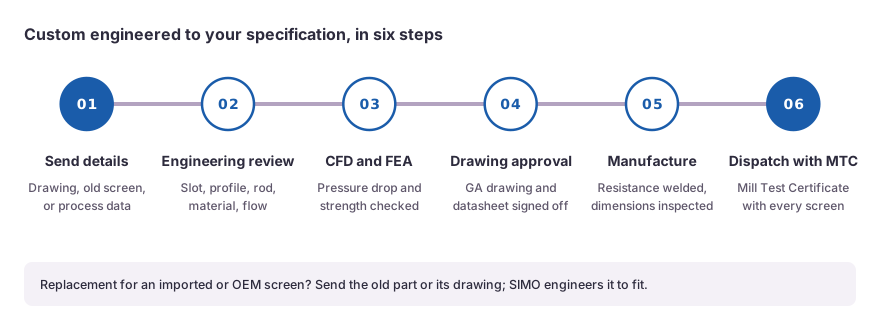
Each aquaculture screen is engineered to the tank, channel or intake it serves. The custom engineering process starts from the customer's drawings and flows and ends with a drawing approved before production.
Profile wire is formed in house to SIMO profile codes and resistance welded to the support rods at every intersection. Slot width is checked with feeler gauges at set-up, during the run and at the end of each screen, and held to a standard tolerance of plus or minus 5 percent of nominal. CFD is used to check approach and through-slot velocity on intake and diversion screens where the flow pattern needs it.
Every screen ships with a Mill Test Certificate, and the dimensional inspection report is supplied on request. Production is at the SIMO works in MIDC Butibori, Nagpur, under an ISO 9001:2015 quality system.
What to send for a quotation
- Application: hatchery tank, raceway, fish diversion, pumping station intake or Coanda intake.
- Species and the smallest life stage you need to retain or protect.
- Design flow and water depth at the screen.
- Tank, channel or intake dimensions, with a drawing or sketch.
- Water type: fresh, brackish or seawater, with an analysis if you have one.
- Any velocity limit set by your fisheries authority or consultant.
- Cleaning and handling arrangement: lift-out panels, frames or guides.
- Quantity.

 Upload a drawing