 +91 93730 08466
 Screen tubes and pipes
 Screen cylinders
 Flat panels and false bottoms
 Candle filter elements
 Water well screens
 Header and hub laterals
 Filter nozzles
 Resin traps
 Support grids
 Sieve bend (DSM) screens
 Centrifuge baskets
 Pressure screen baskets
 Screw press screens
 Rotary drum screens
 Passive intake screens
 Coanda intake screens
 Water and wastewater treatment
 Water wells and groundwater
 Sugar and distillery
 Brewing, malting and beverages
 Food processing
 Mining and minerals
 Oil, gas and petrochemicals
 Chemicals, fertilisers and pharma
 Power generation
 Pulp and paper
 Buildings and drainage

Coal centrifuge basket overview
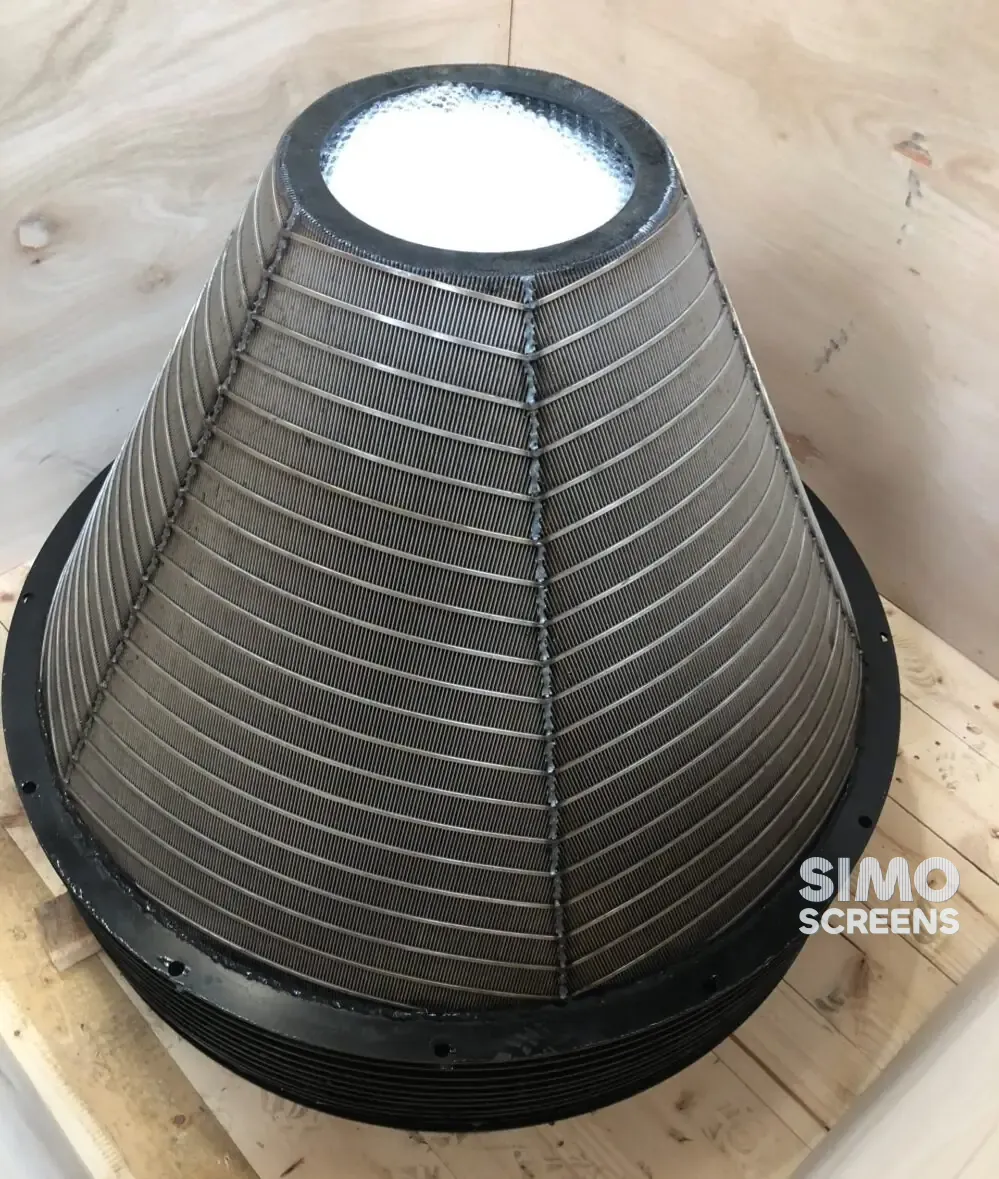
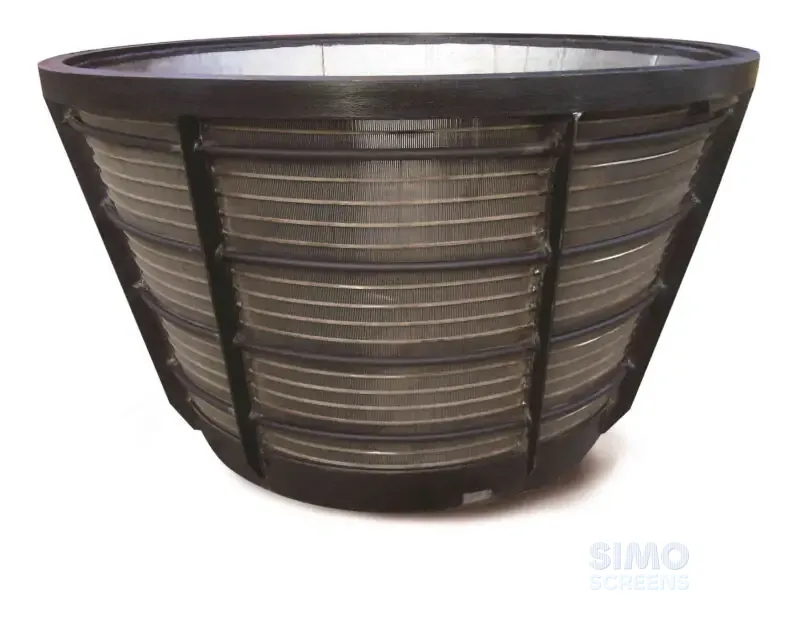
After the sieve bends and dewatering screens, washed coal still carries surface water, and a centrifuge spins it off so that the product meets its moisture target. Vibrating basket centrifuges handle small coal, while scroll centrifuges, also called screw conveyor or screen scroll centrifuges, handle fine coal. In both machines the coal travels across a conical wedge wire basket while water passes through the slots.
Few screens in a washery work harder than the coal centrifuge basket. Coal and shale abrade the wire top and widen the slot, which sends fines to the effluent and raises product moisture. Vibration and high g cycle every weld, and uneven wear or a damaged section throws the basket out of balance, which loads the bearings and drive.
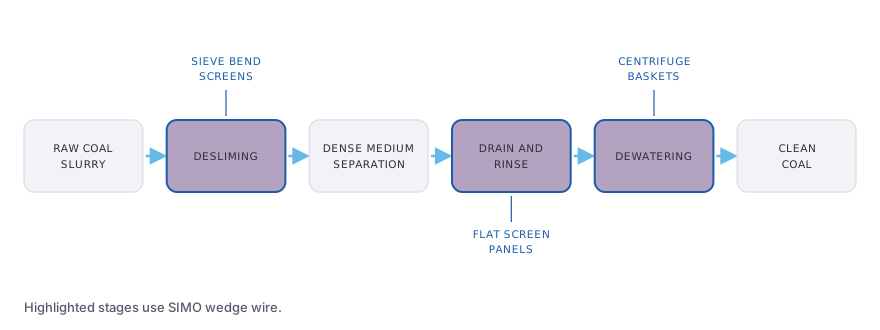
Swipe to see the full drawing.
Design considerations for a coal centrifuge screen
Slot. Fine coal machines commonly run slots of about 0.25 to 0.5 mm, and small coal machines about 0.5 to 1 mm. The slot is set from the feed size and the effluent target.
Slot orientation. Slots typically run axially on SIMO coal centrifuge baskets, following the machine design and the existing basket. The V-profile slot widens behind the face, so that near-size particles pass through instead of wedging and blinding the screen.
Profile and wear allowance. Baskets need wear allowance on the wire and stiffness in the rods. Heavy profiles such as 42SB, 55SB or 56SB on Q55 rods or F-series bars are typical, so that the wire head can lose material before the slot opens beyond its limit.
Load and fatigue. The basket carries centrifugal load and, on vibrating machines, constant cyclic load. FEA is used on custom designs to check the cone, the rods and the end rings under these loads.
Balance. A rotating basket must be balanced before service. Coal centrifuge baskets are usually balanced by the user, and dynamic balancing through an approved agency is available on request.
Open area (%) = Slot x 100 / (Slot + Wire width). A 0.5 mm slot on 42SB wire, 3.3 mm wide, gives about 13 percent open area, and a 0.75 mm slot on 35SB, 3 mm wide, gives 20 percent. Options can be compared in the open area calculator.
Construction and options
Each basket is formed as a cone of SIMO profile wire, formed in house, on deep support rods, with resistance welding at every intersection. End rings, flanges and stiffening rings are fabricated as part of the basket and drilled to the machine, and large baskets can be built in segments.
| Item | SIMO range or typical value |
|---|---|
| Form | Conical basket, one piece or segmented |
| Slot opening | 25 microns (0.025 mm) to 25 mm; fine coal typically 0.25 to 0.5 mm |
| Slot orientation | Typically axial |
| Slot tolerance | Plus or minus 5% of nominal, stated on the drawing |
| Diameter | 25 to 800 mm |
| Profile wire | 35SB, 42SB, 55SB, 56SB |
| Support rods | Q55, F203, F253 |
| Balancing | Usually by the user; dynamic balancing through an approved agency on request |
Swipe sideways to see the whole table.
Slot width is checked with feeler gauges at set-up, during the run and on the finished basket, and the inspection report records the minimum, maximum and mean slot. Each basket is identified with job number, item and slot on a QR-coded tag, and laser marked where the client requires it.
Materials
SS 304 and SS 316L suit many washeries. Duplex 2205 is stronger and harder, which helps where wear and fatigue limit basket life, and Super Duplex 2507 is selected for highly corrosive process water. The Mill Test Certificate is supplied as standard, with heat numbers traceable to the finished basket, and PMI through an approved agency is available on request.
Replacement and retrofit
Most coal centrifuge baskets are replacements for imported or OEM baskets. SIMO Screens builds from the OEM drawing, or measures a used basket for diameters, height, cone angle, flange PCD and bolt holes.
A used basket shows the cause of failure. Even wear across the cone indicates normal abrasion, which a heavier profile or harder grade extends. Wear at the feed end only points to feed distribution, so the feed pipe and cone should be checked before the design is changed. Cracks at rings or rods indicate fatigue, which heavier rods and stiffening rings address. One spare basket per machine allows each change to be made in a planned stop, and a record of running hours shows whether a heavier wire or Duplex grade pays back.
Our centrifuge baskets page and the centrifuge basket guide cover the wider range. Upstream screens are described under coal washery sieve bends and panels.
What to send for a quotation
- Centrifuge type, vibrating or scroll, with make and model.
- Basket large and small diameter, height and cone angle.
- Flange PCD, bolt holes and ring details.
- Feed size range and throughput in t/h.
- Current slot and wire, and the slot you want.
- Current basket life and failure mode.
- Process water pH and chlorides.
- OEM drawing or a used basket for measurement.

 Upload a drawing