 +91 93730 08466
 Screen tubes and pipes
 Screen cylinders
 Flat panels and false bottoms
 Candle filter elements
 Water well screens
 Header and hub laterals
 Filter nozzles
 Resin traps
 Support grids
 Sieve bend (DSM) screens
 Centrifuge baskets
 Pressure screen baskets
 Screw press screens
 Rotary drum screens
 Passive intake screens
 Coanda intake screens
 Water and wastewater treatment
 Water wells and groundwater
 Sugar and distillery
 Brewing, malting and beverages
 Food processing
 Mining and minerals
 Oil, gas and petrochemicals
 Chemicals, fertilisers and pharma
 Power generation
 Pulp and paper
 Buildings and drainage
 Datasheet

Outlet basket overview
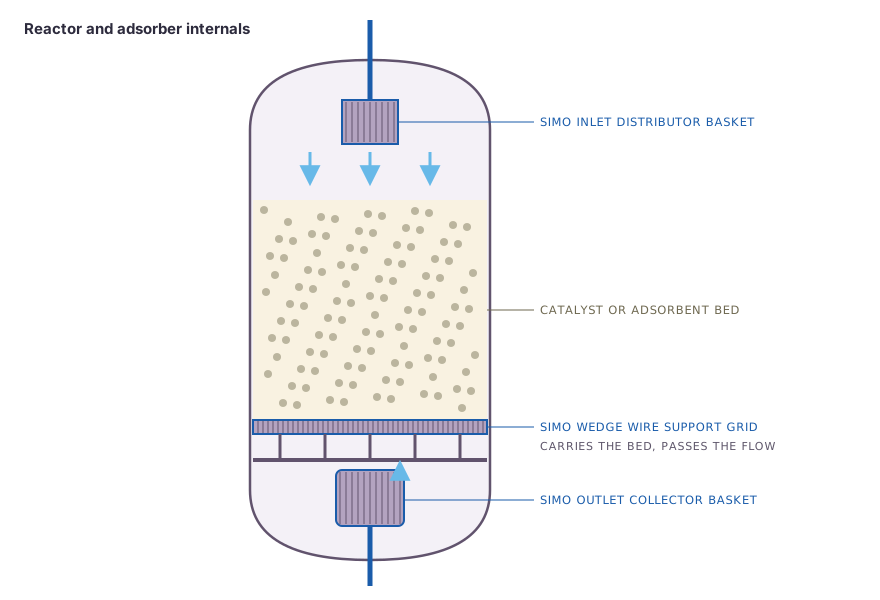
When catalyst, adsorbent or support balls reach the outlet line, they block valves, damage pumps and contaminate the product, and the lost media must be replaced at the next shutdown. An outlet basket retains the media at the nozzle, before it can leave the vessel.
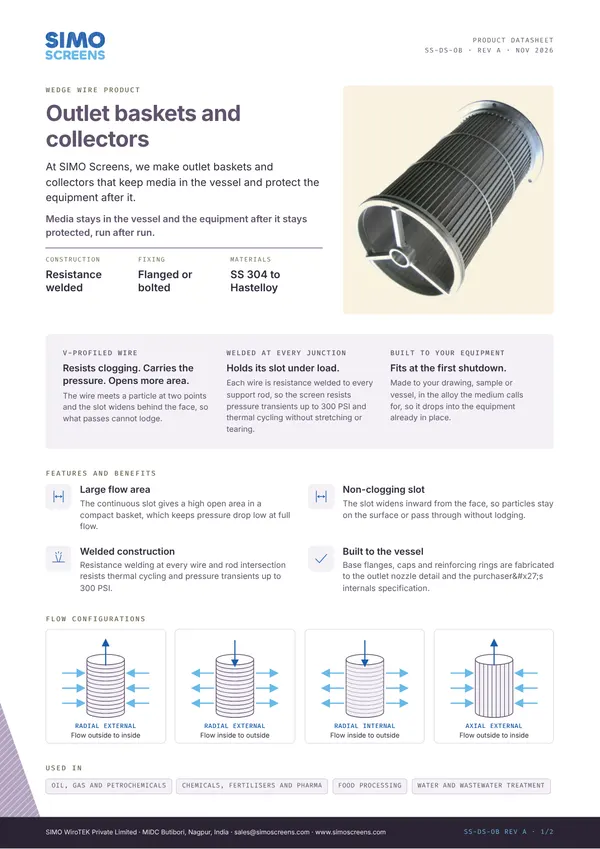
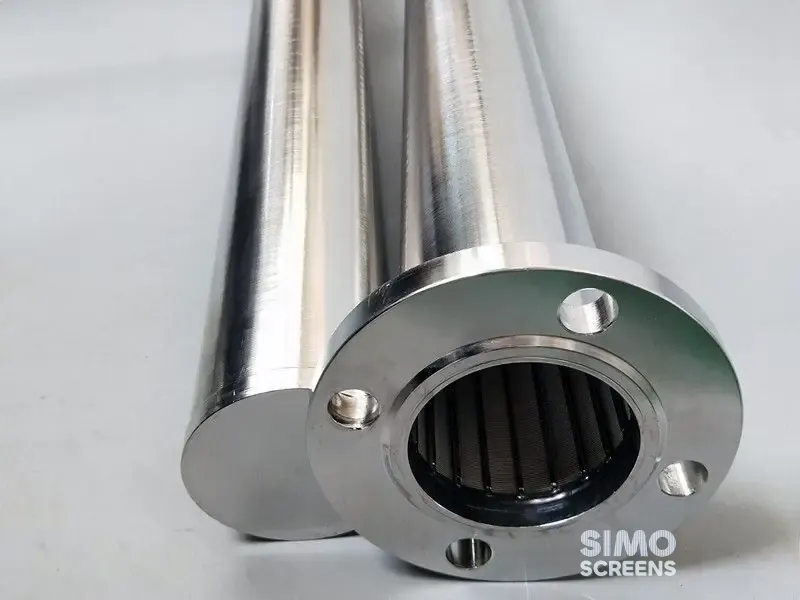
SIMO Screens outlet baskets are built as wedge wire cylinders with a continuous slot, which gives a large flow area in a small volume so that pressure drop stays low. Fluid passes from the bed or tank into the basket and leaves through the outlet nozzle, with the flat wire face outside where the media sits.
Features and benefits
- Large flow area. The continuous slot gives a high open area in a compact basket, which keeps pressure drop low at full flow.
- Non-clogging slot. The slot widens inward from the face, so particles stay on the surface or pass through without lodging.
- Welded construction. Resistance welding at every wire and rod intersection resists thermal cycling and pressure transients up to 300 PSI.
- Built to the vessel. Base flanges, caps and reinforcing rings are fabricated to the outlet nozzle detail and the purchaser's internals specification.
- Precise slot. The slot is held to plus or minus 5 percent of nominal and recorded in the final inspection report.
Applications
- Hydroprocessing reactor outlet collectors, below the catalyst bed with the catalyst support grid, as described under reactor support grids.
- Molecular sieve driers and adsorbers, at the outlet nozzle.
- Catalyst and packed bed vessels in chemical and fertiliser plants.
- Tank outlets and pump suctions in water and process plants.
- Edible oil and food liquid filtration, protecting pumps and fillers.
Swipe to see the full drawing.
For line-mounted protection between vessels, SIMO resin traps and inline strainers apply the same wedge wire element in a housing.
Construction and specifications
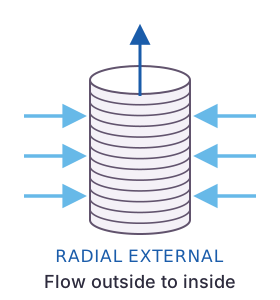
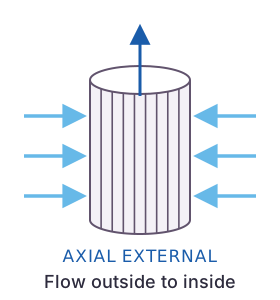
The basket is radial flow with an external profile, outside to inside. Each basket can carry a flat or domed top cap, solid or screened where more flow area is needed, a base flange or ring to suit the outlet nozzle, and reinforcing rings and lifting points on tall baskets.
| Parameter | SIMO range |
|---|---|
| Slot opening | 25 microns (0.025 mm) to 25 mm, tolerance plus or minus 5% of nominal |
| Basket diameter | 25 to 800 mm |
| Basket length | Up to 6,000 mm |
| Profile wire | Light, standard, heavy duty or custom, 12SB to 56SB |
| Support rods | Q23, Q35, Q55, 35SB, F123, F203, F253, round 120, round 140 |
| Flow configuration | Radial, external profile, outside to inside |
| Top cap | Flat or domed, solid or screened |
| Base fixing | Flanged, clamped or welded to the nozzle |
| Construction | Resistance welded at every intersection; resists thermal cycling and pressure transients up to 300 PSI |
Swipe sideways to see the whole table.
Materials
Reactor and drier service sets the alloy by temperature, hydrogen, sulphur compounds and chlorides. SS 316L suits many refinery applications, while Duplex 2205, Super Duplex 2507, Hastelloy C-276 and Monel are used where corrosion is more severe. Water and food applications usually run in SS 304 or SS 316L, and the material selection guide covers the choice.
Engineering and quality
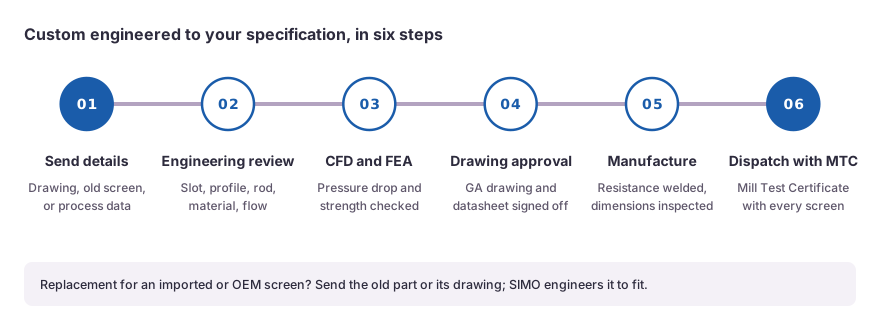
Outlet collectors are designed and documented to the purchaser's reactor internals specification. Open area (%) = Slot x 100 / (Slot + Wire width), so a 1 mm slot on 15SB wire (1.52 mm wide) gives about 40 percent open area, while the same slot on 35SB wire (3 mm wide) gives 25 percent with a stronger basket. The basket surface is then sized so that the clean pressure drop stays low at full flow, with a margin for fouling, using CFD for pressure drop prediction and FEA for structural validation where required.
Slot is checked with feeler gauges through welding, and each basket receives a dimensional inspection against the approved drawing before dispatch. Baskets carry a QR-coded tag with job number, item and slot, and are laser marked where the client requires it, so heat numbers trace from the Mill Test Certificate to the finished screen. The MTC is supplied as standard; a dimensional inspection report, quality assurance plan, PMI through an approved agency and dye penetrant testing of fabrication welds are available where specified.
What to send for a quotation
- Vessel type and service: reactor, drier, adsorber, tank or pump suction.
- Outlet nozzle size and detail, with a vessel drawing if available.
- Media type and smallest particle size, or the debris to be caught.
- Flow rate and allowable pressure drop.
- Design pressure and temperature.
- Process fluid and contaminants.
- Your internals specification and material grade.
 Upload a drawing