 +91 93730 08466
 Screen tubes and pipes
 Screen cylinders
 Flat panels and false bottoms
 Candle filter elements
 Water well screens
 Header and hub laterals
 Filter nozzles
 Resin traps
 Support grids
 Sieve bend (DSM) screens
 Centrifuge baskets
 Pressure screen baskets
 Screw press screens
 Rotary drum screens
 Passive intake screens
 Coanda intake screens
 Water and wastewater treatment
 Water wells and groundwater
 Sugar and distillery
 Brewing, malting and beverages
 Food processing
 Mining and minerals
 Oil, gas and petrochemicals
 Chemicals, fertilisers and pharma
 Power generation
 Pulp and paper
 Buildings and drainage
Made to order screens
Most SIMO screens are engineered to order from the customer's process data, drawing or sample. Vessel nozzles, bed depths, manway sizes and flow rates vary from plant to plant, and a screen that does not match them can lose media, cause channelling or fail early.
SIMO Screens therefore supplies made to order screens designed for the specific vessel or machine. The method below applies equally to one replacement element and to a complete set of vessel internals.
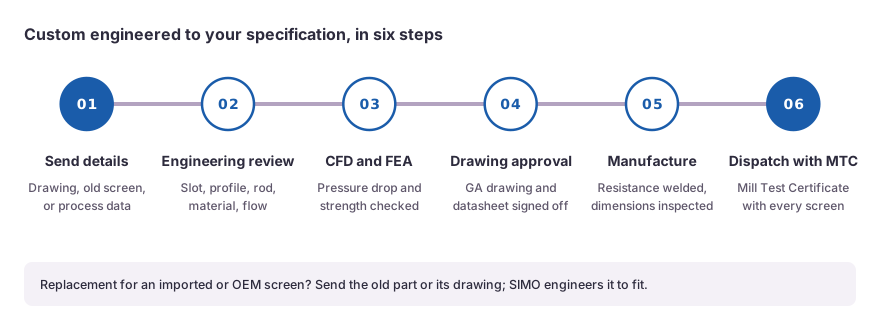
Custom wedge wire screen process
1. Requirement and process data
The customer provides the application, the operating conditions and the space the screen must fit. A data sheet, a drawing, a photograph or a sample are all suitable starting points.
2. Engineering review
SIMO engineering reviews the data, raises any questions and selects the slot, profile wire, support rod, flow configuration and material. Where information is incomplete or a specified parameter carries a risk, this is stated before quotation.
3. CFD and FEA
Where flow distribution or structural load governs the design, CFD is used to predict pressure drop and flow distribution, and FEA to validate the structure against collapse pressure, bed load, centrifugal load and thermal expansion.
4. Drawing approval
A general arrangement drawing is issued showing slot, wire, rod, material, flow direction, key dimensions and fabricated parts. Manufacture starts only after written approval.
5. Manufacture
The screen is resistance welded at every wire and rod intersection at our Butibori works, and frames, flanges, end rings or housings are fabricated as drawn.
6. Dispatch with Mill Test Certificate
The finished screen passes dimensional inspection against the approved drawing, with slot held to plus or minus 5 percent of nominal, and is dispatched with its Mill Test Certificate.
Drawing revision control
- The drawing is issued at its first revision for review against the customer's equipment.
- Comments are incorporated, and each revision records what changed.
- The cycle continues until approval is given in writing.
- Manufacture and inspection are carried out against the approved revision.
- Any change after approval is reissued as a new drawing revision for approval.
Replacement and reverse engineering
Many plants operate imported or older screens for which no drawing is on file. Replacements are made from a sample, an existing drawing, the general arrangement drawing or a site visit, and a sample is measured as follows.
- Interfaces. Outside and inside diameters, length, flange or end ring sizes, bolt circle and hole pattern.
- Slot. Measured at several points along and around the screen with feeler gauges, or by optical measurement where a gauge cannot be used.
- Profile wire. Width and height, matched to the nearest SIMO profile code.
- Support rods. Section, size, number and pitch.
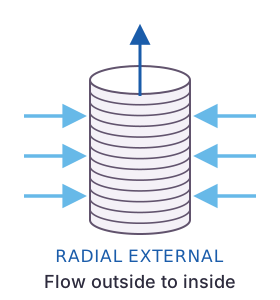
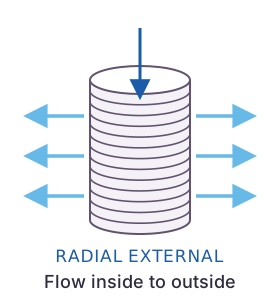
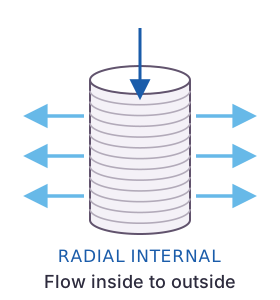
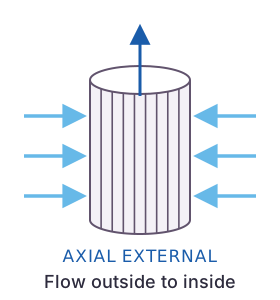
- Flow direction. The side carrying the slot face, and whether flow reverses in service.
- Material. From markings and documents, or by PMI through an approved agency where the grade is unknown.
- Wear and damage. Worn slots, eroded zones and cracked welds, which indicate where the original design was under strain.
The screen is then drawn and enters the revision cycle above. Where the operating conditions point to a better slot, profile or alloy, the proposal is noted on the drawing.
Typical custom requests
- Header and lateral assemblies sized to an existing vessel and nozzle layout
- Segmented support grids and false bottoms that pass a manway
- Cylinders and outlet baskets with flanges drilled to the customer's standard
- Conical or stepped centrifuge baskets to suit a machine
- Sieve bends to a set radius, slot and wire orientation, with feed boxes and housings as an option
- A wedge wire screen for treatment of process fluids with high chlorides or acids, in Duplex, Super Duplex, Hastelloy or Monel
- Non-standard diameters from 25 to 800 mm, in lengths up to 6,000 mm
- Complete housings on request, including basket strainer housings and resin trap housings in carbon steel or lined construction
The selection of each parameter is described under design engineering, and the parts built around the screen under fabrication.
What to send for a custom design
- The application and equipment, for example a DM plant lateral or a lauter tun false bottom
- The media, solids or particle size to retain, ideally with a sieve analysis
- Flow rate and allowable pressure drop
- Operating pressure, upset pressure and temperature
- Fluid and chemistry, including chlorides and pH
- Dimensions, end connections and the manway or space the screen must pass
- A drawing, photograph or sample of the present screen, if available
- Quantity, and any inspection or document requirements
Each point is explained in the RFQ checklist. Slot options can be compared in the open area calculator, and enquiries sent through the quote request page. Our engineers will connect with you within a working day.