 +91 93730 08466
 Screen tubes and pipes
 Screen cylinders
 Flat panels and false bottoms
 Candle filter elements
 Water well screens
 Header and hub laterals
 Filter nozzles
 Resin traps
 Support grids
 Sieve bend (DSM) screens
 Centrifuge baskets
 Pressure screen baskets
 Screw press screens
 Rotary drum screens
 Passive intake screens
 Coanda intake screens
 Water and wastewater treatment
 Water wells and groundwater
 Sugar and distillery
 Brewing, malting and beverages
 Food processing
 Mining and minerals
 Oil, gas and petrochemicals
 Chemicals, fertilisers and pharma
 Power generation
 Pulp and paper
 Buildings and drainage
Rooftop rainwater harvesting filter overview
Rain from a roof carries leaves, bird droppings, dust, grit and plastic. Water sent straight to a tank fills it with sludge, while water sent straight to a recharge well carries silt that clogs the well screen and the aquifer around it. The rooftop rainwater harvesting filter sits on the downpipe, between the roof and the tank, recharge pit or recharge well, and forms the first treatment stage of a rainwater system. On flat roofs the same unit is often called a terrace rainwater filter.
Most filters are tested in the first heavy rain after a dry spell, when the debris load is highest. Mesh filters and nylon nets blind with leaves and pollen, so water overflows and bypasses them, and fine mesh tears under wet leaves and grit. Filters that hold water between rains breed mosquitoes and grow algae, and plastic housings turn brittle in the sun.
Design considerations for a rooftop rainwater filter
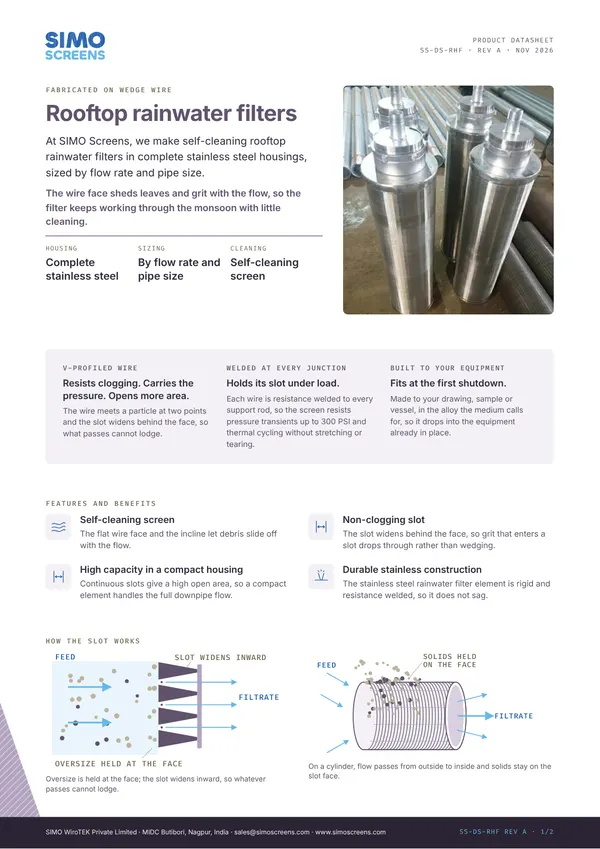
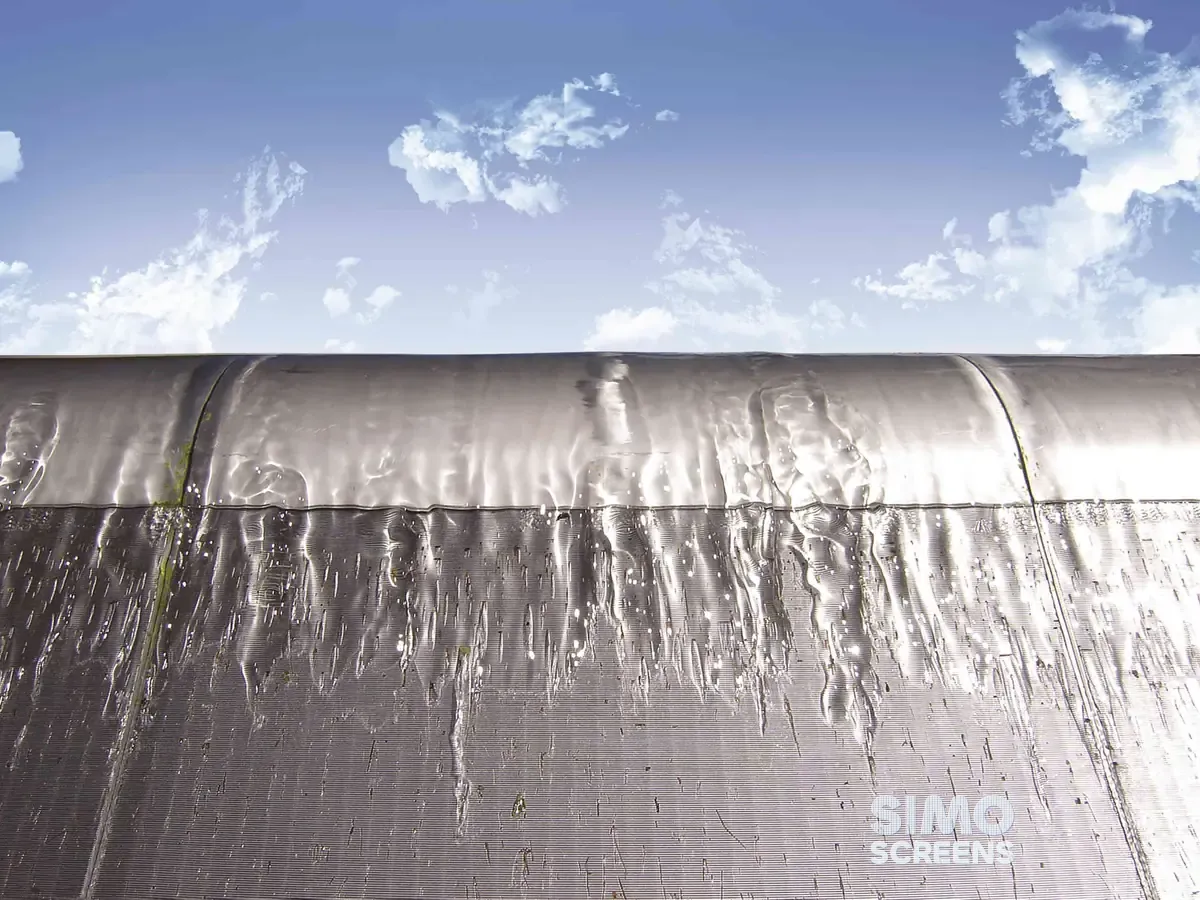
Self-cleaning screen. The filter is built around a self-cleaning wedge wire screen element. Water enters over the screen and clean water drops through the slots, while leaves and grit slide off the smooth V-profile face to a separate waste outlet. The slots run across the flow, so that each wire edge skims off a thin layer of water, the principle also used in sieve bends and Coanda screens.
Slot. The slot follows the destination of the water. In general practice, slots of about 0.3 to 1 mm cover most rooftop applications, finer for storage tanks and coarser for recharge pits that include a further sand and gravel filter.
Profile and open area. A light or standard profile such as 12SB or 15SB gives a high open area on a compact element. Open area (%) = Slot x 100 / (Slot + Wire width), so a 0.5 mm slot on 15SB wire, 1.52 mm wide, gives about 25 percent open area.
Fall and drainage. A self-cleaning screen needs some fall between the inlet and the outlet to work. The housing drains fully between rains, so that no standing water remains.
Sizing by flow rate and pipe size
The filter is sized on the peak flow from the roof it serves:
Flow (L/s) = Roof area (m²) x Rainfall intensity (mm/h) / 3600
A 200 m² roof at 100 mm/h gives about 5.6 L/s. This is multiplied by a run-off coefficient, commonly about 0.8 to 0.9 for a hard roof, and the design intensity for the city is used in place of the annual rainfall. The housing inlet and outlet are then matched to the downpipe size. Many systems also divert the first flush of each rain to waste before the filter. A specific roof can be checked in the rainwater filter calculator.
Construction and options
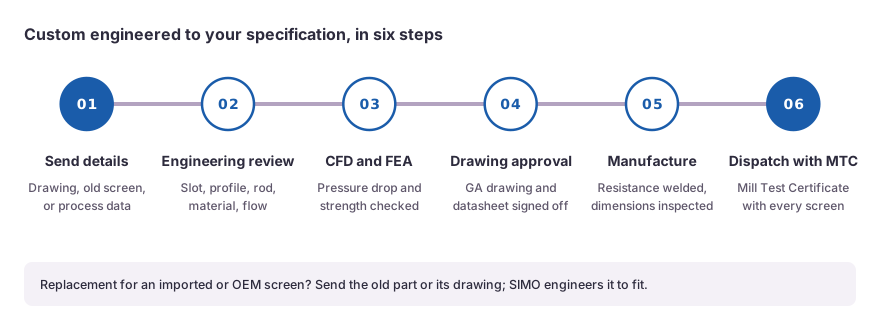
The element is a curved or inclined wedge wire panel, or a short cylinder, fixed in a complete housing with a roof inlet, a filtered water outlet, a debris outlet and an access cover for inspection. SIMO profile wire is formed in house and resistance welded to the support rods at every intersection.
| Item | SIMO range or typical value |
|---|---|
| Screen | Self-cleaning wedge wire element, curved panel or cylinder |
| Slot opening | 25 microns (0.025 mm) to 25 mm; rooftop filters typically 0.3 to 1 mm |
| Profile wire | 12SB, 15SB, 18SB |
| Housing | Wall-mounted or in-ground chamber, with inlet, filtered outlet, debris outlet and access cover |
| Housing material | SS 304, SS 316L; MS and SS 410 to client requirement |
| Sizing | By flow rate and pipe size; each filter is engineered to order |
| Connections | To suit the downpipe size |
Swipe sideways to see the whole table.
No standard catalogue range exists at present, so each filter is engineered to the roof area, the design flow and the pipe size.
Materials
SS 304 suits most buildings, and SS 316L is selected for coastal sites and industrial roofs. MS and SS 410 housings are supplied to client requirement, with the screen element in stainless steel. The Mill Test Certificate is supplied as standard.
Replacement and retrofit
Most retrofits replace a mesh box or a sand filter chamber on an existing downpipe. The downpipe size and the fall available between the inlet and the tank or pit are measured, and the housing is selected as wall-mounted or in-ground to suit the site. For recharge wells, the filter is paired with a continuous slot water well screen in the recharge borewell.
Our rooftop rainwater harvesting filters page covers the product, and the rainwater harvesting filter guide explains sizing and selection in more detail.
What to send for a quotation
- Roof area served by each downpipe, and the roof type.
- Number and size of downpipes.
- City, or the design rainfall intensity you use.
- Destination: storage tank, recharge pit or recharge well.
- Mounting: on the wall, or in an in-ground chamber.
- Fall available between the filter inlet and the outlet.
- Housing material: SS 304, SS 316L, MS or SS 410.

 Upload a drawing