 +91 93730 08466
 Screen tubes and pipes
 Screen cylinders
 Flat panels and false bottoms
 Candle filter elements
 Water well screens
 Header and hub laterals
 Filter nozzles
 Resin traps
 Support grids
 Sieve bend (DSM) screens
 Centrifuge baskets
 Pressure screen baskets
 Screw press screens
 Rotary drum screens
 Passive intake screens
 Coanda intake screens
 Water and wastewater treatment
 Water wells and groundwater
 Sugar and distillery
 Brewing, malting and beverages
 Food processing
 Mining and minerals
 Oil, gas and petrochemicals
 Chemicals, fertilisers and pharma
 Power generation
 Pulp and paper
 Buildings and drainage

Commercial kitchen drain grate overview
Commercial kitchens, hotel kitchens, canteens and food plants wash their floors several times a day, and trench drains and floor channels carry the wash water, spills and drippings to the grease trap. The commercial kitchen drain grate sits in the channel rebate, flush with the finished floor, over a stainless kitchen drain channel or a tiled trench. Staff walk on it, trolleys cross it and, in food plants, pallet trucks run over it.
A poorly chosen grate becomes a hygiene and safety concern. Perforated and ladder grates catch food and grease in their openings, which leads to odour and pests, while cast iron and mild steel grates corrode under hot water and cleaning chemicals and stain the floor. Wide bar gaps catch heels and small trolley wheels, and light grates rock in the rebate or bend under load, leaving raised edges.
Design considerations for a kitchen floor grate
Slot. SIMO kitchen grates use 3 mm or 5 mm slots. These narrow, continuous slots are heel safe and do not catch small trolley wheels, and the slot is selected for the wash-down flow and the debris expected in the channel.
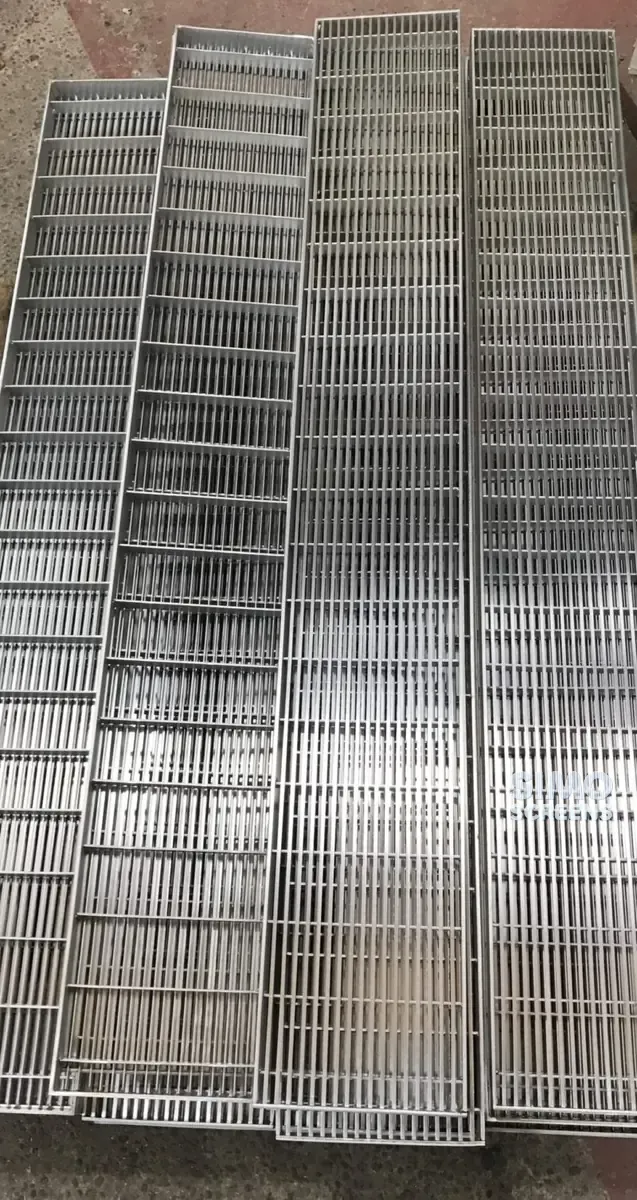
Slot orientation. The slots run along the length of the grate. The V-profile wire forms a flat walking surface, and each slot widens below the surface, so that water and fine waste drop straight through to the channel instead of lodging.
Load. Pedestrian kitchens can use standard profiles such as 28SB or 35SB on F123 bars, while food plants with pallet trucks need heavier profiles such as 55SB or 56SB on F203 or F253 bars. Load class is specific to the buyer and the country. EN 1433 or EN 124 classes may be referenced as the buyer's specification, and the design is confirmed per order.
Flatness and seating. Each section has a welded edge frame so that it sits flat in the rebate without rocking. A grate can only sit as flat as its seat, so a damaged rebate is corrected with a new angle frame.
Cleaning. Lift points on each section allow quick removal for wash-down. The smooth wire face and open slot do not retain food waste, which shortens cleaning time and supports food safety audits.
Open area (%) = Slot x 100 / (Slot + Wire width). A 3 mm slot on 35SB wire, 3 mm wide, gives 50 percent open area, and a 5 mm slot on 55SB wire, 5 mm wide, also gives 50 percent. Other combinations can be checked in the open area calculator.
Construction and options
SIMO profile wire is formed in house and resistance welded to flat support bars at every intersection. Grates are made as lift-out sections with a welded edge frame, in straight runs, corners, tees and end pieces to the drain layout. Angle frames for new channels are supplied with the grates on request, and SIMO Screens also fabricates complete stainless channel bodies.
| Item | SIMO range or typical value |
|---|---|
| Form | Lift-out grate sections with welded edge frame |
| Slot opening | 3 mm or 5 mm for kitchen grates, running along the length |
| Profile wire | 28SB, 35SB, 42SB, 55SB, 56SB |
| Support bars | F123, F203, F253 |
| Section size | Single panels up to 2,400 mm wide and 4,000 mm long; usually shorter for handling |
| Load class | To the buyer's specification, confirmed per order |
| Scope | Grates, angle frames and stainless channel bodies |
| Finish | Pickled and passivated as standard |
Swipe sideways to see the whole table.
Each section is tagged with job number and item for installation by run, and can be laser marked where the client requires it, and the Mill Test Certificate is supplied as standard.
Materials
SS 304 suits most hotel and restaurant kitchens. SS 316L is selected for food plants, seafood and pickle kitchens, and sites using chlorinated cleaners. Grates are pickled and passivated as standard, which restores the passive layer after welding and fabrication. Grades can be compared with the material selector.
Replacement and retrofit
Most kitchen projects replace rusted or perforated grates in existing channels. The channel inside width, the rebate width and depth, and every run length and corner are measured, and grates are built to drop into the existing rebate, flush with the floor. Where the rebate is damaged or uneven, a new angle frame is fitted at the same time.
Our stainless steel wedge wire drainage grates page covers the wider range, and our pool, shower and balcony grates suit wet areas. The cleaning and maintenance guide covers routine care.
What to send for a quotation
- Drain layout with run lengths, corners and tees.
- Channel inside width, rebate width and rebate depth.
- Scope: grates only, grates with frames, or complete channel bodies.
- Traffic type and the load class in your specification.
- Expected wash-down flow and type of waste.
- Slot preference, 3 mm or 5 mm.
- Material, SS 304 or SS 316L.
- Drawings or photographs of the existing channel.

 Upload a drawing