 +91 93730 08466
 Screen tubes and pipes
 Screen cylinders
 Flat panels and false bottoms
 Candle filter elements
 Water well screens
 Header and hub laterals
 Filter nozzles
 Resin traps
 Support grids
 Sieve bend (DSM) screens
 Centrifuge baskets
 Pressure screen baskets
 Screw press screens
 Rotary drum screens
 Passive intake screens
 Coanda intake screens
 Water and wastewater treatment
 Water wells and groundwater
 Sugar and distillery
 Brewing, malting and beverages
 Food processing
 Mining and minerals
 Oil, gas and petrochemicals
 Chemicals, fertilisers and pharma
 Power generation
 Pulp and paper
 Buildings and drainage
 Datasheet

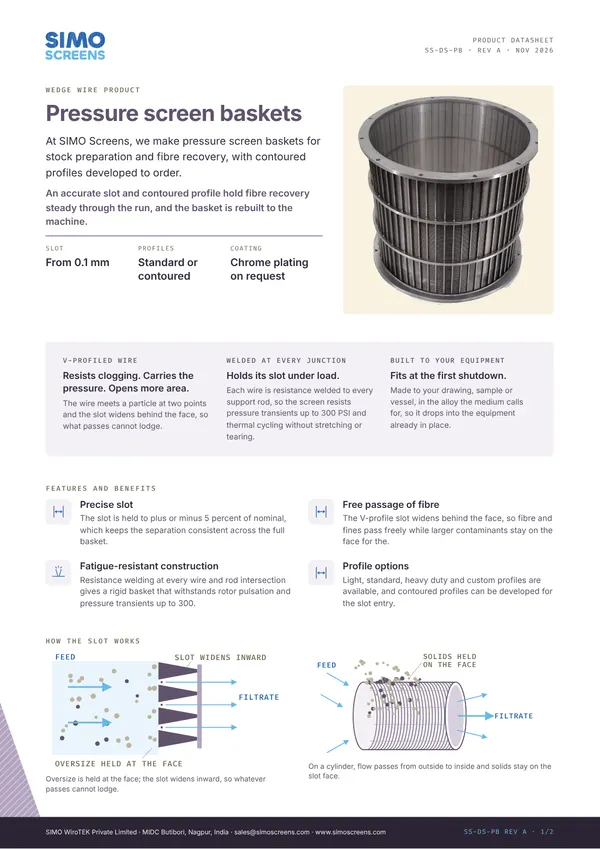
Pressure screen basket overview
The screen basket sets the cleanliness and throughput of a stock preparation line. A worn basket passes shives and stickies to the paper machine, a blinded basket reduces throughput, and a cracked basket stops the line until it is replaced.
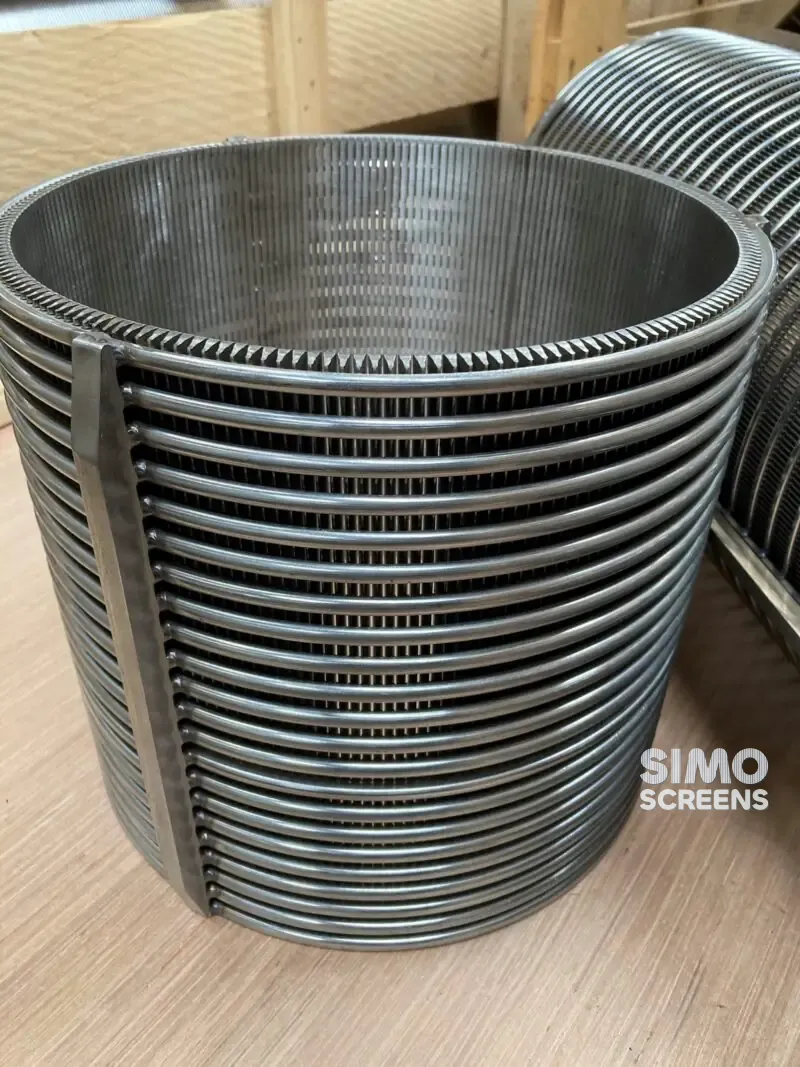
A SIMO Screens wedge wire screen basket for pulp gives a precise, continuous slot with high open area. Stock enters the screen under pressure, and a rotor with foils or bumps sweeps the slot face, creating pressure pulses that keep the slots open. Accepted stock passes through the slots, while rejects travel along the face to the reject outlet.
Features and benefits
- Precise slot. The slot is held to plus or minus 5 percent of nominal, which keeps the separation consistent across the full basket.
- Free passage of fibre. The V-profile slot widens behind the face, so fibre and fines pass freely while larger contaminants stay on the face for the rotor to clear.
- Fatigue-resistant construction. Resistance welding at every wire and rod intersection gives a rigid basket that withstands rotor pulsation and pressure transients up to 300 PSI.
- Profile options. Light, standard, heavy duty and custom profiles are available, and contoured profiles can be developed for the slot entry.
- Wear protection. Hard chrome plating of the wire face is available through approved agencies on request.
Applications
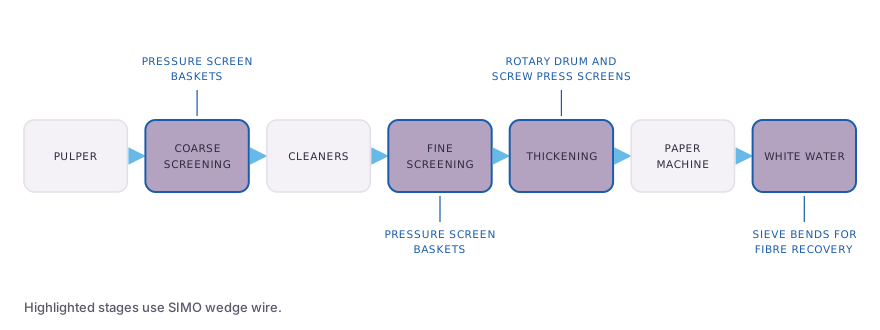
- Stock preparation pressure screens for coarse, fine and approach flow screening, as described under pressure screen baskets.
- Recycled fibre lines, for removal of plastics, stickies and debris.
- Fibre recovery from white water and rejects.
- Fine screening of other slurries in pulp and paper and related process plants.
Swipe to see the full drawing.
Construction and specifications
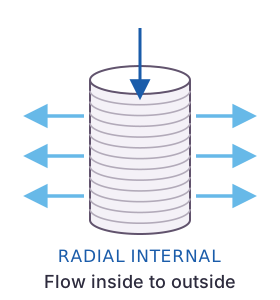
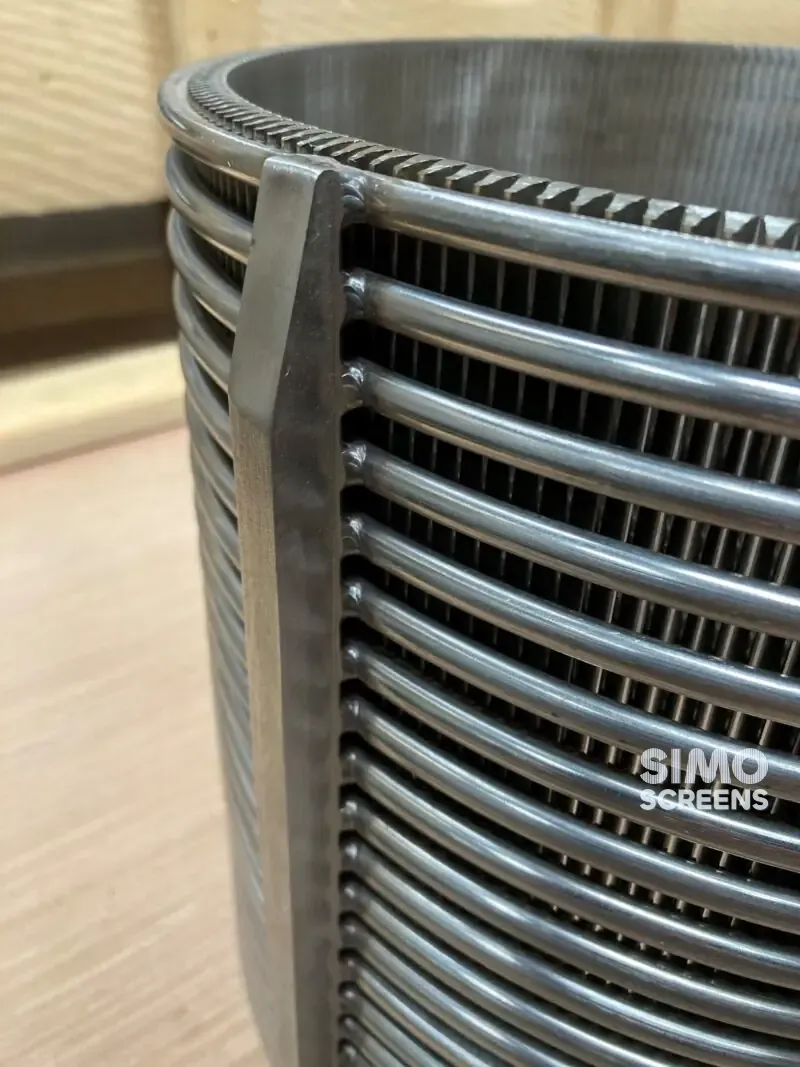
In the usual outflow screen, stock is inside the basket and accepts pass outward, so the flat wire face is inside and the slot widens outward. Profile wire is wound with its face inside, either on internal-profile machines or from reverse rolled panels, and welded to outer support rods. End flanges and reinforcing rings are fabricated and machined to the fit dimensions of the screen, and inflow baskets are built with the face outside.
| Parameter | SIMO range |
|---|---|
| Slot opening | 25 microns (0.025 mm) to 25 mm, tolerance plus or minus 5% of nominal |
| Basket diameter | 25 to 800 mm |
| Basket length | Up to 6,000 mm |
| Profile wire | Light, standard, heavy duty or custom, 12SB to 56SB; contoured profiles on request |
| Support rods | Q23, Q35, Q55, 35SB, F123, F203, F253, round 120, round 140 |
| Flow configuration | Radial internal, inside to outside (outflow), or radial external, outside to inside (inflow) |
| Surface options | Hard chrome plating through approved agencies |
| Construction | Resistance welded at every intersection; resists thermal cycling and pressure transients up to 300 PSI |
Swipe sideways to see the whole table.
The profile wire selection guide explains how the wire profile and face contour affect capacity and fibre handling.
Materials
SS 316L is common in stock preparation, where white water carries chlorides and process chemicals. Duplex 2205 adds strength and chloride resistance for heavily loaded baskets, and Super Duplex 2507 or higher alloys are selected for bleach plants and other aggressive service. The material selection guide is a useful starting point.
Engineering and quality
Each basket is designed around the slot width for its position in the line, the wire profile, the flow direction of the screen and the support rods and rings needed for rotor pulsation. FEA is used for structural validation of custom designs, and a general arrangement drawing is issued for approval before manufacture.
Slot is checked with feeler gauges at welding set-up, during the run and at the end of each basket, with optical measurement where a physical gauge cannot be used. The final inspection report records the minimum, maximum and mean slot, and each basket is identified with job number, item and slot on a QR-coded tag, or laser marked where the client requires it. The Mill Test Certificate is supplied as standard, with a dimensional inspection report and quality assurance plan on request.
What to send for a quotation
- Pressure screen make, model and size.
- Position in the line: coarse, fine, approach flow or fibre recovery.
- OEM basket drawing, or the worn basket or a sample.
- Current slot width and wire profile, if known.
- Furnish type and consistency.
- Problems with the present basket: wear, blinding, cracking or poor cleanliness.
- White water chemistry and temperature.
- Material grade, and whether you need chrome plating.
 Upload a drawing