 +91 93730 08466
 Screen tubes and pipes
 Screen cylinders
 Flat panels and false bottoms
 Candle filter elements
 Water well screens
 Header and hub laterals
 Filter nozzles
 Resin traps
 Support grids
 Sieve bend (DSM) screens
 Centrifuge baskets
 Pressure screen baskets
 Screw press screens
 Rotary drum screens
 Passive intake screens
 Coanda intake screens
 Water and wastewater treatment
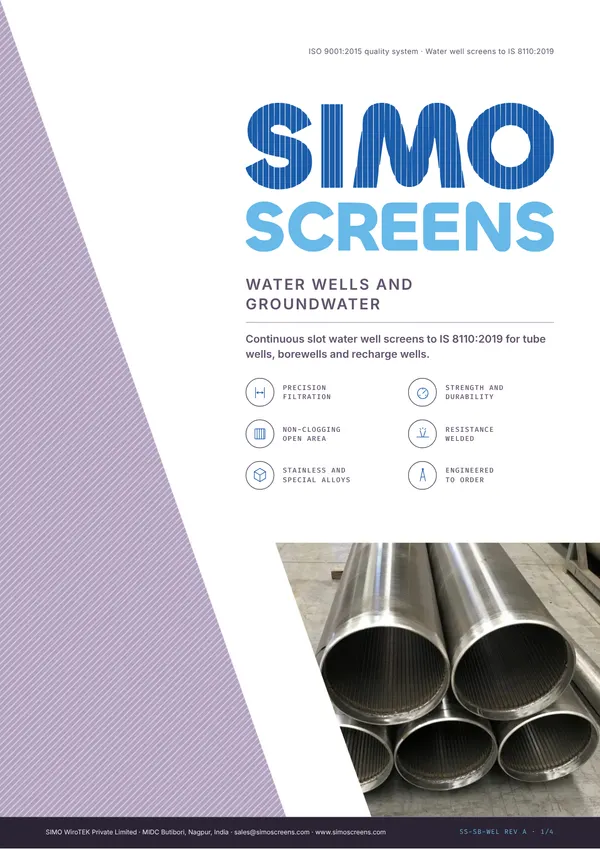
 Water wells and groundwater
 Sugar and distillery
 Brewing, malting and beverages
 Food processing
 Mining and minerals
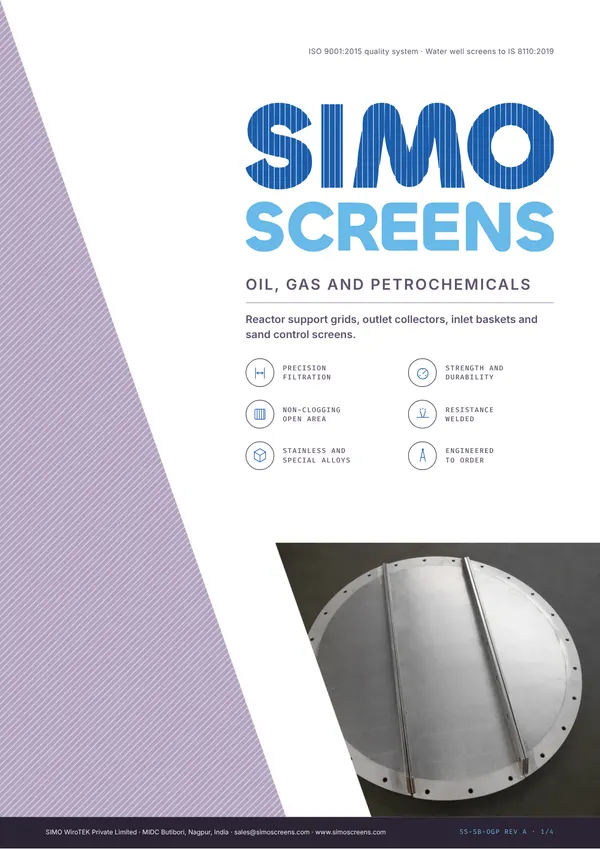
 Oil, gas and petrochemicals
 Chemicals, fertilisers and pharma
 Power generation
 Pulp and paper
 Buildings and drainage
 Datasheet

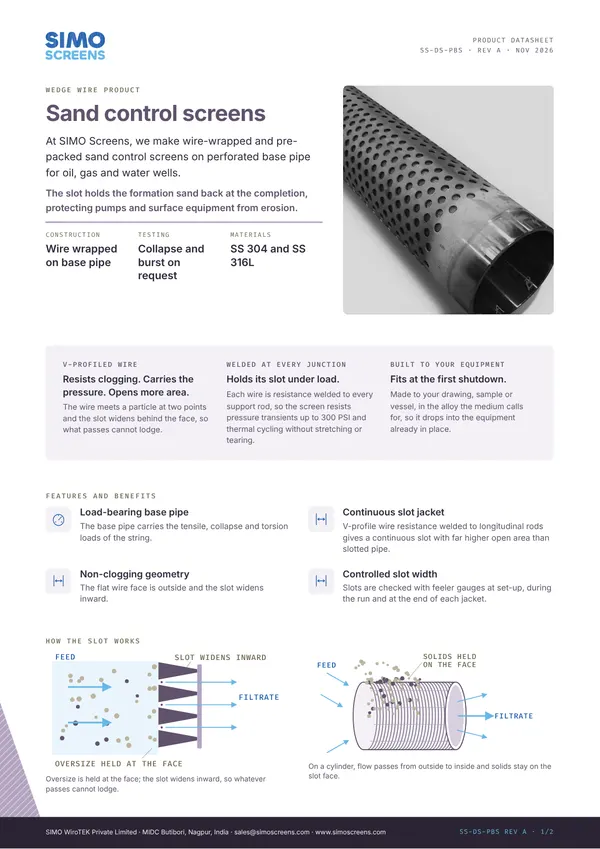
Sand control screen overview
Formation sand that enters a well erodes chokes, valves and pumps, fills separators and can destabilise the open hole around the completion.
A SIMO Screens sand control screen stops the sand at the formation face. The slot or the pack retains the grains, the sand bridges behind it and the formation stays in place while fluid flows into the well. Screens are supplied for oil, gas and water wells.
Features and benefits
- Load-bearing base pipe. The base pipe carries the tensile, collapse and torsion loads of the string, so the pipe can be selected for the well and the jacket for the sand.
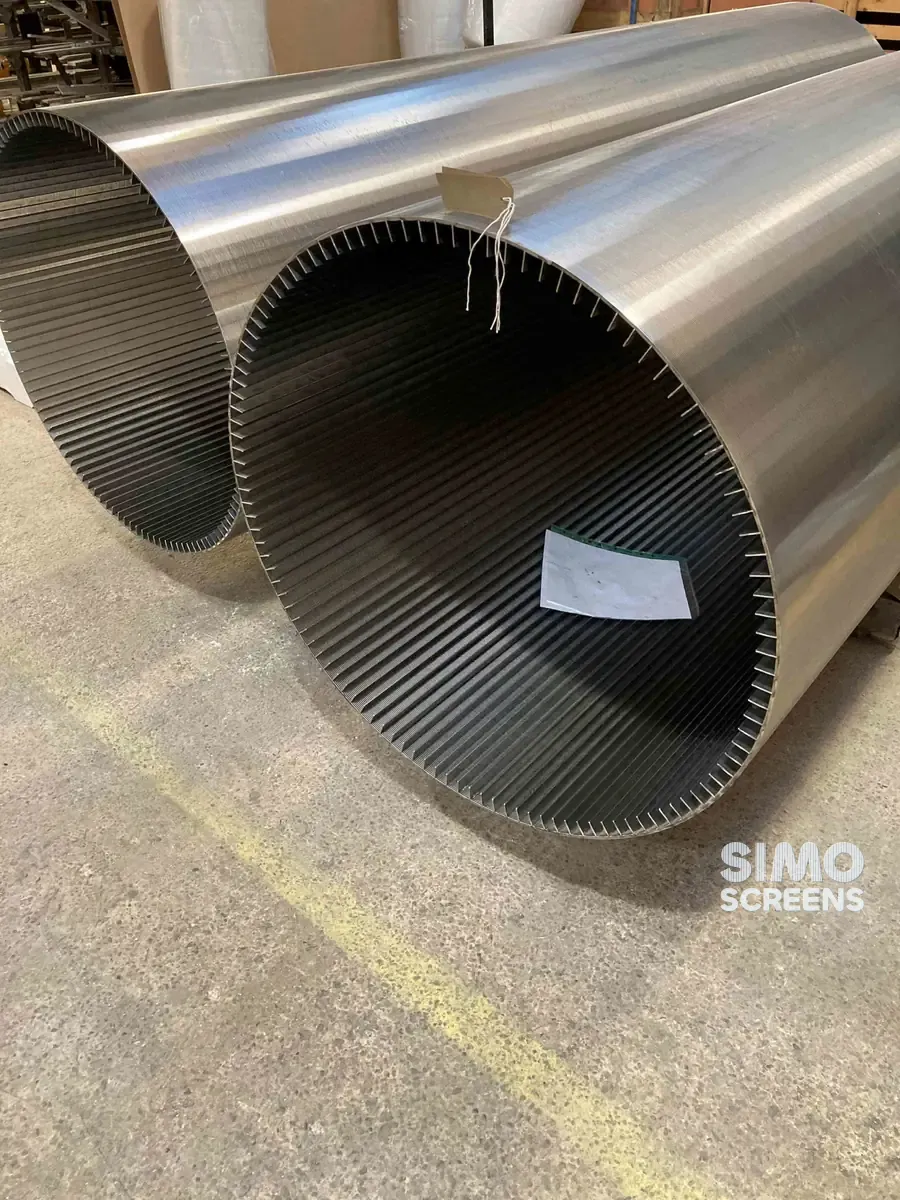
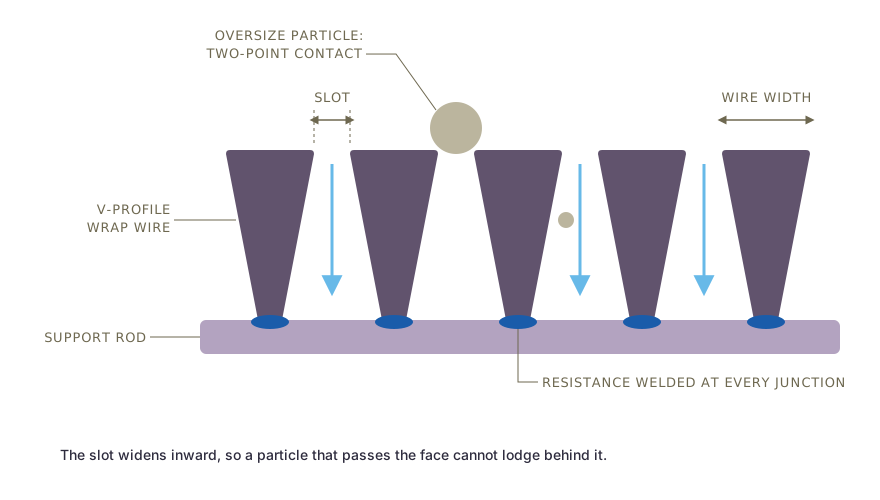
- Continuous slot jacket. V-profile wire resistance welded to longitudinal rods gives a continuous slot with far higher open area than slotted pipe, which keeps entry velocity low.
- Non-clogging geometry. The flat wire face is outside and the slot widens inward, so a grain that passes the face does not wedge behind it.
- Controlled slot width. Slots are checked with feeler gauges at set-up, during the run and at the end of each jacket, to plus or minus 5 percent of nominal.
- Built to operator specifications. Operator specifications, third-party inspection and order-specific testing are accepted as part of each order.
Pipe-based and pre-packed sand screens
Two types of sand screens are built on a perforated base pipe:
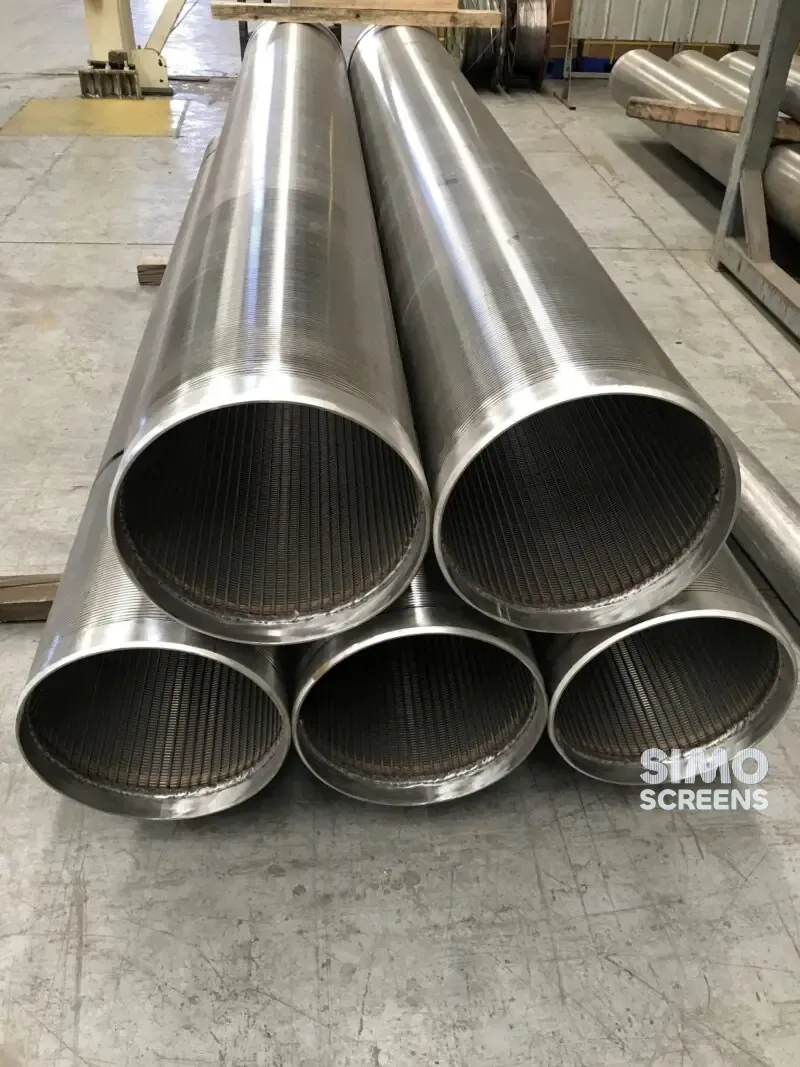
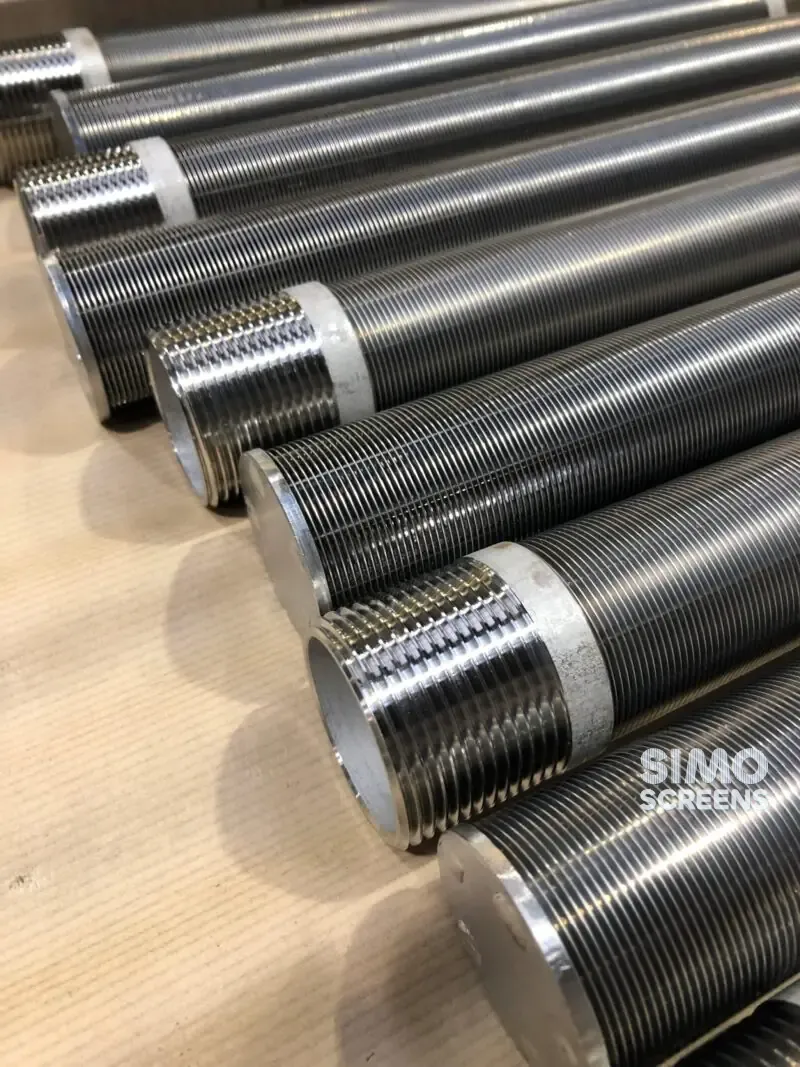
- Wire-wrapped, pipe-based screens. V-profile wire is welded to longitudinal support rods to form a continuous slot jacket, which sits over a base pipe drilled with a hole pattern and is welded to end rings on the pipe.
- Pre-packed screens. Two wire-wrapped jackets, one inside the other, with graded gravel or resin-coated sand filling the space between them. A wire wrapped base pipe pre-packed screen carries its own filter layer into the hole.
Swipe to see the full drawing.
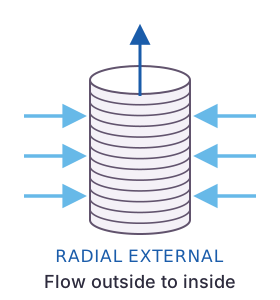
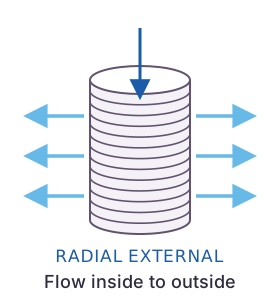
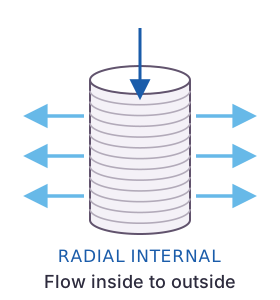
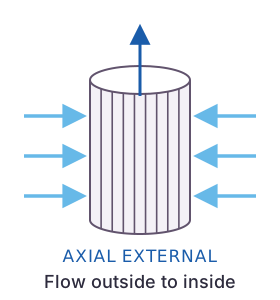
Flow runs in radial flow with an external profile, outside to inside. Fluid passes the slot, runs along the gap between jacket and pipe on the support rods, and enters the base pipe through its holes. On a pre-packed screen it passes the outer jacket, the pack and then the inner jacket.
Applications
- Oil and gas wells, as standalone screens or with a gravel pack, in oil and gas projects.
- Deep, heavy or deviated water wells where a rod-based screen cannot carry the string loads, in water wells.
Slot selection against formation sand
Slot selection starts with a sieve analysis of the formation sample, after which the well designer selects the completion and the sizing rule.
- Standalone screen. The slot is sized from the coarser fraction of the formation, so that grains bridge across it and the finer sand behind them stays in place.
- Gravel pack. As general practice, the pack median size is often set at about 5 to 6 times the formation median size, and the screen slot is then chosen to hold the pack.
- Pre-packed screen. The inner and outer slots are chosen to hold the pack media, and the pack grade is chosen against the formation.
The slot and open area guide and the water well screen design guide explain the method for water wells.
Construction and specifications
The base pipe grade, size, weight and connection follow the well design, and the hole pattern, jacket and end rings are built to the approved drawing. Blank lengths are left at each end for tongs and the coupling. Base pipe is API 5CT casing or tubing with API 5B threaded and coupled ends (STC, LTC or BTC, as the well design requires), sourced pre-threaded from an API-licensed mill or free-issued by the customer, then drilled and jacketed by SIMO, with EN 10204 3.1 certificates for the pipe.
| Parameter | SIMO range |
|---|---|
| Construction | Wire-wrapped jacket on perforated base pipe, or pre-packed with two jackets |
| Pack media | Graded gravel or resin-coated sand |
| Slot opening | 25 microns (0.025 mm) to 25 mm |
| Diameter and joint length | Within 25 mm to 800 mm; joints up to 6,000 mm |
| Profile wire | Light, standard, heavy duty or custom: 12SB to 56SB |
| Support rods | Q23, Q35, Q55, 35SB, F123, F203, F253, round 120, round 140 |
| Jacket materials | SS 304, SS 316L, Duplex 2205, Super Duplex 2507 |
| Base pipe and connections | Sourced or free-issued, to the specification and drawing |
| Testing | Collapse, burst and similar tests on request, at additional cost |
Swipe sideways to see the whole table.
Materials
SS 304 suits most fresh groundwater, and SS 316L is the usual step up where chlorides are higher. Duplex 2205 and Super Duplex 2507 suit brackish and saline water and well fluids with higher chlorides. The well fluid analysis and design specification decide the grade, as described in the material selection guide.
Engineering and quality
The final inspection report records the minimum, maximum and mean slot, heat numbers are traceable from the Mill Test Certificate to the finished joint, and each joint is identified with job number, item and slot on a QR-coded tag, or laser marked where the client requires it. The MTC is standard; the dimensional inspection report, QAP and test reports are supplied on request.
Our rod-based water well screens to IS 8110:2019 use the same continuous slot wedge wire for tube wells and borewells.
What to send for a quotation
- Well type (oil, gas or water), depth and hole angle.
- Completion: standalone screen, gravel pack or pre-packed screen.
- Sieve analysis of the formation sand, or the gravel pack and pack media grading.
- Base pipe size, grade, weight and connection, and whether you will free-issue it.
- Screen joint length, number of joints and blank lengths at each end.
- Well fluid analysis: chlorides, gases and temperature.
- Your specification, drawing, design loads and any inspection or test requirements.
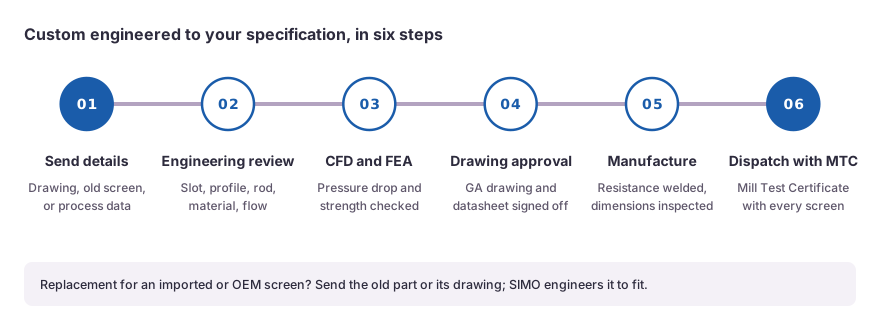
Our engineers will connect with you within a working day of your quotation request.
 Upload a drawing