 +91 93730 08466
 Screen tubes and pipes
 Screen cylinders
 Flat panels and false bottoms
 Candle filter elements
 Water well screens
 Header and hub laterals
 Filter nozzles
 Resin traps
 Support grids
 Sieve bend (DSM) screens
 Centrifuge baskets
 Pressure screen baskets
 Screw press screens
 Rotary drum screens
 Passive intake screens
 Coanda intake screens
 Water and wastewater treatment
 Water wells and groundwater
 Sugar and distillery
 Brewing, malting and beverages
 Food processing
 Mining and minerals
 Oil, gas and petrochemicals
 Chemicals, fertilisers and pharma
 Power generation
 Pulp and paper
 Buildings and drainage
Wedge wire screen inspection and test plan
SIMO Screens inspects each screen at every stage of manufacture, from material receipt to dispatch. The standard inspection and test plan below operates under our ISO 9001:2015 quality management system, described on the quality page, and is marked up against the customer's own plan where one is specified.
| Stage | Check | Method or instrument | Frequency | Record | Acceptance basis |
|---|---|---|---|---|---|
| 1. Incoming wire and rod | Certificate against the purchase order; grade identification and segregation | Certificate review; PMI through an approved agency, on request | Every heat or lot | Goods receipt record, MTC | Purchase order and material standard |
| 2. Profile wire forming | Width and height against the SIMO profile code | Calibrated micrometer or profile gauge | Start of each coil or batch, then at intervals | Forming record | SIMO profile code |
| 3. Welding | Slot opening | Feeler gauges; optical measurement where a physical gauge cannot be used | Set-up, at intervals during the run, end of each screen | Welding and slot record | Slot and tolerance on the approved drawing |
| 4. Forming | Diameter, ovality, straightness; panel flatness | Tape, callipers, straight edge | Every screen | Dimensional record | Approved drawing |
| 5. Fabrication | Visual weld inspection; dye penetrant testing where specified | Visual to ISO 17637; DP to ISO 3452 or ASTM E165 | Every weld; DP as specified | Weld and test records | Approved drawing and purchase specification |
| 6. Cleaning and passivation | Surface free of scale, oil and free iron | ASTM A380 or ASTM A967, through an approved agency, on request | Every screen treated | Passivation certificate | Standard named on the order |
| 7. Final inspection | Dimensions, slot sample, welds and finish | Feeler gauges, optical measurement, dimensional instruments | Every screen | Final inspection report | Approved drawing |
| 8. Marking and packing | Marking, quantities, protection of the slot face | Visual check against the packing list | Every consignment | Packing list | Order and dispatch instructions |
Swipe sideways to see the whole table.
The manufacturing sequence behind these stages is described in how wedge wire screens are made.
Slot measurement and tolerance
Swipe to see the full drawing.
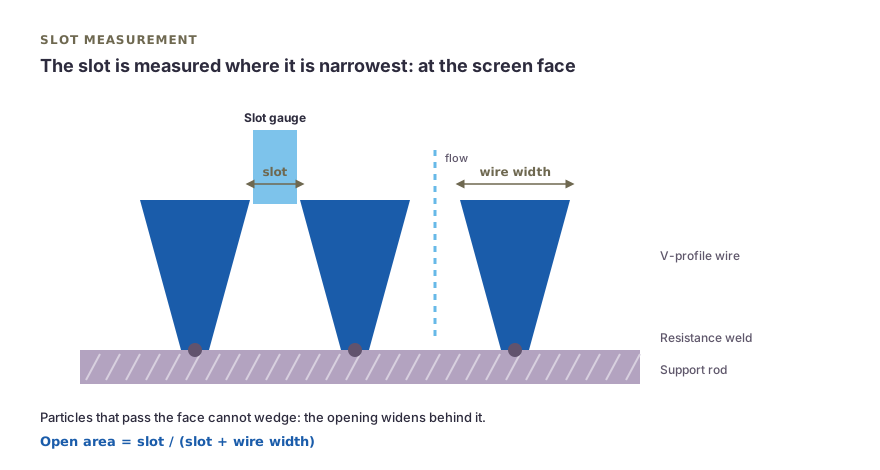
The slot determines what the screen retains, so it is controlled during welding rather than corrected afterwards. A slot that opens beyond tolerance passes resin, sand or catalyst, while one that closes raises pressure drop and shortens the service run.
Slot is checked with feeler gauges at welding set-up, at intervals during the run and at the end of each screen. Readings are taken at set positions along the length and around the circumference, and optical measurement is used where a physical gauge cannot be used.
The standard slot tolerance is plus or minus 5 percent of the nominal slot, stated on the drawing. The final inspection report records the minimum, maximum and mean slot, and we ensure that every reading falls within that tolerance before the screen is released.
Example of a slot sample record (illustration, not test data)
| Item | Value |
|---|---|
| Nominal slot | 0.25 mm |
| Tolerance on drawing | Plus or minus 5% (0.2375 to 0.2625 mm) |
| Readings taken | 40, at 10 positions x 4 angles |
| Minimum | 0.24 mm |
| Maximum | 0.26 mm |
| Mean | 0.25 mm |
| Result | Within drawing tolerance |
Swipe sideways to see the whole table.
Material traceability from heat number to finished screen
Incoming wire and rod certificates are reviewed against the purchase order before material is released to production, and grades are identified and stored apart on receipt. The Mill Test Certificate records the heat number, chemical composition and mechanical properties of the material.
Each screen is identified by a QR-coded tag carrying its job number, item and slot, and is laser marked on the screen where the client requires it. Heat numbers remain traceable from the MTC to the finished screen. What a certificate should contain is explained in the quality documentation guide.
Witness inspection and third-party inspection
A hold point stops work until the customer or the appointed inspector releases it. A witness point is notified in advance, and work continues if the inspector does not attend.
Customer hold and witness points and third-party inspection agencies are accommodated, with notice given before each point. Typical witness inspection points are slot checks during welding and final dimensional inspection.
Documents
Standard with every order. Mill Test Certificate for the material, and a packing list with every dispatch.
On request, confirmed in the quotation. Final inspection report with minimum, maximum and mean slot; quality assurance plan; PMI report; dye penetrant report; passivation certificate; heat number traceability record; and a data book with index, approved drawing, MTCs, inspection reports and certificates.
The documents required should be listed in the enquiry so that they are confirmed in the quotation. Enquiries can be sent through the quote request page.
 Upload a drawing